AI in hiring is no longer just for large companies. It’s built into job boards and applicant tracking systems, and plenty of small business owners now use ChatGPT or Claude to write job posts and sort resumes. Meanwhile, the federal picture has shifted. In January 2025, the EEOC took down its guidance on AI hiring tools. A few months later, a federal court let an age discrimination lawsuit against Workday, a major HR software vendor, proceed as a nationwide collective action.
The laws themselves haven’t changed. This guide covers what still applies to North Carolina employers using AI in hiring, the state laws that matter if you hire elsewhere, and a short checklist for using these tools without creating legal risk. It’s general information, not legal advice.
Where AI in hiring shows up
AI can show up at almost every step of the process:
- Job descriptions and postings. Drafting the post, or rewriting it for different job boards.
- Resume screening. Sorting, scoring or ranking applicants, often inside an applicant tracking system.
- Chatbots. Answering applicant questions and scheduling interviews.
- Assessments and video interviews. Online tests, games and recorded interviews scored by software.
- Interview notes. Transcribing and summarizing conversations with candidates.
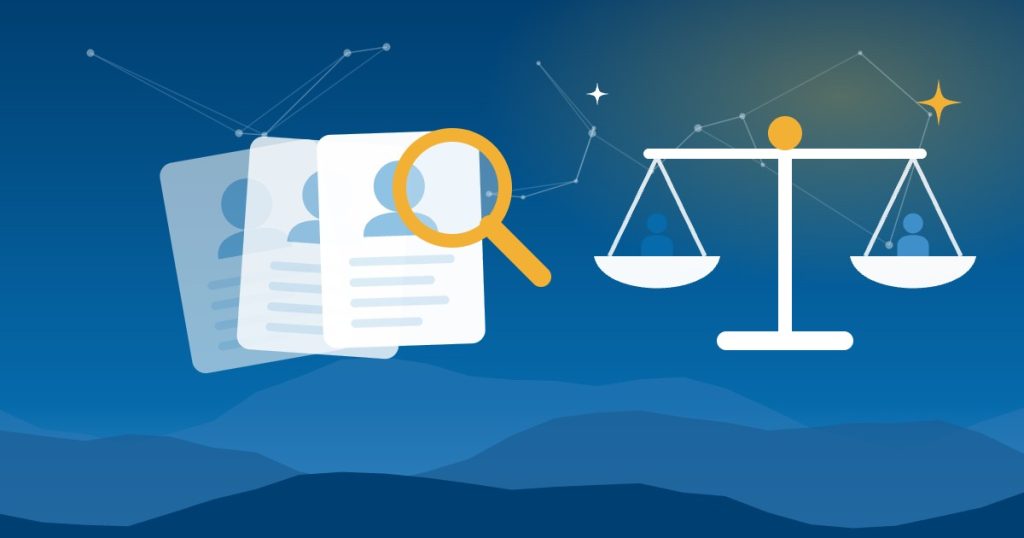
Drafting and scheduling carry little legal risk. The risk sits with AI hiring tools that score, rank or reject people, because that’s where a tool can screen out a protected group without anyone noticing.
Federal law still applies to AI hiring tools
The EEOC removed its AI guidance from its website in January 2025, according to the National Law Review. However, Title VII, the Americans with Disabilities Act and the Age Discrimination in Employment Act still apply to every hiring decision, whether a person or software makes it. According to the EEOC, Title VII and the ADA cover employers with 15 or more employees, and the age law covers employers with 20 or more.
Two points matter most for AI recruiting:
Discrimination doesn’t have to be intentional. A tool that screens out one group at a much higher rate can create liability even if nobody meant it to. The federal Uniform Guidelines on Employee Selection Procedures generally treat a selection rate for one group that’s below four-fifths of the highest group’s rate as evidence of adverse impact. For example, if a screening tool advances 50% of male applicants but only 35% of female applicants, the women’s rate is 70% of the men’s, which is below that line.
Using a vendor doesn’t shift the responsibility. In Mobley v. Workday, the court allowed claims that Workday could be liable as an agent of the employers using its software. In May 2025, it let the age claim proceed as a nationwide collective action, according to Maynard Nexsen. The case is still open, but the lesson is already clear. Buying a tool doesn’t hand off responsibility for a hiring decision.
The same Maynard Nexsen analysis notes that the EEOC has deprioritized disparate impact cases. Private lawsuits are still possible, though.
Disability accommodations and AI assessments
The ADA requires employers to make reasonable accommodations for qualified applicants. The EEOC’s ADA fact sheet lists adjusting or modifying exams as one example. That matters for timed online tests, games and video interviews that analyze speech. An applicant who is blind, deaf or has a speech or motor disability may score poorly for reasons that have nothing to do with the job.
So tell applicants how to request an accommodation before any AI assessment, and make sure a person reads those requests. When it’s needed, offer another way to complete that step.
What North Carolina law says about AI in hiring
North Carolina hasn’t enacted a law specifically about AI in hiring. A House bill filed in April 2026, H1161, includes a proposed Fair AI Hiring Act. According to the UNC School of Government’s summary, it would require employers with 15 or more employees to get an independent bias audit before using automated hiring tools, publish a summary of the results and notify applicants. At its latest listed action in May 2026, the bill had been referred to committee, according to the General Assembly.
For now, the federal rules above apply. If you record or transcribe interviews with an AI notetaker, tell candidates. Our guide to AI meeting notes and recording consent covers the rules. North Carolina allows one party to record a conversation, but candidates in other states may be covered by stricter rules.
If you hire outside North Carolina
Remote roles can bring other states’ rules into play. Several places now have their own laws, according to trackers from the National Law Review, Husch Blackwell and Vaquill:
| Where | Law | In effect | What it requires |
|---|---|---|---|
| New York City | Local Law 144 | July 2023 | Bias audits of automated hiring tools and notice to candidates |
| Illinois | Human Rights Act, as amended by HB 3773 | January 1, 2026 | No AI use that has a discriminatory effect, plus notice to applicants and employees |
| Illinois | AI Video Interview Act | January 2020 | Rules for AI analysis of recorded video interviews |
| California | Civil Rights Council rules on automated decision systems | October 1, 2025 | Anti-discrimination rules apply to automated tools, with records kept four years |
| Colorado | SB 26-189 | January 1, 2027 | Notice before use, then an explanation and human review after a negative decision |
| Connecticut | Public Act 26-15 | October 1, 2027, for notice | Written notice when automated tools are used in hiring decisions |
If you hire for positions in any of these places, review the details with your employment attorney.
How to use AI in hiring safely
A short checklist covers most of the risk:
- List every tool that touches applicants, including AI features inside your job board or applicant tracking system.
- Ask vendors hard questions. What data does the tool use? Has it been tested for adverse impact, and will they share the results? What does the contract say about who’s responsible?
- Keep a person in the decision. Don’t let AI resume screening reject anyone automatically. A person should review applicants before they’re screened out.
- Check your numbers. A few times a year, compare how many applicants from each group move forward at each step.
- Watch for stand-ins. The Workday plaintiffs argue that factors like employment gaps, years of experience and school names can act as proxies for protected traits.
- Tell applicants when AI is part of the process and how to ask for an accommodation.
- Keep records of which tools you used and how decisions were made.
- Protect applicant data. Resumes contain personal information, so keep them out of personal AI accounts. Our guide on whether ChatGPT is safe for business data explains why.
A one-page AI use policy is a good place to write these rules down.
Background checks still follow the FCRA
If you use a background check company, the Fair Credit Reporting Act applies whether or not AI is involved. According to the FTC, you need a standalone written notice and the applicant’s written permission before ordering a report. Before rejecting someone based on it, you must send a pre-adverse action notice with a copy of the report and a summary of their rights. After that comes the adverse action notice itself.
Getting help in Asheville and across North Carolina
Good People Technologies helps with AI implementation for small businesses in Asheville, Western North Carolina and across the state. For hiring, that usually means choosing tools, setting up human review steps and writing the policy that goes with them. We’re not a law firm, so we work alongside your employment attorney. Our AI rollout plan covers training your team on the new process. To talk it through, start with a free 15-minute operations and technology audit.
Frequently asked questions
Is it legal to use AI resume screening in North Carolina?
Yes. No North Carolina law bans it. Federal anti-discrimination laws still apply, so keep a person in the decision and check the results for adverse impact.
Are we responsible if a vendor’s AI hiring tool is biased?
Assume so. Employers are responsible for their hiring decisions, and the Workday case shows that vendors can face claims too.
Do we have to tell applicants we use AI?
North Carolina doesn’t require it today. New York City and Illinois do for jobs there, and Colorado and Connecticut will. Telling applicants is good practice anyway.
Do these rules apply to a business with fewer than 15 employees?
Title VII and the ADA start at 15 employees, and the age law starts at 20. Smaller businesses may fall outside those federal laws, but fair hiring is still good practice, and local rules can differ.
Sources, checked November 2026: the National Law Review, the EEOC on small businesses and the ADA, the Uniform Guidelines, Maynard Nexsen on Mobley v. Workday, the UNC School of Government and NC General Assembly on H1161, Husch Blackwell, Vaquill, the Reporters Committee and the FTC.

Hi, I’m Benji, founder and CTO of Good People Technologies in Asheville, NC. We help small and mid-sized businesses put AI to work safely and connect it to the systems they already run, from QuickBooks to NetSuite.
For over a decade, we’ve helped businesses solve complex operations and technology problems. When not working, I’m hiking or enjoying rivers in western North Carolina with my wife and two dogs.