
As businesses grow, operational complexity increases quickly.
Initially, many companies operate successfully using separate tools for accounting, inventory, fulfillment, reporting, CRM, and e-commerce management. However, as operations expand, disconnected systems often create inefficiencies that slow down growth.
At this stage, many businesses begin asking an important question:
Do we need a full ERP system, or can integrations solve our operational problems?
The answer depends on the complexity of the business, the current operational infrastructure, and the long-term growth strategy.
At Good People Technologies, we help businesses evaluate operational systems, implement ERP platforms, and build integrations and automation workflows that support scalable growth.
In this guide, we’ll explain the difference between ERP systems and integrations, when integrations are enough, and when businesses typically need ERP.
What Is the Difference Between ERP vs integrations?
ERP systems and integrations solve different operational problems.
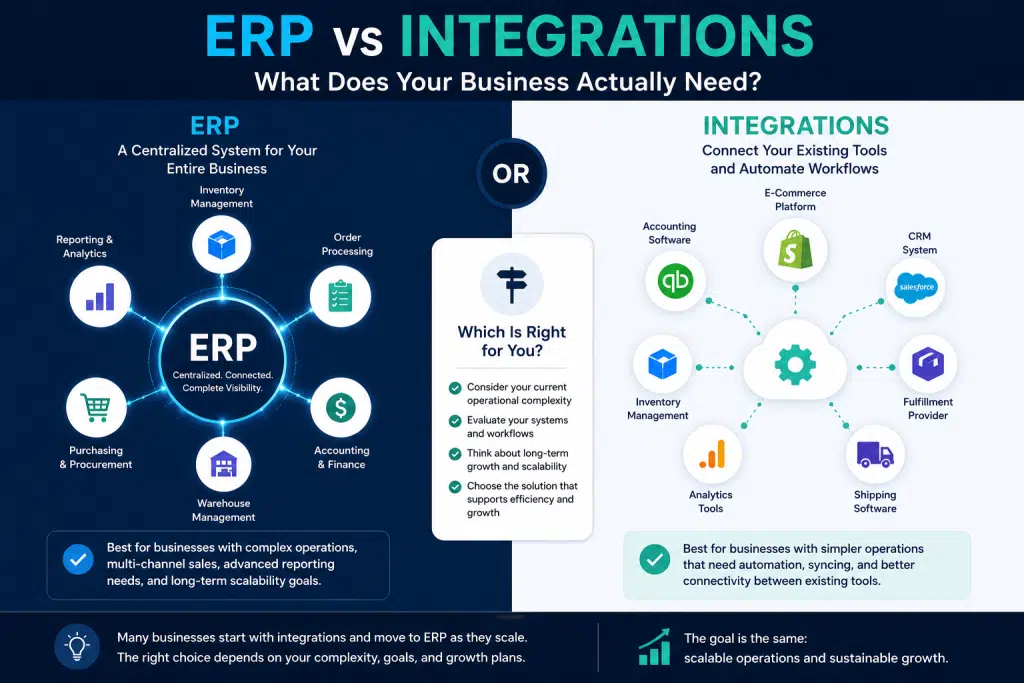
An ERP system acts as a centralized operational platform that manages core business functions such as:
- inventory management
- accounting and finance
- order processing
- purchasing and procurement
- warehouse operations
- reporting and analytics
Integrations, on the other hand, connect separate software platforms so they can exchange information automatically.
For example, integrations may connect:
- Shopify and QuickBooks
- Amazon and inventory systems
- CRM platforms and fulfillment tools
- ERP systems and analytics platforms
As a result, businesses reduce manual data entry and improve workflow efficiency without necessarily replacing existing systems.
If you need a basic explanation first, read our guide on what ERP is for e-commerce.
When Integrations Are Enough
Not every business needs ERP immediately.
In many cases, integrations can significantly improve operational efficiency without the complexity or investment of a full ERP implementation.
Businesses may only need integrations when:
- operations are still relatively simple
- order volume is manageable
- teams are small
- operational workflows are not highly complex
- existing systems already meet most business needs
For example, a growing e-commerce business may simply need:
- inventory synchronization
- automated reporting
- accounting integrations
- fulfillment automation
In these situations, integrations can help streamline operations while allowing the business to continue scaling efficiently.
Benefits of Integrations
Integrations provide several important advantages for growing businesses.
Reduced Manual Work
One of the biggest benefits of integrations is automation.
Instead of manually transferring data between systems, integrations allow information to flow automatically across platforms.
As a result, businesses reduce operational inefficiencies and improve accuracy.
Lower Operational Complexity
Implementing integrations is often less disruptive than implementing a full ERP system.
Businesses can improve workflows without completely changing their operational infrastructure.
Consequently, integrations can be a practical solution for companies that are still in earlier growth stages.
Faster Implementation
ERP implementations often require significant planning, operational restructuring, and long-term investment.
Integrations are usually faster to deploy and easier to manage.
Because of this, businesses can improve operational efficiency more quickly.
Better System Connectivity
Many businesses already use strong operational tools.
Integrations help connect these platforms so teams can work more efficiently without replacing existing systems.
When Businesses Usually Need ERP
Although integrations solve many operational challenges, there comes a point where disconnected systems become difficult to manage.
As businesses scale, operational complexity increases across:
- inventory management
- fulfillment
- reporting
- accounting
- purchasing
- multi-channel operations
Eventually, integrations alone may no longer be enough.
ERP systems become necessary when businesses need a centralized operational infrastructure instead of multiple loosely connected tools.
If your systems are becoming harder to manage, read our guide on when to implement ERP.
Signs Your Business May Need ERP Instead of Just Integrations
Several operational signs often indicate that ERP may be the better long-term solution.
Operational Complexity Is Increasing Rapidly
As businesses grow, operational workflows become more difficult to manage across disconnected systems.
For example, teams may struggle with:
- inconsistent operational data
- inventory inaccuracies
- delayed reporting
- workflow inefficiencies
- operational bottlenecks
ERP systems help centralize operations and reduce this complexity.
Reporting Becomes Fragmented
Businesses often struggle to generate accurate reporting when operational data exists across multiple platforms.
Although integrations can improve data flow, they do not always solve deeper operational visibility problems.
ERP systems create a centralized data environment that improves reporting consistency and visibility.
Manual Work Continues Increasing
If teams continue relying heavily on spreadsheets and manual processes despite existing integrations, this is often a sign that operational systems are no longer scalable.
ERP systems help automate and centralize operational workflows more effectively.
Multiple Integrations Become Difficult to Manage
Over time, businesses may accumulate many disconnected integrations between different platforms.
As a result, operational infrastructure becomes increasingly difficult to maintain.
ERP systems help simplify operations by consolidating workflows into one centralized platform.
ERP and Integrations Often Work Together
Integrations and ERP are not mutually exclusive.
In fact, most modern ERP systems rely heavily on integrations.
ERP systems are commonly integrated with:
- e-commerce platforms
- CRM systems
- fulfillment providers
- analytics tools
- automation platforms
At Good People Technologies, we help businesses design operational ecosystems where ERP, integrations, and automation work together to improve scalability and efficiency.
ERP vs Integrations: Which Is Right for Your Business?
The right solution depends on the complexity of your operations.
Businesses with relatively simple workflows may benefit significantly from integrations alone.
However, businesses experiencing operational bottlenecks, disconnected systems, fragmented reporting, and increasing operational complexity often benefit from ERP implementation.
Ultimately, the goal is not simply to add more software.
The goal is to create scalable operational infrastructure that supports long-term growth.
How Good People Technologies Helps Businesses Evaluate ERP vs integrations
At Good People Technologies, we help businesses evaluate their operational systems and determine whether they need:
- ERP implementation
- system integrations
- automation workflows
- operational optimization
Our approach focuses on building scalable operational ecosystems that improve efficiency, visibility, and long-term operational performance.
Learn more about our services:
https://goodpeopletech.com/
Final Thoughts
ERP systems and integrations solve different operational challenges.
Integrations help businesses connect existing systems and automate workflows. ERP systems help businesses centralize operations within one scalable operational platform.
Many growing businesses begin with integrations before eventually implementing ERP as operational complexity increases.
Understanding the difference between ERP and integrations helps businesses make better operational and technology decisions as they scale.
ERP systems centralize operational processes within one platform, while integrations connect separate software systems so they can exchange data automatically.
In some cases, yes. Businesses with relatively simple operational workflows may improve efficiency significantly through integrations without needing ERP immediately.
Businesses often choose ERP when operational complexity, fragmented reporting, disconnected systems, and manual workflows become difficult to manage.
Yes. Most ERP systems integrate with e-commerce platforms, CRM systems, analytics tools, and other operational software.
Businesses often consider ERP when existing systems no longer scale efficiently and operational complexity begins slowing down growth.

Roman is a B2B marketing specialist focused on technology, ERP systems, business automation, and digital growth strategies. At Good People Technologies, he helps translate complex technology solutions—such as ERP integrations, system integrations, and business process automation—into clear insights for founders, operators, and growing companies.
His work focuses on content strategy, SEO, and thought leadership that helps businesses understand how the right technology infrastructure can support scalable operations and sustainable growth.
At Good People Technologies, Roman contributes to content that explores ERP implementation, automation strategies, and system integration best practices for companies navigating rapid growth and operational complexity.