
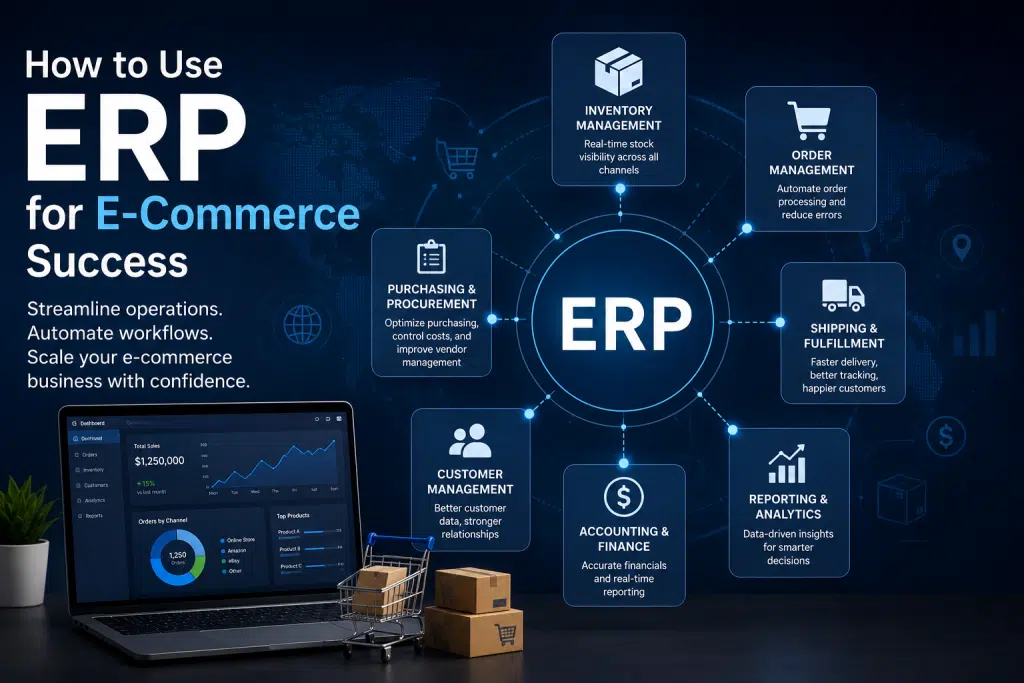
Running a successful e-commerce business becomes significantly more complex as growth accelerates.
At the beginning, it’s manageable to operate with separate tools for inventory, accounting, fulfillment, customer management, and reporting. However, as order volume increases and operations expand across multiple channels, disconnected systems quickly become a major obstacle to growth.
As a result, many businesses find themselves spending more time managing operations than actually scaling the company.
This is where ERP systems become essential.
An ERP (Enterprise Resource Planning) system helps e-commerce businesses centralize operations, automate workflows, and gain real-time visibility across the organization.
At Good People Technologies, we help growing businesses implement ERP systems, automation, and integrations that support scalable and efficient e-commerce operations.
In this guide, we’ll explore how ERP helps e-commerce businesses scale successfully and why the right operational infrastructure is critical for long-term growth.
If you are new to ERP, start with our beginner guide on what ERP is for e-commerce.
Why E-Commerce Businesses Outgrow Their Systems
Most e-commerce companies begin with lightweight operational tools.
A typical setup may include:
- Shopify or WooCommerce
- QuickBooks
- spreadsheets
- standalone inventory systems
- shipping and fulfillment software
- disconnected reporting tools
Initially, this setup works well because operations are relatively simple. However, as the business grows, operational complexity increases rapidly.
Data becomes scattered across multiple systems that don’t communicate with each other. Consequently, teams spend hours manually transferring information between platforms. Processes that were once manageable become time-consuming and error-prone.
In addition, leadership teams begin to lose visibility into the business. Simple questions—such as real-time inventory levels, margins, or operational performance—become difficult to answer.
Eventually, growth itself becomes the problem. Not because of lack of demand, but because operations can no longer scale efficiently.
What Is ERP for E-Commerce?
ERP for e-commerce refers to using an Enterprise Resource Planning system to connect and manage core business operations within a centralized platform.
Instead of relying on disconnected tools, ERP integrates critical business functions such as:
- inventory management
- order processing
- accounting and finance
- warehouse operations
- purchasing and procurement
- shipping and fulfillment
- reporting and analytics
As a result, businesses create a unified operational ecosystem where data flows automatically between systems.
This allows companies to operate more efficiently while reducing operational friction as they scale.
The Biggest Operational Challenges in E-Commerce
Growing e-commerce companies often face several recurring operational problems. Although these issues may seem manageable initially, they become increasingly expensive as order volume grows.
Inventory Management Becomes Difficult
As businesses expand across multiple sales channels, inventory management becomes significantly more complicated.
Without integrated systems, businesses often experience:
- overselling products
- inaccurate stock levels
- delayed inventory updates
- fulfillment issues
For example, inventory may appear available on one platform while already sold out on another.
ERP systems solve this problem by synchronizing inventory in real time across all connected platforms. Consequently, businesses gain more accurate visibility into stock levels while reducing costly operational errors.
Order Processing Slows Down
Manual order processing is one of the most common bottlenecks in scaling e-commerce operations.
As order volume increases, manual workflows become inefficient and error-prone. As a result, teams spend more time correcting operational mistakes instead of focusing on growth initiatives.
ERP systems automate much of the order lifecycle, including:
- order creation
- inventory allocation
- shipping updates
- invoice generation
- fulfillment workflows
Because of this, businesses can improve operational speed, reduce errors, and increase efficiency at scale.
Financial Reporting Becomes Fragmented
Many growing businesses struggle with disconnected financial systems.
Revenue data, inventory costs, refunds, shipping expenses, and operational metrics often exist across multiple platforms. Consequently, reporting becomes slow and difficult to manage.
Because of this fragmentation, leadership teams often lack accurate real-time visibility into business performance.
ERP systems centralize financial data and improve reporting accuracy. Furthermore, they allow businesses to make faster and more informed operational decisions.
Multi-Channel Operations Become Complex
Modern e-commerce businesses rarely operate on a single platform.
Many companies sell through:
- Shopify
- Amazon
- Walmart Marketplace
- wholesale channels
- retail partners
- direct sales platforms
However, managing all of these channels independently quickly becomes unsustainable.
Additionally, disconnected systems create inventory inconsistencies, reporting delays, and operational inefficiencies.
ERP systems help centralize operations and synchronize data across every sales channel. As a result, businesses create a far more scalable operational structure.
How ERP Helps E-Commerce Businesses Scale
ERP systems provide several major advantages for growing e-commerce companies.
Centralized Business Operations
One of the biggest benefits of ERP is operational centralization.
Instead of using disconnected systems, teams work within a unified infrastructure where all business data is connected.
As a result, businesses improve efficiency while eliminating operational silos. Furthermore, teams can collaborate more effectively because everyone works from the same data source.
Real-Time Visibility
ERP systems provide real-time operational and financial visibility.
Leadership teams can quickly access:
- inventory data
- order status
- revenue performance
- operational KPIs
- fulfillment metrics
Because of this, businesses can make proactive decisions rather than reacting to problems after they occur.
Automation of Repetitive Workflows
Automation is one of the most valuable aspects of ERP.
Manual operational work slows down growth. However, ERP systems automate repetitive processes such as:
- order routing
- inventory synchronization
- financial reporting
- customer notifications
- purchasing workflows
As a result, businesses reduce labor costs while increasing operational efficiency.
At the same time, automation allows teams to focus on higher-value strategic work instead of repetitive administrative tasks.
Improved Customer Experience
Operational efficiency directly impacts customer experience.
ERP systems help businesses:
- reduce shipping delays
- improve order accuracy
- maintain accurate inventory
- provide faster fulfillment
Ultimately, a stronger operational infrastructure creates a better customer experience.
Better Scalability
Many e-commerce businesses reach a stage where growth itself creates operational chaos.
ERP systems help businesses scale without proportionally increasing operational complexity. Consequently, companies can grow more sustainably while maintaining operational efficiency.
This is one of the biggest reasons successful companies invest in ERP before operational problems become severe.
ERP + Integrations + Automation: The Real Competitive Advantage
ERP alone is powerful. However, the real competitive advantage comes when ERP is combined with:
- system integrations
- business automation
- operational strategy
At Good People Technologies, we help companies build fully connected operational ecosystems where ERP acts as the central hub.
We integrate ERP systems with:
- e-commerce platforms
- fulfillment software
- accounting systems
- inventory platforms
- CRM tools
- analytics systems
As a result, businesses create seamless data flow across the organization.
This leads to faster operations, better visibility, and a stronger foundation for scalable growth.
For businesses deciding between a full ERP system and connected tools, our guide on ERP vs integrations explains the difference.
Common Mistakes E-Commerce Businesses Make
Unfortunately, many companies wait too long before improving their operational systems.
Common mistakes include:
- relying too heavily on spreadsheets
- delaying automation
- using disconnected systems for too long
- implementing ERP too late
- focusing only on front-end growth while neglecting operations
Over time, unresolved operational inefficiencies become significantly more expensive and difficult to fix.
When Should an E-Commerce Business Implement ERP?
There is no universal rule. However, several signs usually indicate it’s time to consider ERP.
These include:
- rapid order growth
- operational bottlenecks
- inaccurate inventory
- delayed reporting
- increasing manual work
- expansion across multiple channels
- lack of real-time visibility
Ultimately, the best time to implement ERP is before operational complexity begins slowing down growth.
If your business is approaching this stage, read our full guide on when to implement ERP.
How Good People Technologies Helps E-Commerce Businesses Scale
At Good People Technologies, we help growing businesses design scalable operational infrastructure through:
- ERP implementation
- system integrations
- business process automation
- e-commerce operational consulting
Our goal is not simply to implement software.
Instead, we help businesses build operational ecosystems that support long-term growth, efficiency, and scalability.
Learn more about our services:
https://goodpeopletech.com/
Final Thoughts
E-commerce growth creates operational complexity.
Without the right systems, businesses eventually encounter bottlenecks that limit scalability and reduce efficiency. However, ERP systems help solve these challenges by centralizing operations, automating workflows, and improving visibility across the organization.
For growing e-commerce businesses, ERP is not just a software investment—it’s a strategic operational decision.
Ultimately, the companies that scale most successfully are usually the ones that build strong operational infrastructure before complexity becomes unmanageable.
FAQ
ERP in e-commerce refers to using Enterprise Resource Planning systems to manage and integrate core business operations such as inventory, orders, fulfillment, accounting, and reporting.
E-commerce businesses need ERP to manage operational complexity, automate workflows, improve inventory accuracy, and scale more efficiently.
Businesses should consider ERP when manual processes, disconnected systems, and operational bottlenecks begin slowing down growth.
ERP improves efficiency, automation, reporting accuracy, inventory management, fulfillment operations, and scalability.
ERP synchronizes inventory across systems and sales channels in real time. As a result, businesses reduce overselling and improve inventory accuracy.

Hi, I’m Benji, founder of Good People Technologies. We create seamless tech solutions for high-growth companies, simplifying operations and delivering real-time insights.
For over a decade, we’ve helped businesses thrive by solving complex problems. When not working, I’m hiking or enjoying rivers in western North Carolina with my wife and two dogs.