
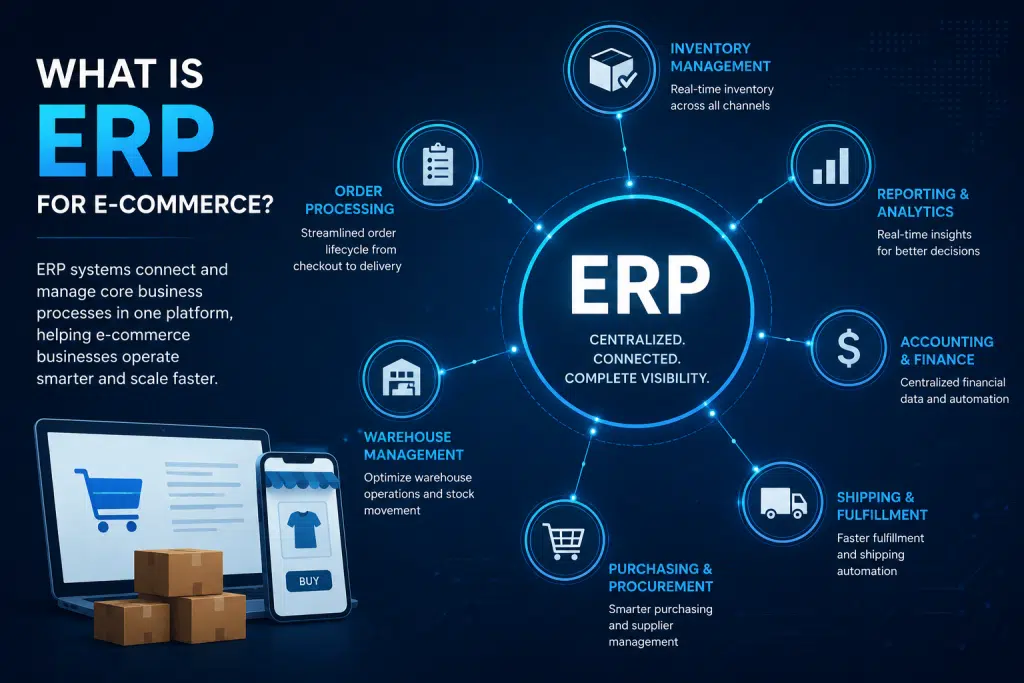
E-commerce businesses use many different systems to manage daily operations.
Inventory, orders, fulfillment, accounting, shipping, and reporting all need to work together efficiently. Initially, many online businesses manage these processes using separate tools and manual workflows. However, as operations grow, disconnected systems often become difficult to manage.
This is where ERP systems become important.
ERP systems help businesses centralize operations, improve visibility, and connect core business processes within one platform.
At Good People Technologies, we help businesses implement ERP systems, integrations, and automation solutions that support scalable e-commerce operations.
In this guide, we’ll explain what ERP means, how ERP works for e-commerce businesses, and why many online companies eventually adopt ERP systems.
What Does ERP Mean?
ERP stands for Enterprise Resource Planning.
An ERP system is software designed to help businesses manage and connect core operational processes in one centralized system.
Instead of using separate tools for accounting, inventory management, fulfillment, reporting, and purchasing, ERP systems bring these functions together into one connected platform.
As a result, businesses can operate more efficiently while improving visibility across different departments and workflows.
Learn more about how businesses use ERP systems successfully in our guide to ERP for e-commerce success.
How Does ERP Work?
ERP systems act as a central operational hub for the business.
Different departments and systems share information through the ERP platform. Consequently, data updates automatically across the organization instead of being managed manually in multiple places.
For example, when a customer places an order:
- inventory updates automatically
- accounting data syncs in real time
- fulfillment workflows begin immediately
- reporting dashboards update automatically
Because all operational data is connected, businesses reduce manual work and improve operational accuracy.
What Does ERP Do for E-Commerce Businesses?
For e-commerce companies, ERP systems help connect operational processes that are often spread across multiple tools.
Online businesses commonly use:
- Shopify or WooCommerce
- marketplaces like Amazon
- accounting software
- fulfillment tools
- inventory management systems
- shipping platforms
Initially, these systems may operate independently without major issues. However, as order volume increases, disconnected systems often create inefficiencies.
ERP systems help solve this problem by centralizing operational data into one system.
As a result, businesses improve visibility, reduce manual work, and create more efficient workflows.
Common Features of ERP Systems
Most ERP systems include features such as:
- inventory management
- order management
- accounting and finance
- purchasing and procurement
- warehouse management
- shipping and fulfillment
- reporting and analytics
Some ERP systems also integrate with CRM platforms, automation tools, and e-commerce marketplaces.
Benefits of ERP for E-Commerce
ERP systems provide several important benefits for growing e-commerce businesses.
Better Inventory Management
Inventory management becomes increasingly difficult as businesses grow across multiple sales channels.
ERP systems help synchronize inventory data in real time. Consequently, businesses improve inventory accuracy while reducing overselling and fulfillment issues.
Improved Operational Efficiency
Manual operational processes can slow down growing businesses.
ERP systems help automate workflows such as:
- order processing
- inventory updates
- reporting
- fulfillment coordination
As a result, teams spend less time managing repetitive tasks and more time focusing on business growth.
Centralized Business Data
Many businesses struggle with information spread across multiple systems.
ERP systems centralize operational and financial data into one platform. Because of this, leadership teams gain better visibility into business performance and operations.
Better Reporting and Visibility
ERP systems provide businesses with real-time operational and financial insights.
This helps leadership teams make faster and more informed decisions based on accurate business data.
More Scalable Operations
As e-commerce businesses grow, operational complexity increases.
ERP systems help businesses create more scalable operational processes that support higher order volume and multi-channel operations.
ERP vs Using Separate Business Tools
Many e-commerce businesses initially rely on separate software tools to manage operations.
For example, businesses may use:
- one platform for accounting
- another for inventory
- another for fulfillment
- spreadsheets for reporting
Although this setup may work early on, disconnected systems often create inefficiencies as operations grow.
ERP systems help solve this problem by connecting operational workflows into one centralized platform.
Consequently, businesses reduce manual work while improving efficiency and visibility.
ERP Integrations for E-Commerce
ERP systems are often integrated with other operational platforms.
At Good People Technologies, we help businesses integrate ERP systems with:
- e-commerce platforms
- fulfillment software
- accounting tools
- CRM systems
- analytics platforms
As a result, businesses create connected operational ecosystems where data flows automatically between systems.
If you are unsure whether your business needs ERP or just better system connectivity, read our guide on ERP vs integrations.
When Do Businesses Usually Need ERP?
Not every business needs ERP immediately.
However, many companies begin considering ERP when they experience:
- rapid operational growth
- disconnected systems
- increasing manual work
- inventory inaccuracies
- operational bottlenecks
- reporting delays
If your business is beginning to outgrow its operational systems, ERP may help create a more scalable operational foundation.
You can also read our guide on ERP for e-commerce success to learn how businesses use ERP systems to scale operations more efficiently.
You can also explore our guide on when to implement ERP.
How Good People Technologies Helps Businesses Implement ERP
At Good People Technologies, we help businesses build scalable operational systems through:
- ERP implementation
- business automation
- system integrations
- operational consulting
Our goal is not simply to implement software.
Instead, we help businesses create connected operational ecosystems that improve efficiency, scalability, and long-term operational performance.
Learn more about our services:
https://goodpeopletech.com/
Final Thoughts
ERP systems help e-commerce businesses centralize operations, improve visibility, and reduce operational inefficiencies.
Initially, many businesses manage operations using disconnected tools and manual workflows. However, as businesses grow, these systems often become difficult to scale efficiently.
ERP helps solve these challenges by connecting operational processes into one centralized system.
For many growing e-commerce businesses, ERP becomes an important step toward building more scalable and efficient operations.
FAQ
ERP in e-commerce refers to software that helps businesses manage inventory, orders, accounting, fulfillment, reporting, and other operational processes within one connected system.
E-commerce businesses use ERP to centralize operations, improve visibility, automate workflows, and reduce manual operational work.
Yes. Many ERP systems integrate with platforms such as Shopify, Amazon, WooCommerce, and other e-commerce tools.
ERP systems improve operational efficiency, inventory management, reporting accuracy, visibility, and scalability.
No. Many growing small and mid-sized e-commerce businesses use ERP systems to improve operations and support long-term growth.

Hi, I’m Benji, founder of Good People Technologies. We create seamless tech solutions for high-growth companies, simplifying operations and delivering real-time insights.
For over a decade, we’ve helped businesses thrive by solving complex problems. When not working, I’m hiking or enjoying rivers in western North Carolina with my wife and two dogs.