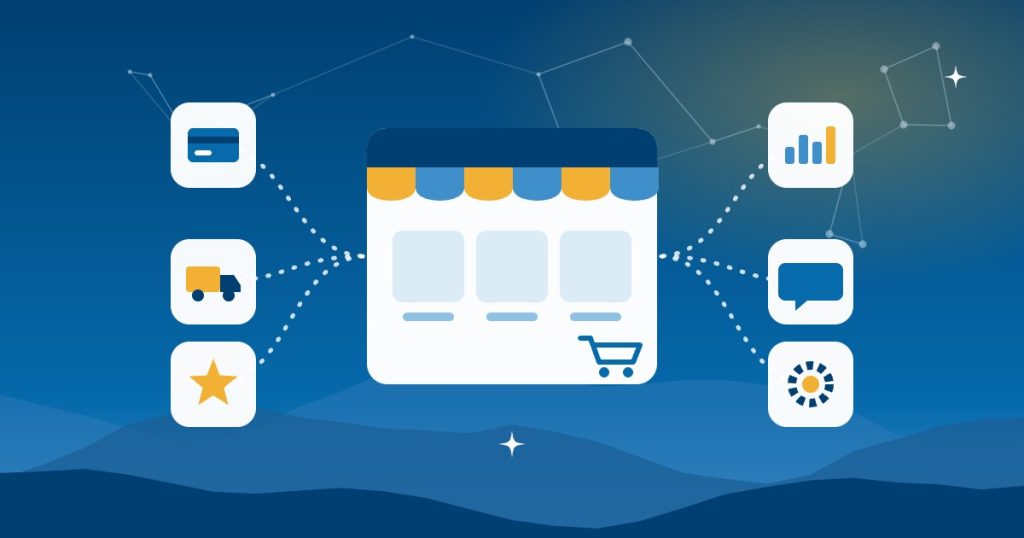
Ecommerce platform integrations connect your online store to the other systems you run, such as your ERP, accounting software, CRM, marketing tools and shipping carriers. They can significantly boost revenue because they automate work, keep data in sync and give customers a better experience.
There are many integration types available to drive revenue growth. This guide covers 22 of them, which ecommerce platforms have the most integrations, and how to connect your store to your other systems.
Which ecommerce platforms have the most app integrations?
If you’re still choosing a platform, look at the size of its app ecosystem. Shopify’s is the best known: according to AppJubilee’s tracking, the Shopify App Store listed 17,891 apps from 11,352 partners in May 2026. BigCommerce, WooCommerce and Adobe Commerce also run their own app marketplaces, and WooCommerce stores can use many WordPress plugins as well.
However, the number of apps matters less than whether the platform connects cleanly to the systems you already run. For example, NetSuite, Acumatica and Business Central all offer Shopify connectors, as our guide to the best ERP for ecommerce explains.
22 ecommerce platform integrations that increase revenue
Here are 22 examples:
Cross-Selling and Up-Selling Integrations
: Collaborate with partners to offer complementary products or services. Use recommendation engines on e-commerce platforms to suggest additional products based on user behavior.Partnership and Affiliate Integrations
: Collaborate with other companies to expand your reach and tap into new audiences. Utilize affiliate platforms to incentivize partners and drive sales.CRM systems
: Integrating with a CRM system enables you to track customer interactions and foster relationships. This, in turn, can boost sales and enhance customer retention.E-commerce Platform and Shopping Cart Integrations
: To ensure smooth and efficient e-commerce operations, integrate inventory management, payment gateways, and other essential functionalities.Loyalty and Rewards Program Integrations
: Partner with rewards platforms or incorporate your own loyalty program to incentivize repeat business.Subscription Management Integrations
: Utilize subscription management tools to effectively handle recurring billing, upselling, and retention.Payment Gateway Integrations
: To cater to a wide audience and ensure seamless transactions, consider offering multiple payment options. By integrating with a payment gateway, you can accept payments from customers worldwide, expanding your reach and boosting sales.Advertising and Retargeting Integrations
: Utilize platforms such as Google AdWords or Facebook Ads to target users who have expressed interest in your products or services.Marketing Automation Integrations
: Connect your CRM and email marketing tools to segment your audience and provide personalized deals and content. By integrating with a marketing automation platform, you can automate your marketing campaigns, reaching more customers and boosting sales.Channel Expansion Integrations
: Connect with platforms such as Amazon, eBay, and others to expand your reach and engage a larger consumer base.Pricing Optimization Integrations
: Use AI and machine learning to apply dynamic pricing strategies. Adjust prices based on demand, competition, and other factors.Content Monetization Integrations
: Utilize paywalls, ads, or affiliate content to generate revenue from your blog or website.Ecommerce Marketplace and Platform Integrations
: If you work in software or SaaS, consider integrating with marketplaces such as Salesforce AppExchange or the WordPress plugin marketplace to expand your reach to a larger audience.Feedback and Review Integrations
: Utilize tools to collect and showcase user reviews, aiding in increasing sales by establishing trust.ERP (Enterprise Resource Planning) Integrations
: Make sure business processes such as procurement, order processing, and finance are streamlined to maximize revenue generation. Our guide to ERP vs integrations explains when you need each.Customer Support Integrations
: To reduce cart abandonment, incorporate chatbots, live chat, and other support tools for real-time assistance. This helps provide prompt help to customers.Personalization and AI Integrations
: Using AI to personalize user experiences can boost sales. Our guide on how to use AI in your business covers other practical uses.Social Media Integrations
: Utilize the power of social media by combining sharing, shopping, and advertising features.Analytics and BI (Business Intelligence) Integrations
: Analyze user behavior, sales trends, and other important data to make informed business decisions. Our comparison of an AI briefing vs a dashboard explains when each helps.Inventory Management Integrations
: Make sure you always have enough stock and can handle demands quickly and efficiently. When stock numbers drift between systems, see our guide to inventory mismatch between systems.Localization Integrations
: Customize your product or service to align with the local culture, currency, and language of different regions.Shipping carriers
: By integrating with a shipping carrier, you can automatically calculate shipping costs and print shipping labels. This saves you time, money, and improves the customer experience. Integrating with multiple shipping carriers enables you to choose the lowest-cost shipping option for each package.
When selecting integrations, it’s crucial to consider your unique requirements and objectives. Additionally, ensure compatibility with your ecommerce platform. Once you’ve chosen the suitable integrations, correctly setting them up is essential. This may require some technical expertise, but the resulting benefits of increased revenue make it worthwhile. Enjoy reaping the rewards once your integrations are up and running!
How to set up ecommerce platform integrations
There are three common ways to connect your ecommerce platform to the rest of your business:
- Native connectors. Many ERPs, accounting tools and apps offer a built-in connector for Shopify, BigCommerce or WooCommerce. Start there, because the vendor maintains it.
- Integration platforms. Tools such as Celigo, Zapier and Make connect systems without custom code. Our comparison of Zapier, Make and n8n covers their AI options.
- Custom integrations. When nothing off the shelf fits, a developer can connect systems through their APIs. In that case, plan for monitoring, because a silent failure is the most expensive kind.
Whichever route you choose, someone should watch the integration’s error log and compare key numbers each week. A daily business report can flag problems early.
Tips for increasing revenue with ecommerce platform integrations
Get your ecommerce platform working before adding integrations
: Before integrating with other systems, ensure that your ecommerce platform is functioning smoothly. This will guarantee successful integrations.Research ecommerce platform integrations
: There are numerous integrations to choose from, making it crucial to conduct research and select the ones that align with your business needs.Start with a few ecommerce platform integrations
: Avoid attempting to integrate with too many systems simultaneously. Begin with a few essential integrations and gradually incorporate more as required.Get help with ecommerce platform integrations
: If you require assistance with setting up or resolving integration issues, you can find numerous online resources and support from your ecommerce platform provider.
If you want to boost revenue, improve the customer experience, and cut costs for your large ecommerce business, consider the power of integrations. Integrations provide valuable insights into customer preferences and buying behavior, while also streamlining processes. By connecting different systems, you can create a seamless experience that customers will appreciate. Plus, integration solutions are cost-effective and scalable, allowing you to easily add new features or services as needed.
To streamline your ecommerce operations, strategic integration is crucial. With careful selection and implementation, these tools unlock untapped potential for your enterprise. If you’re ready to take your ecommerce business to the next level, don’t hesitate to contact us. Our team of experts is always available to guide you through the process and help you maximize the benefits of your integrations. Schedule a consultation today, and let’s collaborate to boost your revenues and deliver unforgettable experiences for your customers.

Hi, I’m Benji, founder and CTO of Good People Technologies in Asheville, NC. We help small and mid-sized businesses put AI to work safely and connect it to the systems they already run, from QuickBooks to NetSuite.
For over a decade, we’ve helped businesses solve complex operations and technology problems. When not working, I’m hiking or enjoying rivers in western North Carolina with my wife and two dogs.