“Should we build more Zaps, or should we get an AI agent?” is one of the most common questions I hear from business owners right now. It’s a fair question, because the line between the two keeps moving. Zapier now sells AI agents, and AI tools like ChatGPT and Claude can now take actions in other apps. When people compare AI agents vs Zapier, though, the real question is simpler: what kind of work are you handing off?
Here’s how the two differ, what each costs, and how to decide which one a task needs. In practice, most small businesses end up using both.
AI agents vs Zapier: the short answer
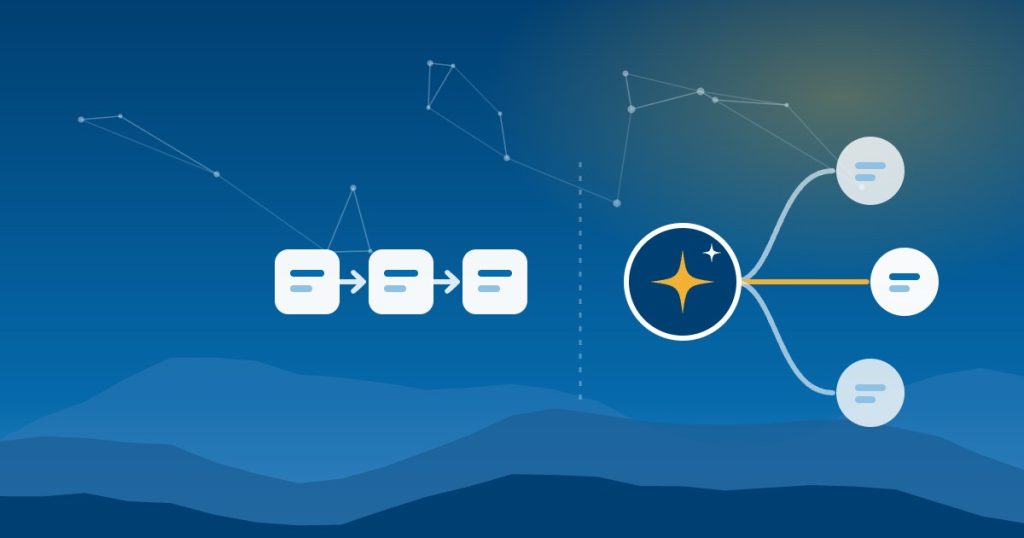
- Use a Zapier automation when the steps are the same every time. New order, add a row, send a message. Rules handle this reliably and cheaply.
- Use an AI agent when the work needs judgment. Reading messy emails, deciding what kind of request something is, researching, drafting a reply.
- Combine them when a routine process has one messy step. Let the automation handle the trigger and the record-keeping, and use AI only for the step that needs reading or deciding.
What a Zapier automation does
A Zap is a set of rules: when this happens (the trigger), do these things (the actions). When a new Shopify order comes in, add it to a spreadsheet and post a note in Slack. When someone fills out a form, create a contact in your CRM and send a welcome email.
The strength of an automation is that it’s predictable. The same input produces the same result, every time. You can test it, and when something breaks, it stops with an error you can see.
The weakness is that it only handles what you planned for. If a customer writes “please cancel my order and send the refund to my other card” in a general inquiry form, a Zap has no way to understand that.
Zapier bills automations by tasks. According to Zapier’s help center, each successful action step uses one task, while triggers, filters and steps that error out don’t count. The free plan includes 100 tasks a month, and paid plans start at $19.99 a month on Professional.
What an AI agent does
An AI agent gets a goal, a set of instructions and access to some tools, then decides the steps on its own. Instead of “when X, do Y,” you tell it something like “read new messages in the support inbox, figure out what each person needs, and draft a reply using our policies.”
There are several kinds now:
- Zapier Agents, which can work across the apps Zapier connects to, browse the web and use knowledge sources you attach. Zapier’s help center describes them as AI-powered assistants that can act on their own or when you interact with them.
- Make’s AI agents, which run inside Make scenarios and can use modules, other scenarios and MCP servers as tools, according to Make’s documentation.
- ChatGPT, Claude and Microsoft Copilot, which can carry out multi-step tasks in apps you connect to them.
The strength of an agent is handling variation. It can read a rambling email and work out what the person wants.
The weakness is that it’s less predictable. The same input can produce slightly different results, and when an agent gets something wrong, it often does so confidently instead of stopping with an error.
Zapier Agents are billed separately from Zaps, by activities. Zapier’s pricing page lists a free plan with 400 activities a month and an Agents Pro plan with 1,500 activities a month for $400 a year.
AI agents vs Zapier automations side by side
| Zapier automation | AI agent | |
|---|---|---|
| How it decides | Rules you set up | Your instructions plus its own judgment |
| Same input, same result? | Yes | Usually, but not always |
| Best for | Moving data, creating records, sending notifications | Reading, sorting, researching and drafting |
| Setup work | Map the fields once | Write instructions and test them on real examples |
| How it’s billed on Zapier | Tasks per successful action | Activities per run |
| When it goes wrong | Stops with a visible error | Can give a confident wrong answer |
| Oversight needed | Check the error log | Review the output, especially at first |
The middle ground: AI steps inside an automation
You don’t have to choose one or the other. Zapier lets you add an AI step to a normal Zap. A common example is a shared inbox: the Zap picks up each new email, an AI step decides whether it’s a quote request, a complaint or an invoice, and the Zap routes it to the right person.
This is often the best place to start. The parts that should be predictable stay as rules, and AI handles only the step that needs reading. Zapier says the task cost of an AI step depends on the model you pick.
There’s also a route in the other direction. With Zapier MCP, an assistant like ChatGPT or Claude can use Zapier to take actions in your other apps when you ask it to. Zapier’s documentation says each successful tool call uses two tasks from your plan, and failed calls don’t count.
Four common examples
These are typical small business situations, not specific client stories:
- A website form sends leads to your CRM and alerts the sales team. Automation. The steps never change, so there’s nothing for an agent to decide.
- A shared inbox gets quote requests, complaints and invoices mixed together. An automation with one AI step to sort each message. A person still handles the replies.
- Every week, someone checks five supplier websites for price changes. A good fit for an agent that can browse the web, with a person reviewing the summary before anything changes.
- Shopify payouts and fees need to match your QuickBooks books. Not an agent. Accounting needs the same result every time, so this belongs in a proper integration. We cover the options in our guide to connecting AI to QuickBooks, NetSuite and Shopify.
How to decide: five questions
Most decisions about AI agents vs Zapier come down to five questions:
- Are the steps the same every time? If yes, use an automation.
- Does the work involve reading unstructured text, like emails, notes or documents? If yes, you need AI for at least that step.
- What happens if it gets something wrong? The higher the stakes, the more you want rules, plus a person approving the result.
- How often does it run? For high-volume, repetitive work, automations are cheaper and easier to predict.
- Can you describe what a good result looks like? If you can’t, you’re not ready to hand the task to an agent yet.
What it costs
Comparing the cost of AI agents vs Zapier automations comes down to how each is billed. On Zapier, automations and AI steps draw from one shared task allowance, and agents use their own activity allowance. If you go over your task limit with pay-per-task billing turned on, Zapier charges extra tasks at a higher rate than your plan’s included tasks. With it turned off, new runs wait until your billing cycle resets.
The bigger cost is usually time. An automation takes a few hours to set up and then mostly runs on its own. An agent takes longer to get right, because you have to test its instructions on real examples and keep checking its work. Our guide to AI implementation cost covers the full picture, including the setup time people forget to budget for.
Guardrails for AI agents
If you decide a task needs an agent, set it up carefully:
- Start in draft mode. Let the agent prepare emails, updates or summaries for a person to approve before anything is sent.
- Give it only the apps it needs. An agent that sorts support email doesn’t need access to your accounting system.
- Require approval for anything that sends, pays or deletes.
- Review its work weekly at first. Look at a sample of what it did, not just whether it ran.
- Name an owner. Someone should be responsible for each agent, the same way someone owns each process.
These fit naturally into an AI use policy. If several people will use agents, our AI rollout plan covers how to introduce them without confusion.
Getting help in Asheville and across North Carolina
Most of the businesses we work with already have a few Zaps running, and the question is what to add next. Sometimes the answer is an agent. More often, it’s a cleaner automation with one AI step in the right place.
We set up and fix Zapier automations and help with AI implementation for small businesses in Asheville, Western North Carolina and across the state. If you’re not sure which approach fits, start with a free 15-minute operations and technology audit.
Frequently asked questions
Is Zapier an AI agent?
Not by itself. Zapier is an automation platform built on rules. It now also offers Zapier Agents and AI steps you can add to Zaps, so you can use both approaches in one account.
Are AI agents replacing Zapier automations?
Not for routine work. Moving data between apps the same way every time is still a job for rules, which are cheaper and more reliable. Agents are taking over the tasks automations couldn’t handle well, like reading and sorting messages.
Which is cheaper, an AI agent or a Zapier automation?
For high-volume work with fixed steps, an automation is usually cheaper and easier to predict. Agents cost more to set up and supervise, so they make sense when the task needs judgment that rules can’t provide.
Can ChatGPT or Claude use my Zaps?
They can use Zapier to take actions in your apps through Zapier MCP. According to Zapier, each successful tool call uses two tasks from your plan.
Sources, checked October 2026: Zapier’s help center on tasks and building agents, Zapier’s MCP usage documentation, Zapier’s pricing page, and Make’s guide to creating an AI agent.

Hi, I’m Benji, founder and CTO of Good People Technologies in Asheville, NC. We help small and mid-sized businesses put AI to work safely and connect it to the systems they already run, from QuickBooks to NetSuite.
For over a decade, we’ve helped businesses solve complex operations and technology problems. When not working, I’m hiking or enjoying rivers in western North Carolina with my wife and two dogs.