
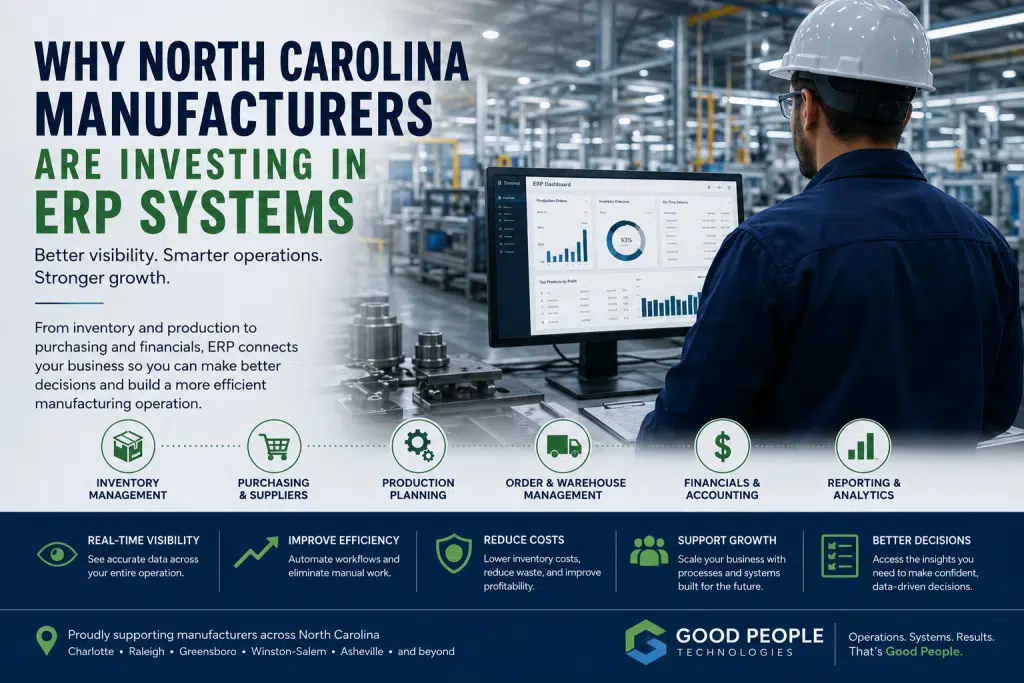
North Carolina manufacturers ERP adoption is becoming more important as manufacturing companies across the state deal with rising operational complexity, labor pressure, supply chain challenges, and the need for better visibility across every part of the business. For many manufacturers, the question is no longer whether technology matters. The real question is whether their current systems can support the next stage of growth.
A manufacturer can have strong products, loyal customers, and a skilled team, but still struggle because daily operations depend on disconnected software, spreadsheets, manual data entry, and outdated reporting processes. Over time, those gaps create delays, inventory issues, purchasing mistakes, production bottlenecks, and leadership blind spots.
That is why more manufacturing companies in North Carolina are looking seriously at ERP systems. ERP is not just accounting software. It is a way to connect operations, inventory, purchasing, production, finance, reporting, and customer data into a more reliable business system.
For growing manufacturers in Charlotte, Raleigh, Durham, Greensboro, Winston-Salem, Asheville, and other parts of North Carolina, ERP can become the operational backbone that helps the business scale without adding unnecessary complexity.
This article explains why ERP adoption is increasing among North Carolina manufacturers, what problems ERP helps solve, when a company should consider it, and how ERP, integrations, and automation can work together to support more efficient growth.
Manufacturing in North Carolina Is Becoming More Complex
North Carolina has a strong and diverse manufacturing economy. The state includes manufacturers in industries such as industrial equipment, furniture, textiles, food and beverage production, aerospace components, automotive suppliers, electronics, plastics, medical devices, packaging, and consumer products.
Many of these companies are not huge global enterprises. They are small and mid-sized manufacturers that have grown steadily over time. They may have started with a simple set of tools, a few spreadsheets, QuickBooks, and a small team that knew how to keep everything moving.
At an early stage, that can work.
However, manufacturing gets more difficult as volume increases. A business that once handled a manageable number of orders, suppliers, SKUs, purchase orders, and production schedules may eventually find itself operating in a much more complicated environment.
The company may now need to manage:
- multiple product lines
- more suppliers
- more customer accounts
- more inventory locations
- custom orders
- production scheduling
- material availability
- shipping deadlines
- quality control
- financial reporting
- customer expectations
- margin pressure
As these moving parts increase, the old systems begin to show their limits.
The challenge is not only growth. It is coordination.
Manufacturing requires many departments to work from the same information. Sales needs to know what can be produced. Purchasing needs to know what materials are required. Production needs accurate schedules. Finance needs reliable cost data. Leadership needs reports that reflect what is actually happening.
When each department uses different tools, different spreadsheets, or different versions of the truth, the business becomes harder to manage.
That is one of the main reasons North Carolina manufacturers ERP adoption is becoming more relevant. ERP helps replace fragmented operational visibility with a more connected system.
Why Many Manufacturers Outgrow QuickBooks, Spreadsheets, and Legacy Systems
Most manufacturers do not start with ERP.
They start with tools that solve immediate problems.
A typical growing manufacturer may use:
- QuickBooks for accounting
- spreadsheets for inventory planning
- email for purchasing communication
- a standalone CRM for sales
- a separate shipping system
- a basic inventory tool
- manual production schedules
- shared drives for documents
- custom spreadsheets for reporting
At first, these tools may feel practical. They are affordable, familiar, and flexible. The team knows how to use them, and the business can move quickly without a large software implementation.
However, as the company grows, these tools begin to create friction.
The problem is not that QuickBooks or spreadsheets are bad. The problem is that they are often not designed to manage the full complexity of a growing manufacturing operation.
For example, a spreadsheet may track inventory reasonably well when there are 50 SKUs. But what happens when there are 500 SKUs, multiple suppliers, backorders, production schedules, raw materials, finished goods, and multiple warehouses?
A spreadsheet can also support planning when one person owns the process. But what happens when multiple departments need the same information at the same time?
Eventually, the business begins to rely on manual work to keep systems aligned.
Someone exports sales data, or updates inventory, or checks purchase orders, or reconciles production data.
The more the company grows, the more manual coordination is required. This creates a hidden operational ceiling.
A business may continue selling more, but the back office becomes increasingly strained. Employees work harder, but the system itself does not become more scalable.
That is when many manufacturers begin evaluating ERP.
The Hidden Cost of Disconnected Manufacturing Systems
Disconnected systems create costs that are easy to miss because they do not always appear as a single line item.
Instead, they show up as delays, mistakes, rework, stress, and poor visibility.
A manufacturer may not immediately see the cost of disconnected software. Orders still ship. Production still happens. Customers still get served.
But underneath the surface, the company may be paying for inefficiency every day.
Common hidden costs include:
- employees entering the same data multiple times
- inventory numbers that do not match across systems
- purchase orders created from outdated information
- production schedules based on incomplete visibility
- finance teams waiting for manual reports
- managers making decisions from stale data
- customer service teams chasing order updates
- leadership lacking real-time margin visibility
These problems often become normalized.
A team may say, “This is just how we do it.”
That phrase is usually a warning sign.
If a process depends on one employee’s spreadsheet, one manual workaround, or one person’s memory, the business is carrying operational risk.
Disconnected systems also create communication problems. One department may think materials are available, while another knows they are delayed. Sales may promise a delivery date without seeing production constraints. Finance may report numbers that do not reflect recent operational changes.
When this happens, the business loses speed.
Instead of working from one reliable operational picture, teams spend time confirming, checking, correcting, and explaining.
This is one of the reasons North Carolina manufacturers ERP investment is not just a technology trend. It is a response to operational pressure.
Manual Data Entry Becomes a Scaling Problem
Manual data entry is one of the most common symptoms of disconnected manufacturing systems.
In many companies, employees manually move data between:
- sales orders and accounting
- purchasing and inventory
- production schedules and spreadsheets
- shipping systems and customer records
- invoices and financial reports
- inventory systems and warehouse records
At low volume, this may seem manageable. At higher volume, it becomes expensive.
Manual data entry creates three major problems.
First, it consumes employee time. Skilled employees should not spend hours copying information from one system into another when that work could be automated.
Second, it increases the risk of errors. A wrong quantity, wrong SKU, wrong customer address, or wrong cost can create downstream problems.
Third, it slows decision-making. If reports depend on manual updates, leadership is always looking at information that may already be outdated.
Manufacturing companies often feel this most clearly during growth periods.
The business gets more orders, but the administrative workload grows with it. Instead of growth creating leverage, it creates more manual work.
That is not sustainable.
ERP helps reduce this burden by centralizing information and automating workflows that would otherwise require manual coordination.
Inventory Visibility Is Often the Breaking Point
Inventory is one of the first areas where manufacturers feel the pain of disconnected systems.
For a manufacturer, inventory is not just finished goods. It may include raw materials, components, work-in-progress, packaging materials, replacement parts, and finished products.
If inventory visibility is weak, the impact spreads across the business.
Purchasing may order too much or too little.
Production may be delayed because materials are not available.
Sales may promise products that cannot be delivered on time.
Finance may struggle with accurate inventory valuation.
Leadership may not know whether cash is tied up in excess stock.
Inventory problems are especially frustrating because they often appear even when teams are working hard. The issue is not always poor effort. Often, the issue is that the systems do not provide accurate, timely information.
ERP systems help manufacturers improve inventory visibility by connecting inventory data with purchasing, production, sales, and finance.
This allows teams to answer questions such as:
- What inventory do we have right now?
- What materials are committed to production?
- What needs to be reordered?
- Which items are slow-moving?
- Which products are creating margin pressure?
- Where are we carrying too much stock?
- What inventory is available to promise?
When this information is reliable, the business becomes easier to manage.
Purchasing and Supplier Management Become More Strategic
Purchasing is another area where ERP can create significant value for manufacturers.
Without integrated systems, purchasing teams often make decisions from incomplete information. They may rely on spreadsheets, email threads, supplier notes, or manual reports.
This can lead to:
- over-ordering
- under-ordering
- missed reorder points
- supplier delays
- emergency purchases
- poor visibility into vendor performance
- difficulty tracking costs
In manufacturing, purchasing decisions directly affect production, cash flow, and profitability.
If materials are not available when needed, production slows down. If too much inventory is purchased, cash is tied up. And if supplier performance is not tracked, the company may continue working with vendors that create recurring problems.
ERP can improve purchasing by connecting material requirements, inventory levels, supplier data, purchase orders, and financial records.
As a result, purchasing becomes less reactive and more strategic.
A manufacturer can better understand what to buy, when to buy it, who to buy it from, and how purchasing decisions affect production and margins.
Production Planning Requires Better Data
Production planning is difficult when data lives in separate systems.
A production manager may need to understand:
- open sales orders
- available materials
- machine capacity
- labor availability
- supplier lead times
- customer deadlines
- current work-in-progress
- quality issues
- shipping requirements
If that information is spread across spreadsheets, emails, accounting software, and warehouse tools, planning becomes slow and error-prone.
ERP systems help create a more connected planning environment.
They can support:
- work orders
- production schedules
- material requirements planning
- capacity planning
- job costing
- quality tracking
- status updates
- production reporting
This helps manufacturers move from reactive planning to more controlled operations.
Better planning also improves customer experience. When production schedules are more accurate, companies can give customers more reliable timelines and reduce last-minute surprises.
Reporting Delays Limit Leadership Decisions
Many growing manufacturers struggle with reporting.
The leadership team may want simple answers:
- Are margins improving?
- Which product lines are most profitable?
- What is our current production efficiency?
- Which customers are most valuable?
- Where are costs increasing?
- Are purchasing delays affecting delivery?
- How much inventory is tied up in slow-moving items?
However, getting these answers may require exports from multiple systems, spreadsheet cleanup, manual reconciliation, and input from several departments.
That means leadership is often making decisions based on delayed information.
ERP helps by centralizing operational and financial data. This does not mean every report becomes perfect overnight. However, it creates a much stronger foundation for accurate reporting.
Instead of waiting days for reports, leadership can move toward more real-time visibility.
This matters because speed of decision-making becomes more important as a manufacturer grows.
If leadership sees problems earlier, the company can respond faster.
Why North Carolina Manufacturers Are Investing in ERP Systems
Why North Carolina manufacturers are investing in ERP systems comes down to a simple reality: growth is becoming harder to manage with disconnected tools.
Manufacturers across the state are dealing with a combination of operational pressure, labor constraints, supply chain complexity, customer expectations, and margin pressure. These challenges make visibility and efficiency more important than ever.
ERP systems help address these pressures by giving manufacturers a more connected way to manage operations.
Several forces are driving this trend.
Growth Without Adding Unnecessary Headcount
Many companies want to grow without increasing administrative headcount at the same pace.
ERP helps by automating workflows, reducing duplicate work, and improving visibility.
This allows teams to handle more complexity without constantly adding manual processes.
Labor Pressure
Manufacturers often face challenges finding and retaining skilled workers.
When labor is limited, companies need systems that help employees work more efficiently.
ERP can reduce time spent on repetitive administrative tasks so employees can focus on higher-value work.
Supply Chain Volatility
Supply chains have become less predictable.
Manufacturers need better visibility into suppliers, inventory, lead times, and purchasing requirements.
ERP helps teams respond faster when materials are delayed or costs change.
Customer Expectations
Customers expect accurate timelines, faster communication, and reliable delivery.
If internal systems are disconnected, customer service suffers.
ERP improves the flow of information between sales, production, fulfillment, and customer service.
Margin Pressure
Manufacturers need better insight into costs and profitability.
ERP can improve visibility into job costs, inventory valuation, purchasing costs, production efficiency, and financial performance.
When margins are tight, better information becomes a competitive advantage.
Composite Case Study: A Greensboro Manufacturer That Outgrew Its Systems
Consider a growing manufacturer near Greensboro with approximately 90 employees.
The company produces custom industrial components for regional and national customers. For years, the business operated with QuickBooks, spreadsheets, email-based purchasing workflows, and a basic inventory tool.
At first, the setup worked well enough.
The team was experienced. People knew the customers. The production manager understood the workflow. The finance team could close the books with some manual effort.
However, as the business grew, cracks began to appear.
Sales increased, but inventory visibility became unreliable.
Production schedules were updated manually.
Purchasing decisions depended on spreadsheets.
Customer service had to ask production for order updates.
Finance needed several days to prepare accurate reports.
Leadership could not easily see margins by product line.
The company did not have one major problem. It had many small operational problems connected by one root issue: systems were not working together.
Before improving its systems, the manufacturer dealt with:
- duplicate order entry
- delayed inventory updates
- manual purchase order tracking
- inconsistent production visibility
- slow financial reporting
- spreadsheet-based planning
- difficulty forecasting material needs
The business had reached a point where employees were spending too much time maintaining the process instead of improving it.
What Was Next?
After evaluating the operational environment, the company began moving toward a more integrated ERP-centered structure.
The improvement plan included:
- defining a central source of truth
- connecting sales, inventory, purchasing, and production data
- reducing spreadsheet dependency
- automating repetitive workflows
- improving reporting dashboards
- creating clearer internal processes
- integrating key systems instead of replacing everything at once
The result was a more scalable operating model.
Production planning became easier because teams had better visibility into materials and orders.
Purchasing became more proactive.
Finance gained faster access to operational data.
Customer service had better information about order status.
Leadership could make decisions with more confidence.
This type of scenario is common among growing manufacturers. The company does not necessarily need technology because something is broken. It needs technology because growth has made the old way too expensive to maintain.
ERP Alone Is Not Enough
ERP can be powerful, but it is not magic.
A successful ERP strategy depends on process design, integrations, automation, and change management.
Some manufacturers assume that choosing ERP software will automatically solve operational problems. In reality, ERP only works well when the business clearly understands its workflows.
Before implementation, companies should answer questions such as:
- What data should live in ERP?
- Which systems need to integrate with ERP?
- Which workflows should be automated?
- Which processes should be redesigned before implementation?
- Who owns each part of the process?
- What reporting does leadership actually need?
- What data needs to be cleaned before migration?
ERP implementation can fail or underperform when companies simply recreate messy old processes inside a new system.
That is why manufacturers should think beyond software selection.
They need an operational technology strategy.
For some companies, the best first step is not a full ERP implementation. It may be system integrations, workflow automation, reporting cleanup, or process mapping.
For others, ERP is clearly needed because the current toolset can no longer support operations.
The right answer depends on the company’s size, complexity, growth stage, and operational problems.
If your manufacturing business is unsure whether it needs ERP, integrations, or automation first, Good People Technologies can help review your current systems and identify the most practical next step.
ERP vs Integrations for Manufacturers
Many manufacturers ask whether they need ERP or just better integrations.
The answer depends on where the operational breakdowns are happening.
Integrations may be enough if the business already has strong systems, but those systems do not communicate properly.
For example, a company may need to connect:
- e-commerce and accounting
- CRM and ERP
- inventory and purchasing
- warehouse and accounting
- production data and reporting dashboards
In this case, integrations can reduce manual work and improve data flow without replacing every platform.
ERP becomes more important when the business needs a central operational system that manages multiple core functions.
ERP may be a better fit when:
- accounting is disconnected from operations
- inventory is difficult to trust
- purchasing is reactive
- production planning is manual
- reporting takes too long
- spreadsheets are used as core infrastructure
- leadership lacks operational visibility
In many manufacturing environments, ERP and integrations work together.
ERP becomes the central hub, while integrations connect other systems around it.
That combination is often more effective than treating ERP as a standalone project.
Common ERP Mistakes Manufacturers Should Avoid
ERP can create major value, but manufacturers should avoid common mistakes.
Choosing Software Before Understanding Processes
Some companies start by comparing ERP platforms before mapping their workflows.
That can lead to poor software decisions.
The better approach is to understand business requirements first, then choose technology that fits those requirements.
Underestimating Data Cleanup
ERP depends on accurate data.
If customer records, inventory data, product information, vendor records, or financial data are messy, implementation becomes harder.
Data cleanup should be part of the project from the beginning.
Ignoring Change Management
ERP affects how employees work.
If teams are not trained properly, they may continue using spreadsheets and workarounds after implementation.
This reduces the value of the system.
Trying to Do Everything at Once
Some manufacturers try to fix every workflow in one project.
That can create unnecessary complexity.
A phased approach is often more practical.
Not Planning Integrations Early
ERP rarely exists alone.
It may need to connect with CRM, e-commerce, warehouse systems, reporting tools, supplier platforms, or shipping systems.
Integration planning should happen early, not after implementation.
When a North Carolina Manufacturer Should Consider ERP
A manufacturer should consider ERP when operational complexity begins limiting growth.
Common signs include:
- employees rely heavily on spreadsheets
- inventory numbers are inconsistent
- production planning is difficult
- reporting takes days instead of minutes
- teams enter the same data multiple times
- purchasing is reactive
- leadership lacks real-time visibility
- customer service depends on manual updates
- finance struggles to close reports quickly
- growth creates more administrative pressure
These signs do not always mean ERP must be implemented immediately. However, they do mean the company should evaluate its technology foundation.
Waiting too long can make the eventual transition harder.
As manual processes multiply, data becomes messier, teams become more dependent on workarounds, and operational complexity increases.
A systems review can help determine whether the company needs ERP now, integrations first, or a phased technology roadmap.
Local Advantage: Why North Carolina Context Matters
ERP is not only a technical decision. It is also a business decision shaped by local realities.
North Carolina manufacturers operate in a competitive environment. Many serve regional, national, and sometimes global customers. They need to balance cost control, customer expectations, workforce challenges, supplier relationships, and growth opportunities.
Local manufacturers also often value practical, relationship-based support. They may not want a generic enterprise software implementation that feels disconnected from their business.
They need technology partners who understand operational realities, not just software features.
For manufacturers in North Carolina, this means ERP planning should account for:
- company size
- industry type
- local labor conditions
- supplier networks
- production workflows
- growth plans
- available internal resources
- current system limitations
The right ERP strategy for a 40-person manufacturer in Asheville may look different from the right strategy for a 250-person manufacturer near Charlotte.
That is why implementation should be practical, phased, and aligned with how the business actually operates.
How Good People Technologies Helps Manufacturers
Good People Technologies helps growing businesses improve operations through ERP, system integrations, automation, and technology consulting.
For manufacturers, this can include:
- reviewing current systems
- identifying operational bottlenecks
- mapping manual workflows
- evaluating ERP readiness
- improving system integrations
- automating repetitive processes
- supporting ERP implementation or optimization
- improving reporting visibility
- helping teams reduce spreadsheet dependency
The goal is not to push every company into the same software solution.
The goal is to understand where the business is losing time, accuracy, and visibility, then design a practical path forward.
For some manufacturers, that may mean ERP implementation, or it may mean integrating existing systems first.
For others, it may mean automating high-friction workflows before making larger platform decisions.
Good technology strategy starts with the business problem, not the software.
If your team is spending too much time reconciling spreadsheets, correcting inventory numbers, or waiting for reports, a technology review can help identify where better systems would create the most immediate value.
Final Thoughts
North Carolina manufacturers ERP adoption is increasing because manufacturing operations are becoming harder to manage with disconnected systems, manual workflows, and outdated reporting processes.
As companies grow, the cost of operational complexity becomes more visible. Inventory issues, purchasing delays, production bottlenecks, reporting gaps, and manual data entry all reduce efficiency.
ERP helps manufacturers create a more connected operational foundation.
It improves visibility, supports better planning, reduces manual work, and helps leadership make decisions with more confidence.
However, ERP should not be treated as a simple software purchase. It should be part of a broader operational strategy that includes integrations, automation, process improvement, and clear business goals.
For North Carolina manufacturers, the opportunity is clear: companies that build stronger systems now will be better positioned to scale efficiently, serve customers reliably, and compete in a more demanding manufacturing environment.
Frequently Asked Questions
North Carolina manufacturers are investing in ERP systems because growth, labor pressure, supply chain complexity, and customer expectations are making disconnected systems harder to manage. ERP helps manufacturers centralize operations, improve visibility, reduce manual work, and support better decision-making.
ERP helps a manufacturing company manage core operations such as inventory, purchasing, production planning, accounting, supplier management, reporting, and order management. It gives teams a more connected view of the business and reduces reliance on spreadsheets and manual processes.
A manufacturer should consider ERP when spreadsheets, disconnected systems, inventory issues, reporting delays, or manual workflows begin slowing down operations. ERP becomes especially important when leadership needs better visibility and the business can no longer scale efficiently with its current tools.
No. ERP is not only for large manufacturers. Many small and mid-sized manufacturers implement ERP when they reach a level of complexity that cannot be managed effectively with QuickBooks, spreadsheets, and disconnected software.
Yes. ERP can reduce manual data entry by centralizing information and automating workflows between departments. When ERP is properly implemented and integrated with other systems, employees spend less time copying data and more time using accurate information.
Often, yes. ERP may become the central operational system, but it still may need to connect with CRM, e-commerce, warehouse, shipping, supplier, or reporting platforms. Integrations help ensure data moves correctly between ERP and the rest of the technology stack.
Manufacturing software may focus on specific production-related tasks, while ERP usually covers a broader set of business operations, including finance, purchasing, inventory, production, reporting, and order management. Some ERP systems include manufacturing-specific modules.
ERP implementation timelines vary depending on company size, system complexity, data quality, integrations, and process requirements. Some projects can be phased gradually, while larger implementations may require several months of planning, setup, testing, and training.
Before choosing ERP software, a manufacturer should map current workflows, identify operational bottlenecks, clean important data, define reporting needs, review integration requirements, and clarify business goals. This helps ensure the ERP system supports real operational needs.
Good People Technologies helps manufacturers review current systems, identify bottlenecks, evaluate ERP readiness, improve integrations, automate workflows, and build more scalable technology foundations. The focus is on practical operational improvement, not just software installation.

Roman is a B2B marketing specialist focused on technology, ERP systems, business automation, and digital growth strategies. At Good People Technologies, he helps translate complex technology solutions—such as ERP integrations, system integrations, and business process automation—into clear insights for founders, operators, and growing companies.
His work focuses on content strategy, SEO, and thought leadership that helps businesses understand how the right technology infrastructure can support scalable operations and sustainable growth.
At Good People Technologies, Roman contributes to content that explores ERP implementation, automation strategies, and system integration best practices for companies navigating rapid growth and operational complexity.