
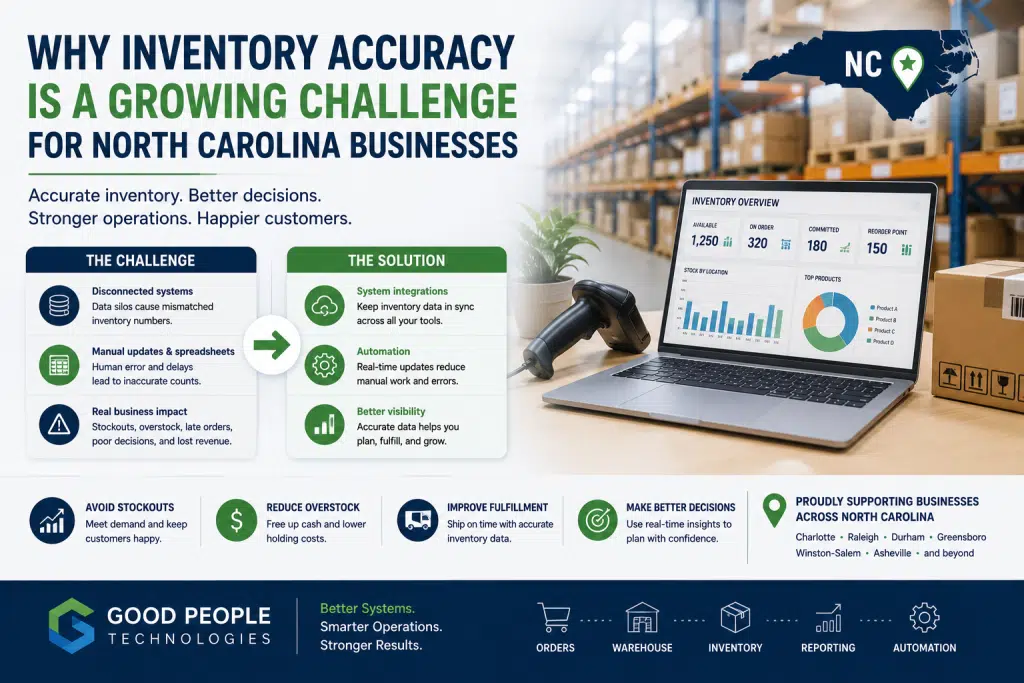
Inventory accuracy for North Carolina businesses is becoming harder to maintain as companies grow across more sales channels, warehouse locations, suppliers, fulfillment workflows, and software systems. A small inventory mismatch may look harmless at first, but over time it can create stockouts, excess inventory, delayed orders, customer frustration, inaccurate financial reports, and poor purchasing decisions.
For many growing businesses in Charlotte, Raleigh, Durham, Greensboro, Winston-Salem, Asheville, and other parts of North Carolina, inventory problems are not caused by a lack of effort. Teams are usually working hard to keep operations moving. The real issue is that inventory data often lives across disconnected systems, spreadsheets, warehouse tools, accounting platforms, e-commerce systems, and manual workflows.
That makes it difficult to know what is actually available, what has already been committed, what needs to be reordered, and what inventory is costing the business.
As companies grow, inventory accuracy becomes more than a warehouse issue. It becomes a business visibility issue. Sales, purchasing, accounting, operations, fulfillment, customer service, and leadership all depend on accurate inventory information.
When that information is wrong, the entire business feels the impact.
This article explains why inventory accuracy is becoming a bigger challenge for North Carolina businesses, which operational problems usually cause inventory errors, and how system integrations, automation, and ERP can help create more reliable inventory visibility.
Why Inventory Accuracy Matters More as Businesses Grow
Inventory accuracy affects almost every part of a product-based business.
A company may sell online, fulfill from a warehouse, purchase from multiple vendors, manage wholesale orders, or operate across several locations. In each case, inventory data needs to stay accurate enough for teams to make decisions with confidence.
If inventory numbers are wrong, several things can happen.
A customer may purchase a product that is not actually available.
The purchasing team may reorder items too late.
A warehouse team may waste time searching for stock that the system says should exist.
Finance may report inventory value incorrectly.
Leadership may make decisions based on numbers that do not reflect reality.
In a small business, teams may be able to catch these issues manually. Someone knows what is in the warehouse. A manager can check a shelf. One person may understand the spreadsheet well enough to correct errors.
Growth changes that.
More orders, products, vendors, customers, and fulfillment requirements create more chances for inventory data to become inaccurate. A business that once relied on informal knowledge eventually needs stronger systems.
This is why inventory accuracy for North Carolina businesses becomes more important as companies move from early growth into more complex operations.
North Carolina Businesses Face a Wide Range of Inventory Challenges
North Carolina has a diverse business environment.
The state includes manufacturers, e-commerce companies, wholesalers, distributors, retailers, food and beverage brands, outdoor product companies, specialty manufacturers, furniture companies, and regional suppliers.
Each type of business manages inventory differently.
A manufacturer may track raw materials, components, work-in-progress, and finished goods.
An e-commerce company may manage inventory across Shopify, Amazon, a warehouse, and accounting software.
A wholesaler may need accurate stock levels across customer orders, purchase orders, backorders, and multiple storage locations.
A retailer may need visibility across physical locations and online sales channels.
Although the business models differ, the inventory challenge is often similar: the company needs accurate, timely, trusted information.
Without that foundation, growth becomes harder to manage.
A product-based company in Charlotte may struggle with e-commerce and warehouse syncing. A manufacturer in Greensboro may face production delays because raw materials are not tracked accurately. A distributor near Raleigh may have trouble forecasting purchasing needs. An Asheville business may depend on spreadsheets that no longer match actual inventory movement.
Local context matters because many North Carolina companies are growing from small or mid-sized operations into more complex organizations. Their systems often have not matured at the same pace as the business.
The First Warning Sign: Different Systems Show Different Numbers
One of the clearest signs of inventory trouble is when different systems show different counts.
The e-commerce platform says one number.
The warehouse system shows another.
Accounting has a different value.
A spreadsheet is used as the “real” answer.
At that point, the business no longer has one source of truth.
Employees may begin checking multiple systems before making decisions. Customer service may ask operations whether a product is actually available. Purchasing may hesitate because reports cannot be trusted. Leadership may receive conflicting information depending on which system was used.
This slows the entire company down.
The problem is not always that one system is wrong. Sometimes each system reflects a different moment in the workflow. One platform may update after a sale, while another updates after fulfillment. Accounting may reflect inventory after financial posting. A spreadsheet may only be updated at the end of the day.
When timing, rules, and integrations are not aligned, inventory accuracy breaks down.
Inventory accuracy for North Carolina businesses often starts with defining which system owns inventory data and how other platforms should update from that source.
Manual Inventory Updates Create Risk
Manual updates are another common cause of inventory errors.
Many businesses still rely on employees to update inventory counts by hand. This might happen after sales, returns, warehouse adjustments, purchase receipts, damaged goods, or internal transfers.
Manual work can be useful in special cases, but it becomes risky when it is part of the normal operating process.
A team member may forget to update a spreadsheet.
Someone might enter the wrong quantity.
An adjustment may happen in one system but not another.
A returned item may be received physically but not added back into available inventory.
These small issues add up.
Manual updates also create timing problems. If inventory is updated once per day, the business may be making decisions with outdated data for hours. During busy periods, that delay can create overselling, stockouts, or fulfillment confusion.
For growing companies, manual inventory management becomes harder every month.
More orders create more updates. Additional sales channels require more coordination. A larger product catalog creates more room for mistakes. Warehouse activity increases the number of adjustments that must be tracked.
Eventually, the business needs automation or integration to keep inventory information moving accurately.
E-Commerce Growth Makes Inventory Accuracy Harder
E-commerce adds a major layer of complexity.
An online business may sell through Shopify, Amazon, Walmart Marketplace, wholesale portals, social commerce, and local retail partners. Every channel creates new inventory movement.
If systems do not sync properly, inventory accuracy becomes difficult to maintain.
For example, a company may have 100 units of a product. Ten sell through Shopify, five sell through Amazon, and twenty are committed to a wholesale order. If those updates do not reach the central inventory system quickly, the business may believe more inventory is available than actually exists.
That creates overselling risk.
The opposite problem can also happen. Products may appear out of stock online even though inventory is available in the warehouse. In that case, the business loses sales because the system is too conservative or outdated.
For North Carolina e-commerce companies, inventory accuracy is closely tied to customer experience.
Customers expect products to be available when listed. They expect timely shipping. If an order is canceled because the item was not actually in stock, trust declines.
A growing e-commerce company cannot rely on manual inventory checks forever.
At some point, the business needs connected systems that update inventory across channels, warehouses, accounting, and reporting.
Inventory Errors Affect Customer Experience
Inventory accuracy is not only an internal operations issue.
Customers feel the impact quickly.
If inventory numbers are wrong, customers may experience:
- canceled orders
- delayed fulfillment
- incorrect availability
- slow customer service responses
- backorder confusion
- missed delivery expectations
- inconsistent communication
From the customer’s perspective, the reason does not matter.
They do not care whether the problem came from Shopify, a spreadsheet, warehouse timing, an accounting system, or a manual update. They only see that the company did not meet expectations.
This creates pressure for customer-facing teams.
Customer service may need to explain delays. Sales may lose confidence when promising availability. Account managers may spend time checking with operations before answering buyers.
Better inventory visibility improves customer communication.
When teams can trust inventory data, they can set clearer expectations, respond faster, and reduce avoidable service issues.
That is why inventory accuracy for North Carolina businesses is directly connected to customer retention and brand trust.
Poor Inventory Accuracy Hurts Purchasing Decisions
Purchasing teams depend on accurate inventory data.
If inventory numbers are wrong, purchasing becomes reactive.
A company may reorder too late and create stockouts. Another business may order too much and tie up cash in excess inventory. Slow-moving products may sit too long because reports do not show true demand. Popular products may run out because inventory trends were not visible soon enough.
Poor purchasing decisions can create several costs:
- emergency supplier orders
- higher shipping costs
- delayed production
- excess storage needs
- cash flow pressure
- product waste
- missed sales opportunities
The issue becomes more serious when supplier lead times are long.
If a North Carolina manufacturer or product-based company depends on specific materials, components, or imported goods, inaccurate inventory data can disrupt the entire operation.
Purchasing works best when it is proactive.
That requires visibility into current inventory, committed inventory, reorder points, sales velocity, supplier lead times, and upcoming demand.
Disconnected systems make this difficult.
ERP, integrations, and automation can help purchasing teams make better decisions from cleaner data.
Inventory Accuracy and Cash Flow Are Connected
Inventory is cash.
When a business carries too much inventory, money is tied up in stock that may not sell quickly. When inventory is too low, the company may lose revenue because it cannot fulfill demand.
Accurate inventory helps companies balance these risks.
A business with poor inventory visibility may believe it has enough stock when it does not. Another company may reorder items unnecessarily because it cannot trust its system. Some organizations carry excess inventory as a safety measure because they lack confidence in their numbers.
That approach may reduce stockouts, but it creates cash flow pressure.
For growing businesses, cash flow matters.
Money tied up in excess inventory cannot be used for marketing, hiring, product development, technology improvements, or operational expansion.
Inventory accuracy gives leadership better control.
Instead of guessing, the company can make decisions based on actual stock levels, product movement, demand patterns, and purchasing needs.
This is one reason inventory accuracy for North Carolina businesses should be treated as a financial priority, not just an operational goal.
Inventory Problems Create Reporting Problems
Leadership teams need accurate reports to make good decisions.
Inventory affects many reports, including:
- profitability
- cash flow
- product performance
- purchasing forecasts
- warehouse efficiency
- fulfillment speed
- cost of goods sold
- inventory valuation
- sales trends
- margin analysis
If inventory data is unreliable, these reports become weaker.
A product may look profitable because inventory costs are not updated correctly. Another product may appear slow-moving because sales and stock data are not aligned. Finance may struggle to close reports because warehouse data and accounting data do not match.
Reporting delays often follow inventory problems.
Teams spend time reconciling numbers before reports can be trusted. Leadership waits for updates. Decisions slow down.
Poor reporting creates a visibility gap.
By the time leadership sees the problem, the business may have already lost sales, overbought inventory, or created fulfillment delays.
A stronger inventory system improves more than warehouse operations. It improves decision-making across the company.
Inventory Accuracy for North Carolina Businesses
Inventory accuracy for North Carolina businesses becomes more difficult when companies grow faster than their systems. This is especially common when inventory is managed through a combination of spreadsheets, accounting software, e-commerce platforms, warehouse tools, manual processes, and disconnected reporting systems.
The main challenge is not only counting products.
The real challenge is keeping inventory data accurate as products move through the business.
Inventory changes when:
- products are purchased
- materials are received
- items are manufactured
- orders are placed
- stock is committed
- products are shipped
- returns are processed
- items are damaged
- inventory is transferred
- adjustments are made
Every movement needs to be reflected correctly.
If one step is missed, delayed, or entered into the wrong system, accuracy begins to break down.
A business can improve inventory accuracy by reviewing the full inventory lifecycle. This means looking at how inventory enters the business, where it is stored, how it is tracked, how it is sold, how it is fulfilled, and how it is reported.
Better systems help, but process clarity matters too.
An integration cannot fix a workflow that nobody understands. ERP cannot solve inventory accuracy if data ownership is unclear. Automation works best when the process is already defined.
Why Spreadsheets Become a Problem
Spreadsheets are common in inventory management.
They are flexible and easy to create. Many teams use them to track counts, reorders, purchase planning, warehouse notes, or product details.
At a certain point, however, spreadsheets become a liability.
Problems usually appear when:
- multiple people edit the same file
- formulas are changed accidentally
- versions become inconsistent
- updates are delayed
- files are not connected to live systems
- inventory decisions depend on manual inputs
- nobody owns data cleanup
- the spreadsheet becomes too large or complicated
A spreadsheet may still be useful for analysis or planning. It should not be the only trusted inventory system for a growing business.
If employees must check a spreadsheet before trusting the inventory system, that is a warning sign.
The business needs to understand why the main system is not trusted.
Sometimes the answer is better integrations. In other cases, the company needs ERP, warehouse management improvements, or process redesign.
Why Warehouse Processes Matter
Technology is important, but inventory accuracy also depends on warehouse discipline.
Even the best software cannot create accurate inventory if physical processes are inconsistent.
Common warehouse-related causes of inventory errors include:
- receiving items without updating the system
- placing products in the wrong location
- shipping items before inventory is adjusted
- handling returns inconsistently
- failing to track damaged goods
- skipping cycle counts
- using unclear picking processes
- relying on verbal updates
- delaying stock transfers
- not documenting adjustments
These issues are operational, not just technical.
A company may need better scanning, clearer receiving workflows, improved pick-pack-ship processes, or regular cycle counting.
System integrations and ERP can support these improvements, but teams still need clean processes.
Inventory accuracy improves when physical movement and system updates happen together.
Composite Example: A Charlotte E-Commerce Brand With Inventory Mismatch
Consider a growing e-commerce company in Charlotte.
The business sells home and lifestyle products through Shopify, wholesale accounts, and occasional marketplace channels. It uses QuickBooks for accounting, a third-party fulfillment provider, and spreadsheets for inventory planning.
For several years, the company managed inventory manually.
As order volume increased, problems became more frequent.
Shopify showed items as available when the fulfillment provider had limited stock. Wholesale orders were tracked separately. Returns were processed inconsistently. Finance had trouble reconciling inventory value at the end of the month.
The team was spending more time checking inventory than improving operations.
Customer service also felt the impact. Some customers received delayed updates because the team needed to confirm availability before responding. A few orders were canceled after the system showed inventory that was already committed elsewhere.
Leadership initially considered hiring another operations coordinator.
After reviewing the process, the company realized the bigger issue was disconnected systems.
The improvement plan focused on:
- connecting Shopify and fulfillment data more reliably
- reducing spreadsheet-based inventory tracking
- creating clearer rules for wholesale inventory commitments
- improving return processing
- building better reporting around available and committed stock
- reviewing whether ERP would be needed in the next growth stage
These improvements helped the team reduce manual checks and make inventory decisions with more confidence.
Hiring still remained possible later, but the first priority was fixing the system environment.
Composite Example: A Greensboro Manufacturer With Raw Material Visibility Issues
A manufacturer near Greensboro faced a different inventory challenge.
The company managed raw materials, work-in-progress, and finished goods. Production planning depended on spreadsheets and regular updates from the warehouse team.
As the business grew, production delays became more common.
Materials that appeared available were sometimes committed to another job. Purchasing did not always see demand early enough. Finance struggled to connect inventory movement with job costing.
The problem was not only inventory count accuracy. It was timing and visibility.
Production, purchasing, warehouse, and finance teams were not working from the same operational picture.
After mapping the inventory workflow, the company identified several gaps:
- material usage was not updated quickly enough
- purchasing relied on manual reorder checks
- production schedules were not connected to available inventory
- work-in-progress was difficult to track
- reporting required too much reconciliation
The company began evaluating ERP and integration improvements.
The goal was to create better visibility from purchasing through production and finished goods.
For manufacturers, inventory accuracy is closely connected to production efficiency. When raw material data is unreliable, the entire production schedule becomes harder to manage.
How System Integrations Improve Inventory Accuracy
System integrations help inventory data move between platforms automatically.
Instead of relying on employees to update multiple systems manually, integrations allow information to flow across the business.
For example, integrations can connect:
- e-commerce platforms
- accounting systems
- ERP platforms
- warehouse tools
- fulfillment providers
- purchasing systems
- reporting dashboards
- CRM platforms
A strong integration strategy can improve inventory accuracy by reducing duplicate data entry, syncing order activity, updating stock levels, improving reporting, and reducing timing gaps.
Integrations are especially useful when a business already has good tools that simply do not communicate well.
A company may not need to replace every system immediately.
Connecting the right systems may solve many inventory problems.
However, integrations should be planned carefully. Poorly designed integrations can create new problems if data flows are unclear, update timing is wrong, or duplicate records are created.
The first step is deciding which system should own inventory data.
Once that is clear, integrations can be designed around the correct source of truth.
When ERP Becomes Necessary
Integrations can solve many inventory problems, but some companies eventually need ERP.
ERP becomes more important when inventory is part of a larger operational complexity problem.
This may happen when:
- accounting and inventory are disconnected
- purchasing is reactive
- production planning depends on spreadsheets
- reporting takes too long
- inventory is tracked across multiple locations
- sales channels are difficult to coordinate
- finance struggles with inventory valuation
- leadership lacks real-time operational visibility
ERP helps centralize inventory, purchasing, accounting, order management, production planning, and reporting.
For manufacturers, distributors, wholesalers, and larger e-commerce companies, ERP can become the operational backbone that supports more accurate inventory management.
Still, ERP should not be rushed.
Before implementation, the business should review workflows, clean data, define inventory rules, map integrations, and clarify reporting needs.
Inventory accuracy for North Carolina businesses improves most when ERP is combined with process improvement, automation, and system integration.
How Automation Reduces Inventory Errors
Automation can reduce inventory errors by removing repetitive manual tasks from the workflow.
Examples include:
- automatically updating stock after an order
- triggering reorder alerts
- syncing warehouse adjustments
- updating customer-facing availability
- routing returns into inventory workflows
- creating reports automatically
- flagging unusual inventory changes
- sending low-stock notifications
Automation is most useful when the task is repetitive, predictable, and high-volume.
For example, if employees manually update inventory after every order, that workflow is a strong automation candidate. If purchasing teams manually check reorder points every week, automated alerts may reduce delays.
Automation should not remove necessary review.
Some inventory adjustments still require human judgment, especially damaged items, unusual returns, custom production, or high-value products.
The goal is to automate routine work so teams can focus on exceptions and decisions.
How to Improve Inventory Accuracy Step by Step
Improving inventory accuracy does not always require a massive project.
A business can start with a practical review.
First, identify every place where inventory data lives. This may include spreadsheets, accounting software, e-commerce platforms, ERP, warehouse tools, fulfillment systems, and reports.
Next, decide which system should be the source of truth. Without clear ownership, teams will continue debating which number is correct.
After that, map how inventory moves through the business. Review purchasing, receiving, storage, sales, fulfillment, returns, adjustments, transfers, and reporting.
Then look for manual steps. Every manual update is a possible source of error.
Once the workflow is visible, prioritize the biggest problems.
A company might begin by integrating e-commerce and fulfillment systems. Another business may need better warehouse receiving processes. A manufacturer may need ERP support for raw materials and production planning.
The right path depends on where inventory breaks down.
If inventory issues are creating fulfillment delays, reporting problems, or purchasing confusion, Good People Technologies can help review your systems and identify the most practical improvfements.
How Good People Technologies Helps With Inventory Accuracy
Good People Technologies helps growing businesses improve operations through ERP, system integrations, automation, and technology strategy.
For inventory-related problems, this can include:
- reviewing current inventory systems
- mapping inventory workflows
- identifying manual update points
- connecting e-commerce and fulfillment systems
- improving accounting and inventory alignment
- evaluating ERP readiness
- automating repetitive inventory tasks
- improving reporting visibility
- reducing spreadsheet dependency
The focus is practical.
Some companies need better integrations. Others need ERP. Many need process cleanup before technology can create the full benefit.
Good People Technologies helps businesses understand where inventory accuracy is breaking down and what improvements will create the most value.
The goal is not just cleaner numbers.
The goal is better business decisions, smoother operations, and stronger customer experience.
Final Thoughts
Inventory accuracy for North Carolina businesses is becoming harder to maintain because operations are becoming more complex.
Companies are selling through more channels, managing more products, working with more suppliers, and relying on more systems. Without clear data flow, inventory errors become more frequent.
The impact spreads across the business.
Customer service slows down. Purchasing becomes reactive. Reporting becomes unreliable. Finance struggles with inventory valuation. Leadership loses visibility. Growth creates more manual work instead of more control.
The good news is that inventory accuracy can improve.
Better integrations, automation, ERP, warehouse processes, and data ownership can help businesses create a more reliable inventory foundation.
For North Carolina companies that want to scale, inventory accuracy is not just an operational detail. It is a growth requirement.
Frequently Asked Questions
Why is inventory accuracy important for North Carolina businesses?
Inventory accuracy is important because it affects fulfillment, purchasing, accounting, cash flow, customer experience, and leadership decisions. When inventory data is wrong, the business may oversell products, reorder poorly, delay shipments, or make decisions from inaccurate reports.
What causes inventory accuracy problems?
Inventory accuracy problems are often caused by disconnected systems, manual updates, spreadsheet dependency, delayed syncing, warehouse process errors, inconsistent returns handling, and unclear data ownership.
How do disconnected systems affect inventory accuracy?
Disconnected systems affect inventory accuracy by creating different inventory numbers across platforms. If e-commerce, warehouse, accounting, and reporting systems do not sync properly, teams may not know which inventory count to trust.
Can system integrations improve inventory accuracy?
Yes. System integrations can improve inventory accuracy by allowing data to move automatically between e-commerce platforms, warehouse tools, accounting systems, ERP, fulfillment providers, and reporting dashboards.
When does a business need ERP for inventory management?
A business may need ERP when inventory complexity affects purchasing, accounting, production planning, reporting, fulfillment, and leadership visibility. ERP becomes more useful when inventory is part of a broader operational challenge.
How can automation reduce inventory errors?
Automation reduces inventory errors by updating stock levels automatically, syncing systems, triggering reorder alerts, routing returns, flagging unusual changes, and reducing repetitive manual data entry.
Why do spreadsheets create inventory problems?
Spreadsheets create inventory problems when they become the main system for tracking stock. They can become outdated, inconsistent, difficult to control, and disconnected from real-time sales or warehouse activity.
What is the first step to improving inventory accuracy?
The first step is identifying every place inventory data lives and deciding which system should be the source of truth. After that, the business should map inventory movement and find manual or disconnected steps.
How does inventory accuracy affect customer experience?
Inventory accuracy affects customer experience by determining whether products are available, orders ship on time, and customer service teams can provide accurate updates. Poor inventory accuracy often leads to delays, cancellations, and frustration.
How can Good People Technologies help improve inventory accuracy?
Good People Technologies helps businesses review inventory workflows, connect systems, reduce manual updates, evaluate ERP readiness, improve reporting, and build more reliable inventory processes.

Roman is a B2B marketing specialist focused on technology, ERP systems, business automation, and digital growth strategies. At Good People Technologies, he helps translate complex technology solutions—such as ERP integrations, system integrations, and business process automation—into clear insights for founders, operators, and growing companies.
His work focuses on content strategy, SEO, and thought leadership that helps businesses understand how the right technology infrastructure can support scalable operations and sustainable growth.
At Good People Technologies, Roman contributes to content that explores ERP implementation, automation strategies, and system integration best practices for companies navigating rapid growth and operational complexity.