
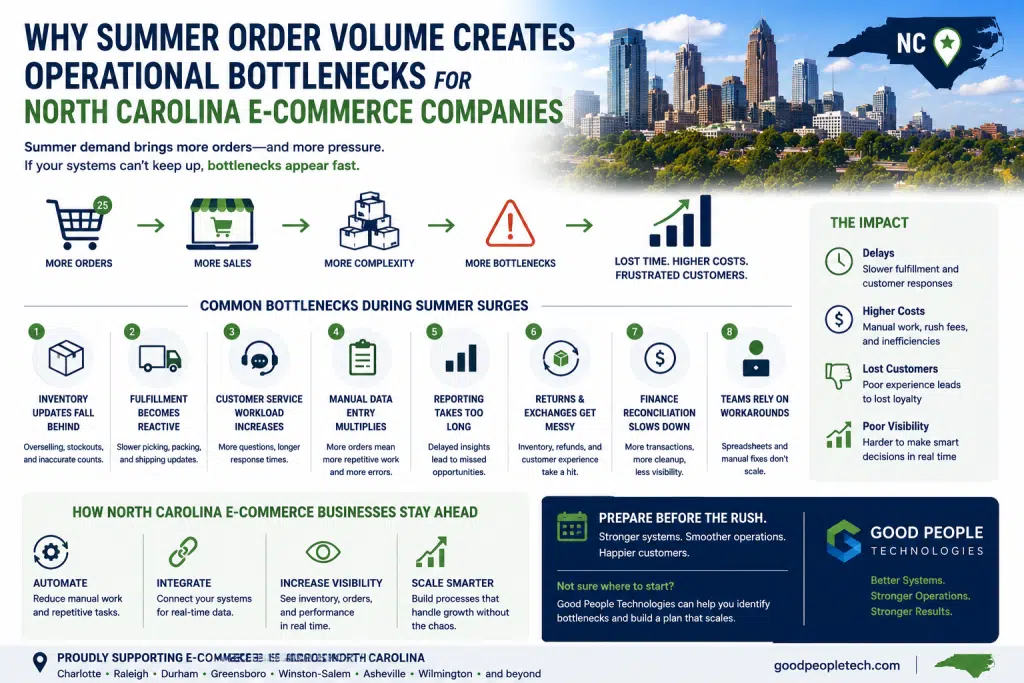
For e-commerce companies across Charlotte, Raleigh, Durham, Greensboro, Winston-Salem, Asheville, Wilmington, and other parts of North Carolina, the warmer season often changes how customers buy. Outdoor products move faster. Travel-related purchases increase. Lifestyle brands may see seasonal spikes. Home, garden, apparel, sporting goods, food, beverage, and regional product companies may all experience higher demand.
That growth can be good for revenue.
However, more orders also create more operational complexity.
A company may suddenly need to process more transactions, update more inventory records, ship more packages, handle more customer questions, manage more returns, reconcile more payments, and prepare more reports. If the business already relies on spreadsheets, manual updates, or disconnected tools, summer demand can turn small inefficiencies into major bottlenecks.
This article explains why seasonal order volume creates operational challenges for North Carolina e-commerce companies, which bottlenecks usually appear first, and how automation, integrations, ERP, and better workflows can help businesses scale through busy periods with more control.
Why Summer Demand Changes E-Commerce Operations
Summer demand is not only about more orders.
It often changes the rhythm of the entire business.
Customers may buy more frequently, expect faster shipping, ask more product questions, and make seasonal purchasing decisions within shorter windows. A product that moves slowly in February may become a top seller in June. A warehouse process that works well during normal volume may become inefficient when daily orders increase.
Seasonal growth also puts pressure on timing.
Inventory needs to be available before demand peaks. Fulfillment teams need enough visibility to avoid delays. Customer service needs accurate order and inventory information. Finance needs clean data for reporting. Leadership needs to understand whether sales growth is actually profitable.
If the systems behind the business are not ready, order volume becomes harder to manage.
A healthy e-commerce operation should be able to handle a busy season without every department feeling overwhelmed. When the opposite happens, the issue is often not the summer rush itself. The deeper problem is that the company’s systems were already close to their limit.
North Carolina e-commerce summer order volume simply makes the weaknesses easier to see.
Why North Carolina E-Commerce Companies Feel Seasonal Pressure
North Carolina has a wide range of e-commerce businesses.
Some companies sell locally made products. Others operate regional lifestyle brands, outdoor products, apparel, specialty food items, home goods, wellness products, or B2B supplies. Many companies sell through Shopify, Amazon, wholesale accounts, retail partners, and direct customer relationships.
The state also has different seasonal demand patterns across regions.
A coastal business near Wilmington may see summer-related product spikes. Outdoor and lifestyle brands near Asheville may experience demand tied to travel, recreation, and warm-weather activity. Charlotte and Raleigh businesses may see increased online sales around events, home improvement, seasonal retail promotions, and customer travel patterns.
The specific product category may vary, but the operational pattern is often similar.
More seasonal demand means more movement across the business.
More orders flow into the e-commerce platform. Inventory moves faster. Fulfillment gets busier. Customer service receives more questions. Finance needs more accurate sales and cost data. Leadership has less time to wait for manual reports.
Businesses that prepared their systems before the busy season usually handle this pressure better. Companies that rely on manual work often feel the strain quickly.
The Difference Between Sales Growth and Operational Readiness
Many e-commerce companies focus heavily on demand generation.
They invest in marketing, product pages, email campaigns, paid ads, social content, seasonal promotions, and customer acquisition.
That work matters.
However, sales growth does not automatically mean the operation is ready.
A successful campaign can create problems if the backend cannot handle the increase. Orders may come in faster than the team can process them. Inventory numbers may become unreliable. Shipping updates may be delayed. Customer service may need to answer more questions with less visibility. Finance may spend extra time reconciling data after the rush.
Operational readiness means the business can handle increased demand without losing control.
That requires clear workflows, accurate inventory, connected systems, automated updates, reliable fulfillment processes, and faster reporting.
A company may be ready from a marketing perspective but unprepared operationally.
That gap is where bottlenecks appear.
Before launching summer promotions, e-commerce companies should ask whether the operations side of the business can support the demand those promotions may create.
Why North Carolina E-Commerce Summer Order Volume Creates Operational Bottlenecks
North Carolina e-commerce summer order volume creates bottlenecks when a business has more orders moving through systems that were designed for lower activity. The issue is not simply that the team becomes busy. The problem is that each additional order can trigger several connected tasks.
One online order may require:
- payment processing
- inventory adjustment
- fulfillment routing
- shipping label creation
- customer confirmation
- warehouse update
- accounting sync
- reporting entry
- possible return handling
- customer service visibility
If these steps are automated and connected, the business can process more orders efficiently.
When they depend on manual work, every new order adds pressure.
During slow periods, employees may compensate for weak systems. They can check inventory manually, fix order issues one by one, update spreadsheets, and answer customer questions individually.
During summer peaks, that approach becomes harder to sustain.
The team begins spending too much time reacting. Instead of improving operations, employees are trying to keep up.
That is when order volume becomes an operational bottleneck.
Bottleneck 1: Inventory Updates Fall Behind
Inventory is often the first area to break down during a busy season.
A product-based business may sell through multiple channels, such as Shopify, Amazon, wholesale orders, local pickup, retail partners, or marketplace platforms. Every sale affects available inventory.
If inventory updates do not move quickly between systems, the business can lose control of what is actually available.
Problems may include:
- overselling products
- showing items as out of stock when they are available
- delayed purchase decisions
- confusion between warehouse and e-commerce counts
- wholesale orders conflicting with online orders
- slow customer service responses
- inaccurate inventory reports
These problems become more common when systems are disconnected.
The e-commerce platform may show one count. The warehouse system may show another. Accounting may update later. A spreadsheet may be used to correct the difference manually.
During normal volume, this may be annoying but manageable.
Under North Carolina e-commerce summer order volume, the timing gap becomes much more expensive. A delay of a few hours can lead to canceled orders, frustrated customers, or missed sales.
Better inventory integrations help keep stock data more aligned across systems. Automation can also trigger low-stock alerts, reorder reminders, and exception notifications before inventory problems affect customers.
Bottleneck 2: Fulfillment Becomes Reactive
Fulfillment is where operational pressure becomes visible to customers.
If orders are delayed, packed incorrectly, routed poorly, or updated slowly, customers notice quickly.
Summer order volume can create fulfillment problems when warehouse, shipping, e-commerce, and customer service systems do not communicate well.
A team may need to manually check whether orders are ready to ship. Shipping labels may be created separately. Tracking numbers may not return to the customer record automatically. Customer service may not know whether a package has left the warehouse.
These small gaps slow everything down.
A fulfillment process that works for 20 orders per day may struggle at 100 orders per day if too many steps require manual action.
Operationally, fulfillment bottlenecks often appear as:
- delayed picking and packing
- missed shipping updates
- unclear order status
- customer service chasing warehouse information
- manual shipping label creation
- returns not flowing back into inventory
- limited visibility into fulfillment performance
Improving fulfillment does not always require a full technology overhaul. Sometimes the most valuable first step is connecting order data, fulfillment status, inventory updates, and customer communication.
When systems work together, fulfillment teams can focus on exceptions instead of manually managing every order.
Bottleneck 3: Customer Service Workload Increases
Higher order volume almost always creates more customer questions.
Even when everything is working, customers may ask about shipping status, delivery timelines, product availability, returns, exchanges, order changes, and payment confirmations.
If internal systems are disconnected, customer service teams spend too much time searching for answers.
A support team may need to check the e-commerce platform, shipping tool, warehouse system, email thread, and inventory spreadsheet before responding. That slows response time and creates frustration for both employees and customers.
Many customer questions can be reduced through automation.
Order confirmations, shipping updates, delivery notifications, return instructions, back-in-stock alerts, and payment confirmations can often be handled automatically.
This does not remove the need for strong customer service. Instead, it allows customer service teams to focus on situations that actually require human attention.
During North Carolina e-commerce summer order volume, automated communication can reduce pressure significantly. Customers receive updates faster, and employees spend less time answering repetitive questions.
That combination improves both operational efficiency and customer experience.
Bottleneck 4: Manual Data Entry Multiplies
Manual data entry becomes more expensive when order volume increases.
A business may manually copy order details into accounting software, update inventory spreadsheets, enter wholesale orders, create invoices, reconcile payments, or prepare fulfillment instructions.
Each task may take only a few minutes.
Summer volume changes the math.
The same workflow repeated hundreds of times becomes a major operational cost.
Manual data entry also increases error risk. A wrong quantity, incorrect address, missed order update, or delayed inventory adjustment can create downstream problems. When teams are busy, mistakes become more likely.
A growing e-commerce company should pay close attention to any workflow where the same data is entered more than once.
That is usually a sign that systems need to be connected.
Automation and integrations can reduce duplicate entry by moving information automatically between e-commerce, accounting, fulfillment, inventory, CRM, and reporting tools.
The goal is not to automate every judgment call. Routine data movement should not depend entirely on manual effort.
Bottleneck 5: Reporting Takes Too Long
Busy seasons create a stronger need for fast reporting.
Leadership needs to know what is happening while there is still time to respond.
Important questions include:
- Which products are selling fastest?
- Which items are at risk of stockout?
- Are fulfillment delays increasing?
- Which sales channels are most profitable?
- Are shipping costs affecting margins?
- How many orders require manual intervention?
- Are returns increasing?
- Is customer service volume manageable?
If reports require manual exports and spreadsheet cleanup, leadership may not see problems until too late.
During a seasonal rush, delayed reporting can lead to missed opportunities.
A product may be selling quickly, but purchasing does not reorder soon enough. A fulfillment issue may be growing, but leadership only sees it after customer complaints increase. A marketing campaign may generate revenue but lower profit because operational costs are not visible quickly.
Good reporting depends on connected systems.
Dashboards and automated reports can help, but they only work if the underlying data is clean and timely.
For companies experiencing North Carolina e-commerce summer order volume, reporting should be treated as part of operations, not an afterthought.
Bottleneck 6: Returns and Exchanges Get Messy
Returns and exchanges can become a major summer bottleneck.
More orders usually mean more returns. That creates extra work for customer service, inventory, accounting, and fulfillment.
A return is not just a customer service issue.
It can affect:
- inventory availability
- refunds
- payment reconciliation
- warehouse processing
- customer records
- product quality tracking
- reporting
- replacement shipments
If returns are handled manually, the process becomes slow and inconsistent.
A returned item may physically arrive but not be added back into inventory. A refund may be processed before the warehouse confirms receipt. A replacement order may be created manually. Customer service may not see the latest return status.
These gaps become more visible during high-volume periods.
Better systems can route returns through a clearer workflow. Automation can trigger return instructions, update status, notify teams, and connect inventory changes when appropriate.
Returns will always require some human oversight, but the process should not depend entirely on manual tracking.
Bottleneck 7: Finance and Accounting Reconciliation Slows Down
E-commerce finance can become complicated quickly.
A growing company may need to reconcile orders, payment processor fees, refunds, sales tax data, shipping costs, discounts, wholesale invoices, marketplace payments, and accounting records.
During summer order spikes, finance teams may face a larger reconciliation workload.
If systems are disconnected, the process becomes even harder.
Finance may need to compare Shopify reports, payment processor data, accounting records, fulfillment costs, and inventory values. Manual cleanup can take hours or days.
This slows down reporting and creates leadership uncertainty.
The business may know that sales increased, but not whether profit improved.
Accounting integrations can reduce manual reconciliation by syncing orders, payments, refunds, customer records, and invoices more cleanly. ERP may also become valuable when financial reporting needs to connect with inventory, purchasing, fulfillment, and operational data.
For growing e-commerce companies, finance should not be left to clean up operational data after the fact.
Better system design can make financial visibility part of the daily workflow.
Bottleneck 8: Teams Become Dependent on Workarounds
Workarounds often appear when systems do not support the business well enough.
A team might create a spreadsheet to track exceptions. Customer service may keep separate order notes. Operations may maintain a manual fulfillment tracker. Finance may build custom reconciliation files.
These workarounds can be useful in the short term.
During busy seasons, they can become risky.
If one person owns a spreadsheet, the process depends on that person’s availability. When files are updated manually, errors become easier to miss. If workarounds are not documented, new employees may struggle to follow the process.
The larger the order volume, the more fragile workarounds become.
A business should review which temporary fixes have become permanent parts of operations. If a workaround is now required every day, it may need to become a real system workflow.
North Carolina e-commerce summer order volume is often the stress test that reveals which workarounds are no longer sustainable.
Composite Example: A Charlotte E-Commerce Brand During a Summer Rush
Consider a growing e-commerce company in Charlotte.
The business sells outdoor lifestyle products through Shopify, wholesale accounts, and occasional marketplace channels. During most of the year, a small team manages operations with Shopify, QuickBooks, spreadsheets, and a fulfillment partner.
The system works reasonably well during normal volume.
Then summer demand increases.
A seasonal promotion performs better than expected. Orders jump. Customer service requests increase. Inventory counts start to feel unreliable. Finance needs more time to reconcile payment data. The fulfillment partner sends updates, but those updates do not always reach customer service quickly.
The team starts relying on manual checks.
One employee updates inventory spreadsheets. Another confirms shipping status. Finance exports order data at the end of each week. Customer service searches across multiple systems before replying to customers.
The business is growing, but operations feel heavier.
After reviewing workflows, the company identifies several problems:
- inventory is not syncing quickly enough
- customer updates are too manual
- order data does not flow cleanly into accounting
- fulfillment status is not easy to access
- reporting takes too long during busy weeks
- returns are handled inconsistently
The first improvement is not hiring more people.
Instead, the company connects order, inventory, accounting, and fulfillment data more effectively. Automated customer updates reduce support volume. Reporting is redesigned so leadership can see order volume, inventory risk, and fulfillment performance sooner.
The result is a more scalable operation.
The company may still hire later, but new roles can focus on customer experience, marketing, or operations improvement rather than repetitive data work.
Composite Example: A Raleigh Brand With Multi-Channel Inventory Issues
A product-based company near Raleigh sells through its website, Amazon, wholesale customers, and local retail partnerships.
During summer, several products become more popular.
The company has enough demand, but inventory visibility becomes the problem.
Website orders reduce available stock, but wholesale orders are tracked separately. Amazon inventory updates on a different schedule. The warehouse system shows one number, while accounting reflects another. A spreadsheet is used to reconcile everything manually.
The team begins overselling some items and over-ordering others.
Customer service receives more complaints about delayed orders. Purchasing becomes reactive. Leadership struggles to understand which products are actually profitable because fulfillment and inventory data are delayed.
The company reviews its systems and decides to improve inventory integrations first.
E-commerce, warehouse, and accounting data are aligned more clearly. Wholesale commitments are tracked in a more structured process. Low-stock alerts help purchasing respond sooner. Reports are improved so leadership can see product movement across channels.
This does not solve every problem immediately, but it reduces the most painful bottlenecks before the next busy period.
For this company, North Carolina e-commerce summer order volume becomes the trigger for better system design.
How Automation Helps Companies Handle Summer Order Volume
Automation helps e-commerce companies manage more volume without manually processing every step.
Useful automations may include:
- order confirmations
- shipping notifications
- inventory updates
- low-stock alerts
- return instructions
- customer service ticket routing
- invoice creation
- payment reconciliation
- report generation
- fulfillment status updates
- exception alerts
The best automations are built around clear workflows.
A company should first identify which tasks happen repeatedly and which problems create the most operational pressure.
Automation works especially well when a task is predictable, frequent, and time-sensitive.
For example, customers should not have to wait for a person to manually send a shipping update. Inventory alerts should not depend on someone checking a spreadsheet. Reports should not require the same manual export every week.
Automation creates leverage.
It allows teams to handle more activity without every additional order creating the same amount of manual work.
When Integrations or ERP Become Necessary
Automation can help, but it usually depends on systems being connected.
If data cannot move between platforms, automation options are limited.
System integrations help connect tools such as:
- Shopify
- QuickBooks
- ERP
- CRM
- warehouse systems
- fulfillment providers
- shipping platforms
- reporting dashboards
- customer support software
- marketplace platforms
Integrations are often the best first step when the business already has useful tools but those tools do not communicate well.
ERP becomes more important when the company needs a central operational system for inventory, accounting, purchasing, order management, reporting, and fulfillment visibility.
An e-commerce business may need ERP when:
- inventory is difficult to trust
- order volume creates too much manual work
- reporting takes too long
- accounting and operations are disconnected
- multiple channels are hard to manage
- purchasing becomes reactive
- leadership lacks real-time visibility
If your company is heading into a busy season with recurring fulfillment, inventory, or reporting problems, Good People Technologies can help review your systems and identify whether automation, integrations, or ERP should come first.
How to Prepare Before the Next Seasonal Rush
E-commerce companies should prepare operations before summer demand peaks.
A practical review can start with a few questions:
- Which workflows slow down when order volume increases?
- Where does the same data get entered twice?
- Which systems show conflicting inventory numbers?
- Which customer questions repeat most often?
- How long does reporting take during busy weeks?
- Where do fulfillment updates get delayed?
- Which returns processes are unclear?
- What tasks depend on one person?
- Which reports does leadership need sooner?
After identifying the biggest bottlenecks, the company can prioritize improvements.
Start with workflows that are frequent, manual, and customer-facing.
Order processing, inventory updates, customer notifications, fulfillment visibility, and reporting usually create the fastest operational gains.
A business does not need to fix every system at once. A phased approach is often more practical.
Fix the bottlenecks that create the most pressure first, then build toward a stronger operating model.
How Good People Technologies Helps E-Commerce Companies
Good People Technologies helps growing businesses improve operations through automation, system integrations, ERP support, and technology strategy.
For e-commerce companies, this can include:
- reviewing current workflows
- identifying order processing bottlenecks
- improving inventory visibility
- connecting e-commerce and accounting systems
- automating customer notifications
- reducing manual reporting
- improving fulfillment data flow
- evaluating ERP readiness
- building scalable operational processes
The work starts with understanding how the business actually operates.
Some companies need targeted automations. Others need integrations between existing tools. More complex businesses may need ERP or ERP optimization.
The goal is not simply to add software.
The goal is to create systems that help the business handle growth with fewer errors, less manual work, and better visibility.
Final Thoughts
North Carolina e-commerce summer order volume can create major opportunities for growing businesses, but it can also expose operational weaknesses.
More orders create more inventory movement, fulfillment pressure, customer questions, reporting needs, finance reconciliation, and returns activity. If these workflows depend on manual work or disconnected systems, summer growth can quickly become difficult to manage.
The companies that handle seasonal demand best usually have stronger operational foundations.
They connect systems, automate repetitive tasks, improve inventory visibility, streamline fulfillment, and give leadership faster access to useful data.
For North Carolina e-commerce companies, the goal should not be simply surviving the summer rush.
The stronger goal is building systems that make every busy season easier to manage.
Frequently Asked Questions
Why does summer order volume create bottlenecks for e-commerce companies?
Summer order volume creates bottlenecks because more orders increase pressure on inventory, fulfillment, customer service, accounting, reporting, and returns. If systems are disconnected or manual, the extra volume creates delays and errors.
What are the most common e-commerce bottlenecks during summer?
Common bottlenecks include inventory mismatch, delayed fulfillment, manual order processing, slow customer updates, finance reconciliation delays, reporting problems, and inconsistent returns handling.
How can North Carolina e-commerce companies prepare for summer demand?
Companies can prepare by reviewing workflows, improving inventory visibility, automating customer updates, connecting e-commerce and accounting systems, streamlining fulfillment, and improving reporting before order volume increases.
Can automation help with seasonal order volume?
Yes. Automation can help by reducing manual order processing, sending customer updates, syncing inventory, generating reports, routing support tickets, and flagging exceptions before they become larger problems.
When do e-commerce companies need system integrations?
System integrations become important when platforms such as Shopify, QuickBooks, warehouse systems, fulfillment providers, customer support tools, and reporting dashboards do not share data reliably.
Does every e-commerce company need ERP?
No. Some e-commerce companies can improve operations with integrations and automation first. ERP becomes more useful when the business needs a central system for inventory, accounting, purchasing, order management, and reporting.
How does poor inventory visibility affect summer sales?
Poor inventory visibility can cause overselling, stockouts, excess inventory, delayed fulfillment, customer complaints, and missed revenue opportunities during high-demand periods.
Why does reporting matter during busy seasons?
Reporting matters because leadership needs to see product demand, fulfillment performance, inventory risk, customer service volume, and profitability while there is still time to respond.
What should businesses automate first before summer?
Good first automation candidates include order confirmations, shipping updates, inventory syncing, low-stock alerts, customer service routing, recurring reports, and return instructions.
How can Good People Technologies help with e-commerce bottlenecks?
Good People Technologies helps e-commerce companies review workflows, identify bottlenecks, connect systems, automate repetitive tasks, improve reporting, evaluate ERP readiness, and build more scalable operations.

Roman is a B2B marketing specialist focused on technology, ERP systems, business automation, and digital growth strategies. At Good People Technologies, he helps translate complex technology solutions—such as ERP integrations, system integrations, and business process automation—into clear insights for founders, operators, and growing companies.
His work focuses on content strategy, SEO, and thought leadership that helps businesses understand how the right technology infrastructure can support scalable operations and sustainable growth.
At Good People Technologies, Roman contributes to content that explores ERP implementation, automation strategies, and system integration best practices for companies navigating rapid growth and operational complexity.