
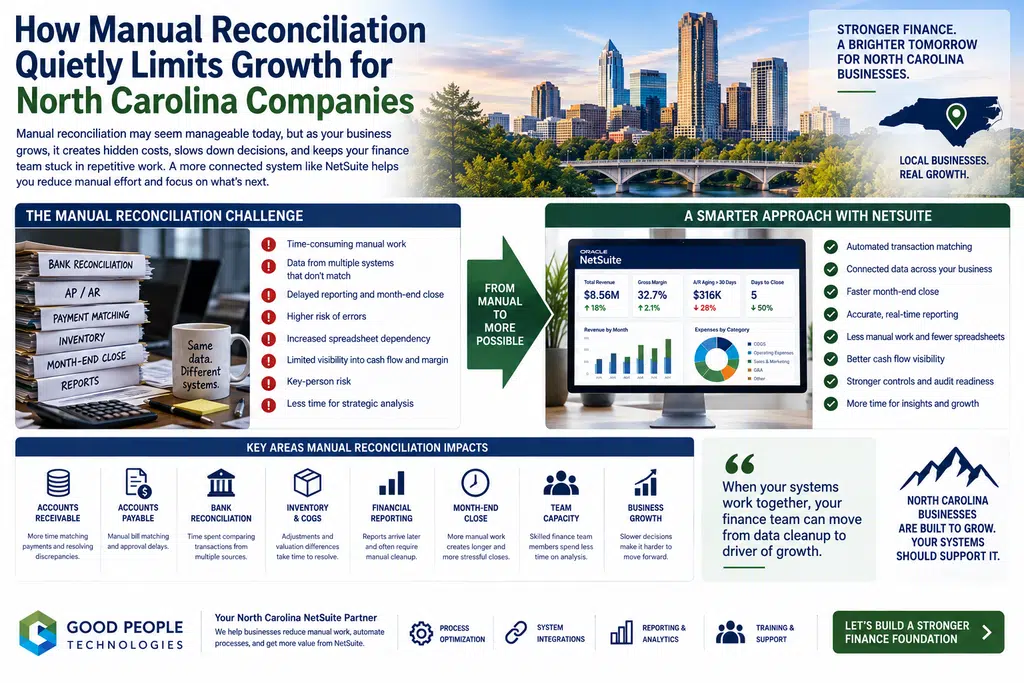
Manual reconciliation for North Carolina companies often starts as a reasonable way to keep financial data accurate. A finance team exports a report, compares transactions, checks a spreadsheet, confirms a payment, reviews an inventory adjustment, and closes the gap between two systems. At a smaller stage, these steps may take limited time. However, as the business grows, the same process repeats across more orders, customers, vendors, payments, products, locations, and sales channels.
The work still gets done.
That is exactly why the problem can remain hidden.
Leadership may see accurate reports at the end of the process without seeing how much manual effort finance needed to produce them. Revenue may continue growing. Customers keep ordering. New channels may open. Yet behind the scenes, employees spend more time matching records, investigating differences, fixing imports, updating spreadsheets, and asking other departments for missing information.
For companies across Charlotte, Raleigh, Greensboro, Durham, Winston-Salem, Wilmington, Asheville, and other North Carolina markets, this can become a quiet growth constraint.
Manual reconciliation does not usually stop the business suddenly.
Instead, it adds friction to every stage of growth.
More sales create more records to match. New payment methods create more finance data. Additional vendors increase accounts payable work. Higher inventory volume adds adjustments and receiving activity. Extra systems create more places where numbers can differ.
Eventually, finance spends too much time proving that the numbers are correct and not enough time helping the business understand what those numbers mean.
This article explains how manual reconciliation limits growth, where the hidden costs appear, and how better workflows, integrations, automation, reporting, ERP, and NetSuite can help North Carolina businesses reduce repetitive finance work.
Why Manual Reconciliation Feels Normal
Reconciliation is an important finance process.
Companies need to make sure records match. Payments should connect to invoices. Vendor bills should line up with purchases. Bank activity should match internal records. Inventory changes should make sense. Sales data should support financial reporting.
So the goal is not to eliminate reconciliation.
The problem is excessive manual reconciliation.
At first, the difference may be difficult to notice.
A finance employee spends a little time comparing a bank report with accounting records. Another person checks payment processor deposits against e-commerce sales. Someone reviews a spreadsheet before posting an adjustment.
These tasks feel like ordinary accounting work.
As transaction volume grows, though, the process changes.
A task that took a short amount of time now appears hundreds of times. More exceptions need investigation. Finance waits for answers from operations. Reports require larger exports. Spreadsheet formulas become more complex.
Meanwhile, the business may add systems faster than it improves the connections between them.
The result is a finance process that works, but only because people keep holding it together manually.
Growth Multiplies Reconciliation Work
Revenue growth usually creates more finance activity.
More orders mean more invoices or payments. A larger customer base creates more accounts receivable activity. Additional suppliers increase bills and purchase records. New sales channels create more settlement reports, fees, refunds, and adjustments.
Therefore, reconciliation volume often grows faster than companies expect.
Consider an e-commerce company that begins with one sales channel and one payment method.
Finance may have a simple process.
Later, the company adds wholesale orders, another marketplace, additional payment processors, a fulfillment partner, returns software, and new shipping methods.
Each change adds another data flow.
Sales may still look strong. However, finance now has to answer more questions:
- Does the payment match the order?
- Did the platform deduct a fee?
- Was part of the order refunded?
- Did the warehouse fulfill the whole shipment?
- Was tax handled correctly?
- Did a return change inventory?
- Does the accounting record match the settlement?
- Which period should include the transaction?
None of these questions is unusual.
The problem comes from answering too many of them manually.
Manual Reconciliation for North Carolina Companies
Manual reconciliation for North Carolina companies becomes a growth problem when finance needs repeated human effort to connect business activity that systems could handle more clearly.
Common examples include:
- matching payments to invoices
- comparing bank activity with accounting records
- checking payment processor settlements
- reconciling e-commerce sales with finance
- comparing purchase orders with vendor bills
- reviewing receiving records
- matching refunds and credits
- checking inventory adjustments
- comparing warehouse data with ERP records
- reviewing intercompany transactions
- rebuilding reports in spreadsheets
- investigating differences between departments
Each process may have a valid reason.
Together, however, they can create a large manual workload.
The risk grows when finance becomes the only team that understands how the pieces connect.
Sales may know the customer activity. Operations understands fulfillment. Purchasing sees vendor activity. Warehouse teams know inventory movement. Yet finance often has to bring those views together at the end.
As a result, finance becomes the cleanup layer for the entire business.
The Hidden Labor Cost
Manual reconciliation creates a direct labor cost.
However, companies do not always measure it because the work sits inside existing finance roles.
An employee may spend part of Monday reviewing payment differences. Another person may rebuild a report at the end of each week. During month-end close, several team members may spend extra time tracking down missing records.
No single task looks dramatic.
The total burden can still become significant.
Manual work also takes capacity away from other finance priorities.
Instead of reviewing margin trends, the team compares spreadsheets. Rather than helping leadership plan cash needs, someone investigates transaction differences. Forecasting gets delayed because finance is still confirming historical data.
In practice, the business pays twice.
It pays for the manual work itself, and it loses the higher-value work finance could have completed instead.
As growth continues, that tradeoff becomes more expensive.
Finance Becomes Reactive
Manual reconciliation pushes finance toward reaction.
The team spends time finding problems after they happen.
A payment does not match. Finance investigates it.
Inventory value changes unexpectedly. Someone tracks the adjustment.
A vendor bill differs from the purchase order. The team follows up.
Revenue reports do not match another department’s numbers. Employees compare exports until they understand why.
This work matters.
Still, a reactive model makes it harder for finance to support forward-looking decisions.
Leadership needs finance to help answer questions such as:
- Are margins improving?
- Which products generate the strongest profit?
- Where is cash getting tied up?
- Which customers pay slowly?
- Are fulfillment costs increasing?
- Which channels perform best?
- How much inventory should we carry?
- Where can the business reduce cost?
Those questions require time for analysis.
When reconciliation consumes too much capacity, finance has less time to provide it.
Manual Reconciliation Slows Month-End Close
Month-end close often exposes manual finance bottlenecks.
During the month, employees may manage issues one at a time. At close, finance needs the full picture to make sense.
The team may review bank accounts, payments, receivables, payables, inventory, accruals, vendor bills, credits, refunds, and other activity.
If systems do not connect well, close becomes a collection project.
Finance waits for information from other departments. Employees pull exports. Spreadsheets help track unresolved items. Managers review adjustments. Reports may not become final until late in the process.
A slow close creates several problems.
First, leadership receives financial information later.
Second, finance starts the next period while still finishing the previous one.
Finally, repeated close pressure can make improvement difficult because the team is constantly moving from one deadline to the next.
Better reconciliation workflows can reduce that pressure by helping teams identify and resolve differences earlier.
Reporting Arrives Later
Manual reconciliation and reporting delays often go together.
Leadership wants a clear view of revenue, margin, cash, inventory, receivables, payables, and business performance. However, finance may need to finish several reconciliation steps before it trusts the numbers.
That creates a delay between business activity and business insight.
For example, leadership may want to understand how a sales channel performed last month. Finance cannot answer confidently until it matches platform sales, refunds, payment fees, shipping costs, and accounting records.
The final report may be correct.
Yet the decision may come later than it should.
In a fast-growing company, timing matters.
Pricing decisions, purchasing choices, marketing budgets, staffing, inventory planning, and cash management all benefit from current information.
Therefore, reconciliation speed becomes a leadership issue, not only a finance issue.
Cash Flow Visibility Gets Harder
Cash flow depends on timing.
A business may show strong revenue while cash moves differently.
Customers may pay later. Vendors may need payment sooner. Inventory purchases can use cash before sales generate collections. Returns may reduce expected receipts. Payment processors can deposit funds on different schedules.
When finance relies on manual reconciliation, current cash visibility can become harder to maintain.
The team may know what the accounting system says, but still need to investigate:
- payments in transit
- unmatched deposits
- overdue invoices
- upcoming vendor bills
- refunds
- purchase commitments
- inventory purchases
- disputed transactions
As a result, leadership may not get the clearest possible view of upcoming cash needs.
A growing business needs more than a bank balance.
It needs context.
Better connected systems help finance understand what cash has arrived, what the company owes, what customers owe, and which commitments will affect future cash.
Manual Reconciliation Can Hide Margin Problems
Revenue can rise while profit pressure grows.
Manual reconciliation can make that pressure harder to see quickly.
An e-commerce channel may produce strong sales but also carry payment fees, discounts, returns, fulfillment costs, and shipping expense. A distributor may increase revenue while rush purchasing adds cost. A product line may perform well in sales but suffer from inventory adjustments or higher vendor prices.
If finance has to assemble those costs manually, margin visibility arrives later.
Leadership sees growth first.
The hidden cost appears afterward.
Better finance systems connect revenue with the costs behind it. That helps teams move beyond the question, “How much did we sell?”
Instead, leadership can ask, “What did those sales actually produce?”
More Systems Can Create More Reconciliation
Businesses often add software to improve operations.
The new system may solve a real problem.
However, each additional platform can create another reconciliation point when integrations are weak.
A company may use:
- an ERP
- CRM software
- an e-commerce platform
- warehouse software
- payment processors
- expense software
- banking systems
- shipping tools
- payroll software
- reporting platforms
More technology does not automatically mean more manual work.
Poorly connected technology often does.
If data does not move cleanly, employees have to check whether one system matches another.
That can lead to an unexpected result: the company buys more software to increase efficiency, while finance receives more exports to reconcile.
The better goal is not fewer systems at any cost.
It is clearer ownership and cleaner data flow between the systems the business actually needs.
Spreadsheet Dependency Grows Quietly
Spreadsheets often become the bridge between systems.
They are flexible, familiar, and fast.
Finance may export one report, paste another dataset next to it, add formulas, highlight differences, and create a file that answers the question.
That can be a useful temporary solution.
Over time, though, the spreadsheet may become part of the core finance process.
Problems appear when:
- one person understands the formulas
- several versions exist
- source reports change
- manual data gets overwritten
- files use old information
- leadership relies on an unofficial report
- updates never flow back into the system
The solution is not to ban spreadsheets.
Finance will continue to use them for analysis.
Instead, businesses should identify which spreadsheets exist because the main systems do not support a reliable workflow.
Those files often reveal the highest-value opportunities for integration, automation, reporting cleanup, or ERP improvement.
Manual Work Creates Key-Person Risk
Manual reconciliation often depends on knowledge that lives with individual employees.
One person knows which export to run.
Another knows why a payment report never matches exactly.
Someone understands a spreadsheet formula built years ago.
A finance manager knows which departments need reminders before close.
This knowledge can be valuable.
It can also create risk.
If the person is unavailable, the process slows down. New employees take longer to learn the workflow. Documentation may not capture every exception. As transaction volume grows, the dependency becomes harder to maintain.
Process ownership and better systems help reduce this risk.
The company can document rules, automate standard steps, create clear exception paths, and give more people access to the same trusted information.
Errors Become Harder to Find at Scale
Manual reconciliation can work accurately when transaction volume is low.
Scale makes the process harder.
More rows, more files, more adjustments, and more systems create more opportunities for small differences.
A duplicate record may enter a report. Someone may paste the wrong date range. A refund can appear in one system before another. A spreadsheet formula may miss new rows.
Most teams catch many of these issues.
However, checking for them takes additional time.
Automation and structured reconciliation do not eliminate every exception.
They help finance focus attention on the exceptions that actually need human review.
That distinction matters.
The goal is not to remove finance judgment.
It is to stop asking skilled finance employees to spend time checking transactions that already match correctly.
Why Manual Reconciliation Makes Scaling Headcount Harder
When finance workload increases, hiring more people may seem like the obvious answer.
Sometimes the business genuinely needs a larger team.
However, adding headcount before improving the process can make a manual model more expensive.
New employees still need to learn the spreadsheets, exports, system checks, and exceptions. More people may create additional handoffs. Managers spend time reviewing work that could follow clearer rules.
Therefore, companies should separate two questions:
Do we need more finance capacity?
And can we reduce the amount of manual work finance needs to perform?
Often, the answer to both is yes.
A stronger system foundation allows new finance hires to spend more time on analysis, controls, planning, and business support rather than repetitive matching.
How System Integrations Reduce Reconciliation Work
Integrations can reduce manual reconciliation by helping systems share data consistently.
For example, an e-commerce order can flow into ERP. Payment data can connect to finance records. Fulfillment updates can support invoicing. Vendor and purchasing activity can link more clearly.
This reduces the number of manual handoffs.
Useful integration opportunities may include:
- e-commerce to ERP
- CRM to finance
- payment processors to accounting
- warehouse systems to inventory
- purchasing to accounts payable
- shipping systems to order records
- expense software to finance
- reporting tools to source systems
A strong integration should do more than move data.
It should also define ownership.
Which system creates the record? Which platform becomes the source of truth? What happens when an error occurs? Who reviews exceptions?
These rules help prevent one integration from creating another reconciliation problem.
How Automation Changes the Reconciliation Process
Automation can help finance move from checking everything to reviewing exceptions.
That is an important shift.
Instead of manually matching every transaction, teams can use rules and system workflows to handle standard activity. Employees then focus on unmatched items, unusual differences, or transactions that need judgment.
Automation may support:
- transaction matching
- bank reconciliation
- payment matching
- recurring reports
- exception alerts
- close reminders
- approval routing
- missing-data notifications
- A/R follow-up
- vendor bill review
However, automation works best after the company understands the process.
Teams should define what counts as a match, what requires review, who owns the exception, and what happens next.
Good automation removes repetitive checks.
It does not remove accountability.
How NetSuite Can Reduce Reconciliation Bottlenecks
NetSuite can help companies reduce reconciliation work by connecting finance with transactions from across the business.
Depending on the company’s setup and products in use, NetSuite can support areas such as bank reconciliation, transaction matching, accounts receivable, accounts payable, inventory, purchasing, order management, saved searches, dashboards, and account reconciliation workflows.
That creates several opportunities.
Finance can work with data that lives closer to the transaction source. Teams can automate more standard matching. Saved searches and dashboards can highlight exceptions. Approvals can follow clearer workflows.
Most importantly, the business can reduce the number of places where finance has to rebuild the truth manually.
NetSuite does not remove the need for reconciliation.
Instead, it can help make reconciliation more structured and easier to manage as transaction volume grows.
How Better Reporting Reduces Reconciliation Questions
A strong reporting environment reduces the amount of time teams spend explaining numbers.
Finance often receives questions because reports show different values.
Sales has one revenue number. Operations has another order count. Inventory uses a separate report. Leadership receives a spreadsheet that combines several sources.
These differences may have valid reasons.
However, teams need clear definitions.
Better reporting should establish:
- which report is official
- what each metric means
- where data comes from
- who owns the report
- when the report updates
- what decision it supports
Once those rules become clearer, finance spends less time reconciling reports for meetings.
Instead, the business can focus on decisions.
Process Ownership Matters
Technology alone will not fix manual reconciliation.
The company also needs process owners.
Someone should own bank reconciliation. Another person or team may own A/R workflows. Purchasing and A/P need clear rules. Inventory adjustments need ownership. Reports need owners. Integrations require both technical and business responsibility.
Process ownership answers important questions:
- Who maintains this process?
- What data does it depend on?
- Which exceptions require review?
- What report shows whether it works?
- Who approves changes?
- When should the process change?
Without ownership, manual work tends to return.
A temporary spreadsheet becomes permanent. An integration error goes unnoticed. A reconciliation rule becomes outdated.
Clear ownership helps the business keep improvements in place.
What North Carolina Companies Should Review First
A company does not need to automate every reconciliation process at once.
Start with the areas that create the most repeated work.
Useful questions include:
- Which reconciliations take the most time?
- What reports require the most manual cleanup?
- Which systems create the most differences?
- Where does finance enter the same data twice?
- What spreadsheets support close?
- Which payment flows require manual matching?
- Where do finance and operations disagree?
- Which inventory adjustments require frequent review?
- What information arrives late?
- Which tasks depend heavily on one person?
Next, estimate business impact.
Does the process delay close, and does it affect cash visibility? Does it prevent margin reporting, and does it create customer billing delays?
That helps leadership prioritize.
The biggest opportunity may not be the reconciliation with the most transactions. It may be the process that delays an important business decision every month.
Composite Example: A Charlotte E-Commerce Company
Consider a growing e-commerce company in Charlotte.
The business sells through its website, wholesale accounts, and another online channel. Revenue is increasing, but finance spends more time reconciling payments every month.
Different platforms send settlement reports in different formats. Refunds appear separately. Shipping costs need review. Payment fees affect the final deposit. Inventory adjustments also need to match the order data.
The team has built a strong spreadsheet process.
It works.
However, the process takes more time as volume grows.
Leadership initially assumes the company needs another finance employee. During a workflow review, the team finds that a large part of the workload comes from disconnected sales, payment, fulfillment, and accounting data.
The company starts by improving integrations and reporting.
Standard transactions flow more cleanly. Finance focuses on exceptions rather than checking every record. Leadership receives margin and cash reports sooner.
The business may still add finance staff as it grows.
However, new employees can now focus more of their time on finance rather than maintaining manual bridges between systems.
Composite Example: A Greensboro Distributor
A distributor near Greensboro experiences a different reconciliation challenge.
The company handles customer orders, purchase orders, inventory receipts, vendor bills, warehouse adjustments, and backorders.
Finance regularly compares purchasing and receiving information before approving bills. Inventory adjustments also require manual review. In addition, customer credits can create more follow-up across departments.
The business is growing, and the process still works.
Yet month-end close keeps becoming harder.
A workflow review shows that several reconciliation issues start outside finance.
Receiving updates arrive late. Purchase order exceptions lack clear ownership. Inventory adjustments need more consistent rules. Backorder information does not always reach finance reporting quickly.
The company improves these upstream workflows and strengthens its NetSuite reporting.
As a result, finance receives cleaner information earlier.
The reconciliation work does not disappear.
It becomes more focused, faster, and easier to manage.
How Good People Technologies Helps Reduce Manual Reconciliation
Good People Technologies helps growing businesses improve finance workflows through NetSuite consulting, ERP planning, system integrations, workflow automation, reporting cleanup, and process review.
For businesses dealing with manual reconciliation for North Carolina companies, this can include:
- mapping current reconciliation workflows
- identifying repeated spreadsheet work
- reviewing finance data flow
- improving NetSuite reports and saved searches
- connecting sales, payment, inventory, purchasing, and finance systems
- automating standard finance workflows
- clarifying process ownership
- reviewing close bottlenecks
- reducing duplicate data entry
- building phased NetSuite optimization roadmaps
The work starts with understanding why manual reconciliation exists.
Some companies need better integrations. Others need reporting cleanup, automation, clearer ownership, or stronger NetSuite workflows. More complex businesses may need a broader ERP plan.
If finance spends too much time matching data instead of analyzing it, Good People Technologies can help identify which improvements would create the most practical value.
Final Thoughts
Manual reconciliation for North Carolina companies can quietly limit growth because the process often keeps working long after it stops scaling well.
Finance continues producing accurate reports.
Payments still get matched.
Month-end still closes.
Leadership still receives numbers.
However, more and more employee time may sit behind those results.
As the business grows, manual reconciliation can slow close, delay reporting, reduce cash visibility, hide margin issues, increase spreadsheet dependency, create key-person risk, and keep finance focused on the past.
The goal is not to eliminate reconciliation.
The goal is to make reconciliation smarter.
Better integrations can reduce unnecessary data gaps. Automation can handle standard matching. NetSuite can connect finance with more of the transactions behind the numbers. Clear process ownership can keep workflows from drifting back into manual work.
Most importantly, finance gets more time to do what growing businesses need from it.
Not only prove that the numbers are correct.
Help the company decide what to do next.
Frequently Asked Questions
What is manual reconciliation?
Manual reconciliation is the process of comparing financial or business records by hand to confirm that transactions, payments, invoices, inventory, bank activity, or other data match correctly.
Why does manual reconciliation become harder as a company grows?
Growth creates more transactions, customers, vendors, systems, orders, payments, refunds, and inventory activity. Therefore, the amount of data finance needs to compare also grows.
How does manual reconciliation limit growth?
Manual reconciliation limits growth by consuming finance capacity, slowing reporting and close, increasing spreadsheet dependency, and reducing the time available for analysis and planning.
Does automation remove the need for reconciliation?
No. Automation can handle standard matching and surface exceptions, but finance teams still need to review unusual items and maintain controls.
Can NetSuite help automate reconciliation?
Yes. Depending on the setup, NetSuite and related NetSuite account reconciliation capabilities can support bank reconciliation, transaction matching, A/R, A/P, intercompany, reporting, and other reconciliation workflows.
How do integrations reduce reconciliation work?
Integrations allow systems to share data automatically, which reduces manual exports, duplicate entry, delayed updates, and differences between platforms.
Why do finance teams use spreadsheets for reconciliation?
Spreadsheets offer flexibility and help bridge gaps between systems. They become a concern when core reconciliation depends on manual files that require repeated updates.
Can manual reconciliation slow month-end close?
Yes. Finance may spend more time gathering data, finding differences, requesting information, and making corrections before reports can become final.
What should a business review first?
Start with the reconciliation processes that require the most repeated manual work, delay important reports, affect cash visibility, or depend heavily on spreadsheets.
How can Good People Technologies help?
Good People Technologies helps businesses map finance workflows, improve NetSuite reporting, connect systems, automate repeated tasks, reduce spreadsheet dependency, and build practical ERP improvement roadmaps.

Roman is a B2B marketing specialist focused on technology, ERP systems, business automation, and digital growth strategies. At Good People Technologies, he helps translate complex technology solutions—such as ERP integrations, system integrations, and business process automation—into clear insights for founders, operators, and growing companies.
His work focuses on content strategy, SEO, and thought leadership that helps businesses understand how the right technology infrastructure can support scalable operations and sustainable growth.
At Good People Technologies, Roman contributes to content that explores ERP implementation, automation strategies, and system integration best practices for companies navigating rapid growth and operational complexity.