
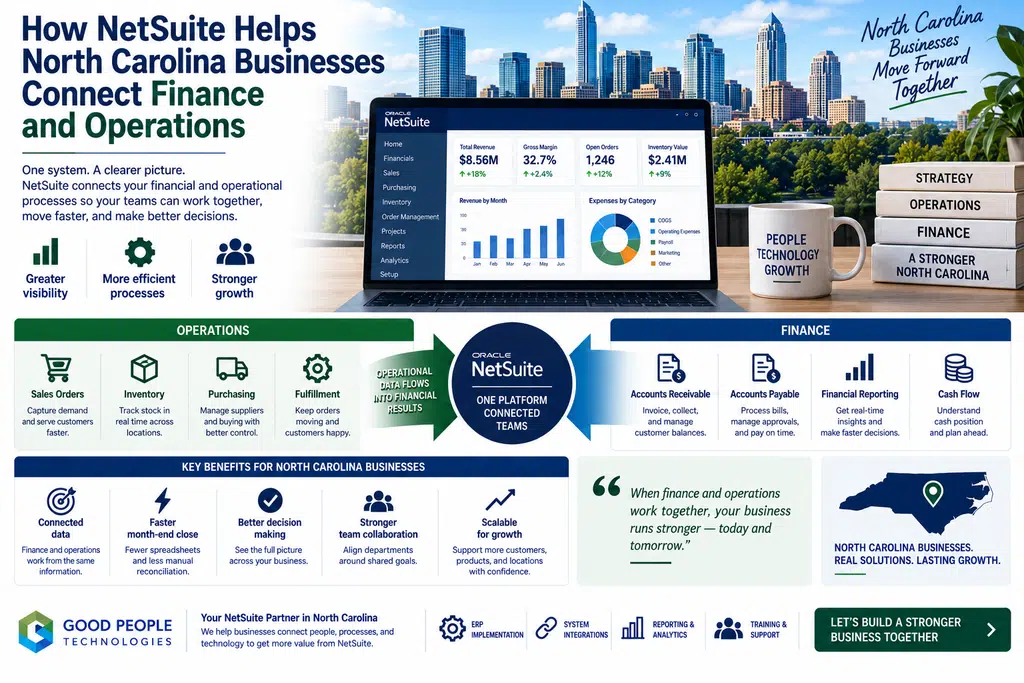
NetSuite finance and operations can help North Carolina businesses solve a common growth problem: finance sees the financial result while operations manages the activity that creates it, yet the two sides do not always work from the same information. Sales orders, inventory movement, purchasing, fulfillment, vendor activity, customer billing, payments, and financial reporting all affect each other. When those workflows sit in separate systems, teams often spend extra time connecting the pieces manually.
For businesses across Charlotte, Raleigh, Durham, Greensboro, Winston-Salem, Wilmington, Asheville, and other North Carolina markets, this disconnect can become more visible during growth.
A product-based business may see strong sales but struggle to understand true margin. A distributor may have purchase orders, inventory, and customer demand spread across different reports. An e-commerce company may need finance to reconcile orders, refunds, fulfillment costs, and payments from several platforms. A service business may complete work before billing data reaches finance.
None of these situations necessarily means the company has poor processes.
Often, the business has simply grown beyond the level of coordination its earlier systems were designed to support.
Employees compensate.
Operations updates spreadsheets. Finance exports reports. Sales asks the warehouse for availability. Purchasing tracks demand separately. Leadership waits for several reports before getting a complete view.
The business still works.
However, people increasingly become the connection between systems.
NetSuite can help change that by bringing financial and operational activity closer together in one ERP environment. Instead of finance learning about operational activity only after reconciliation, teams can work from more connected orders, purchasing, inventory, customers, vendors, fulfillment, billing, and reporting.
The goal is not only better accounting.
It is better business visibility.
This article explains how North Carolina businesses can connect finance and operations with NetSuite, where disconnected workflows create hidden costs, and how better reporting, integrations, automation, and process ownership can help companies make decisions with more confidence.
Why Finance and Operations Drift Apart as Businesses Grow
Finance and operations often begin closely connected in a smaller company.
There are fewer employees. Transaction volume is lower. Teams communicate directly. One person may understand both the customer order and the financial result behind it.
Growth changes that structure.
Sales becomes its own function. Purchasing handles more suppliers. Warehouse activity grows. Customer service manages more accounts. Finance develops its own reporting and control processes.
Each department naturally focuses on its own responsibilities.
Operations asks questions such as:
- Can we fulfill this order?
- What inventory is available?
- What needs to be purchased?
- Which orders are delayed?
- What does the warehouse need to process today?
- Which supplier requires attention?
Finance asks different questions:
- What revenue did we generate?
- What do customers owe?
- What do we owe vendors?
- What is our inventory worth?
- How are margins changing?
- What does cash flow look like?
- Which costs are increasing?
Both sets of questions matter.
The problem appears when the answers come from different systems and update at different times.
Finance may receive the result after operations has already acted. Operations may make decisions without enough financial context.
As a result, the business sees two versions of the same activity.
The Cost of Finance and Operations Working Separately
A disconnect between finance and operations creates more than reporting inconvenience.
It can affect daily decisions.
Consider inventory purchasing.
Operations may see that a product is running low and want to reorder it. Finance may see that inventory already represents a large cash investment. Purchasing may know that supplier lead times are changing. Sales may expect a large customer order soon.
The right decision requires all four views.
If each team works separately, the business may overbuy, underbuy, or spend too much time gathering information before deciding.
The same issue appears with sales.
Revenue may grow, but finance may later discover that a product carries lower margin because shipping, returns, discounts, or rush purchasing increased.
Operations saw strong demand.
Finance saw weaker profitability.
Leadership needs both.
Connecting those views helps companies manage growth based on the full business result rather than individual department metrics.
NetSuite Finance and Operations Create a Shared Foundation
NetSuite finance and operations can create a shared foundation because many operational transactions also become financial transactions inside the same broader ERP environment.
A sales order affects demand.
Fulfillment affects order status.
An invoice affects accounts receivable.
Payment affects cash.
A purchase order creates a future inventory and cash commitment.
Receiving changes inventory.
A vendor bill affects accounts payable.
Inventory transactions influence both operational availability and financial value.
When these workflows connect, finance does not have to reconstruct the business from separate exports after the fact.
Operations can also gain better financial context.
That creates a more useful operating model.
Instead of asking finance to verify every result later, teams can design processes so data moves correctly from the beginning.
NetSuite does not remove the need for controls, review, or reconciliation.
Rather, it can reduce the number of manual bridges teams need between everyday operational activity and financial reporting.
Order-to-Cash Connects Sales Activity With Finance
Order-to-cash is one of the clearest examples of finance and operations working together.
The process usually starts when the customer places an order.
Then several things may happen:
- the company confirms pricing
- inventory gets checked or committed
- the order moves toward fulfillment
- products ship or services get delivered
- the company creates an invoice
- the customer pays
- finance records and reports the result
If these steps happen across disconnected systems, finance may spend time determining what happened operationally.
Did the order ship?
Was it only partially fulfilled?
Did the customer receive a refund?
Was a discount added?
Is the invoice still open?
Did the payment arrive?
NetSuite can connect more of this order-to-cash activity in one environment.
That creates better visibility for both sides.
Operations can see order status and fulfillment needs. Finance can connect billing and collections to the underlying customer activity.
Leadership gets a clearer view of how orders become revenue and eventually cash.
Finance Needs Operational Context Behind Revenue
Revenue is important.
However, revenue alone does not explain business performance.
Finance may need to know what happened operationally before it can interpret the number.
For example, revenue may rise because a product category sold extremely well.
That sounds positive.
Yet operations may also have used rush shipping, paid more for emergency inventory, processed more returns, or spent more labor handling exceptions.
Now the revenue increase has a different meaning.
The company still grew.
However, the quality of that growth may differ from what the top-line number suggests.
NetSuite finance and operations reporting can help teams examine activity with more context.
Leadership may review:
- revenue by customer
- margin by item
- sales by channel
- fulfillment cost
- inventory movement
- returns
- purchasing activity
- order volume
- customer profitability
This gives finance a better connection to the events behind the financial result.
Operations Needs Financial Context Too
The connection works in the other direction as well.
Operations should not make every decision based only on operational speed.
A warehouse may be able to ship an order faster through a more expensive method.
Purchasing may secure inventory quickly by using a higher-cost supplier.
Customer service may authorize a replacement to resolve an issue.
Each decision may make operational sense.
Still, there is a financial effect.
That does not mean finance needs to approve every daily action.
Instead, businesses should give operational teams enough context to understand how their choices affect cost and margin.
For example, purchasing reports can connect inventory demand with vendor pricing. Order reporting can help teams see which exceptions create additional cost. Inventory reporting can reveal where excess stock ties up cash.
When finance and operations share information, teams can make tradeoffs more deliberately.
Purchasing Connects Inventory Needs With Cash
Purchasing is another area where financial and operational priorities meet.
Operations wants the right products available when customers need them.
Finance wants to manage cash carefully.
Both goals are valid.
If the business buys too little, stockouts can reduce sales and customer satisfaction. When it buys too much, cash sits in inventory that may move slowly.
Therefore, purchasing requires connected information.
Teams need to understand:
- current inventory
- available inventory
- committed inventory
- open customer demand
- backorders
- expected receipts
- supplier lead times
- purchase commitments
- item cost
- cash requirements
NetSuite purchasing workflows can connect purchase orders, vendor activity, receiving, inventory, and accounts payable more clearly.
As a result, purchasing decisions can include both demand and financial context.
That is especially useful for North Carolina distributors, wholesalers, manufacturers, and product-based companies where inventory represents a meaningful part of working capital.
NetSuite Finance and Operations Improve Procure-to-Pay Visibility
NetSuite finance and operations also meet inside procure-to-pay.
A purchasing need appears.
Someone creates a purchase order.
The company may require approval.
A vendor supplies the goods or services.
Operations confirms receiving.
The vendor sends a bill.
Finance reviews and eventually pays it.
Each step creates information that another team needs.
If receiving happens outside the finance system, accounts payable may not know whether the business actually received what the vendor billed.
When purchasing uses spreadsheets, finance may struggle to understand future commitments.
If vendor bills arrive without clear purchase records, employees need to investigate.
These exceptions slow finance.
They also slow operations.
A more connected procure-to-pay process allows purchasing, receiving, approvals, vendor records, bills, and reporting to work together more clearly.
The result is not only faster accounts payable.
It is stronger visibility into what the business has ordered, received, owes, and expects next.
Inventory Is Both an Operational and Financial Asset
Inventory is one of the strongest examples of why finance and operations should stay connected.
For warehouse and sales teams, inventory answers an operational question:
What can we sell or fulfill?
For finance, inventory answers another question:
What value does the business currently hold?
Both answers come from the same underlying activity.
Receipts add stock.
Sales reduce it.
Returns may add inventory back after review.
Transfers move stock between locations.
Adjustments change quantities.
Damaged goods may require another treatment.
If operations and finance rely on different inventory views, problems appear quickly.
Sales may think a product is available while finance questions the inventory record. Purchasing may reorder based on one report while leadership sees excess inventory in another.
Better NetSuite finance and operations visibility helps bring these perspectives closer together.
Operational teams can manage availability while finance gains more confidence in inventory value and cost.
Why “On Hand” Does Not Tell the Whole Story
Growing product businesses often discover that simple inventory counts are not enough.
A system may show that the company has inventory on hand.
However, some of it may already be committed to customers.
Another quantity may be in transit.
Some inventory may sit in another location.
Certain products may be damaged or unavailable.
Purchasing needs more than a total.
Sales also needs a clear answer before promising products.
Meanwhile, finance wants to know whether inventory supports healthy demand or whether too much cash sits in slow-moving stock.
This is where connected reporting matters.
Instead of departments maintaining separate inventory spreadsheets, the business can build reports around specific decisions.
What can sales promise?
What should purchasing reorder?
Which products move slowly?
Where is cash tied up?
Which items create the most backorders?
A shared ERP foundation makes these questions easier to answer from consistent data.
Fulfillment Activity Affects Finance
Fulfillment can look like an operations-only process.
It is not.
When orders ship affects invoicing, customer communication, revenue timing, shipping cost, inventory, returns, and cash flow.
A delay in the warehouse can eventually become a finance issue.
For example, an order may remain open longer than expected. Billing may wait. Customer payment arrives later. A partial shipment may require additional handling.
If finance only sees the final transaction, it may not understand why cash or revenue timing changed.
Connected order and fulfillment data creates context.
Leadership can see not only how much the company sold but also whether the company successfully turned those sales into fulfilled, billed, and paid orders.
That connection becomes more important as transaction volume grows.
Customer Service Connects to Finance More Than It Seems
Customer service also affects financial operations.
A customer may question an invoice.
Another may request a refund.
Someone may return a product.
A key account may need a credit.
A service issue can delay payment.
If customer service activity lives separately from customer orders and financial data, finance may need extra follow-up before understanding what happened.
At the same time, customer service benefits from financial and operational visibility.
Representatives may need to know:
- whether an invoice is open
- whether the customer has a credit
- whether an order shipped
- whether a refund was processed
- what inventory is available
- what the customer previously ordered
A more connected customer record helps teams provide clearer answers.
That improves the customer experience while reducing internal chasing.
NetSuite Finance and Operations Reduce Manual Reconciliation
NetSuite finance and operations can reduce manual reconciliation when the business captures transactions closer to where they happen.
Finance often reconciles manually because data arrives from separate systems.
Orders come from one place.
Payments come from another.
Warehouse activity sits somewhere else.
Purchasing has its own files.
Employees export everything into spreadsheets and try to make the numbers agree.
Some reconciliation will always remain necessary.
The goal is not to remove financial control.
The goal is to reduce reconciliation created only because systems do not communicate.
When transactions flow more consistently, finance can focus on exceptions.
That gives the team more time for margin analysis, cash planning, reporting, and business support.
Why Reporting Becomes Better When Data Is Connected
A dashboard can only be as useful as the data behind it.
If finance and operations remain disconnected, leadership may have several dashboards but still struggle to understand the business.
One report shows revenue.
Another shows inventory.
A third shows orders.
Finance provides a spreadsheet with margin.
Operations creates another spreadsheet for fulfillment.
The information exists.
The complete picture does not.
SuiteAnalytics tools such as dashboards, searches, reports, and workbooks can help NetSuite users analyze connected business data when teams configure reporting around the decisions that matter.
A useful leadership view might connect:
- sales
- margin
- inventory
- orders
- purchasing
- backorders
- receivables
- payables
- cash
- fulfillment performance
The purpose is not to put every metric on one screen.
Instead, businesses should connect the financial and operational indicators that support a specific decision.
NetSuite Finance and Operations Support Decision-Based Reporting
NetSuite finance and operations become more valuable when reporting starts with decisions rather than available data.
Leadership may need to decide whether to reorder inventory.
That report should connect demand, available stock, supplier lead time, purchase cost, backorders, and cash impact.
Another decision may involve a customer account.
The company may want to review revenue, margin, payment behavior, return activity, support burden, and order history.
A third decision may involve a sales channel.
Leadership could compare revenue with margin, fulfillment cost, returns, inventory pressure, and customer service demand.
This type of reporting gives businesses more than visibility.
It gives context.
For North Carolina companies trying to scale, that can reduce the time leaders spend asking different departments to explain what each number means.
Faster Month-End Close Starts Outside Finance
Finance and operations also connect through month-end close.
Many closing delays begin outside finance.
A warehouse may need to complete receiving.
Purchasing may need to resolve open transactions.
Customer billing may still be incomplete.
Inventory adjustments may need review.
A department manager may have an approval waiting.
Finance eventually sees all these issues because the books cannot close cleanly until the underlying activity is accurate.
Therefore, improving close requires stronger upstream workflows.
NetSuite can provide financial controls and period-close tools, but the business gets more value when operations completes its part of the process consistently throughout the month.
This moves work earlier.
Instead of finance discovering every issue during close, teams resolve more exceptions when they happen.
Better Connections Improve Cash Flow Visibility
Cash flow is another area where finance needs operating data.
A business may have strong revenue while cash remains tight.
Why?
Inventory purchases may happen before customer payments. Customers may have longer terms. Vendor bills may come due quickly. Projects may require labor before invoicing. Returns can reduce expected cash.
Operations influences all of these factors.
Purchasing creates commitments.
Sales creates receivables.
Inventory holds working capital.
Fulfillment affects billing timing.
NetSuite can help bring these inputs into a more connected financial view.
This allows leadership to understand not only the current cash balance, but also the business activity likely to influence cash next.
How Automation Connects Teams
Automation can reduce delays between departments.
For example, a system can alert purchasing when inventory reaches a threshold. An approval workflow can route a purchase request. Finance can receive notifications about billing exceptions. Customer service can see updated order status without asking operations.
Useful automation may include:
- purchasing approvals
- invoice workflows
- low-stock alerts
- order exception notifications
- vendor bill approvals
- customer payment reminders
- fulfillment alerts
- close task reminders
- recurring reports
- integration error alerts
However, automation should support a clearly defined process.
The business needs to know what triggers the workflow, who owns the next action, and what happens when an exception appears.
Otherwise, automation simply creates more notifications.
The best automation reduces handoffs while making ownership clearer.
Integrations Still Matter With NetSuite
Most companies do not run every workflow in one application.
North Carolina businesses may still use Shopify, CRM platforms, EDI, warehouse software, shipping systems, payment processors, project tools, payroll software, or customer portals.
That is normal.
The important issue is how those systems connect to NetSuite.
A good integration strategy should answer:
- Which system owns customer data?
- Where should orders originate?
- Where should inventory availability come from?
- How should payment data reach finance?
- How quickly should fulfillment updates sync?
- What happens when an integration fails?
- Who owns the exception?
Without these rules, the company can implement ERP and still recreate the same silos.
Integrations should extend the shared finance-and-operations foundation, not build new barriers around it.
Process Ownership Keeps the Connection Working
Systems do not stay organized automatically.
Businesses change.
New products appear. Customer expectations shift. Employees join. Vendors change. Reports evolve. Integrations expand.
That is why process ownership matters.
A company should know who owns key workflows such as:
- order-to-cash
- procure-to-pay
- inventory
- item data
- customer data
- vendor data
- reporting
- integrations
- finance close
- approvals
Owners help teams maintain definitions, review exceptions, prioritize improvements, and keep workflows aligned with the business.
NetSuite can provide the system structure.
Process ownership keeps that structure useful.
Without owners, teams may gradually return to spreadsheets and manual workarounds even after a successful ERP project.
What North Carolina Businesses Should Map First
Before improving the connection between finance and operations, businesses should map how information moves today.
Start with the workflows that affect both sides most.
Order-to-Cash
Map the process from customer order through fulfillment, invoicing, payment, returns, and reporting.
Look for:
- duplicate entry
- delayed billing
- manual updates
- disconnected payment data
- fulfillment gaps
- customer credits
- spreadsheet reporting
Procure-to-Pay
Follow purchasing from demand through purchase order, approval, receipt, vendor bill, and payment.
Look for:
- unclear approval rules
- missing receipts
- supplier information in spreadsheets
- duplicate records
- manual bill matching
- poor purchasing visibility
Inventory
Review how products enter, move through, and leave the business.
Look for:
- unclear availability
- manual adjustments
- location differences
- returns
- committed inventory
- inaccurate item data
- finance reconciliation work
Reporting
Finally, map the reports leadership actually uses.
Ask:
- Who owns each report?
- What decision does it support?
- Where does the data come from?
- Which reports require manual cleanup?
- Where do finance and operations show different numbers?
This gives the business a practical roadmap.
Signs Finance and Operations Need Better Integration
A company does not need to wait for a major system failure.
Several smaller signs can show that finance and operations need a stronger connection.
These include:
- finance spends too much time reconciling
- operations relies on separate spreadsheets
- inventory is difficult to trust
- purchasing reacts to demand too late
- billing waits for manual updates
- leadership receives reports late
- departments use different numbers
- customer service checks multiple systems
- margin visibility is limited
- month-end close gets harder as the company grows
- people repeatedly copy data between tools
- employees become the integration layer
One or two of these issues may require only a targeted fix.
When several appear together, the company may need a broader ERP or NetSuite review.
Composite Example: A Charlotte Product-Based Business
Consider a growing product-based business in Charlotte.
The company sells online and through wholesale accounts. Sales are healthy, but finance and operations use several separate tools.
Shopify holds online orders. Warehouse activity sits in another system. Purchasing relies partly on spreadsheets. Finance receives payment data from several sources.
Each department can do its job.
However, leadership struggles to connect the full story.
Operations sees fast-selling products and wants more inventory. Finance sees cash tied up in stock. Customer service sees an increase in delayed-order questions. Sales sees revenue growth.
The company reviews its workflows.
It finds that the issue is not a lack of data.
The data does not connect around decisions.
The business begins improving integrations between orders, inventory, fulfillment, purchasing, and finance. It also redesigns reporting to connect revenue with margin and inventory activity.
Later, NetSuite becomes the central foundation for more of those workflows.
As a result, finance spends less time rebuilding operational data, while operations receives stronger financial context before making decisions.
Composite Example: A Greensboro Distributor
A distributor near Greensboro manages customer-specific pricing, open orders, supplier lead times, inventory, purchasing, backorders, and warehouse activity.
Finance uses NetSuite, but several operational workflows still depend on manual processes and connected tools.
Purchasing tracks some demand outside the ERP. Customer service uses a backorder spreadsheet. Warehouse teams manage certain exceptions manually.
The processes work.
Yet finance spends additional time understanding inventory adjustments, vendor activity, and delayed orders.
The company reviews NetSuite finance and operations together instead of treating each department separately.
It maps purchasing, receiving, order fulfillment, customer pricing, backorders, and finance reporting.
Several improvements follow.
Purchasing gets better demand visibility. Warehouse exceptions become easier to report. Backorders connect more clearly to expected supply. Finance receives cleaner operational data.
Leadership can now review inventory investment, margin, customer demand, purchasing needs, and cash flow with more context.
For this distributor, the biggest benefit is not simply automation.
It is having teams make decisions from a more connected picture of the business.
How Good People Technologies Helps Connect Finance and Operations
Good People Technologies helps growing businesses connect finance and operations through NetSuite consulting, ERP planning, workflow mapping, system integrations, automation, reporting improvement, and process optimization.
For North Carolina businesses, this can include:
- mapping order-to-cash
- reviewing procure-to-pay
- connecting inventory and financial workflows
- reducing manual reconciliation
- improving NetSuite dashboards and saved searches
- reviewing purchasing and demand visibility
- connecting e-commerce, warehouse, CRM, and finance systems
- automating recurring workflows
- clarifying process ownership
- improving decision-based reporting
- building phased NetSuite optimization roadmaps
The work begins with the process rather than the software feature.
Some companies need better NetSuite reporting. Others need integrations, cleaner inventory workflows, improved purchasing, automation, or process ownership.
More complex businesses may need a broader ERP roadmap.
The goal is to connect operational activity with financial visibility in a way that supports the company’s next stage of growth.
Final Thoughts
NetSuite finance and operations can help North Carolina businesses move away from a model where each department sees only part of the company.
Finance needs to understand the operational activity behind revenue, margin, inventory, purchasing, billing, and cash.
Operations benefits from knowing how daily decisions affect cost, working capital, profitability, and financial performance.
When these teams work from disconnected systems, employees spend more time reconciling, exporting, explaining, and checking information.
A connected ERP environment can reduce that friction.
NetSuite can bring finance, orders, inventory, purchasing, vendors, customers, fulfillment, and reporting closer together. Integrations can connect the external systems the business still needs. Automation can reduce repeated handoffs. Process ownership helps the system remain aligned as the company grows.
The goal is not to make finance run operations or operations run finance.
It is to help both sides see the same business.
For growing North Carolina companies, that shared visibility can lead to faster reporting, stronger cash management, better purchasing, clearer margins, fewer manual workarounds, and more confident decisions.
Frequently Asked Questions
How does NetSuite connect finance and operations?
NetSuite can connect finance with sales orders, purchasing, inventory, fulfillment, customers, vendors, billing, accounts receivable, accounts payable, and reporting in a shared ERP environment.
Why should finance and operations work from connected data?
Connected data helps finance understand the activity behind financial results while giving operations more context about cost, cash, margin, and business performance.
How do NetSuite finance and operations help with reporting?
NetSuite finance and operations can support reports and dashboards that combine financial and operational data, helping leadership connect revenue, margin, inventory, orders, purchasing, and other business signals.
Can NetSuite reduce manual reconciliation?
NetSuite can reduce reconciliation caused by disconnected systems by keeping more related transactions within connected workflows. Finance still needs controls and reconciliation, especially for exceptions.
How does NetSuite connect purchasing and finance?
Purchase orders, receiving, vendor bills, approvals, inventory, and accounts payable can work together so purchasing decisions and financial commitments become easier to track.
Why is inventory important to both finance and operations?
Operations uses inventory data to manage availability and fulfillment, while finance needs inventory cost and value for reporting, margin, and working-capital decisions.
Do businesses still need integrations after implementing NetSuite?
Often, yes. Businesses may still use e-commerce platforms, CRM tools, warehouse systems, EDI, shipping software, payment processors, or other applications that need to exchange data with NetSuite.
Can better finance and operations integration help month-end close?
Yes. Cleaner purchasing, inventory, billing, fulfillment, and transaction workflows can reduce the number of upstream exceptions finance needs to resolve during close.
What should North Carolina businesses review first?
Businesses should start with order-to-cash, procure-to-pay, inventory, reporting, integrations, manual spreadsheets, and process ownership.
How can Good People Technologies help?
Good People Technologies helps businesses map workflows, improve NetSuite reporting, connect systems, automate processes, reduce reconciliation, and create practical ERP optimization roadmaps.

Roman is a B2B marketing specialist focused on technology, ERP systems, business automation, and digital growth strategies. At Good People Technologies, he helps translate complex technology solutions—such as ERP integrations, system integrations, and business process automation—into clear insights for founders, operators, and growing companies.
His work focuses on content strategy, SEO, and thought leadership that helps businesses understand how the right technology infrastructure can support scalable operations and sustainable growth.
At Good People Technologies, Roman contributes to content that explores ERP implementation, automation strategies, and system integration best practices for companies navigating rapid growth and operational complexity.