
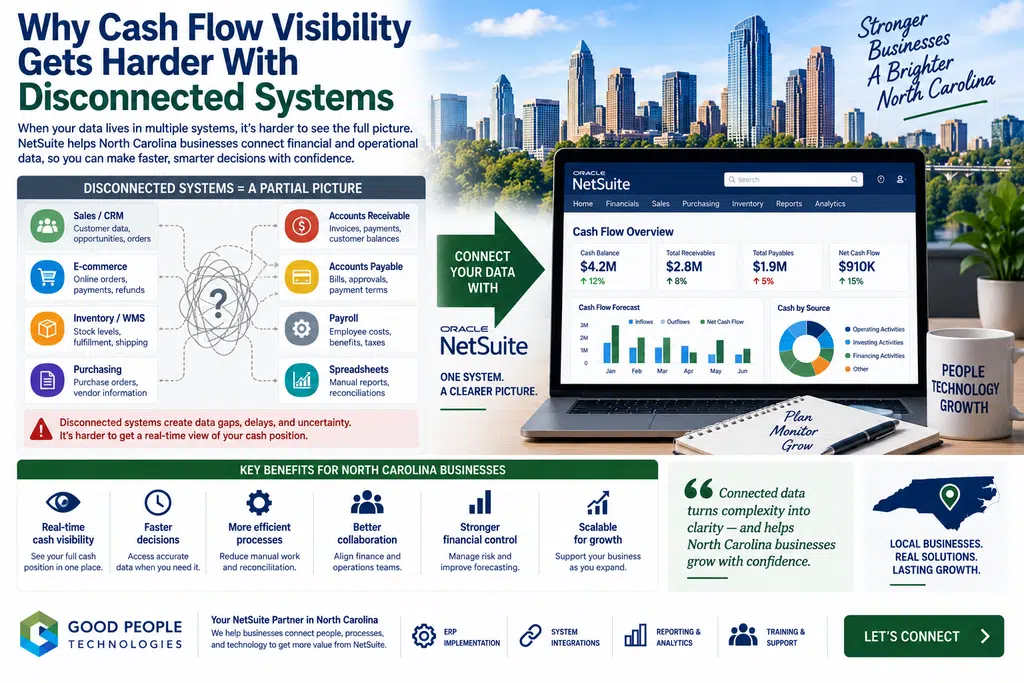
Cash flow visibility with disconnected systems becomes harder because the information that explains cash often lives in many different places. A finance system may show the current bank balance, while accounts receivable tracks money customers still owe. Purchasing creates future cash commitments. Inventory ties up working capital. Sales adds new revenue expectations. Vendor bills affect upcoming payments, and operational systems may hold information that finance has not received yet.
For growing North Carolina businesses, this challenge often becomes more noticeable as the company adds customers, employees, products, vendors, locations, and sales channels.
Revenue may be increasing.
Orders may look healthy.
The business may even have several dashboards that appear to provide good visibility.
However, understanding cash requires more than looking at the bank account or reviewing last month’s financial statements.
Leadership needs to know what cash is available today, what customers are expected to pay, what vendor obligations are coming, how much money sits in inventory, which orders still need to be billed, and what operational activity may change the outlook.
When those answers come from separate systems, finance has to assemble the picture manually.
Someone exports an A/R report. Another employee reviews accounts payable. Purchasing checks open purchase orders. Operations confirms whether an order shipped. Inventory data comes from another report. Finance then combines those pieces into a spreadsheet or forecast.
The business eventually gets an answer.
The challenge is how much work it takes to get there and how quickly that answer becomes outdated.
For companies across Charlotte, Raleigh, Greensboro, Durham, Winston-Salem, Wilmington, Asheville, and other North Carolina markets, better cash visibility can become essential as growth creates more moving parts.
This article explains why disconnected systems make cash flow harder to understand, which business processes affect cash visibility most, and how NetSuite, integrations, reporting, automation, and clearer process ownership can help companies see cash with more confidence.
Why Cash Flow Visibility With Disconnected Systems Gets Harder as You Grow
A smaller business may have relatively simple cash movement.
Customers pay through a limited number of channels. The company works with a manageable group of vendors. Inventory may be limited. Finance understands most transactions directly.
In that environment, cash visibility can rely partly on experience.
A business owner may know that a major customer usually pays next week. Finance knows which bills are coming. Purchasing understands what orders the company plans to place.
Growth changes that model.
More customer accounts create more receivables. Additional suppliers create more payment schedules. Higher order volume increases inventory needs. New sales channels create different payment timing, refunds, fees, and settlement rules.
Meanwhile, departments become more specialized.
Sales understands customer demand. Purchasing sees vendor commitments. Operations sees fulfillment. Finance sees payments and accounting activity.
Each team holds part of the cash story.
If their systems do not connect, leadership cannot see the full picture without manual work.
That is why cash flow visibility with disconnected systems tends to become less reliable as operational complexity increases.
The issue is rarely a lack of data.
Usually, the company has plenty of data.
The problem is that the data does not arrive together.
A Bank Balance Is Not the Same as Cash Flow Visibility
A bank balance tells the company how much money sits in an account at a particular moment.
That information matters.
However, it does not explain what happens next.
Imagine a business has a healthy bank balance today.
At the same time:
- several large vendor bills are due next week
- payroll is approaching
- the company plans to purchase inventory
- a major customer payment is late
- another customer has disputed an invoice
- several orders have shipped but billing is incomplete
- returns may reduce expected collections
The bank balance can look comfortable while future cash becomes tighter.
The opposite can also happen.
A business may have limited cash today while large customer payments are expected soon.
Therefore, cash visibility should include both position and movement.
Leadership needs a view of current cash along with the inflows and outflows likely to affect it.
When systems are disconnected, creating that forward-looking view becomes much harder.
Why Revenue Does Not Equal Cash
Revenue and cash are connected, but they are not the same thing.
A company may record a sale today and receive payment weeks later.
For example, a North Carolina wholesaler may sell a large order to a business customer with payment terms. Revenue looks strong, but the customer has not paid yet.
Meanwhile, the wholesaler may already have paid the supplier for the inventory.
This creates a timing gap.
The same pattern appears in service businesses.
A company may complete substantial work before invoicing. After invoicing, the customer may have additional time to pay.
E-commerce can create different timing issues.
Orders, refunds, processor fees, returns, and settlements may all affect the final amount and the date cash reaches the business.
Therefore, leadership needs to see the path from sale to cash.
Disconnected sales, billing, A/R, and payment systems make that path harder to follow.
Accounts Receivable Is a Major Cash Signal
Accounts receivable is one of the most important parts of cash visibility.
A business may have strong sales but weak collections.
If finance looks only at revenue, leadership may think performance is stronger than the cash position suggests.
A/R reporting should help teams understand:
- total outstanding receivables
- aging balances
- overdue accounts
- large upcoming collections
- customer payment behavior
- unapplied payments
- credits
- disputed invoices
This information helps leadership estimate when expected revenue may actually turn into cash.
However, A/R itself may depend on operational processes.
A customer may delay payment because an invoice is incorrect. Billing may be late because fulfillment data did not arrive. A dispute may sit with customer service.
Therefore, receivables visibility often requires more than finance data.
Sales, customer service, billing, and operations can all affect collections.
Cash Flow Visibility With Disconnected Systems and Accounts Receivable
Cash flow visibility with disconnected systems becomes especially difficult when customer activity and A/R live in separate environments.
Finance may see that an invoice is overdue.
Sales may know that the customer is waiting for a credit.
Customer service may know that part of the order arrived damaged.
Operations may know that a replacement has already shipped.
No department has the wrong information.
The problem is that no one sees the entire situation.
Finance may forecast the payment as late without knowing that the issue should be resolved soon. Leadership may see rising A/R without understanding the operational reasons behind it.
A connected system can provide more context.
The company can link customer records, orders, fulfillment, invoices, credits, payments, and reporting more closely.
That helps finance understand not only how much customers owe, but also what may affect the timing of collection.
Accounts Payable Creates the Other Side of the Picture
Accounts payable represents future cash outflow.
Finance needs to know what the company owes, when payments are due, and which commitments may affect liquidity.
However, upcoming cash needs may begin before the vendor bill reaches A/P.
Purchasing may have already issued a purchase order.
A warehouse may be waiting for the goods.
Operations may expect the inventory for upcoming customer demand.
Finance needs visibility into those commitments before payment becomes urgent.
Otherwise, leadership can underestimate future cash needs.
Useful A/P and purchasing visibility may include:
- open vendor bills
- due dates
- purchase orders
- expected receipts
- vendor terms
- upcoming inventory purchases
- recurring expenses
- approval status
- disputed bills
A/P becomes much more useful when finance can connect it to purchasing activity.
Cash Flow Visibility With Disconnected Systems and Payables
Cash flow visibility with disconnected systems also suffers when purchasing and A/P operate separately.
Purchasing may know that several large orders are coming.
Finance may only see the obligation after the vendor bill appears.
That delay matters.
A large inventory purchase may change the company’s cash needs well before payment is due.
When purchasing data flows into the financial view, leadership can prepare earlier.
This is especially valuable for distributors, wholesalers, manufacturers, and product-based North Carolina businesses.
Those companies may need to invest substantial cash in inventory before customer demand turns into collections.
A connected procure-to-pay process helps finance understand what the company has ordered, what it has received, what vendors have billed, and what the company will likely need to pay.
Inventory Can Hide Large Amounts of Cash
Inventory is another major cash flow factor.
A business can be profitable and still experience cash pressure because too much money sits in stock.
Consider two products.
One sells quickly.
The other sits in the warehouse for months.
Both appear as inventory assets, but they affect cash differently.
Fast-moving inventory may convert back into cash quickly through sales.
Slow-moving inventory keeps working capital tied up.
Leadership therefore needs visibility into:
- total inventory value
- available inventory
- committed inventory
- slow-moving stock
- excess inventory
- backorders
- incoming inventory
- inventory by location
- sales velocity
Finance alone may not have all of this context.
Operations, purchasing, sales, and warehouse teams often understand the inventory story more clearly.
Connecting those views helps leadership understand how inventory decisions affect cash.
Why Overstock and Stockouts Can Both Hurt Cash Flow
Overstock is an obvious cash flow issue because money sits in products that have not sold.
Stockouts can create a different type of cash problem.
If the business cannot fulfill customer demand, it may delay revenue and collections.
The company may also rush new inventory.
Emergency purchases can lead to higher shipping costs or less favorable supplier terms.
Therefore, inventory planning affects cash in both directions.
Buy too much and cash becomes trapped in stock.
Buy too little and the business may lose sales or spend more to recover.
Connected demand, inventory, purchasing, and finance data helps businesses find a better balance.
Cash Flow Visibility With Disconnected Systems Makes Inventory Planning Harder
Cash flow visibility with disconnected systems becomes more difficult when finance sees inventory value but operations sees inventory movement.
Finance may know that inventory increased.
Purchasing may know why.
Sales may know which products customers want.
Warehouse teams may know what actually moves quickly.
Leadership needs those views together.
Otherwise, the business may reduce purchasing simply because inventory value looks high, even though the company is short on the items customers want most.
Alternatively, purchasing may keep buying based on demand without seeing how much cash the company has already committed.
The best inventory decision therefore requires both operational and financial context.
Billing Delays Can Create Hidden Cash Problems
Cash flow begins to slow before an invoice becomes overdue.
Sometimes the problem starts because the invoice was never created on time.
This can happen when billing depends on operational milestones.
A product must ship first.
A service must reach a certain stage.
A project manager needs to approve work.
A warehouse must confirm fulfillment.
If those updates happen in another system, finance may not know that billing can begin.
Every day of billing delay can push collection later.
A company may think it has an A/R problem when the deeper issue is an order-to-cash workflow problem.
Therefore, businesses should review the whole path:
order → fulfillment or service completion → billing → invoice → collection → cash.
Customer Returns and Credits Complicate the Forecast
Expected cash can change.
A customer may return a product.
Another account may receive a credit.
A refund may be approved.
An invoice dispute can delay payment.
If these events live outside finance, cash forecasts may stay too optimistic until someone manually updates them.
This is another reason customer service and operations can affect finance visibility.
A return is not only a customer service issue.
It may also affect inventory, revenue, margin, receivables, and cash.
Connected systems help those effects reach finance sooner.
Why Manual Cash Forecasting Becomes Harder to Maintain
Many businesses build cash forecasts in spreadsheets.
That approach can work well, especially when the business is small or the model is simple.
Problems appear when the spreadsheet requires too many manual inputs.
Someone exports bank balances.
Another person adds A/R.
A/P comes from another report.
Purchasing sends open commitments.
Finance estimates payroll, recurring expenses, and expected collections.
The spreadsheet gives leadership a forecast.
Then business activity changes.
A customer pays early.
Another invoice becomes late.
Purchasing places an unexpected order.
A vendor changes terms.
The forecast can become outdated quickly.
As transaction volume grows, maintaining the spreadsheet becomes a continuous process.
That does not mean spreadsheets have no role in forecasting.
It means the company may need better source data feeding the forecast.
Cash Flow Visibility With Disconnected Systems Creates More Manual Reconciliation
Cash flow visibility with disconnected systems often requires finance teams to reconcile several versions of the same business activity before forecasting anything.
A payment processor may show one total.
The bank shows the settlement.
E-commerce reports another figure before fees and refunds.
The ERP may show invoice activity.
Finance must explain the differences.
A similar issue can happen with purchasing.
The purchase order shows one future commitment, the vendor bill shows another amount, and receiving data may still be incomplete.
Every disconnected handoff adds another step.
This keeps finance focused on proving what happened rather than understanding what happens next.
Better integrations can reduce those gaps and allow finance to spend more time reviewing exceptions instead of rebuilding the full picture manually.
Why Reporting Delays Hurt Cash Decisions
Cash decisions often need to happen quickly.
Leadership may need to decide whether to:
- place a large inventory order
- delay an optional purchase
- hire additional employees
- invest in equipment
- increase marketing spend
- negotiate customer terms
- change vendor payment timing
- accelerate collections
If reporting arrives late, the business makes these choices with less context.
A monthly cash report may show what happened last month.
Leadership often needs to understand what may happen next week or next month.
That is why operational data matters.
Open orders, purchasing commitments, billing activity, A/R, A/P, inventory movement, and expected expenses can all improve the forward-looking view.
NetSuite and Cash Flow Visibility
NetSuite can help businesses bring several important cash signals into a more connected environment.
Its standard financial reporting connects the cash flow statement with categories including accounts receivable, inventory assets, accounts payable, current assets, current liabilities, fixed assets, and other financial activity.
In addition, NetSuite Cash 360 can provide a view of bank balances, total receivables, total payables, and projected cash flow, depending on the company’s setup and use of the SuiteApp.
That matters because cash does not exist separately from operations.
Receivables depend on customer activity.
Payables depend on purchasing and vendors.
Inventory affects working capital.
Orders and billing affect future collections.
A connected ERP environment gives finance more of that context without requiring every answer to come from manual spreadsheet assembly.
How NetSuite Can Improve Cash Flow Visibility With Disconnected Systems
NetSuite can improve cash flow visibility with disconnected systems by serving as a stronger financial and operational hub while integrations connect the external platforms a company still needs.
The goal is not necessarily to force every process into one application.
Many businesses still rely on e-commerce platforms, CRM software, warehouse tools, payment processors, payroll systems, EDI, customer portals, or other specialized tools.
Instead, the company needs clear data ownership and reliable connections.
NetSuite may become the primary source for finance, customer transactions, purchasing, inventory, and other core processes, while integrations bring in supporting activity.
This can reduce the amount of time finance spends collecting information before building a cash view.
Cash 360 and Near-Term Forecasting
For NetSuite users, Cash 360 can add another layer of cash management.
Oracle documentation describes Cash 360 as providing a real-time view of cash position and near-term forecasting.
The dashboard can include bank balances, receivables, payables, and forecast information. It can also show A/R and A/P aging summaries.
That creates useful context.
Finance can review what the company currently has alongside what customers owe and what the company owes.
Forecasting can also use several types of information, including current A/R and A/P data and planned expenditures.
Still, a dashboard only helps when the underlying transactions stay accurate and current.
Good cash visibility therefore depends on both the tool and the processes feeding it.
SuiteAnalytics Can Help Turn Cash Data Into Decisions
NetSuite SuiteAnalytics includes reporting tools such as dashboards, reports, searches, and workbooks.
These tools can help businesses build cash-related reporting around decisions.
For example, leadership may want to monitor:
- cash balance
- A/R aging
- A/P aging
- overdue customer balances
- inventory investment
- open purchase commitments
- customer collection trends
- major upcoming payments
- cash flow trends
Not every company needs every metric.
The better approach is to ask what decision the report should support.
A purchasing leader may need cash context before approving a large order.
Finance may want visibility into overdue receivables.
Leadership may want to understand how inventory growth affects working capital.
Decision-based reporting keeps dashboards useful instead of turning them into collections of unrelated metrics.
Integrations Are Essential When External Systems Affect Cash
Even a strong ERP cannot improve visibility if important data never reaches it.
Imagine a company uses an external e-commerce platform.
Orders, refunds, and payments affect cash.
If the integration is delayed or incomplete, finance may work with old information.
The same applies to warehouse systems, payment processors, expense platforms, and CRM tools.
Businesses should define:
- which system owns the data
- what needs to sync
- how often data moves
- what happens when the connection fails
- who monitors exceptions
- which reports depend on the integration
Clear ownership reduces uncertainty.
Instead of finance discovering a missing data flow during reporting, someone already owns the health of the process.
Automation Helps Surface Cash Issues Earlier
Automation can help teams notice important changes before they become larger problems.
Useful examples may include:
- overdue invoice alerts
- payment reminders
- vendor bill approval reminders
- large purchase alerts
- low-cash thresholds
- inventory exception reports
- billing delay notifications
- integration failure alerts
- recurring cash reports
The goal is not to send more notifications.
Automation should help the right person act sooner.
For example, an A/R reminder may help finance address a late account before the delay becomes serious.
A purchasing approval can give leadership financial context before the company makes a large commitment.
An integration alert can prevent missing payment data from remaining unnoticed.
Automation improves cash visibility when it shortens the time between an event and the team seeing it.
Process Ownership Makes Cash Visibility More Reliable
Cash visibility touches many departments.
Therefore, no single finance employee can own every upstream process alone.
The company should have clear owners for areas such as:
- accounts receivable
- accounts payable
- billing
- purchasing
- inventory
- customer credits
- cash forecasting
- reporting
- integrations
Each owner contributes to the quality of the cash view.
Purchasing owns the accuracy of purchasing commitments.
Operations helps ensure receiving and fulfillment data stays current.
Sales and customer service can help resolve customer issues that delay collections.
Finance owns financial review and cash reporting.
Systems teams or partners can support integrations and automation.
Clear ownership helps the company fix recurring problems instead of rebuilding the same spreadsheet every month.
What to Review When Cash Visibility Feels Weak
Businesses do not need to start by replacing every system.
A better first step is mapping where cash information comes from.
Start with inflows.
Where do customer payments originate? How quickly do invoices go out? What payment methods does the company use? Where do credits and refunds appear?
Then map outflows.
Which systems create purchase commitments? Where do vendor bills live? What recurring expenses affect cash? Who approves large purchases?
Next, review working capital.
How much cash sits in inventory? Which products move slowly? How does purchasing decide what to reorder?
Finally, map the reports.
What cash report does leadership use today? How much manual work goes into it? Which data sources arrive late? Who owns each input?
Useful questions include:
- Do we know what customers should pay over the next few weeks?
- Can we see major vendor obligations before they become due?
- Can leadership see open purchase commitments?
- How much cash sits in inventory?
- How many manual exports support the forecast?
- Do bank, A/R, A/P, and operating data connect?
- Which reports require spreadsheet cleanup?
- Which system is the source of truth?
- How quickly can leadership update the forecast when something changes?
These questions often reveal the real visibility gap.
Composite Example: A Charlotte E-Commerce Business
Consider a growing e-commerce company in Charlotte.
Sales come from the company website, a wholesale channel, and another marketplace.
Revenue looks strong.
However, finance struggles to forecast cash confidently.
Customer payments arrive through different channels. Refunds and processing fees affect settlements. Inventory purchases require cash before products sell. The fulfillment partner provides another stream of operational data.
Finance builds a weekly cash spreadsheet.
The team exports bank balances, payment reports, open bills, A/R, and purchasing data. The forecast works, but preparing it takes more time each month.
Then the company reviews the workflow.
It discovers that several important inputs can move into a more connected system automatically. Order and payment integrations improve. Purchasing commitments become easier to see. Finance develops clearer A/R and A/P reports.
The forecast still requires judgment.
However, the team spends less time assembling the starting data.
Leadership can update its view faster when demand, payments, or purchasing plans change.
Composite Example: A Greensboro Distributor
A distributor near Greensboro has a different cash flow challenge.
The company manages customer terms, supplier relationships, inventory, purchasing, backorders, and warehouse operations.
Sales is growing, but inventory investment is also rising.
Operations wants enough stock to support customers. Purchasing sees strong demand and long supplier lead times. Finance sees increasing cash tied up in inventory.
Each department has a reasonable perspective.
The company lacks one connected view.
After reviewing cash flow visibility with disconnected systems, leadership starts connecting purchasing, inventory, orders, A/R, and A/P reporting more closely.
The new view reveals that some product groups justify additional inventory because demand is strong and reliable.
Other products move more slowly and absorb cash without supporting the same level of sales.
That context improves purchasing decisions.
Instead of treating inventory only as an operating requirement, the company begins managing it as both inventory and working capital.
How Good People Technologies Helps Improve Cash Flow Visibility
Good People Technologies helps growing businesses improve cash flow visibility through NetSuite consulting, workflow mapping, system integrations, automation, reporting improvements, and ERP optimization.
For businesses dealing with fragmented cash data, this can include:
- mapping cash-related data flows
- connecting finance and operations
- reviewing A/R and A/P workflows
- improving NetSuite dashboards and saved searches
- reducing manual reconciliation
- reviewing inventory and purchasing visibility
- integrating e-commerce, warehouse, payment, and finance systems
- automating recurring alerts
- clarifying process ownership
- improving decision-based reporting
- building phased NetSuite optimization roadmaps
The work starts with understanding where the current cash picture breaks down.
Some businesses need better finance reporting.
Others need integrations, billing improvements, purchasing visibility, inventory reporting, automation, or process ownership.
The right approach depends on where the most important cash signals live today.
Final Thoughts
Cash flow visibility with disconnected systems gets harder because cash is the result of activity across the entire business.
Finance sees the money.
However, sales, billing, purchasing, inventory, operations, customer service, and vendors all affect when that money moves.
When those workflows sit in separate systems, finance has to rebuild the picture manually.
The business may still produce a forecast.
It may still manage cash successfully.
Yet the process becomes slower, more dependent on spreadsheets, and harder to update as the company grows.
A better approach connects the inputs behind cash.
NetSuite can provide a stronger financial and operational foundation. Cash 360 can support current cash position and near-term forecast visibility for appropriate NetSuite environments. SuiteAnalytics can help teams build reports around the decisions leadership actually needs to make.
Integrations connect external platforms. Automation surfaces important changes earlier. Clear process ownership keeps the data reliable.
For growing North Carolina businesses, the goal is not simply to know how much cash is in the bank.
It is to understand where cash is coming from, where it needs to go, what may change next, and what decisions the company should make while there is still time to act.
Frequently Asked Questions
Why does cash flow visibility get harder with disconnected systems?
Cash flow visibility gets harder because cash depends on A/R, A/P, purchasing, inventory, billing, orders, payments, and other activity that may live in different systems.
Is a bank balance enough to understand cash flow?
No. A bank balance shows current cash but does not fully show upcoming customer collections, vendor payments, inventory commitments, billing delays, or other future inflows and outflows.
How does A/R affect cash flow visibility with disconnected systems?
A/R affects cash flow visibility with disconnected systems because finance needs to understand not only outstanding invoices but also customer issues, credits, disputes, and billing activity that may affect collection timing.
Why does inventory affect cash flow?
Inventory uses working capital. Excess or slow-moving inventory can tie up cash, while insufficient inventory can delay sales or create costly emergency purchasing.
How does purchasing affect cash forecasting?
Purchase orders and supplier commitments can create future cash outflows before vendor bills appear, so finance benefits from visibility into purchasing activity.
Can NetSuite improve cash flow visibility?
Yes. NetSuite can connect financial and operating transactions, while tools such as Cash 360 can provide cash position, receivables, payables, and near-term forecast visibility depending on setup.
What is NetSuite Cash 360?
Cash 360 is a NetSuite SuiteApp designed to provide visibility into cash position and near-term forecasts, including information such as bank balances, receivables, and payables.
Do companies still need integrations with NetSuite?
Often, yes. E-commerce, CRM, warehouse, payment, payroll, or other systems may still need to exchange data with NetSuite for a complete financial view.
Can automation improve cash flow reporting?
Yes. Automation can help surface overdue invoices, billing delays, approvals, major purchases, integration errors, and other events that may affect cash.
How can Good People Technologies help?
Good People Technologies helps businesses map cash-related workflows, improve NetSuite reporting, connect systems, automate alerts, reduce manual reconciliation, and build practical ERP optimization roadmaps.

Roman is a B2B marketing specialist focused on technology, ERP systems, business automation, and digital growth strategies. At Good People Technologies, he helps translate complex technology solutions—such as ERP integrations, system integrations, and business process automation—into clear insights for founders, operators, and growing companies.
His work focuses on content strategy, SEO, and thought leadership that helps businesses understand how the right technology infrastructure can support scalable operations and sustainable growth.
At Good People Technologies, Roman contributes to content that explores ERP implementation, automation strategies, and system integration best practices for companies navigating rapid growth and operational complexity.