
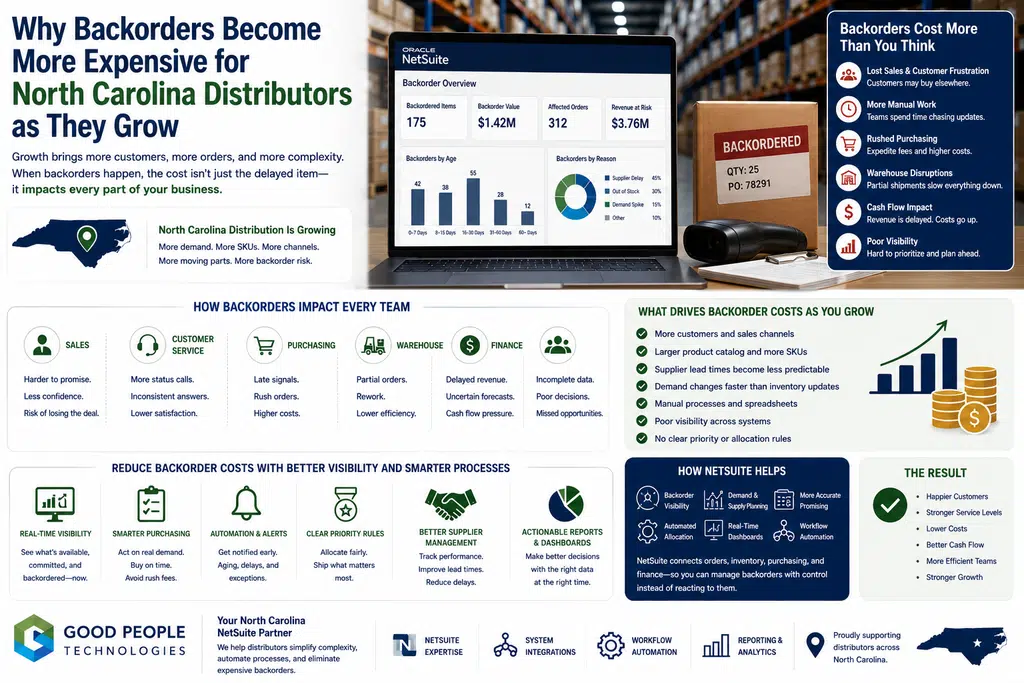
Backorders for North Carolina distributors become more expensive as companies grow because every delayed item starts to affect more people, more systems, more customer promises, and more cash flow decisions. At a smaller stage, a backorder may be easy to manage with a phone call, a spreadsheet note, or a quick update from the warehouse. Later, the same issue can create sales delays, customer service pressure, purchasing urgency, warehouse confusion, finance questions, and leadership reporting gaps.
A growing distributor may still run a healthy business. Customers may still place orders. Sales may still build strong relationships. Purchasing may still work hard to keep products available. Warehouse teams may still fulfill most orders on time.
However, growth changes the cost of exceptions.
A backorder is not only an inventory problem. It is also a customer promise, a purchasing signal, a warehouse priority, a finance issue, and a reporting event. When the business grows, those connections become harder to manage manually.
For distributors across Charlotte, Raleigh, Greensboro, Durham, Winston-Salem, Wilmington, Asheville, and other North Carolina markets, backorders can become more difficult as product catalogs expand, customer accounts grow, supplier timing changes, and sales channels multiply. A few delayed items may not seem like a major issue at first. Over time, though, repeated backorders can reduce customer trust, create extra manual work, and hide deeper system gaps.
This article explains why backorders become more expensive as distributors grow, how they affect different parts of the business, and how better inventory visibility, purchasing workflows, reporting, automation, system integrations, ERP, and NetSuite can help North Carolina distributors manage backorders with more control.
Why Backorders Seem Manageable at First
Backorders often feel manageable when a distributor is smaller.
The team may know the product catalog well. Sales may understand which customers can wait and which ones need faster updates. Purchasing may have close supplier relationships. Warehouse teams may know where delays usually happen. Customer service may handle exceptions directly.
At this stage, informal communication can cover many gaps.
Someone checks a shelf. Another person calls a vendor. Sales sends a customer update. Purchasing tracks the item in a spreadsheet. The warehouse ships the rest of the order while the delayed item waits.
This approach can work for a while.
In fact, it often works because the team is experienced and responsive.
The problem appears when volume increases.
More customers create more expectations. A larger catalog creates more item-level risk. New sales channels create more demand signals. Supplier lead times may become harder to track. Warehouse teams may handle more orders with less time for manual checking.
As a result, the same backorder process that once felt personal and flexible begins to create friction.
The business does not necessarily have a people problem.
More often, it has a visibility problem.
Why Growth Makes Backorders More Expensive
Growth increases the cost of backorders because every exception touches more workflows.
A delayed item may start in inventory, but it quickly spreads into sales, customer service, purchasing, fulfillment, finance, and reporting.
Sales may need to explain the delay. Customer service may answer follow-up questions. Purchasing may rush a reorder. Warehouse teams may split shipments or hold partial orders. Finance may adjust invoices, revenue timing, or cash flow expectations. Leadership may need to understand whether the problem affects only one item or a broader demand pattern.
That creates hidden labor.
One backorder may not look expensive by itself. Yet repeated backorders create a constant stream of manual work. People check status, update files, send emails, revise expected dates, and explain delays to customers.
Meanwhile, customer trust can weaken.
A distributor often wins business by being reliable. If customers cannot trust availability or delivery timing, they may begin looking for alternatives, even if the relationship is strong.
Therefore, backorders for North Carolina distributors become more expensive not only because products are delayed, but because the whole business has to spend more time managing the delay.
Backorders Are Not the Same as Stockouts
Backorders and stockouts are related, but they are not the same.
A stockout usually means the product is not available. The business may lose the sale immediately if the customer cannot wait.
A backorder means the company accepts or keeps the order even though it cannot fulfill the item right away. The customer may still want the product, but the distributor must now manage the promise until supply arrives.
That promise has value.
It also has cost.
When a distributor keeps an item on backorder, the team must answer important questions:
- Who is waiting for the item?
- Which customers should get priority?
- When will supply arrive?
- Can the business promise a realistic date?
- Should the order ship partially?
- Does purchasing need to act now?
- What should customer service communicate?
- How much revenue is waiting on fulfillment?
- Which supplier delays are causing the issue?
- Does the backorder point to a larger planning problem?
If systems cannot answer these questions quickly, employees have to do the work manually.
That is where backorders become costly.
They do not only represent missing inventory. They represent open commitments that require active management.
Backorders for North Carolina Distributors
Backorders for North Carolina distributors often become more costly when growth adds complexity faster than systems improve. A distributor may add customers, vendors, warehouses, sales reps, product groups, pricing levels, or e-commerce channels. Each new layer creates more places where demand, inventory, and order status need to stay aligned.
This matters because distributors depend on trust.
Customers want to know whether items are available, when orders will ship, and whether the distributor can meet expectations. Sales teams need clear information before they make promises. Purchasing needs demand signals early enough to act. Warehouse teams need accurate order status. Finance needs to understand how delayed fulfillment affects cash flow and reporting.
When those answers live in different systems, backorders become harder to control.
The problem can appear in several ways:
- sales promises products before availability is clear
- customer service lacks reliable backorder dates
- purchasing sees demand too late
- warehouse teams manage too many exceptions
- finance cannot see how much revenue is waiting on supply
- leadership receives reports after the issue has grown
- suppliers delay orders without clear internal visibility
- spreadsheets become the main backorder tracker
A backorder process can still function this way.
However, it becomes harder to scale.
The Customer Trust Cost
Backorders affect customer trust because they create uncertainty.
A customer may accept a delay once. If updates are clear, timing is realistic, and the order arrives as promised, the relationship can remain strong. In some industries, customers understand that supplier timing changes or demand spikes can happen.
Repeated uncertainty creates a different experience.
A customer may ask for an update and receive a vague answer. Another customer may hear one date from sales and a different date from customer service. A business account may depend on the delayed item to complete its own work. If the distributor cannot provide reliable information, the customer may lose confidence.
Trust does not usually disappear after one backorder.
It weakens through repeated friction.
That friction may include delayed updates, missed promise dates, partial shipments without clear explanation, or a lack of visibility into when the item will arrive.
For North Carolina distributors serving regional business customers, reliability often becomes part of the brand. Customers may choose a distributor not only for price, but for availability, speed, and clear communication.
Because of that, backorders should not be managed only as internal inventory events.
They should be managed as customer relationship moments.
The Sales Cost
Sales teams feel backorders directly.
When inventory is unclear, sales has to be careful with promises. A rep may need to check with purchasing before confirming an order. Someone may ask the warehouse whether any stock is available. Another person may review open purchase orders to estimate timing.
This slows the sales process.
In addition, backorders can make account management harder.
A customer may want to know whether a product can ship by a certain date. The sales team may not have a confident answer. If the customer has options, the delay may create pressure on the relationship.
Sales also needs to know which customers should receive available supply first.
A long-term account may have priority. A large order may have special terms. Another customer may have an urgent need. Without clear rules, sales teams may negotiate priority manually, which can create internal conflict.
Better backorder visibility helps sales make better promises.
It can show what is available, what is committed, what is on order, which customers are waiting, and when supply may arrive.
As a result, sales can spend less time chasing answers and more time managing relationships.
The Customer Service Cost
Customer service often becomes the front line for backorder issues.
Customers ask where items are, when they will ship, whether they can split an order, whether substitutes exist, and whether expected dates have changed. If the service team does not have accurate information, every question becomes harder to answer.
A representative may need to check the order system, warehouse notes, purchasing records, supplier updates, spreadsheets, emails, and internal chat messages.
That creates delays.
It also creates inconsistent answers.
One person may see an old expected date. Another may know about a supplier delay. A third may rely on a spreadsheet that has not been updated yet. Customers do not see the system gap. They only hear uncertainty.
Backorders for North Carolina distributors become more expensive when customer service spends too much time searching for information that should be visible in one place.
Better reporting, automation, and system integration can help customer service teams see order status, backorder details, expected receipts, customer priority, and communication history more clearly.
That does not remove the need for human service.
Instead, it gives people better context so they can serve customers faster.
The Purchasing Cost
Purchasing teams need early signals.
Backorders often tell buyers that demand and supply are not aligned. However, if the signal arrives too late, the buyer may have fewer good options.
A purchasing team may rush an order, pay more for shipping, accept less favorable vendor terms, or buy extra inventory to avoid future backorders. On the other hand, buyers may hesitate because they do not know whether demand is real, temporary, seasonal, or tied to one customer.
This creates a difficult balance.
Underbuying can lead to missed sales. Overbuying can tie up cash. Buying too late can disappoint customers. Ordering too early can leave slow-moving inventory in the warehouse.
Therefore, purchasing needs more than a backorder count.
It needs context.
Which customers are waiting? Which items are repeatedly delayed? What purchase orders are already open? Which suppliers are late? How quickly is demand moving? Are backorders tied to a promotion, seasonal trend, or long-term growth?
NetSuite, better reporting, and integrated workflows can help buyers connect backorders to real demand, supplier timing, inventory availability, and financial impact.
The Warehouse Cost
Warehouse teams absorb many backorder problems.
A backordered item may cause a partial shipment. Another order may need to wait. Workers may pick what is available, hold the order, update status, split the shipment, or wait for instructions.
These exceptions interrupt warehouse flow.
Warehouses work best when tasks are clear and repeatable. Backorders create decisions inside the fulfillment process. Should the team ship partial? Hold the order? Substitute another item? Wait for incoming supply? Prioritize a key account?
If systems do not provide clear instructions, employees have to ask.
That takes time.
Backorders can also create space and handling issues. Partial orders may wait in staging. Incoming stock may need to be allocated quickly. Returns or substitutions may add more work.
For growing distributors, warehouse efficiency depends on accurate data and clear rules.
Backorders should connect to sales orders, inventory status, expected receipts, customer priority, and fulfillment workflows. When they do, warehouse teams can act with less confusion.
The Finance Cost
Finance may not create the backorder, but it often has to explain its impact.
Backorders can affect revenue timing, cash flow, invoicing, purchasing commitments, inventory value, margin, and customer credits. If orders cannot ship, revenue may be delayed. If the company rushes purchases, costs may rise. If customers cancel backordered items, expected sales may disappear.
Finance needs to understand the size and risk of the issue.
How much revenue sits in backordered items? Which product groups create the most exposure? Are backorders increasing because demand is growing or because purchasing is falling behind? Are supplier delays affecting margin? Do partial shipments change billing or collection timing?
When finance has to collect this information manually, reporting slows down.
A distributor may know that backorders exist, but not understand their full financial impact.
That can create weak decisions.
Leadership may see revenue growth without seeing fulfillment risk. Purchasing may increase orders without enough cash flow context. Sales may promise future availability without knowing margin pressure.
Better backorder reporting helps finance connect operational delays to business results.
The Reporting Cost
Backorders become more expensive when reporting cannot keep up.
A distributor needs more than a basic list of delayed items. Leadership needs to understand patterns, risk, and priority.
Useful backorder reporting can answer questions such as:
- Which items are backordered most often?
- Which customers are affected?
- Which suppliers cause the most delays?
- What revenue is tied to backordered items?
- Which orders are waiting on incoming supply?
- Which products need purchasing attention?
- Which backorders are aging too long?
- Which sales channels create the most backorder risk?
- What inventory should receive priority after receipt?
- Are backorders increasing over time?
Without reliable reporting, teams manage backorders one issue at a time.
That can work in the short term. Yet it prevents the business from seeing the larger pattern.
For example, one item may have repeated backorders because reorder points are too low. Another product may backorder because supplier lead times changed. A specific channel may create demand faster than inventory updates. A certain customer segment may need better allocation rules.
Reporting turns these issues into signals.
Once leadership sees the pattern, the company can make better purchasing, inventory, supplier, and customer service decisions.
Why Spreadsheets Become the Backorder System
Many distributors manage backorders in spreadsheets.
That usually happens for practical reasons.
The system may not show backorder details in the format the team needs. Customer service may need a quick tracker. Purchasing may want to add vendor notes. Sales may need a shared file with customer updates. Warehouse teams may track exceptions manually.
At first, the spreadsheet helps.
Later, it can become a risk.
A spreadsheet may not update in real time. Several people may work from different versions. A key employee may be the only person who understands the file. Important updates may not flow back into the order system. Leadership may not know whether the spreadsheet or system report is the source of truth.
The issue is not that spreadsheets are bad.
They are useful for analysis and planning.
However, backorders for North Carolina distributors should not depend entirely on manual spreadsheets once the business reaches higher volume. Backorders affect too many areas of the company to sit outside the main operating system.
A better approach is to review the spreadsheet and ask why it exists.
Often, the spreadsheet points directly to the system gap that needs attention.
Supplier Lead Times Make Backorders More Complex
Supplier timing plays a major role in backorder cost.
A product with a short and reliable lead time creates less risk. A product with a long, changing, or uncertain lead time requires much tighter planning.
When supplier lead times change, backorder promises become harder to manage.
A customer may accept a delay if the distributor can give a realistic date. If expected dates keep changing, trust declines. Purchasing may also struggle to decide whether to place larger orders, switch suppliers, or adjust reorder rules.
Supplier data needs regular review.
Which vendors deliver late? Which items have unstable lead times? Are expected receipt dates reliable? Do certain suppliers cause repeat backorders? Which products need earlier reorder points because of vendor timing?
Without this visibility, teams often rely on memory and manual follow-up.
Better systems can help capture supplier performance, purchase order status, expected receipts, and backorder exposure in one view.
As a result, the business can manage customer promises with more confidence.
Customer Priority and Allocation Matter More as You Grow
When supply is limited, distributors need clear allocation rules.
A small business may handle this case by case. As the company grows, manual allocation can become difficult.
Which customer gets limited stock first? Should long-term accounts receive priority? Should the largest order wait for complete fulfillment? Should available items go to customers with urgent needs? Should sales, purchasing, or leadership decide?
Without clear rules, allocation becomes stressful.
Teams may spend time debating decisions. Customers may receive uneven communication. Sales may feel pressure to protect key relationships. Warehouse teams may need to wait for direction.
A more mature backorder process defines allocation logic before the pressure hits.
This does not mean every decision becomes automatic.
Some customer situations still need judgment.
However, clear rules help the team act faster and explain decisions more consistently.
NetSuite can support backorder and allocation workflows depending on setup, inventory rules, demand planning, available supply, customer priority, and order management needs.
The larger point is simple: growth requires clearer promise management.
How NetSuite Can Help With Backorder Visibility
NetSuite can help distributors manage backorders by connecting order, inventory, purchasing, customer, warehouse, and reporting data in a more unified environment.
The value depends on setup and process design.
A distributor may use NetSuite to see backordered items, track open sales orders, review purchase orders, monitor expected receipts, understand available inventory, and improve reporting. Depending on the company’s needs, NetSuite can also support demand planning, supply planning, backorder rules, allocation processes, dashboards, saved searches, and order management workflows.
These tools can help teams answer practical questions faster.
What is backordered? Who is affected? What supply is expected? Which purchase order supports the demand? Which customers should receive priority? What should the team communicate? How much revenue is waiting?
NetSuite should not only record the backorder.
It should help teams manage the decision around the backorder.
That requires clean item data, clear inventory rules, reliable vendor records, useful dashboards, and workflows that match how the distributor actually operates.
For backorders for North Carolina distributors, the strongest results usually come when NetSuite supports both visibility and action.
How Integrations Reduce Backorder Confusion
Distributors often use more than one system.
Even with NetSuite, orders may come from e-commerce platforms, EDI, customer portals, sales tools, marketplaces, or external systems. Warehouse updates may involve shipping platforms, scanning tools, or third-party logistics providers. Customer communication may happen in a CRM or service platform.
Integrations help these systems share information.
That matters because backorder confusion often starts when systems disagree.
An online channel may show a product as available after stock has already been committed. A warehouse tool may update fulfillment status, but customer service may not see it quickly. A purchase order may change, yet sales may still promise an old date.
Better integrations can reduce these gaps.
They help order, inventory, purchasing, fulfillment, customer, and reporting data move with less manual effort.
A distributor does not need to integrate every system at once.
Instead, the team should start with the systems that affect backorder promises most directly: sales orders, available inventory, warehouse status, purchase orders, expected receipts, and customer communication.
How Automation Helps Teams Act Earlier
Automation can help teams manage backorders before they become larger problems.
Many backorder tasks are repetitive. Someone needs to flag aging backorders, notify purchasing, update customer service, alert sales, monitor incoming supply, or send leadership a report.
When people handle these tasks manually, delays happen.
Automation can support:
- low-stock alerts
- backorder aging reports
- expected receipt reminders
- customer service notifications
- sales rep updates
- purchase order follow-ups
- supplier delay alerts
- allocation review tasks
- demand spike alerts
- recurring leadership summaries
Automation should not replace judgment.
Instead, it should make important signals visible sooner.
A buyer should not discover a repeat backorder only after customers complain. Sales should not wait until a customer calls to learn that an expected date changed. Leadership should not see a backorder trend only after revenue is affected.
Good automation gives the right person the right signal at the right time.
How Demand Planning Helps Reduce Repeat Backorders
Backorders often repeat when purchasing does not connect closely enough to demand.
A distributor may reorder based on past sales, but current demand may be changing. Customer behavior may shift. A new sales channel may grow. Seasonal demand may increase. Supplier lead times may extend. Promotions may create short-term spikes.
Demand planning helps teams look forward instead of only backward.
A better planning process may use sales history, open orders, customer commitments, seasonal patterns, supplier timing, and inventory availability to guide purchasing decisions.
This does not guarantee perfect forecasts.
No system can remove all uncertainty.
However, planning can reduce avoidable surprises.
NetSuite demand planning and supply planning can help distributors create a more structured view of anticipated demand and supply, depending on features, setup, and business needs.
The goal is not to eliminate every backorder.
The goal is to reduce repeat backorders that happen because the business sees demand too late.
Reports North Carolina Distributors Should Review
A distributor that wants to reduce backorder cost should start by reviewing the reports it uses today.
Important reports may include:
- current backordered items
- backorders by customer
- backorders by sales rep
- backorders by supplier
- backorders by item group
- aging backorders
- open purchase orders
- expected receipts
- inventory available to sell
- committed inventory
- items below reorder point
- slow-moving inventory
- customer priority lists
- fill rate
- canceled orders
- revenue waiting on fulfillment
Each report should support a decision.
For example, a backorder aging report should help the team decide which orders need review. A supplier delay report should help purchasing follow up or adjust buying plans. A customer impact report should help sales and service communicate better.
Reports that do not support decisions may add noise.
The best reporting setup helps teams act faster.
What to Review Before Fixing Backorders
Before changing systems, distributors should review how backorders happen today.
Start with order flow.
How do orders enter the business? Which channels create the most backorder risk? When does the team know an item is not available? Who decides whether to backorder, split ship, substitute, or cancel?
Next, review inventory rules.
What does available inventory mean? How does the business handle committed stock? Are returns added back only after inspection? Do location-level quantities matter? Which items have frequent adjustments?
Purchasing also needs review.
Which reports trigger buying decisions? Are supplier lead times current? Do buyers see open orders and backorders together? How does the team manage urgent purchase needs?
Customer communication deserves attention as well.
Who tells customers about delays? How often do updates go out? What happens when expected dates change? Does sales see the same information as customer service?
Finally, leadership should review reporting.
Which backorder reports are trusted? Which spreadsheets still exist? Can the company see revenue exposure, customer impact, supplier patterns, and aging issues clearly?
This review helps the business decide whether it needs process cleanup, better reports, integrations, automation, NetSuite optimization, or a broader ERP roadmap.
Composite Example: A Greensboro Distributor With Repeat Backorders
Consider a distributor near Greensboro.
The company serves business customers across several product groups. Orders arrive through sales reps, email, and an online portal. Inventory lives in the main system, but purchasing also uses spreadsheets to monitor demand. Customer service tracks backorder updates in a shared file.
At first, this works well enough.
As the distributor grows, repeat backorders become harder to manage. Sales wants clearer promise dates. Purchasing needs better demand signals. Warehouse teams handle more partial shipments. Customer service spends more time answering status questions. Finance wants to understand how much revenue is waiting on supply.
The company maps the backorder process and finds several gaps.
Available inventory is not always clear. Supplier lead times have not been reviewed recently. Purchase order updates do not reach customer service quickly enough. Leadership reports show backorders, but not customer impact or aging trends.
The first improvements focus on reporting and workflow clarity.
The team defines available versus committed inventory, reviews supplier timing, connects purchase order updates to customer-facing teams, and creates reports for aging backorders and revenue exposure.
Later, the distributor evaluates whether NetSuite improvements, integrations, or demand planning should support the next stage of growth.
The main lesson is not that backorders disappeared overnight.
Instead, the business gained more control over them.
Composite Example: A Charlotte Wholesaler Managing Customer Promises
A wholesale business in Charlotte faces a different challenge.
The company has strong customer relationships and account-specific ordering patterns. Some customers accept backorders if communication is clear. Others need firm dates because the products support their own operations.
As the business grows, customer promise management becomes harder.
Sales keeps notes about priority accounts. Customer service uses a spreadsheet for backorder updates. Purchasing tracks vendor timing separately. Warehouse teams receive partial shipment instructions by email.
Each workaround solves a short-term problem.
Together, they create risk.
The company reviews its process and finds that the biggest need is shared visibility. Sales, purchasing, warehouse, service, and finance all need the same backorder view.
The business improves reporting around open backorders, expected receipts, customer priority, and communication status. It also reduces manual updates between teams.
As a result, customers receive clearer answers, and internal teams spend less time chasing status.
For this wholesaler, backorders for North Carolina distributors became less expensive once the company treated them as a shared workflow instead of a warehouse issue.
How Good People Technologies Helps Distributors Reduce Backorder Costs
Good People Technologies helps distributors and wholesalers improve operations through NetSuite consulting, ERP planning, system integrations, workflow automation, reporting cleanup, and practical technology strategy.
For backorder visibility and control, this can include:
- reviewing current backorder workflows
- mapping order, inventory, purchasing, and warehouse data
- improving NetSuite saved searches and dashboards
- connecting purchase orders with customer-facing teams
- reducing spreadsheet dependency
- automating low-stock and backorder alerts
- improving demand and supply planning visibility
- reviewing item and vendor data quality
- identifying integration gaps
- building phased ERP and reporting roadmaps
The work starts with understanding how backorders affect the business today.
Some distributors need clearer reports. Others need better integrations between sales, inventory, warehouse, and purchasing systems. More complex businesses may need NetSuite optimization, demand planning, supply planning, or a broader ERP roadmap.
If backorders are creating more manual work, slower customer updates, or less confidence in purchasing decisions, Good People Technologies can help identify which system improvements would create the most practical value.
Final Thoughts
Backorders for North Carolina distributors become more expensive as companies grow because each delayed item creates more than an inventory issue.
It affects customer promises, sales confidence, warehouse flow, purchasing plans, supplier communication, finance visibility, and leadership reporting.
A smaller distributor may manage backorders through experience and manual follow-up. However, as volume grows, the business needs stronger systems behind those decisions.
The goal is not to eliminate every backorder.
Some backorders may happen because demand changes, suppliers run late, or customers accept delayed fulfillment. The bigger goal is to manage backorders with clearer visibility, better timing, stronger communication, and fewer manual workarounds.
NetSuite, system integrations, automation, demand planning, reporting cleanup, and better inventory rules can all help distributors reduce backorder cost.
For North Carolina distributors and wholesalers, the most useful first step is to map where backorders happen, who needs the information, which reports are trusted, where spreadsheets fill gaps, and which decisions need faster visibility.
Backorders become less expensive when teams stop chasing status and start managing demand, supply, and customer promises from a clearer system foundation.
Frequently Asked Questions
Why do backorders become more expensive as distributors grow?
Backorders become more expensive because each delayed item affects more customers, sales promises, warehouse tasks, purchasing decisions, finance reports, and customer service updates.
Are backorders always bad?
No. Some backorders are normal and manageable. They become costly when teams lack clear visibility, customer updates are delayed, or the same items backorder repeatedly.
What is the difference between a backorder and a stockout?
A stockout means inventory is not available. A backorder means the company keeps or accepts the order even though it cannot fulfill the item right away.
How do backorders affect customer service?
Backorders increase customer service work because customers need updates about timing, availability, partial shipments, substitutes, and order status.
How do backorders affect purchasing?
Backorders help show demand, but they can also force purchasing teams into rushed orders, supplier follow-ups, or overbuying if the business lacks clear planning data.
Can NetSuite help manage backorders?
Yes. NetSuite can help manage backorders through order, inventory, purchasing, reporting, demand planning, supply planning, allocation, and backorder-related workflows depending on setup and business needs.
Why do distributors use spreadsheets to manage backorders?
Distributors often use spreadsheets when their systems do not show the backorder details, customer context, supplier updates, or priority rules the team needs.
What reports help manage backorders?
Useful reports include backorders by item, customer, supplier, age, sales rep, item group, expected receipt date, revenue exposure, and open purchase order status.
Can automation reduce backorder costs?
Yes. Automation can help by sending low-stock alerts, supplier delay notices, backorder aging reports, purchase order reminders, and customer service updates.
How can Good People Technologies help?
Good People Technologies helps distributors review backorder workflows, improve NetSuite reporting, connect systems, automate alerts, reduce spreadsheet dependency, and build practical ERP roadmaps.

Roman is a B2B marketing specialist focused on technology, ERP systems, business automation, and digital growth strategies. At Good People Technologies, he helps translate complex technology solutions—such as ERP integrations, system integrations, and business process automation—into clear insights for founders, operators, and growing companies.
His work focuses on content strategy, SEO, and thought leadership that helps businesses understand how the right technology infrastructure can support scalable operations and sustainable growth.
At Good People Technologies, Roman contributes to content that explores ERP implementation, automation strategies, and system integration best practices for companies navigating rapid growth and operational complexity.