
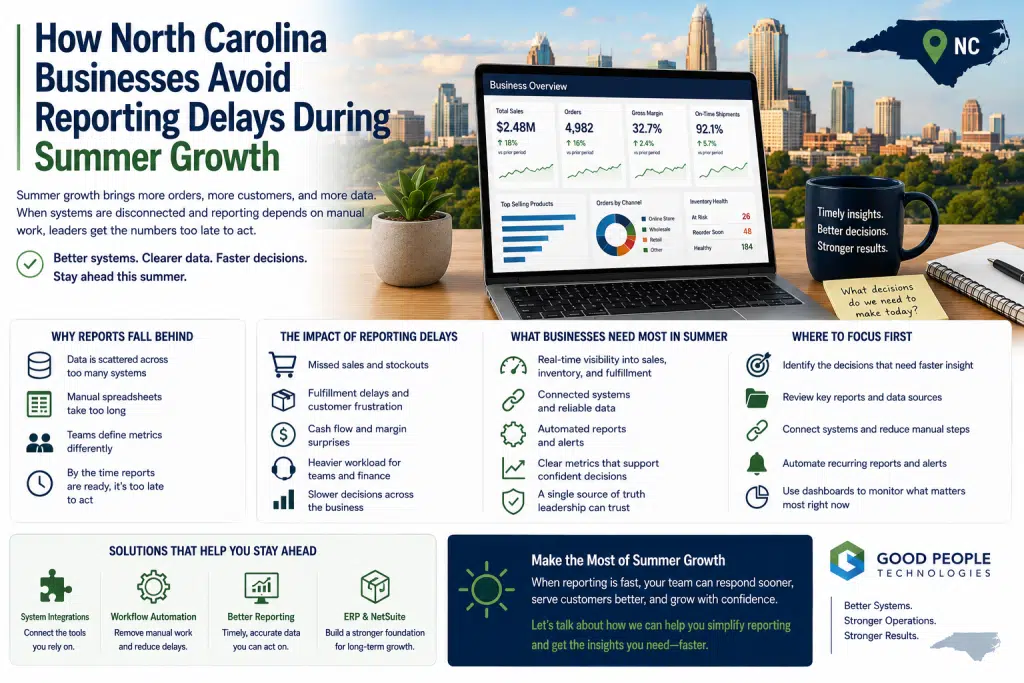
North Carolina summer reporting delays become a real business problem when companies enter a busy season with disconnected systems, manual spreadsheets, slow data cleanup, and limited visibility across sales, operations, inventory, finance, and customer activity. Summer growth can bring more revenue opportunities, but it can also make reporting harder at the exact moment when leadership needs faster, clearer information.
For businesses across Charlotte, Raleigh, Durham, Greensboro, Winston-Salem, Asheville, Wilmington, and other parts of North Carolina, summer can create different types of operational pressure. E-commerce companies may see higher order volume. Outdoor and lifestyle brands may experience seasonal demand spikes. Product-based businesses may deal with faster inventory movement. Service companies may receive more customer requests. Manufacturers and distributors may need to manage supplier timing, fulfillment pressure, and purchasing decisions more carefully.
The common challenge is visibility.
When business activity increases, leaders need to understand what is happening quickly. They need to know which products are selling, where delays are forming, how cash flow is changing, which teams are overloaded, whether inventory is accurate, and whether growth is actually profitable.
If reports arrive late, the business becomes reactive.
A report that was acceptable at the end of the month may not be enough during a fast-moving seasonal period. By the time the numbers are cleaned, combined, and reviewed, the opportunity to act may already be gone.
This article explains why reporting delays happen during summer growth, how they affect North Carolina businesses, and how better systems, automation, integrations, ERP, and reporting workflows can help companies make faster decisions during busy periods.
Why Reporting Delays Become More Painful During Summer Growth
Reporting delays are frustrating in any season.
During summer growth, they become more expensive.
A company may be dealing with more orders, more customer questions, more inventory movement, more service requests, more fulfillment activity, more supplier communication, and more finance reconciliation. At the same time, leadership needs faster visibility into what is working and what needs attention.
A delayed report can hide problems until they become harder to fix.
Inventory may be running low, but purchasing does not see the risk soon enough. A fulfillment issue may be getting worse, but leadership only notices after customers start complaining. A marketing campaign may generate more sales, but the business may not know whether margins are shrinking until the numbers are reviewed later.
Reporting delays also affect team coordination.
Finance may wait for operations. Operations may wait for warehouse updates. Customer service may wait for order status. Leadership may wait for everyone to manually combine data before making decisions.
That slows the entire business.
Summer growth creates momentum, but weak reporting can prevent companies from using that momentum well.
A business needs reports that help teams respond while there is still time to improve outcomes.
Why Summer Growth Creates More Reporting Complexity
Summer growth does not simply mean more sales.
It usually creates more activity across the business.
An e-commerce company may receive more orders, more returns, more shipping questions, and more inventory updates. A product-based business may need to track seasonal SKUs, wholesale commitments, warehouse activity, and purchasing timelines. A service company may manage more appointments, customer inquiries, job updates, invoices, and scheduling pressure.
Every increase creates more data.
The problem is that data may live in different systems.
Sales information may sit in Shopify or another e-commerce platform. Accounting records may live in QuickBooks or NetSuite. Customer updates may be stored in a CRM. Fulfillment status may come from a warehouse system or shipping tool. Inventory may be tracked across spreadsheets, ERP, warehouse software, and sales channels.
When these systems do not connect, reporting becomes manual.
Someone exports data. Another person cleans the spreadsheet. Finance checks numbers against accounting records. Operations adds missing context. Leadership waits for the final version.
That process may work during slower months.
Summer growth exposes the weakness.
Higher volume means more data to collect, more exceptions to explain, and more pressure to act quickly. If reporting workflows are not designed for speed, delays become part of the operating rhythm.
The First Cause: Data Lives in Too Many Places
One of the most common causes of reporting delays is fragmented data.
A business may have useful tools, but those tools may not share information automatically.
For example:
- sales data lives in an e-commerce platform
- financial data lives in accounting software
- inventory data lives in warehouse tools
- customer data lives in a CRM
- support activity lives in a ticketing system
- fulfillment data lives with a shipping provider
- leadership reports live in spreadsheets
None of these tools is necessarily wrong.
The issue appears when leadership needs one clear view of performance.
If data is scattered across platforms, reporting depends on manual collection and cleanup. That creates delays and increases the risk of mistakes.
A report may show revenue but miss fulfillment cost. Another view may show order volume but not inventory availability. A spreadsheet may show customer demand but not margin. Finance may have accurate records, but not enough operational context.
This is why North Carolina summer reporting delays often begin as system integration problems.
The company does not lack data.
It lacks connected data.
Better integrations can help information move between systems faster, which makes reporting more timely and more reliable.
The Second Cause: Spreadsheets Carry Too Much Reporting Work
Spreadsheets are useful.
They help teams analyze information, compare numbers, build custom views, and support planning.
Problems begin when spreadsheets become the main reporting engine.
A growing business may use spreadsheets to combine sales, finance, inventory, fulfillment, customer service, and operational data. During normal periods, this may seem manageable. During summer growth, the workload can increase quickly.
Spreadsheet reporting often creates delays because it depends on manual steps.
A team member exports data from one system. Someone else copies information from another tool. A manager adjusts formulas, checks totals, formats the file, and sends the final version to leadership.
Each step takes time.
Errors can also appear.
A formula may break. A report may use outdated data. One person may update a file while another works from an older version. Manual adjustments may not be documented clearly.
When reports depend on spreadsheets, leadership may not know whether the numbers are current or complete.
That uncertainty slows decision-making.
Spreadsheets can still be useful for analysis, but growing businesses should avoid depending on them as the only source of reporting truth.
The Third Cause: Teams Define Metrics Differently
Reporting delays are not always caused by slow systems.
Sometimes they happen because teams define numbers differently.
Sales may count an order when it is placed. Finance may recognize revenue at a different point. Operations may track fulfilled orders. Customer service may focus on open issues. Inventory teams may separate available stock from committed stock.
Each view may be valid.
The problem appears when the business does not clearly define which metric should be used for which decision.
During summer growth, these differences become more visible.
Leadership may ask a simple question: “How many orders did we process this week?”
Sales, operations, and finance may each produce a different answer because they are measuring different stages of the workflow.
This does not mean anyone is wrong.
It means the company needs clearer reporting definitions.
Good reporting requires shared language.
Businesses should define key metrics before the busy season. Terms like revenue, open order, fulfilled order, available inventory, committed inventory, delayed order, gross margin, customer issue, and return rate should be understood consistently.
When teams agree on definitions, reports become easier to trust.
That reduces delays caused by repeated clarification and reconciliation.
North Carolina Summer Reporting Delays
North Carolina summer reporting delays often happen when seasonal growth increases business activity faster than reporting systems can keep up. A company may have more orders, more inventory movement, more customer requests, more fulfillment pressure, and more financial transactions, but still depend on slow manual reporting workflows.
The result is a visibility gap.
Leadership may know the business is busier, but not know where the pressure is coming from. Sales may increase, but margin may be unclear. Inventory may move faster, but purchasing may not see the risk soon enough. Customer service may be overloaded, but reports may not show the pattern until later.
These delays affect several areas:
- sales performance
- inventory planning
- fulfillment visibility
- cash flow
- customer service workload
- finance reconciliation
- purchasing decisions
- staffing decisions
- operational bottlenecks
- profitability analysis
A business cannot manage seasonal growth well if it only sees the full picture after the season has already moved on.
Solving North Carolina summer reporting delays usually requires a combination of better data flow, cleaner metric definitions, automated reporting, stronger system integrations, and dashboards that show the right information at the right time.
Why Reporting Delays Affect Inventory Decisions
Inventory is one of the first areas affected by reporting delays.
Product-based businesses need timely visibility into what is available, what is committed, what is moving quickly, what is on order, and what is at risk of stockout.
If reports arrive late, purchasing becomes reactive.
A business may not reorder a fast-moving product soon enough. Another company may overbuy because it does not have a clear view of current inventory. Some teams may hold extra safety stock because they do not trust their reports.
During summer growth, timing matters.
If a seasonal product sells out, the missed revenue may not return later. A product that would have sold strongly in July may not perform the same way in September. Delayed inventory reporting can therefore create both missed sales and excess stock.
Inventory reporting should help businesses answer practical questions:
- Which items are selling faster than expected?
- What inventory is already committed?
- Which products are close to stockout?
- What needs to be reordered now?
- Which items are moving slower than planned?
- Where is cash tied up in inventory?
- Are returns affecting available stock?
These questions should not require days of manual reconciliation.
Better integrations between e-commerce, warehouse, accounting, ERP, and reporting tools can help inventory data move more quickly.
Why Reporting Delays Affect Fulfillment
Fulfillment visibility matters during busy periods.
Customers want timely updates. Teams need to know which orders are delayed, which shipments are pending, and where exceptions are forming.
If fulfillment reporting is slow, the company may not see operational problems early enough.
A warehouse may be falling behind. Shipping updates may not be flowing back into customer records. Certain products may be creating more exceptions. Returns may be piling up. Customer service may be answering the same questions repeatedly because fulfillment visibility is limited.
Delayed reporting makes these issues harder to solve.
By the time leadership sees a report, customer experience may already be affected.
Better fulfillment reporting helps teams identify bottlenecks while they are still manageable.
A strong summer reporting process should show:
- open orders
- delayed orders
- shipped orders
- pending fulfillment
- backorders
- return status
- fulfillment exceptions
- customer service pressure
- shipping performance
- warehouse workload
This kind of visibility helps teams respond before small issues become larger customer-facing problems.
Why Reporting Delays Affect Finance
Finance teams often feel summer growth through reconciliation work.
More orders create more transactions. Additional sales channels create more payment records. Returns, refunds, discounts, taxes, shipping fees, and fulfillment costs add complexity.
If finance has to manually collect and clean data from several systems, reporting slows down.
The business may know that revenue increased, but not whether profit improved.
That is a serious problem.
Seasonal growth can look successful on the surface while margins quietly shrink. Higher fulfillment costs, more returns, rush shipping, discounts, or manual labor can reduce profitability.
Finance needs timely data to show the real picture.
Good financial reporting should help leadership understand:
- revenue
- gross margin
- cash flow
- accounts receivable
- payment reconciliation
- refund volume
- product profitability
- channel profitability
- inventory value
- fulfillment costs
North Carolina summer reporting delays become especially costly when finance cannot connect revenue with operational costs quickly enough.
Integrations and ERP can help by connecting accounting with sales, inventory, fulfillment, purchasing, and reporting workflows.
Why Reporting Delays Affect Customer Service
Customer service teams depend on accurate information.
During summer growth, support volume may increase because more customers are placing orders, requesting updates, asking about availability, changing delivery details, or starting returns.
If reporting is delayed, customer service works with incomplete visibility.
A representative may not know whether an order has shipped. Another team member may need to check a warehouse system manually. Someone may respond to a customer using information that is no longer current.
This creates slower response times and more internal chasing.
Reporting should help customer service leaders understand:
- ticket volume
- repeated customer questions
- order-related issues
- delayed response patterns
- return volume
- fulfillment-related complaints
- products causing support pressure
- channels creating the most questions
Without this visibility, customer service becomes reactive.
Automation can reduce some pressure by sending order confirmations, shipping updates, return instructions, and customer notifications automatically.
Better reporting helps managers see where human support is needed most.
How Automation Reduces Reporting Delays
Automation helps reduce reporting delays by removing repetitive manual steps.
Instead of exporting the same data every week, teams can create recurring reports, dashboards, alerts, and workflows that update more reliably.
Automation can support:
- daily sales reports
- low-stock alerts
- fulfillment exception alerts
- overdue order notifications
- customer service volume reports
- finance reconciliation workflows
- purchasing reminders
- return status reporting
- management dashboards
- KPI updates
The goal is not to automate every business decision.
The goal is to automate the repetitive reporting steps that delay decisions.
For example, leadership should not need to wait for someone to manually combine sales, inventory, and fulfillment data before seeing whether a seasonal campaign is creating operational strain.
A purchasing team should not depend on a weekly spreadsheet to learn that a fast-moving product is close to stockout.
Customer service managers should not discover recurring issues only after complaints increase.
Automation helps information reach the right people sooner.
That makes the business more responsive during seasonal growth.
How System Integrations Improve Reporting Speed
Reporting improves when systems share data.
System integrations connect tools so information can move automatically between platforms.
For North Carolina businesses, common integration opportunities include:
- Shopify and accounting software
- QuickBooks and reporting dashboards
- NetSuite and e-commerce systems
- CRM and project management tools
- warehouse systems and ERP
- fulfillment providers and customer service platforms
- payment processors and finance workflows
- inventory systems and purchasing reports
Integrations reduce the need for manual exports and duplicate entry.
They also help teams work from more consistent data.
When sales, inventory, fulfillment, finance, and customer data are connected, reports can be built faster and trusted more easily.
This does not mean every business needs a complex system overhaul.
Some reporting delays can be reduced with targeted integrations.
A company may start by connecting the systems that produce the most important summer performance data. For an e-commerce business, that might mean order, inventory, fulfillment, and accounting data. A service company may prioritize CRM, scheduling, project status, billing, and reporting tools.
If reporting delays are slowing seasonal decisions, Good People Technologies can help review your workflows and identify where integrations would create the most immediate visibility improvements.
When ERP Becomes Necessary
Integrations and automation can solve many reporting delays.
Some companies eventually need ERP.
ERP becomes more relevant when reporting delays are part of a larger operational visibility problem.
A business may need ERP when:
- accounting and operations are disconnected
- inventory is difficult to trust
- reporting depends heavily on spreadsheets
- multiple departments maintain separate records
- purchasing is reactive
- order management is too manual
- leadership lacks real-time visibility
- customer service cannot access accurate status information
- finance spends too much time reconciling operational data
ERP can create a central foundation for finance, inventory, purchasing, orders, customers, fulfillment, reporting, and workflow visibility.
For companies already using NetSuite or considering NetSuite, reporting improvements may involve dashboards, saved searches, workbooks, KPIs, integrations, and process cleanup.
ERP should not be rushed because of one busy season.
However, repeated seasonal reporting problems are a strong signal that the business needs a better system foundation.
A company that experiences the same reporting delays every summer should review whether its current tools can support the next stage of growth.
What Reports Businesses Should Review Before Summer Growth
Businesses can prepare for summer growth by reviewing the reports that matter most before demand increases.
The goal is to identify where reporting will slow down under pressure.
Important reports may include:
- sales by product
- sales by channel
- open orders
- delayed orders
- inventory availability
- committed inventory
- low-stock items
- purchase orders
- supplier delays
- fulfillment status
- return volume
- customer service volume
- payment reconciliation
- margin by product or channel
- cash flow indicators
Each report should be reviewed for usefulness, accuracy, owner, cadence, and decision support.
A practical question helps:
What decision does this report support?
If the answer is unclear, the report may need to be redesigned or retired. If the decision is important but the report is slow, the workflow should be improved before the busy season.
This type of review prevents teams from spending time on reports that do not help the business act.
How to Build a Summer Reporting Readiness Plan
A summer reporting readiness plan does not need to be complicated.
It should focus on the reports and workflows that help leadership manage seasonal growth.
A practical plan can include several steps.
First, identify the decisions that need faster visibility. These may include purchasing, staffing, fulfillment, cash flow, inventory, customer service, or marketing decisions.
Next, list the reports that support those decisions. The team should know who owns each report, where the data comes from, and how often it needs to be reviewed.
After that, find the manual steps. Any report that requires repeated exports, spreadsheet cleanup, manual formatting, or cross-department chasing should be flagged.
Then review the systems involved. If the same data is being moved manually between tools, an integration may be needed.
Finally, decide which dashboards, alerts, or recurring reports should be created before demand increases.
The goal is not perfect reporting.
The goal is timely enough visibility to make better decisions during the season.
Composite Example: A Charlotte E-Commerce Company With Late Reports
Consider a growing e-commerce company in Charlotte.
The business sells seasonal lifestyle products through Shopify, wholesale accounts, and occasional marketplace channels. Summer demand increases after several successful promotions.
Sales look strong, but reporting becomes slow.
Finance needs to reconcile Shopify orders, payment processor data, refunds, shipping costs, and accounting records. Operations tracks fulfillment delays in a spreadsheet. Inventory counts do not always match between Shopify, the warehouse, and internal reports. Customer service receives more shipping questions, but leadership does not see the pattern until later.
The business is growing, but decision-making feels delayed.
After reviewing the reporting process, the company identifies several issues:
- sales and inventory data are not connected clearly
- fulfillment reporting depends on manual updates
- customer service trends are reviewed too late
- finance reconciliation takes too long
- leadership reports require spreadsheet cleanup
- purchasing lacks timely low-stock visibility
The company improves reporting by connecting order, inventory, fulfillment, and accounting data more effectively. Automated alerts help purchasing respond sooner. Customer service reporting becomes easier to review. Leadership receives a clearer weekly view during the busy season.
The result is not perfect reporting.
It is better timing, fewer surprises, and more confident decisions.
Composite Example: A Raleigh Service Company Managing Summer Growth
A service company near Raleigh faces a different reporting challenge.
Summer creates more customer inquiries, scheduled work, team coordination, and billing activity. The company uses CRM software, scheduling tools, accounting software, and spreadsheets.
Reports are available, but they take too long to prepare.
Leadership wants to understand customer demand, open jobs, team capacity, billing status, and service delays. Instead, managers spend time collecting data from different systems and reconciling spreadsheets.
By the time leadership sees the report, the team has already made several decisions without complete visibility.
The business reviews its reporting workflow and identifies the biggest gaps:
- CRM and scheduling data do not connect well
- billing updates lag behind completed work
- team capacity is tracked manually
- recurring reports are rebuilt from exports
- customer demand trends are not visible early enough
The company begins improving integrations between CRM, scheduling, billing, and reporting tools. It also automates recurring reports so leadership can review demand and capacity more frequently.
For service businesses, North Carolina summer reporting delays may not involve inventory, but they still affect scheduling, staffing, billing, and customer experience.
How Good People Technologies Helps Reduce Reporting Delays
Good People Technologies helps growing businesses improve reporting visibility through system integrations, workflow automation, ERP support, and practical technology strategy.
For companies dealing with reporting delays, this can include:
- reviewing current reporting workflows
- identifying manual reporting steps
- connecting disconnected systems
- improving ERP or NetSuite reporting
- automating recurring reports
- creating clearer dashboards
- reducing spreadsheet dependency
- improving inventory and fulfillment visibility
- connecting finance and operations data
- building seasonal reporting readiness plans
The work starts with understanding which decisions need better visibility.
Some companies need targeted integrations. Others need automation around recurring reports. More complex businesses may need ERP improvements, NetSuite dashboards, saved searches, or broader reporting architecture.
If your team is entering a busy season with slow reports, unclear numbers, or too much spreadsheet work, Good People Technologies can help identify where better systems would create the most value.
Final Thoughts
North Carolina summer reporting delays can make seasonal growth harder to manage because busy periods require faster decisions, not slower reports.
More sales, more customers, more orders, more inventory movement, more service requests, and more finance activity all create additional reporting pressure. When data lives across disconnected systems and spreadsheets, leadership may not see the full picture until it is too late to act.
The good news is that reporting delays can be reduced.
Businesses can prepare by defining key metrics, connecting systems, automating repetitive reporting steps, improving dashboards, reviewing decision-support reports, and evaluating whether ERP or NetSuite improvements are needed.
Summer growth should give companies more opportunity, not more confusion.
With stronger reporting workflows, North Carolina businesses can respond faster, protect margins, improve customer experience, and manage busy seasons with more confidence.
Frequently Asked Questions
What causes reporting delays during summer growth?
Reporting delays usually happen when sales, inventory, finance, fulfillment, customer service, and operational data live in disconnected systems or manual spreadsheets.
Why are reporting delays more serious during summer?
Summer growth often increases order volume, customer demand, fulfillment pressure, inventory movement, and finance reconciliation. Businesses need faster visibility during these periods.
How can businesses avoid reporting delays?
Businesses can avoid reporting delays by connecting systems, automating recurring reports, defining key metrics, improving dashboards, reducing spreadsheet dependency, and reviewing report ownership before demand increases.
What reports should businesses monitor during summer growth?
Important reports may include sales by product, inventory availability, open orders, delayed orders, fulfillment status, customer service volume, purchasing needs, cash flow, margins, and returns.
Can automation reduce reporting delays?
Yes. Automation can reduce reporting delays by creating recurring reports, updating dashboards, sending alerts, routing exceptions, and reducing manual data exports.
How do integrations improve reporting?
Integrations improve reporting by allowing data to move between systems automatically. This reduces manual cleanup and helps teams work from more accurate information.
When does ERP help with reporting delays?
ERP helps when reporting delays are caused by disconnected finance, inventory, purchasing, order management, fulfillment, and customer data. ERP can create a more connected reporting foundation.
Can NetSuite help reduce reporting delays?
Yes. NetSuite can help businesses improve reporting through dashboards, saved searches, workbooks, KPIs, and connected ERP data when configured around business needs.
Why are spreadsheets risky for reporting?
Spreadsheets become risky when they are the main reporting system. They can be outdated, inconsistent, manual, dependent on one person, and disconnected from real-time data.
How can Good People Technologies help with reporting delays?
Good People Technologies helps businesses review reporting workflows, connect systems, automate reports, improve ERP or NetSuite visibility, and build practical reporting roadmaps.

Roman is a B2B marketing specialist focused on technology, ERP systems, business automation, and digital growth strategies. At Good People Technologies, he helps translate complex technology solutions—such as ERP integrations, system integrations, and business process automation—into clear insights for founders, operators, and growing companies.
His work focuses on content strategy, SEO, and thought leadership that helps businesses understand how the right technology infrastructure can support scalable operations and sustainable growth.
At Good People Technologies, Roman contributes to content that explores ERP implementation, automation strategies, and system integration best practices for companies navigating rapid growth and operational complexity.