
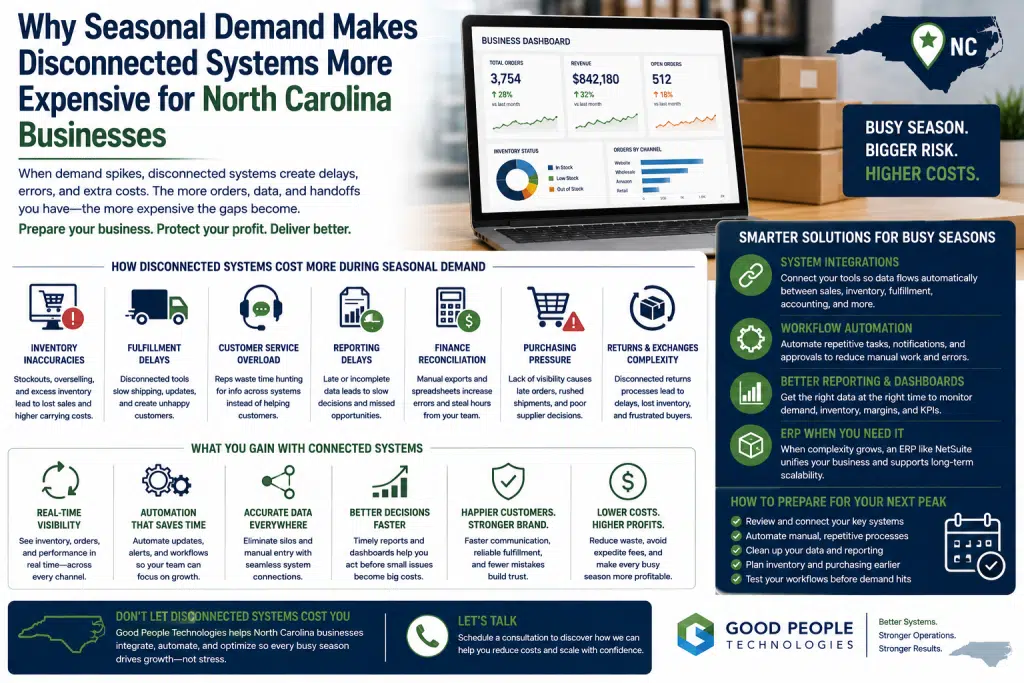
North Carolina seasonal demand disconnected systems can become a serious cost problem when businesses enter busy periods without the technology foundation needed to handle higher order volume, faster inventory movement, more customer communication, and increased reporting pressure. During slower months, disconnected tools may feel inconvenient but manageable. During seasonal spikes, those same gaps can create delays, errors, missed revenue, higher labor costs, and customer frustration.
For businesses across Charlotte, Raleigh, Durham, Greensboro, Winston-Salem, Asheville, Wilmington, and other parts of North Carolina, seasonal demand can come from many directions. E-commerce companies may see summer order spikes. Outdoor and lifestyle brands may sell more during warm-weather months. Product-based businesses may prepare for tourism, events, wholesale cycles, school seasons, or holiday inventory planning. Service companies may experience seasonal booking pressure, while manufacturers may face production and supplier timing challenges.
The challenge is not only that demand increases.
The deeper issue is that seasonal demand makes every weak system connection more expensive.
If sales data does not sync with inventory, overselling becomes more likely. When warehouse systems do not update customer service tools, support teams spend more time chasing answers. If accounting software is disconnected from e-commerce or fulfillment platforms, finance spends more time reconciling reports. When leadership relies on spreadsheets, decisions are often delayed until the seasonal rush has already created problems.
This article explains why seasonal demand makes disconnected systems more expensive for North Carolina businesses, which bottlenecks usually appear first, and how integrations, automation, ERP, and better workflows can help companies handle busy periods with more control.
Why Disconnected Systems Feel Manageable Until Demand Increases
Disconnected systems are common in growing businesses.
A company may use QuickBooks for accounting, Shopify for e-commerce, spreadsheets for inventory planning, a CRM for customer records, a warehouse tool for fulfillment, email for approvals, and separate dashboards for reporting.
At low volume, this setup can work.
Employees have enough time to check multiple systems, update spreadsheets, correct data manually, and communicate across departments. A few delays may not feel urgent because the team can still catch issues before they affect customers.
Seasonal demand changes the math.
Higher volume means more orders, more transactions, more inventory updates, more shipping activity, more customer questions, more supplier communication, and more reporting needs. Each disconnected workflow now creates more manual work.
A process that takes five minutes may not matter if it happens ten times a week. The same process becomes expensive when it happens hundreds of times during a busy period.
That is why seasonal demand often reveals technology weaknesses that were already there.
The systems did not suddenly become disconnected. The business simply reached a volume where the cost became harder to ignore.
Seasonal Demand Increases the Cost of Manual Work
Manual work becomes more expensive during busy periods because every task repeats more often.
A team may manually copy customer details from one system into another. Someone may update inventory spreadsheets after orders. Finance may reconcile sales manually at the end of the week. Customer service may check several tools before answering a basic order question.
During normal demand, those tasks may feel like part of the job.
When seasonal volume increases, they become a bottleneck.
Manual work creates costs in several ways.
First, employees spend more time on repetitive tasks instead of higher-value work. Operations teams are pulled into data cleanup. Finance spends extra time reconciling reports. Customer service answers preventable questions. Managers get involved in exceptions that could have been avoided.
Accuracy also suffers. The more often data is entered manually, the more chances there are for mistakes. A wrong SKU, incorrect quantity, delayed update, or missed customer note can create downstream problems.
Speed becomes another issue. Information does not move until someone moves it. If the team is already busy, updates happen later, and the business starts working from outdated information.
North Carolina seasonal demand disconnected systems often become expensive because they turn people into the integration layer between tools.
That is not a scalable way to operate.
Inventory Problems Become More Expensive During Seasonal Peaks
Inventory is one of the first areas where disconnected systems create cost during seasonal demand.
A product-based business may sell through Shopify, Amazon, wholesale customers, retail partners, local events, or direct sales. Each channel affects available inventory.
If those channels do not share data reliably, the business may not know what is truly available.
That creates several expensive problems:
- overselling products
- stockouts during peak demand
- excess inventory after the season ends
- delayed fulfillment
- canceled orders
- poor purchasing decisions
- customer service pressure
- inaccurate financial reports
Seasonal inventory problems are expensive because timing matters.
If a business stocks out during a short demand window, the lost sales may not come back. A summer product that sells out in June may not generate the same revenue if restocked in September. A seasonal promotion may drive traffic, but weak inventory visibility can prevent the business from capturing the opportunity.
Disconnected inventory systems also affect cash flow.
A company may overbuy because it cannot trust stock data. Another business may underbuy because reports do not show true demand early enough. Some teams hold too much safety stock because they do not feel confident in their systems.
Better integrations can help inventory data move between e-commerce, warehouse, accounting, fulfillment, and reporting tools. ERP may become necessary when inventory complexity connects deeply with purchasing, accounting, sales, and operations.
Fulfillment Delays Hurt Customer Trust
Seasonal demand puts extra pressure on fulfillment.
More orders need to be picked, packed, shipped, tracked, updated, and sometimes returned. If order data, warehouse tools, shipping platforms, and customer communication systems are disconnected, fulfillment teams lose speed.
The problem often appears in small ways.
Shipping updates may not flow back to the customer record automatically. Customer service may not know whether an order has shipped. Warehouse teams may receive incomplete order details. Returns may not update inventory correctly. Finance may not see fulfillment-related costs clearly.
These small gaps affect the customer experience.
Customers expect accurate updates, especially when they are buying around a seasonal need. A delayed product may miss a trip, event, promotion, or time-sensitive use case. If communication is slow, frustration increases.
Fulfillment delays are not only operational problems.
They can become brand problems.
A customer may not care which internal system caused the delay. They only know the business did not deliver as expected.
When North Carolina seasonal demand disconnected systems affect fulfillment, the cost can show up as refunds, support tickets, negative reviews, lost repeat purchases, and lower customer trust.
Customer Service Gets Overloaded
Customer service volume usually increases during busy seasons.
More orders create more questions. Customers ask about shipping, availability, returns, exchanges, delivery timing, payment confirmation, and order changes.
Disconnected systems make these questions harder to answer.
A customer service representative may need to check the e-commerce platform, warehouse system, shipping tool, payment platform, inventory spreadsheet, and internal messages before responding. That slows response time and increases employee frustration.
Many customer questions can be prevented with better system connections.
Order confirmations can be automated. Shipping updates can trigger automatically. Return instructions can be sent without manual effort. Inventory availability can be clearer on the website. Support tools can connect with order data so employees have the context they need.
The goal is not to remove human service.
The goal is to stop wasting human service time on questions that systems should answer automatically.
During seasonal demand, customer service teams should focus on exceptions, high-value conversations, and customer care. They should not spend most of their day chasing information across disconnected tools.
Reporting Delays Become More Dangerous
During busy periods, leadership needs fast visibility.
A company needs to know what is selling, where delays are happening, which products are at risk of stockout, what orders need attention, how returns are trending, whether margins are holding, and how much pressure teams are carrying.
If reporting depends on manual exports and spreadsheets, leaders may see problems too late.
A delayed report can lead to missed decisions.
Inventory may be running low, but purchasing does not react quickly enough. Fulfillment delays may be increasing, but leadership sees the pattern after customer complaints rise. A promotion may generate revenue, but high shipping costs or returns may reduce profitability. Customer service may be overloaded, but the business may not recognize the issue until response times worsen.
Disconnected systems create reporting gaps because important data lives in different places.
Finance may have revenue data. Operations may have fulfillment data. Customer service may have complaint patterns. Inventory may live in a warehouse system. E-commerce platforms may show sales velocity. Spreadsheets may hold manual adjustments.
A business needs those pieces connected to make better decisions.
North Carolina seasonal demand disconnected systems are especially costly when leadership cannot see what is happening while there is still time to respond.
North Carolina Seasonal Demand Disconnected Systems
NC seasonal demand disconnected systems become more expensive because seasonal growth increases the number of transactions, handoffs, updates, decisions, and exceptions moving through the business. When systems do not communicate, each additional unit of demand creates more manual coordination.
The most common cost areas include:
- duplicate data entry
- slow inventory updates
- delayed fulfillment visibility
- customer service overload
- manual financial reconciliation
- inaccurate reporting
- missed purchasing signals
- poor return handling
- spreadsheet dependency
- leadership blind spots
A business may not notice the full cost during slower months because employees can compensate. During seasonal peaks, that compensation becomes harder.
People work longer hours. Managers spend more time resolving issues. Customers wait longer for answers. Finance closes reports more slowly. Operations becomes reactive.
The company may still generate more sales, but the extra revenue may come with higher hidden costs.
That is why seasonal demand should be used as a systems test.
If operations feel chaotic every time demand increases, the business likely needs better integrations, workflow automation, ERP planning, or reporting improvements before the next busy period.
Finance Reconciliation Becomes Harder
Seasonal demand often creates more financial complexity.
More sales mean more transactions, payment processor fees, refunds, discounts, shipping costs, tax details, wholesale invoices, marketplace payouts, and accounting entries.
If finance systems are disconnected from order, inventory, and fulfillment systems, reconciliation becomes time-consuming.
A finance team may need to compare Shopify data, QuickBooks records, payment processor reports, warehouse charges, shipping fees, and spreadsheets. Every manual step adds time and increases the risk of errors.
The business may know sales increased, but not whether profit improved.
That is a serious visibility problem.
Higher revenue does not always mean better performance. Seasonal promotions may increase order volume while lowering margins. Shipping costs may rise. Returns may increase. Inventory write-offs may reduce profitability. Manual labor may expand.
Finance needs connected data to understand the real cost of seasonal growth.
Better integrations between e-commerce, accounting, payment processors, fulfillment, and reporting tools can reduce manual reconciliation. ERP may become valuable when finance needs a central view across orders, inventory, purchasing, fulfillment, and profitability.
Supplier and Purchasing Problems Get More Urgent
Seasonal demand makes purchasing timing more important.
A product-based company needs to understand what is selling, what is on hand, what is committed, what is on order, and what suppliers can deliver in time.
Disconnected systems make this difficult.
Purchasing may rely on spreadsheets, email threads, manual reorder checks, or outdated reports. If sales increase quickly, the team may not see the inventory risk soon enough.
Supplier delays become more expensive during busy periods because replacement opportunities may be limited. A late purchase order can create stockouts. Poor visibility into lead times can cause rushed orders, higher shipping costs, or missed sales.
Manufacturers may feel this pressure even more strongly.
Raw materials, components, packaging, and work-in-progress all need accurate tracking. If purchasing does not see production needs early, customer commitments may be affected.
A stronger system environment can improve purchasing by connecting demand signals, inventory data, supplier records, purchase orders, and reporting.
When purchasing becomes proactive instead of reactive, seasonal demand becomes easier to manage.
Returns and Exchanges Create Additional Complexity
Returns and exchanges increase the cost of disconnected systems because they touch several departments.
A return may involve customer service, warehouse processing, inventory updates, accounting, refunds, replacement orders, and reporting.
If these steps are not connected, the process becomes messy.
A returned item may arrive but not be added back into inventory. A refund may be issued before inspection. Customer service may not see return status. Finance may need to reconcile refunds manually. Warehouse teams may process returns inconsistently.
During seasonal peaks, return volume can increase quickly.
A weak returns workflow can affect customer experience and inventory accuracy at the same time.
Automation can help with return instructions, status updates, task routing, and customer communication. Integrations can connect returns with inventory, accounting, and order records.
Human review still matters, especially for damaged items, high-value products, or unusual cases. However, the basic workflow should not depend on scattered emails and manual tracking.
Spreadsheet Workarounds Stop Scaling
Spreadsheets often help growing businesses move quickly.
They are flexible and easy to create.
A team might use spreadsheets for seasonal forecasting, inventory planning, order exceptions, wholesale commitments, customer follow-ups, reporting, supplier tracking, or fulfillment notes.
The problem begins when spreadsheets become part of core operations.
During seasonal demand, spreadsheet workarounds become fragile.
Files may not update in real time. Multiple people may change different versions. Formulas can break. One person may become the only person who understands the workflow. Data may not connect with systems used by finance, operations, customer service, or leadership.
A spreadsheet can support analysis, but it should not be the only place where critical operational truth lives.
If a seasonal rush depends on one spreadsheet being perfectly maintained, the business is exposed to risk.
North Carolina seasonal demand disconnected systems often include spreadsheet dependency because spreadsheets are used to fill gaps between tools that should be integrated.
Composite Example: A Charlotte E-Commerce Brand During Summer Demand
Consider a growing e-commerce brand in Charlotte.
The company sells lifestyle products through Shopify, wholesale accounts, and occasional marketplace channels. During summer, a few products become popular after a successful campaign.
Orders increase quickly.
The team is excited, but operations begin to strain.
Inventory counts do not match across Shopify, the warehouse system, and spreadsheets. Customer service receives more questions about shipping and availability. Finance spends extra time reconciling sales, payment fees, refunds, and inventory adjustments. Fulfillment updates do not always reach customer records quickly.
The company generates more revenue, but the team feels overwhelmed.
After reviewing workflows, leadership finds several root causes:
- inventory updates are not syncing reliably
- order data does not flow cleanly into accounting
- customer notifications require manual effort
- returns are handled inconsistently
- reporting takes too long during busy weeks
- wholesale commitments are tracked outside the main system
The company decides to improve integrations before the next seasonal peak.
Shopify, accounting, fulfillment, and reporting workflows are connected more clearly. Automated order and shipping updates reduce customer service pressure. Low-stock alerts help purchasing respond earlier.
The next busy period is still demanding, but the business handles it with more control.
The lesson is clear: seasonal demand did not create the system problems. It exposed them.
Composite Example: A Raleigh Distributor With Purchasing Pressure
A distributor near Raleigh sells products to regional customers and wholesale buyers.
During a seasonal demand cycle, orders increase faster than expected. The sales team sees strong customer interest, but purchasing does not have real-time visibility into demand. Inventory reports are updated manually. Supplier lead times are tracked through email. Finance waits for reconciled reports before leadership can review performance.
Problems begin to stack up.
A few fast-moving items stock out. Some slow-moving products are over-ordered. Customer service spends more time explaining delays. Leadership cannot easily see which products are profitable during the seasonal cycle.
The business initially considers adding another operations coordinator.
After mapping the process, leaders realize the issue is not just staffing. It is visibility.
The company improves demand reporting, connects inventory and order data more clearly, and creates better purchasing alerts. Over time, it also evaluates whether ERP could provide a stronger foundation for inventory, purchasing, finance, and reporting.
For this distributor, North Carolina seasonal demand disconnected systems create costs through delayed purchasing signals and weak reporting.
Better systems help the business respond before problems reach customers.
How Integrations Reduce Seasonal Cost
System integrations help businesses reduce the cost of disconnected tools.
Instead of relying on employees to move data manually, integrations allow systems to share information more reliably.
Common integration opportunities include:
- e-commerce and accounting
- CRM and project management
- inventory and warehouse systems
- fulfillment and customer service
- shipping and order management
- payment processors and finance
- ERP and reporting dashboards
- wholesale platforms and inventory records
The goal is not simply technical connection.
The business outcome is reduced friction.
Integrations can help companies reduce duplicate data entry, improve inventory accuracy, speed up reporting, automate updates, and give teams better visibility.
For businesses dealing with seasonal demand, integrations can create immediate value because they reduce the manual workload that expands during busy periods.
If your business experiences the same operational problems every busy season, Good People Technologies can help review your workflows and identify where integrations would reduce the most pressure.
How Automation Helps During Seasonal Spikes
Automation helps reduce repetitive work during busy periods.
Useful seasonal automations may include:
- order confirmations
- shipping notifications
- low-stock alerts
- reorder reminders
- customer service routing
- return instructions
- invoice creation
- payment reminders
- report generation
- fulfillment exception alerts
- approval workflows
Automation works best when a task is frequent, predictable, and time-sensitive.
For example, customers should not wait for a person to manually send basic shipping updates. Purchasing should not depend entirely on someone checking a spreadsheet. Leadership should not need to wait for manual report building every time demand increases.
Automation supports the team by removing repetitive steps.
It does not replace judgment.
Employees still need to handle exceptions, customer relationships, supplier conversations, unusual orders, and operational decisions. Automation simply gives them more time and better information.
When ERP Becomes Necessary
Integrations and automation can solve many seasonal problems.
Some businesses eventually need ERP.
ERP becomes more important when disconnected systems are not just causing one or two issues, but affecting the entire operating model.
A company may need ERP when:
- accounting and operations are disconnected
- inventory is difficult to trust
- purchasing is reactive
- reporting takes too long
- order management is too manual
- customer visibility is limited
- multiple locations or channels create confusion
- leadership lacks real-time insight
- spreadsheets run core workflows
ERP can create a central foundation for finance, inventory, purchasing, order management, customer records, reporting, and workflow visibility.
However, ERP should not be rushed because of one busy season.
A better approach is to review patterns. If every seasonal spike creates the same problems, the business likely needs a more durable system foundation.
Good People Technologies can help evaluate whether automation, integrations, ERP, or a phased roadmap makes the most sense for your current stage of growth.
How to Prepare Before the Next Seasonal Peak
Businesses should review systems before demand increases.
A practical readiness review can start with several questions:
- Which workflows slow down during busy periods?
- Where does the same data get entered twice?
- Which systems show conflicting numbers?
- Which reports take too long?
- What customer questions repeat most often?
- Where do fulfillment updates get delayed?
- Which inventory problems happen every season?
- What purchasing decisions are made too late?
- Which spreadsheets are required to keep operations moving?
- Where does leadership lack visibility?
After answering these questions, prioritize the workflows that create the most customer impact, labor cost, or reporting delay.
Start with the problems that repeat.
A one-time issue may not need a major system change. A seasonal pattern is different. Repeated bottlenecks usually indicate that the current system environment is not ready for growth.
The best improvements are often phased.
Connect the most important systems first. Automate repetitive tasks. Improve reporting. Clean data. Then evaluate ERP if the business needs a stronger operational foundation.
How Good People Technologies Helps North Carolina Businesses
Good People Technologies helps growing businesses improve operations through system integrations, workflow automation, ERP support, and technology strategy.
For seasonal demand challenges, this can include:
- reviewing current software and workflows
- identifying disconnected systems
- mapping manual data entry points
- improving inventory visibility
- connecting e-commerce and accounting platforms
- automating customer updates
- improving reporting dashboards
- reducing spreadsheet dependency
- evaluating ERP readiness
- building phased technology roadmaps
The work starts with understanding where seasonal pressure creates the most cost.
Some companies need better integrations. Others need automation around repetitive workflows. More complex businesses may need ERP or ERP optimization.
The goal is to help companies handle growth without adding unnecessary manual work, delays, and system confusion.
Final Thoughts
North Carolina seasonal demand disconnected systems become more expensive because busy periods increase everything at once: orders, inventory movement, customer questions, fulfillment activity, returns, supplier communication, finance reconciliation, and reporting pressure.
During slower months, teams may be able to compensate for disconnected systems manually.
Seasonal demand makes that approach harder.
Manual work multiplies. Inventory problems appear faster. Customer service gets overloaded. Reports arrive too late. Purchasing becomes reactive. Finance spends more time reconciling information. Leadership loses visibility when it needs it most.
The good news is that these problems can be improved.
With better system integrations, automation, ERP planning, reporting workflows, and process design, North Carolina businesses can reduce the cost of seasonal demand and build operations that scale with more confidence.
A busy season should not expose the same problems every year.
With the right systems, it can become a growth opportunity instead of an operational stress test.
Frequently Asked Questions
Why does seasonal demand make disconnected systems more expensive?
Seasonal demand makes disconnected systems more expensive because higher volume creates more manual work, more data movement, more customer questions, more inventory updates, and more reporting pressure.
What are disconnected systems in business?
Disconnected systems are software tools that do not share data reliably. Examples include separate accounting, e-commerce, inventory, warehouse, CRM, fulfillment, and reporting platforms.
How do disconnected systems affect seasonal inventory?
Disconnected systems affect seasonal inventory by creating inaccurate stock levels, delayed updates, overselling, stockouts, excess inventory, and poor purchasing decisions.
Can system integrations reduce seasonal bottlenecks?
Yes. System integrations can reduce seasonal bottlenecks by connecting tools, reducing manual data entry, improving inventory visibility, speeding up reporting, and helping teams access accurate information.
How does automation help during busy seasons?
Automation helps by handling repetitive tasks such as order confirmations, shipping updates, low-stock alerts, return instructions, customer service routing, and recurring reports.
When should a business consider ERP?
A business should consider ERP when disconnected systems affect accounting, inventory, purchasing, order management, reporting, customer service, and leadership visibility across the company.
Why do spreadsheets become risky during seasonal demand?
Spreadsheets become risky because they require manual updates, may not reflect real-time data, can contain errors, and often depend on one person or one version of the file.
How can businesses prepare before seasonal demand increases?
Businesses can prepare by reviewing workflows, identifying manual tasks, connecting key systems, automating repetitive updates, improving reporting, and evaluating whether ERP is needed.
What businesses are most affected by seasonal system problems?
E-commerce companies, product-based businesses, manufacturers, distributors, outdoor brands, lifestyle brands, retailers, and service companies can all be affected when seasonal demand increases.
How can Good People Technologies help?
Good People Technologies helps businesses review systems, identify bottlenecks, improve integrations, automate workflows, evaluate ERP readiness, and build scalable technology roadmaps.

Roman is a B2B marketing specialist focused on technology, ERP systems, business automation, and digital growth strategies. At Good People Technologies, he helps translate complex technology solutions—such as ERP integrations, system integrations, and business process automation—into clear insights for founders, operators, and growing companies.
His work focuses on content strategy, SEO, and thought leadership that helps businesses understand how the right technology infrastructure can support scalable operations and sustainable growth.
At Good People Technologies, Roman contributes to content that explores ERP implementation, automation strategies, and system integration best practices for companies navigating rapid growth and operational complexity.