
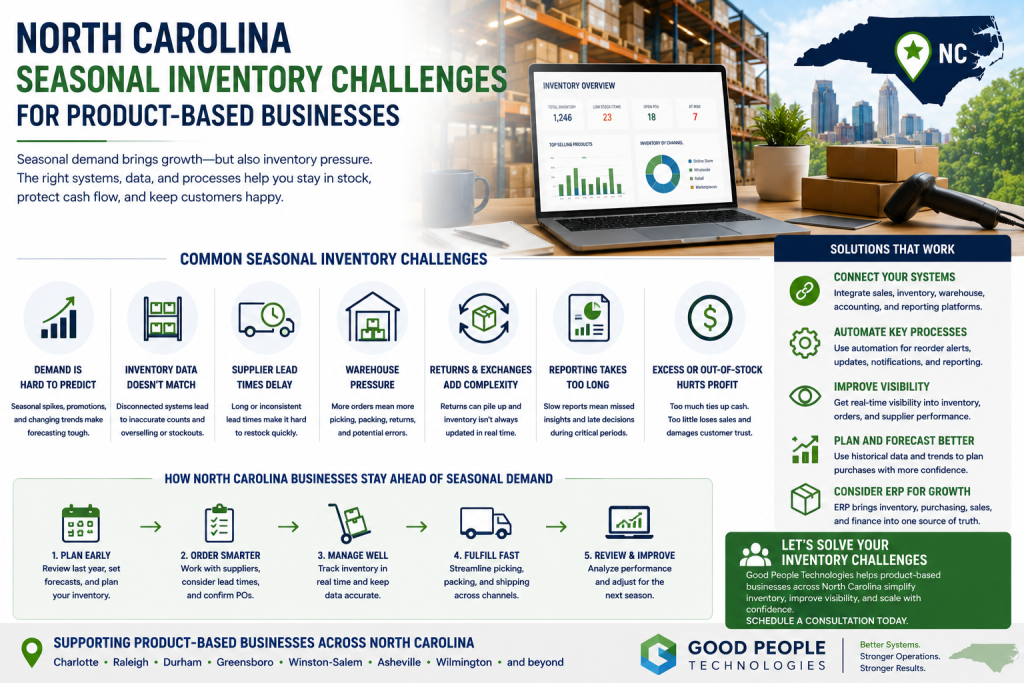
North Carolina seasonal inventory challenges become especially difficult for product-based businesses when demand changes quickly, sales channels get busier, suppliers move slower, and inventory data is spread across disconnected systems. A business may feel prepared at the start of the season, but a few weeks of higher demand can expose problems in forecasting, purchasing, fulfillment, reporting, and warehouse visibility.
For companies across Charlotte, Raleigh, Durham, Greensboro, Winston-Salem, Asheville, Wilmington, and other parts of North Carolina, seasonal inventory pressure can come from many directions. Summer demand may increase for outdoor products, apparel, home goods, food and beverage items, lifestyle brands, travel-related products, regional merchandise, and specialty consumer goods. Other businesses may see peaks around tourism, events, wholesale buying cycles, or back-to-school preparation.
The problem is not only that customers buy more.
Seasonal demand changes how inventory moves through the entire business.
Products sell faster. Reorder timing becomes more important. Returns may increase. Warehouse teams handle more movement. Customer service needs better availability information. Finance needs accurate inventory valuation. Leadership wants to know which products are moving, which items are at risk, and whether seasonal growth is actually profitable.
When systems are connected and workflows are clear, a busy season can become a growth opportunity.
If inventory is managed through spreadsheets, manual updates, disconnected sales channels, delayed warehouse data, or outdated reports, the same seasonal demand can create confusion and lost revenue.
This article explains why product-based businesses in North Carolina struggle with seasonal inventory, which bottlenecks usually appear first, and how integrations, automation, ERP, and better process design can help companies handle seasonal demand with more control.
Why Seasonal Inventory Is Harder Than Regular Inventory
Inventory is already complex during normal business periods.
A product-based company needs to know what is available, what has been sold, what is committed, what is on order, what is being returned, and what should be reordered.
Seasonal demand makes every one of those questions more urgent.
During slower periods, a company may be able to manage inventory with extra manual checks. A team member can look at a spreadsheet, confirm warehouse availability, review open orders, and make a purchasing decision.
That process becomes harder when sales accelerate.
Inventory moves faster than reports are updated. Products that were stable for months may suddenly sell out. A supplier delay that was manageable in March can become a serious issue in July. If purchasing waits too long, the business may miss the seasonal window entirely.
Seasonal inventory is difficult because timing matters.
Ordering too late creates stockouts. Buying too much creates excess inventory after demand slows. Failing to track fast-moving items can cause missed sales. Poor visibility into slow-moving products can tie up cash in items that do not perform.
A product-based business needs to balance speed, accuracy, and cash flow.
That is why North Carolina seasonal inventory challenges should be treated as a planning and systems issue, not just a warehouse issue.
Why Product-Based Businesses in North Carolina Feel Seasonal Pressure
North Carolina has many product-based businesses that operate across retail, e-commerce, wholesale, manufacturing, distribution, local food and beverage, outdoor products, apparel, home goods, specialty consumer goods, and regional lifestyle brands.
Many of these companies are not huge enterprises. They are small or mid-sized businesses that have grown over time with practical tools and hands-on processes.
A Charlotte e-commerce brand may sell through Shopify, wholesale accounts, and seasonal promotions. A Wilmington business may see product demand tied to tourism and coastal activity. A manufacturer near Greensboro may need better raw material visibility before a peak production period. An Asheville outdoor or lifestyle brand may experience warm-weather sales spikes across online and retail channels.
The local industries differ, but the operational pattern is similar.
Seasonal demand increases pressure on systems that were already stretched.
A business may rely on:
- QuickBooks for accounting
- Shopify or WooCommerce for online sales
- spreadsheets for inventory planning
- warehouse software for fulfillment
- email for supplier communication
- manual reports for leadership visibility
- marketplace tools for additional sales channels
Each tool may serve a purpose. Problems appear when inventory data does not move cleanly between them.
Seasonal demand makes disconnected systems more expensive because the business has less time to correct mistakes manually.
The First Problem: Forecasting Demand Is Difficult
Forecasting is one of the hardest parts of seasonal inventory management.
A product-based business needs to estimate demand before the season peaks. That means looking at historical sales, current trends, supplier lead times, marketing plans, wholesale orders, promotions, and customer behavior.
Many companies make forecasting harder by relying too heavily on spreadsheets or memory.
A manager may remember that a product sold well last summer. Another team member may expect a promotion to perform strongly. Sales may be optimistic based on customer interest. Purchasing may place orders based on last year’s numbers without adjusting for new channels or current inventory.
Some of that judgment is useful.
However, seasonal inventory decisions need better data.
If historical sales, current stock, open purchase orders, sales channel activity, and supplier timelines are not connected, forecasting becomes a guessing game.
Poor forecasting creates two common problems.
The first is understocking. The business sells out too early, loses revenue, disappoints customers, and may not be able to restock before demand fades.
Overstocking creates a different issue. Cash gets tied up in products that may not sell after the season ends. Storage costs increase, discounts may become necessary, and margins can shrink.
Better forecasting starts with better visibility.
Product-based businesses need to understand what sold before, what is selling now, what is committed, what is on order, and what demand signals are changing.
Without that foundation, North Carolina seasonal inventory challenges become harder to manage every year.
The Second Problem: Inventory Data Does Not Match Across Systems
Inventory mismatch is one of the most common problems during busy seasons.
The e-commerce platform may show one number. A warehouse system may show another. Accounting may reflect inventory after financial posting. A spreadsheet may be updated at the end of the day. Wholesale commitments may be tracked separately.
When those numbers do not match, teams stop trusting the system.
Customer service may need to confirm availability manually before responding to customers. Purchasing may hesitate before reordering. Operations may spend extra time checking actual stock. Finance may struggle to reconcile inventory value.
This slows down the entire business.
During seasonal peaks, delayed inventory visibility can quickly affect revenue.
If a product appears available online but is already committed elsewhere, the company may oversell. When the system shows an item as unavailable even though stock exists, the business may lose sales unnecessarily. A wholesale order may reserve inventory that the e-commerce team still thinks is available.
These problems often happen because there is no clear source of truth.
A business needs to decide which system owns inventory data and how other platforms should update from that source.
For some companies, that source may be ERP. Others may use a warehouse system, inventory platform, or e-commerce-connected inventory tool. The exact answer depends on the company, but the principle is the same: inventory data needs ownership.
Without ownership, seasonal demand creates confusion.
North Carolina Seasonal Inventory Challenges
North Carolina seasonal inventory challenges often become visible when product movement increases faster than the business’s systems can handle. A company may be able to manage normal sales volume with manual checks, but seasonal peaks create more orders, returns, supplier communication, warehouse activity, and reporting pressure.
The issue is not just having enough inventory.
Product-based businesses also need to know where inventory is, how quickly it is moving, which products are committed, what needs to be reordered, and how inventory affects cash flow.
Seasonal pressure can create problems such as:
- stockouts
- overselling
- excess inventory
- warehouse confusion
- slow fulfillment
- delayed purchasing
- poor reporting
- inaccurate inventory valuation
- customer service delays
- rushed supplier decisions
Many of these problems come from the same root cause: the business has outgrown manual inventory management.
A company may have grown from a simple operation into a multi-channel product business without redesigning its systems. What worked when the team had fewer orders and fewer SKUs may no longer support seasonal demand.
That is why solving North Carolina seasonal inventory challenges usually requires better data flow, stronger workflows, and clearer operational visibility.
Supplier Lead Times Become More Important
Seasonal inventory problems often begin before the season starts.
Purchasing teams need to order enough inventory early enough to meet demand. If suppliers have long lead times, the business may need to make decisions weeks or months in advance.
This creates risk.
Ordering too little can lead to missed sales. Ordering too much can create excess stock. Delayed supplier shipments can disrupt fulfillment. Cost increases may affect margins if they are not factored into pricing or purchasing plans.
Supplier visibility becomes especially important for companies that depend on:
- imported goods
- custom products
- raw materials
- packaging
- seasonal merchandise
- specialty components
- regional production schedules
A supplier delay may not be a major issue during slower periods. During a seasonal rush, the same delay can create stockouts and customer frustration.
Businesses can reduce this risk by tracking supplier performance more closely.
Useful questions include:
- Which suppliers are consistently late?
- Which products have the longest lead times?
- Which items should be ordered earlier?
- Which seasonal products have the highest stockout risk?
- How often do purchase orders need manual follow-up?
- Are supplier updates visible to operations and leadership?
If purchasing data lives in email threads and spreadsheets, the business may not see supplier problems early enough.
ERP, integrations, and purchasing workflows can help teams track supplier activity more clearly and make better seasonal decisions.
Warehouse Activity Increases During Seasonal Peaks
Warehouse operations can become a bottleneck when seasonal demand increases.
More orders mean more picking, packing, shipping, receiving, returns, adjustments, and stock movement.
A warehouse process that works during normal volume may struggle when daily activity increases sharply.
Common warehouse issues include:
- delayed receiving
- misplaced products
- slow picking
- packing errors
- delayed shipment updates
- inconsistent return handling
- missed inventory adjustments
- poor location visibility
Technology helps, but process discipline matters too.
Even a good inventory system will struggle if physical movement is not recorded correctly. If products are received but not updated in the system, availability becomes inaccurate. When returns are placed back into stock without proper processing, customer-facing inventory may be wrong. A transfer between locations can create confusion if it is handled informally.
Seasonal demand gives warehouse teams less room for error.
Better warehouse visibility helps product-based businesses respond faster. Teams can see what is available, where items are located, which orders are pending, what has shipped, and which products need attention.
For growing businesses, warehouse improvements do not always require a full system replacement. Sometimes better workflows, barcode scanning, inventory integrations, or clearer receiving processes can create meaningful gains.
Customer Experience Depends on Inventory Accuracy
Customers do not see internal inventory workflows.
They see whether the business delivers what it promised.
If a product is listed as available, customers expect it to ship. When an order is canceled because the item is out of stock, the customer may lose trust. Slow updates create frustration, especially during seasonal buying periods when timing matters.
Inventory problems can affect customer experience through:
- canceled orders
- delayed shipments
- inaccurate availability
- slow support responses
- backorder confusion
- missed delivery expectations
- inconsistent communication
- delayed refunds or exchanges
Customer service teams often carry the burden of inventory issues.
They may have to explain why a product is unavailable, check warehouse status manually, respond to shipping delays, or handle complaints caused by system problems.
Better inventory visibility gives customer-facing teams better answers.
If support teams can quickly see order status, stock availability, fulfillment progress, and return updates, customers receive faster and more accurate communication.
This is one reason North Carolina seasonal inventory challenges affect more than operations. They affect brand trust, repeat purchases, and customer satisfaction.
Returns and Exchanges Add More Complexity
Seasonal sales often lead to seasonal returns.
Returns are not just customer service tasks. They affect inventory, accounting, fulfillment, reporting, and customer experience.
A return may need to move through several steps:
- customer request
- return authorization
- shipping label
- warehouse receipt
- item inspection
- inventory adjustment
- refund or exchange
- customer notification
- accounting update
- reporting entry
If this process is manual, delays and mistakes become more likely.
A returned product may physically arrive but not be added back into available stock. Another item may be refunded before inspection. Customer service may not see return status. Finance may need to reconcile refunds manually.
During busy seasons, returns can pile up quickly.
A company should review whether returns are handled consistently and whether inventory updates happen at the right point in the process.
Automation can help with return instructions, status notifications, task routing, and reporting. Integrations can connect returns with inventory, accounting, and customer records.
Human review still matters, especially for damaged goods or high-value items. However, the basic workflow should not depend on scattered emails and manual tracking.
Seasonal Inventory Problems Affect Cash Flow
Inventory decisions directly affect cash flow.
A company that underbuys may lose revenue because it cannot fulfill demand. Another business may overbuy and end the season with excess stock. Both problems hurt financial performance.
Seasonal inventory adds extra pressure because timing is limited.
If a summer product does not arrive until demand has already passed, the company may need to discount it. When cash is tied up in unsold inventory, leadership may have less flexibility for marketing, hiring, technology improvements, or new product development.
Poor inventory data makes cash flow harder to manage.
A business may think it needs to reorder products that are actually available. Another team may assume there is enough stock when inventory has already been committed. Finance may not see inventory value clearly until after reports are reconciled.
Accurate inventory helps leadership understand where money is sitting.
It also helps companies make better purchasing decisions before and during seasonal peaks.
For product-based businesses, cash flow visibility should be part of inventory planning.
Inventory is not just product. It is working capital.
Reporting Needs to Move Faster During Busy Seasons
Seasonal inventory decisions need timely reporting.
Leadership should be able to see which products are moving, which items are at risk, where stockouts may happen, how fulfillment is performing, and whether margins are holding up.
If reporting takes days, the business loses time.
A product may be selling faster than expected, but purchasing may not respond soon enough. A warehouse delay may be affecting fulfillment, but leadership may not see the pattern until customers complain. Slow-moving inventory may continue receiving marketing attention while stronger products need more support.
Manual reporting makes these problems worse.
Teams may export data from Shopify, accounting software, warehouse tools, spreadsheets, and fulfillment platforms before building a report.
That process is too slow for seasonal inventory management.
Better reporting depends on cleaner data flow.
System integrations can pull inventory, order, purchasing, and fulfillment data into more useful dashboards. ERP can help when inventory is connected to broader accounting, purchasing, and operational workflows.
North Carolina seasonal inventory challenges are easier to manage when leaders can see problems while there is still time to act.
How Integrations Help Product-Based Businesses
System integrations help inventory data move automatically between tools.
Instead of relying on employees to update several platforms manually, integrations can connect systems such as:
- Shopify
- WooCommerce
- Amazon
- QuickBooks
- ERP
- warehouse software
- fulfillment providers
- shipping platforms
- CRM
- reporting dashboards
A strong integration strategy can reduce duplicate data entry, improve inventory visibility, update order status, support customer communication, and make reporting faster.
For many product-based businesses, integrations are the best first step.
The company may not need to replace every tool immediately. It may simply need the existing tools to communicate more reliably.
For example, Shopify sales can update inventory more quickly. Fulfillment data can return to customer service. Accounting records can sync more cleanly with order activity. Reporting dashboards can pull from connected systems instead of manual exports.
If seasonal inventory problems are affecting fulfillment, reporting, or customer experience, Good People Technologies can help review your systems and identify where integrations could reduce the most friction.
How Automation Reduces Seasonal Inventory Pressure
Automation helps product-based businesses handle repetitive tasks during busy periods.
Useful automations may include:
- low-stock alerts
- reorder reminders
- order confirmations
- shipping notifications
- inventory adjustment alerts
- return status updates
- fulfillment exception notifications
- recurring inventory reports
- customer service routing
- purchasing task creation
Automation is most useful when the task is frequent, predictable, and time-sensitive.
A low-stock alert can help purchasing respond before a product sells out. Automated shipping updates can reduce customer service tickets. Return workflows can keep customers informed while helping operations track what needs to happen next.
The key is to automate the right work.
A company should not automate a messy process without understanding it first. If inventory rules are unclear, automation can spread mistakes faster.
Before automating, the business should define how inventory moves, which system owns the data, when updates should happen, and who reviews exceptions.
Good automation improves visibility without removing necessary human judgment.
When ERP Becomes Necessary
Integrations and automation can solve many inventory problems.
Some companies eventually need ERP.
ERP becomes more important when inventory connects to broader operational complexity, such as purchasing, accounting, production, order management, fulfillment, reporting, and cash flow.
A business may need ERP when:
- inventory is difficult to trust
- purchasing is reactive
- accounting and inventory do not align
- reporting takes too long
- warehouse processes are hard to manage
- multiple sales channels create confusion
- production planning depends on spreadsheets
- leadership lacks real-time visibility
ERP can help centralize key business functions and create a stronger source of truth.
Still, ERP should not be rushed just because seasonal demand is difficult.
The better approach is to review workflows, clean inventory data, define reporting needs, and decide whether ERP is truly needed or whether integrations and automation should come first.
For many companies, a phased roadmap works best.
Composite Example: A Charlotte Lifestyle Brand Managing Summer Demand
Consider a growing lifestyle brand in Charlotte.
The company sells through Shopify, wholesale accounts, local events, and a few retail partners. Summer is one of its strongest seasons.
During the first few years, the team manages inventory with spreadsheets, Shopify reports, QuickBooks, and regular warehouse checks.
The process works while volume is manageable.
Then a summer campaign performs better than expected.
Orders increase quickly. Wholesale buyers place larger requests. A few popular products sell faster than anticipated. Customer service begins receiving more questions about availability and shipping. Finance needs updated inventory information for reporting, but the numbers do not match across systems.
The team starts checking everything manually.
One employee updates the inventory spreadsheet. Another confirms warehouse availability. Customer service asks operations before answering customers. Purchasing tries to reorder fast-moving products, but supplier lead times make timing difficult.
The business is growing, but the operation feels strained.
After reviewing the workflow, the company identifies several issues:
- Shopify and warehouse inventory are not syncing quickly enough
- wholesale inventory commitments are tracked separately
- returns are not always added back consistently
- reporting takes too long during busy weeks
- purchasing decisions depend on manual checks
- customer service lacks real-time availability data
The first improvement is better integration between sales, inventory, fulfillment, and reporting systems. The company also creates low-stock alerts and clearer rules for wholesale inventory commitments.
These changes help the team manage seasonal demand with more control.
The business may eventually need ERP, but integrations and automation provide immediate relief before the next peak season.
Composite Example: A Greensboro Manufacturer With Seasonal Raw Material Pressure
A manufacturer near Greensboro produces consumer products that sell heavily during warm-weather months.
The company needs to manage raw materials, packaging, work-in-progress, finished goods, and wholesale demand.
During normal months, production planning is manageable. As seasonal demand increases, raw material visibility becomes a bottleneck.
Purchasing depends on spreadsheets. Production schedules are updated manually. Warehouse updates do not always reach finance quickly. Leadership wants to know whether the company can meet demand, but reports require manual reconciliation.
A supplier delay creates a production issue.
The business has strong demand, but limited visibility into material availability makes fulfillment harder.
After mapping the process, leadership realizes that inventory accuracy is not only a finished goods issue. Raw materials, supplier timelines, production schedules, and purchasing data all need to work together.
The company begins improving inventory workflows by:
- clarifying raw material tracking
- connecting purchasing and production data
- improving reporting around available materials
- reducing spreadsheet dependency
- evaluating ERP readiness
- creating earlier alerts for supplier risk
For manufacturers, North Carolina seasonal inventory challenges often begin before the customer order is placed. The business needs better visibility upstream so it can meet seasonal demand downstream.
How to Prepare for Seasonal Inventory Demand
Product-based businesses should prepare before seasonal demand peaks.
A practical readiness review can include several steps.
First, review last year’s sales patterns. Identify which products sold quickly, which items underperformed, and where stockouts or excess inventory occurred.
Next, evaluate supplier lead times. Products with long lead times need earlier planning.
After that, check system accuracy. Compare inventory numbers across e-commerce, warehouse, accounting, spreadsheets, and fulfillment tools.
Then identify manual workflows. Any process that depends on repeated manual updates may become a bottleneck during busy periods.
The company should also review reporting. Leadership needs timely visibility into product movement, stock risk, fulfillment performance, and purchasing needs.
Finally, define ownership. Teams should know which system owns inventory data, who reviews exceptions, and how updates move across the business.
Preparation does not need to be complicated, but it does need to be intentional.
Waiting until demand spikes makes inventory problems harder to fix.
How Good People Technologies Helps With Seasonal Inventory Challenges
Good People Technologies helps growing businesses improve operations through ERP, system integrations, workflow automation, and technology strategy.
For product-based businesses dealing with seasonal inventory, this can include:
- reviewing current inventory workflows
- identifying disconnected systems
- mapping manual update points
- improving e-commerce and warehouse integrations
- automating low-stock alerts
- improving reporting visibility
- connecting inventory with accounting
- evaluating ERP readiness
- reducing spreadsheet dependency
- building a scalable seasonal operations plan
The work starts with understanding how inventory actually moves through the business.
Some companies need better integrations. Others need automation around repetitive tasks. More complex businesses may need ERP or ERP optimization.
If your team is preparing for seasonal demand and already sees inventory, fulfillment, or reporting gaps, a systems review can help identify the most practical improvements before those gaps become customer-facing problems.
Final Thoughts
North Carolina seasonal inventory challenges can create real pressure for product-based businesses, especially during warm-weather demand spikes and busy sales periods.
Inventory accuracy, forecasting, supplier timing, fulfillment, returns, reporting, and cash flow all become more important when products move faster.
The businesses that handle seasonal demand best usually have stronger systems before the rush begins.
They know where inventory lives. Their systems communicate. Purchasing has better visibility. Customer service can answer questions faster. Leadership sees useful data sooner. Teams spend less time checking spreadsheets and more time managing the business.
Seasonal growth should be an opportunity, not an operational crisis.
With better integrations, automation, ERP planning, and inventory workflows, North Carolina product-based businesses can handle seasonal demand with more confidence and less chaos.
Frequently Asked Questions
What are seasonal inventory challenges?
Seasonal inventory challenges are inventory problems that become more difficult during high-demand periods. These may include stockouts, excess inventory, supplier delays, fulfillment pressure, inaccurate inventory data, and slow reporting.
Why do North Carolina product-based businesses face seasonal inventory issues?
North Carolina product-based businesses often face seasonal inventory issues because demand can increase during warm-weather months, tourism periods, retail promotions, outdoor activity seasons, and regional buying cycles.
How can businesses prevent seasonal stockouts?
Businesses can prevent seasonal stockouts by forecasting demand earlier, tracking supplier lead times, improving inventory visibility, setting low-stock alerts, and connecting sales, warehouse, purchasing, and reporting systems.
How do disconnected systems affect seasonal inventory?
Disconnected systems make seasonal inventory harder to manage because sales, warehouse, accounting, and reporting tools may show different numbers. This creates confusion and increases manual work.
Can automation help with seasonal inventory?
Yes. Automation can help with low-stock alerts, reorder reminders, inventory updates, customer notifications, return workflows, and recurring reports.
When should a business consider ERP for inventory?
A business should consider ERP when inventory complexity affects purchasing, accounting, fulfillment, production, reporting, and leadership visibility. ERP becomes more useful when inventory is part of a larger operational challenge.
Are spreadsheets enough for seasonal inventory planning?
Spreadsheets can help with planning, but they become risky when they are the main system for inventory management. Growing businesses usually need connected systems for reliable seasonal inventory visibility.
How does inventory affect cash flow?
Inventory affects cash flow because excess stock ties up money, while too little stock can lead to missed sales. Accurate inventory helps businesses make better purchasing decisions.
What should companies do before a busy season?
Companies should review historical sales, supplier lead times, inventory accuracy, manual workflows, reporting needs, and system connections before seasonal demand increases.
How can Good People Technologies help with seasonal inventory challenges?
Good People Technologies helps businesses review inventory workflows, connect systems, automate repetitive tasks, improve reporting, evaluate ERP readiness, and build more scalable inventory processes.

Roman is a B2B marketing specialist focused on technology, ERP systems, business automation, and digital growth strategies. At Good People Technologies, he helps translate complex technology solutions—such as ERP integrations, system integrations, and business process automation—into clear insights for founders, operators, and growing companies.
His work focuses on content strategy, SEO, and thought leadership that helps businesses understand how the right technology infrastructure can support scalable operations and sustainable growth.
At Good People Technologies, Roman contributes to content that explores ERP implementation, automation strategies, and system integration best practices for companies navigating rapid growth and operational complexity.