
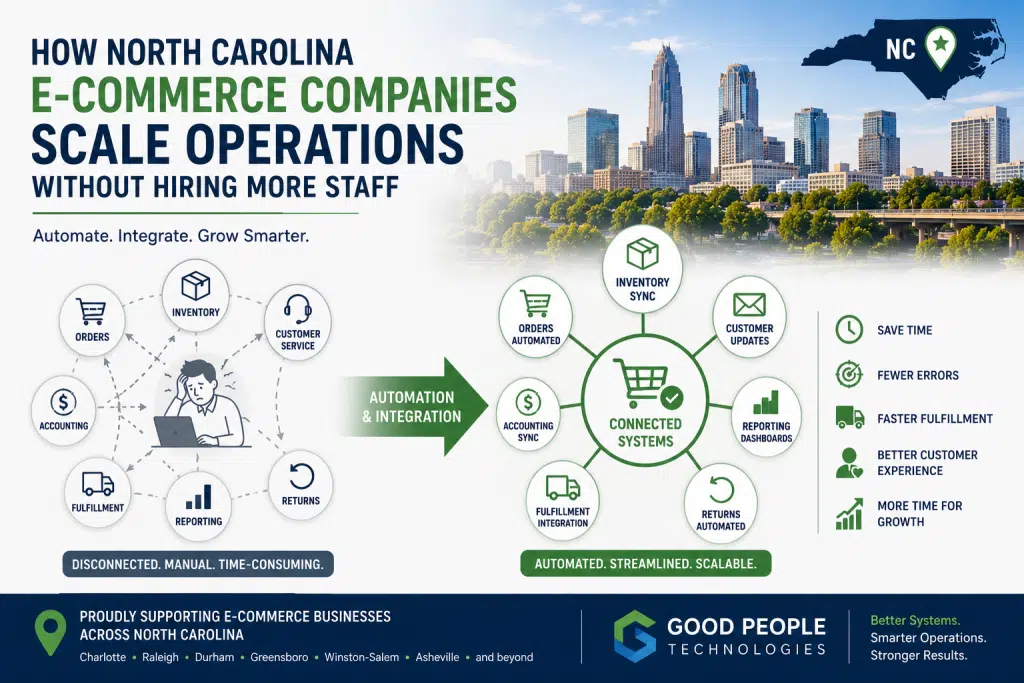
North Carolina business automation is becoming a practical growth strategy for e-commerce companies that want to increase order volume, improve fulfillment, reduce manual work, and support more customers without constantly adding more staff. For many growing online businesses, the challenge is not demand. The real challenge is building operations that can handle growth without creating more administrative pressure every month.
An e-commerce company can have strong products, effective marketing, and loyal customers, but still struggle to scale because daily operations depend on manual processes. Orders need to be checked. Inventory has to be updated. Customer records must be synced. Accounting requires reconciliation. Shipping updates need to be communicated. Reports take time to prepare.
At first, these tasks may feel manageable. As sales increase, they become a bottleneck.
For e-commerce businesses across Charlotte, Raleigh, Durham, Greensboro, Winston-Salem, Asheville, and other parts of North Carolina, the question is often simple: how can we grow without hiring another person for every operational problem?
The answer is not always more people. In many cases, the better answer is better systems.
This article explains how North Carolina e-commerce companies can scale operations without hiring more staff by using automation, integrations, ERP, workflow improvements, and cleaner operational processes.
Why Hiring More Staff Is Not Always the Best Scaling Strategy
Hiring is sometimes necessary.
A growing company may need more people in customer service, operations, fulfillment, finance, marketing, or management. People remain essential to business growth.
However, hiring should not be the first solution for every operational problem.
If a company hires people to maintain broken workflows, the cost of inefficiency increases. The business may add headcount, but the underlying systems remain weak.
For example, hiring another operations coordinator may help temporarily if the team is overwhelmed by manual order checks. Yet if the real issue is that Shopify, accounting software, inventory tools, and the fulfillment system do not communicate properly, the new hire becomes part of the workaround.
The business has not solved the problem. It has added another person to manage the problem.
This creates a pattern.
Growth increases order volume. Higher order volume creates more manual work. More manual work leads to more hiring. Additional hiring increases overhead, but the systems still do not become more scalable.
Eventually, margins tighten.
The better approach is to separate people problems from systems problems.
A people problem may require training, management, or hiring.
A systems problem requires better technology, automation, integrations, and process design.
Many North Carolina e-commerce companies need to ask: are we hiring because we truly need more capacity, or because our systems are forcing people to do work that software could handle?
The E-Commerce Growth Trap
E-commerce growth often looks exciting from the outside.
Revenue increases. Orders grow. Customers discover the brand. Marketing campaigns perform well. New product lines launch. Wholesale or marketplace opportunities may appear.
Inside the business, growth can feel very different.
The team may be dealing with:
- more order exceptions
- more inventory questions
- more customer service requests
- more fulfillment coordination
- more accounting reconciliation
- more product data updates
- more returns
- more reporting demands
- more manual spreadsheet work
This is the e-commerce growth trap.
The business grows, but operations become heavier.
Instead of creating leverage, growth creates friction.
A company may sell more products while becoming less efficient behind the scenes. Team members work harder, but systems do not support them. Leadership sees revenue growth, yet profitability may not improve as expected because manual work keeps expanding.
North Carolina business automation helps solve this problem by reducing repetitive tasks and improving how information moves between systems.
The goal is not to replace people.
The goal is to stop using people as the connection between disconnected tools.
Where Manual Work Usually Appears in E-Commerce Operations
Manual work often hides inside everyday processes.
It may not look dramatic. In fact, many teams consider it normal.
Someone checks whether inventory is available before confirming an order. A team member manually exports sales data. Another employee copies customer information into accounting software. A manager updates a spreadsheet to track fulfillment status. Customer service sends manual updates because systems do not automatically notify customers.
These tasks may only take a few minutes each. Repeated hundreds or thousands of times, they become expensive.
Common manual workflows in e-commerce include:
- copying orders into accounting software
- updating inventory across channels
- reconciling payments manually
- creating invoices by hand
- checking fulfillment status in multiple systems
- sending manual customer updates
- managing returns through spreadsheets
- preparing weekly reports from exports
- updating product data across platforms
- tracking wholesale orders separately
Manual work becomes especially difficult when a company sells through multiple channels.
A business may sell through its own website, Amazon, wholesale buyers, social commerce, retail partners, and local events. Each channel creates different data, different workflows, and different reporting needs.
Without connected systems, the team spends more time keeping everything aligned.
That is when automation becomes a strategic advantage.
Why Disconnected Systems Slow Down E-Commerce Growth
Most e-commerce companies do not start with a perfect technology stack.
They add tools over time.
Shopify or WooCommerce may handle online sales. QuickBooks may manage accounting. A CRM may track customers or wholesale relationships. A shipping platform may support fulfillment. Inventory might live in a spreadsheet or a standalone system. Reporting may happen through manual exports.
Each tool solves a specific problem.
The issue appears when these tools do not communicate.
Disconnected systems create operational gaps such as:
- orders not syncing correctly
- inventory updates lagging behind sales
- accounting records requiring manual cleanup
- customer data being incomplete or duplicated
- fulfillment updates not reaching customer service
- reports showing conflicting numbers
- teams relying on spreadsheets to bridge gaps
These problems create unnecessary work.
Employees become the integration layer. They check systems, compare numbers, update spreadsheets, reconcile records, and chase answers.
For a small business, this may be tolerable.
For a growing e-commerce company, it becomes a barrier to scale.
North Carolina business automation is most valuable when it connects these workflows and reduces the amount of manual coordination required to keep the business moving.
The Real Cost of Scaling Through Headcount Alone
Hiring more staff can solve capacity problems, but it also increases fixed costs.
A new employee requires salary, training, management, tools, onboarding, and time. If the role exists mainly to move data between systems, the company may be paying for work that could be reduced through automation.
This does not mean automation eliminates the need for employees.
Instead, automation helps employees focus on higher-value work.
Customer service can spend more time solving meaningful customer issues instead of chasing tracking numbers. Operations can improve fulfillment strategy rather than constantly correcting data. Finance can analyze performance instead of cleaning exports. Leadership can focus on growth decisions instead of waiting for manual reports.
Scaling through headcount alone can also create management complexity.
More people require more coordination. If processes are unclear, adding staff can make workflows more complicated, not easier.
Better systems create leverage.
When order volume increases, automated workflows can handle more activity without the same increase in manual effort. The company may still hire, but hiring becomes more strategic.
A business might add people for customer experience, product development, sales, or operational leadership rather than repetitive data work.
That is a healthier way to scale.
North Carolina Business Automation for E-Commerce Growth
North Carolina business automation helps e-commerce companies reduce repetitive work, connect systems, and create more scalable operations.
In practical terms, automation can support:
- order processing
- inventory updates
- customer notifications
- accounting workflows
- fulfillment communication
- returns management
- reporting
- product data management
- purchase order workflows
- customer segmentation
- abandoned cart processes
- wholesale order handling
The best automation strategy starts with workflow review.
A business should not automate a broken process without understanding it first. If the workflow is unclear, automation may simply make mistakes happen faster.
A better approach is to identify repetitive, high-volume, and high-risk tasks.
For example, if employees manually create invoices from online orders every day, that workflow may be a strong automation candidate. If inventory updates are delayed because data moves manually between systems, integration should be considered. When customer service repeatedly sends the same order status emails, automated notifications may reduce workload.
North Carolina business automation works best when it supports clear business outcomes: fewer errors, faster workflows, better visibility, and less administrative pressure.
Area 1: Automating Order Processing
Order processing is one of the first areas e-commerce companies should evaluate.
A growing business may receive orders through multiple channels. Website orders, marketplace sales, wholesale requests, and special orders may all require different handling.
Manual order processing often creates bottlenecks.
Employees may check orders for missing information, copy details into accounting software, assign fulfillment tasks, update inventory, and send customer confirmations. If volume is low, the process may work. With higher volume, delays and errors become more likely.
Automation can help by:
- sending orders to fulfillment automatically
- syncing order details with accounting
- creating invoices or sales receipts
- routing special orders for review
- updating customer records
- triggering confirmation emails
- flagging exceptions
The goal is not to remove human oversight entirely.
Some orders still need review. Custom orders, high-risk transactions, wholesale requests, or unusual shipping situations may require human judgment.
However, routine orders should not require excessive manual work.
When standard order workflows are automated, employees can focus on exceptions instead of processing every order by hand.
Area 2: Improving Inventory Visibility
Inventory is one of the most important operational areas for e-commerce companies.
Poor inventory visibility can lead to stockouts, overselling, delayed fulfillment, unnecessary purchasing, and customer frustration.
Inventory problems often happen when systems are disconnected.
The e-commerce platform may show one number. The warehouse may show another. Accounting may have a different view. A spreadsheet may be used to adjust everything manually.
This creates confusion.
A company cannot scale confidently if it does not trust its inventory numbers.
Automation and integrations can improve inventory visibility by connecting:
- e-commerce platforms
- warehouse systems
- accounting tools
- ERP systems
- fulfillment providers
- purchasing workflows
- reporting dashboards
When inventory updates move automatically, teams can make better decisions.
Purchasing becomes less reactive. Customer service has more accurate information. Fulfillment teams can work from better data. Leadership can understand what inventory is available, what is committed, and what needs attention.
For product-based companies, inventory automation is often one of the highest-impact improvements.
Area 3: Reducing Customer Service Workload
Customer service often becomes overloaded as e-commerce companies grow.
Many support requests are not complex. Customers ask questions such as:
- Where is my order?
- Has my item shipped?
- Can I change my address?
- Is this product available?
- When will this item be back in stock?
- How do I return something?
- Did my payment go through?
If systems are disconnected, customer service teams must search across multiple platforms to answer these questions.
That slows response time and increases workload.
Automation can reduce repetitive customer service tasks by:
- sending order confirmation emails
- sending shipping notifications
- creating delivery updates
- automating return instructions
- syncing customer records
- routing support tickets
- triggering back-in-stock notifications
- connecting order status to support platforms
This does not replace the need for strong customer service.
It allows customer service teams to spend more time on issues that actually require care, judgment, and personal attention.
Better systems create better customer experiences.
Area 4: Streamlining Accounting and Finance
Finance teams often feel the pain of e-commerce growth.
More orders create more transactions. Additional channels create more reconciliation work. Refunds, discounts, taxes, shipping fees, payment processors, and wholesale invoices add complexity.
If accounting is disconnected from e-commerce operations, finance teams spend too much time cleaning data.
Manual finance workflows may include:
- importing orders
- reconciling payments
- matching deposits
- creating invoices
- adjusting refunds
- categorizing fees
- preparing reports
- checking sales tax data
- comparing platform reports against accounting records
Automation can help reduce this workload.
E-commerce platforms can sync with accounting systems. Orders, payments, refunds, and customer information can move more cleanly. Reports can become easier to prepare.
This helps finance teams focus on analysis rather than manual cleanup.
It also helps leadership understand performance faster.
A company cannot make strong growth decisions if financial reporting is slow or unreliable.
Area 5: Making Fulfillment More Efficient
Fulfillment is where customer expectations meet operational reality.
A company may have great marketing and strong products, but if fulfillment is slow or inaccurate, customer trust suffers.
Disconnected fulfillment workflows often create problems such as:
- delayed shipping updates
- manual order routing
- incorrect addresses
- missing tracking information
- warehouse communication delays
- slow returns processing
- poor visibility into order status
Automation can improve fulfillment by connecting order management, warehouse systems, shipping platforms, and customer notifications.
For example, an order can automatically flow from the e-commerce platform to fulfillment. Tracking information can return to the customer record. Inventory can update after shipment. Customer notifications can trigger without manual effort.
These improvements reduce operational pressure.
Teams spend less time chasing status updates and more time improving the fulfillment experience.
For North Carolina e-commerce companies shipping regionally or nationally, fulfillment automation can become a major scaling advantage.
Area 6: Improving Reporting and Decision-Making
Many e-commerce companies struggle with reporting as they grow.
Leadership may want to know:
- which products are most profitable
- which channels perform best
- how much inventory is tied up
- which customers return most often
- where fulfillment delays happen
- how much manual work is slowing operations
- which promotions create profitable growth
- where margins are shrinking
If data lives across disconnected systems, these questions take too long to answer.
Reports may depend on exports from Shopify, spreadsheets, accounting software, ad platforms, fulfillment tools, and payment processors.
By the time everything is cleaned and combined, the information may already be outdated.
Automation and integrations can improve reporting by creating cleaner data flows.
The company can move toward dashboards that reflect more accurate and timely information. Leadership gains better visibility into growth, profitability, operations, and customer behavior.
This helps the business make decisions faster.
Reporting should not be a monthly scramble. It should become part of the operating system.
Composite Example: A Charlotte E-Commerce Brand Scaling Without More Admin Staff
Consider a growing e-commerce company in Charlotte.
The business sells specialty consumer products through Shopify, wholesale accounts, and occasional marketplace channels. For years, a small team handled operations manually.
Orders were reviewed by hand. Inventory was adjusted in spreadsheets. QuickBooks was updated manually. Customer service checked multiple tools for shipping status. Reports were prepared weekly through exports.
The company grew quickly after a successful marketing campaign.
Revenue increased, but operations became strained.
The founder considered hiring two additional administrative employees. Before doing that, the company reviewed its workflows and found that much of the workload came from disconnected systems.
Several improvements were identified:
- automate routine order processing
- sync Shopify orders with accounting
- connect fulfillment updates to customer records
- reduce spreadsheet-based inventory checks
- automate weekly reporting
- create exception rules for orders that need human review
After improving integrations and automation, the team handled higher order volume without immediately adding more administrative staff.
Customer service response time improved because order status was easier to access. Finance spent less time reconciling orders. Operations focused more on exceptions and less on routine processing.
The company still hired later, but the new role was focused on growth and customer experience rather than repetitive data work.
This is the ideal outcome.
Automation did not eliminate people. It allowed the business to hire more strategically.
Composite Example: A Raleigh Product Company With Inventory and Reporting Problems
A product-based company near Raleigh faced a different scaling issue.
The business had strong sales through its website and wholesale relationships, but inventory visibility was weak. The warehouse used one system, the e-commerce store used another, and finance relied on accounting records that lagged behind operations.
The team used spreadsheets to make decisions.
When sales increased, inventory problems became more frequent. Popular products sold out unexpectedly. Slow-moving products were reordered too often. Customer service had to explain delays. Leadership struggled to understand which products were truly profitable.
Instead of hiring more staff to manage inventory manually, the company focused on integrations.
Inventory updates were improved between sales and fulfillment systems. Reporting was redesigned to give leadership clearer visibility. Purchasing workflows were reviewed to reduce reactive decisions.
The business gained a better operational picture without adding unnecessary headcount.
This example shows why North Carolina business automation can be valuable even when the company is not ready for a full ERP implementation.
Targeted improvements can reduce friction quickly.
When Automation Is Enough and When ERP Is Needed
Automation can solve many problems, but it is not always enough.
A company may begin with integrations and workflow automation, then later discover that it needs a central operational system.
Automation may be enough when:
- current tools are still useful
- the main problem is repetitive manual work
- systems need better data flow
- reporting can improve through integrations
- order processing needs workflow rules
- customer communication needs automation
ERP may become necessary when:
- operations are spread across too many systems
- inventory is difficult to trust
- accounting and operations are disconnected
- reporting requires too much manual work
- leadership lacks visibility
- spreadsheets run core processes
- purchasing and fulfillment need stronger coordination
- growth creates too much administrative complexity
The right answer depends on the business.
Some e-commerce companies need automation first. Others need ERP sooner. Many need both over time.
A practical approach starts with the current bottlenecks and builds a roadmap from there.
If your company is unsure whether it needs automation, integrations, or ERP, Good People Technologies can help review your workflows and identify the most practical next step.
How to Start Scaling Operations Without Hiring More Staff
E-commerce companies can begin with a practical review.
The goal is to identify where the team is spending time on repetitive, manual, or avoidable work.
Useful questions include:
- Which tasks happen every day?
- Where is the same data entered twice?
- Which reports take too long?
- Which customer questions require internal chasing?
- Where do errors happen repeatedly?
- Which workflows depend on spreadsheets?
- What work increases every time order volume grows?
- Which systems do not communicate?
- Where does leadership lack visibility?
After answering these questions, the company can prioritize improvements.
Start with workflows that are high-volume, repetitive, and error-prone.
These usually create the fastest return.
Examples may include order syncing, inventory updates, customer notifications, accounting reconciliation, fulfillment status, and weekly reporting.
Small improvements can have a large impact when they remove daily friction.
How Good People Technologies Helps North Carolina E-Commerce Companies
Good People Technologies helps growing businesses improve operations through automation, system integrations, ERP support, and technology strategy.
For e-commerce companies, this can include:
- reviewing current workflows
- identifying manual data entry
- connecting e-commerce and accounting systems
- improving inventory visibility
- automating fulfillment communication
- reducing reporting delays
- evaluating ERP readiness
- building scalable operations
- improving system architecture
The work starts with understanding how the business currently operates.
Some companies need better integrations between existing tools. Others need workflow automation around repetitive tasks. More complex businesses may need ERP as the central foundation.
Good People Technologies focuses on practical improvements that reduce friction and support growth.
The goal is not technology for its own sake. The goal is better operations, clearer data, and more scalable systems.
Final Thoughts
North Carolina business automation is becoming essential for e-commerce companies that want to grow without adding unnecessary staff at every stage.
As order volume increases, manual processes become more expensive. Disconnected systems slow teams down. Reporting takes longer. Inventory becomes harder to trust. Customer service carries more pressure. Finance spends more time reconciling data.
Hiring may still be necessary, but it should not be the only scaling strategy.
Automation, integrations, ERP, and better workflow design help e-commerce companies create leverage. They allow teams to handle more volume with fewer repetitive tasks and better information.
For North Carolina e-commerce businesses, the opportunity is clear: companies that improve their systems can scale with more confidence, better visibility, and stronger operational control.
Growth should not always mean more manual work.
With the right systems, growth can become easier to manage.
Frequently Asked Questions
How can e-commerce companies scale without hiring more staff?
E-commerce companies can scale without hiring more staff by automating repetitive workflows, integrating disconnected systems, improving inventory visibility, streamlining fulfillment, reducing manual data entry, and improving reporting.
What is business automation for e-commerce?
Business automation for e-commerce means using software, integrations, and workflow rules to reduce manual tasks such as order processing, inventory updates, customer notifications, accounting reconciliation, and reporting.
Why do growing e-commerce companies struggle with manual work?
Growing e-commerce companies struggle with manual work because order volume, customer requests, inventory updates, fulfillment needs, and reporting requirements increase as the business grows. If systems are disconnected, employees must handle more tasks manually.
Can automation replace employees?
Automation should not be viewed as a replacement for employees. Instead, it helps employees spend less time on repetitive tasks and more time on customer experience, operations improvement, problem-solving, and growth-focused work.
What tasks should e-commerce businesses automate first?
Good first automation candidates include order syncing, inventory updates, customer notifications, fulfillment status updates, invoice creation, payment reconciliation, return workflows, and recurring reports.
Do e-commerce companies need ERP to automate operations?
Not always. Some e-commerce companies can improve operations with integrations and workflow automation first. ERP becomes more important when the business needs a central system for inventory, accounting, purchasing, reporting, and operational visibility.
How do integrations help e-commerce businesses scale?
Integrations help e-commerce businesses scale by connecting platforms such as Shopify, QuickBooks, CRM systems, warehouse tools, fulfillment providers, and reporting dashboards. This reduces manual work and improves data accuracy.
What are signs an e-commerce company needs automation?
Signs include duplicate data entry, delayed reports, frequent inventory issues, slow customer updates, manual fulfillment coordination, spreadsheet dependency, and operational work increasing with every new order.
How can automation improve customer experience?
Automation improves customer experience by sending faster order updates, reducing errors, improving inventory accuracy, supporting quicker response times, and helping customer service teams access better information.
How can Good People Technologies help with e-commerce automation?
Good People Technologies helps e-commerce companies review workflows, identify manual processes, connect systems, automate repetitive tasks, improve reporting, evaluate ERP readiness, and build more scalable operations.

Roman is a B2B marketing specialist focused on technology, ERP systems, business automation, and digital growth strategies. At Good People Technologies, he helps translate complex technology solutions—such as ERP integrations, system integrations, and business process automation—into clear insights for founders, operators, and growing companies.
His work focuses on content strategy, SEO, and thought leadership that helps businesses understand how the right technology infrastructure can support scalable operations and sustainable growth.
At Good People Technologies, Roman contributes to content that explores ERP implementation, automation strategies, and system integration best practices for companies navigating rapid growth and operational complexity.