
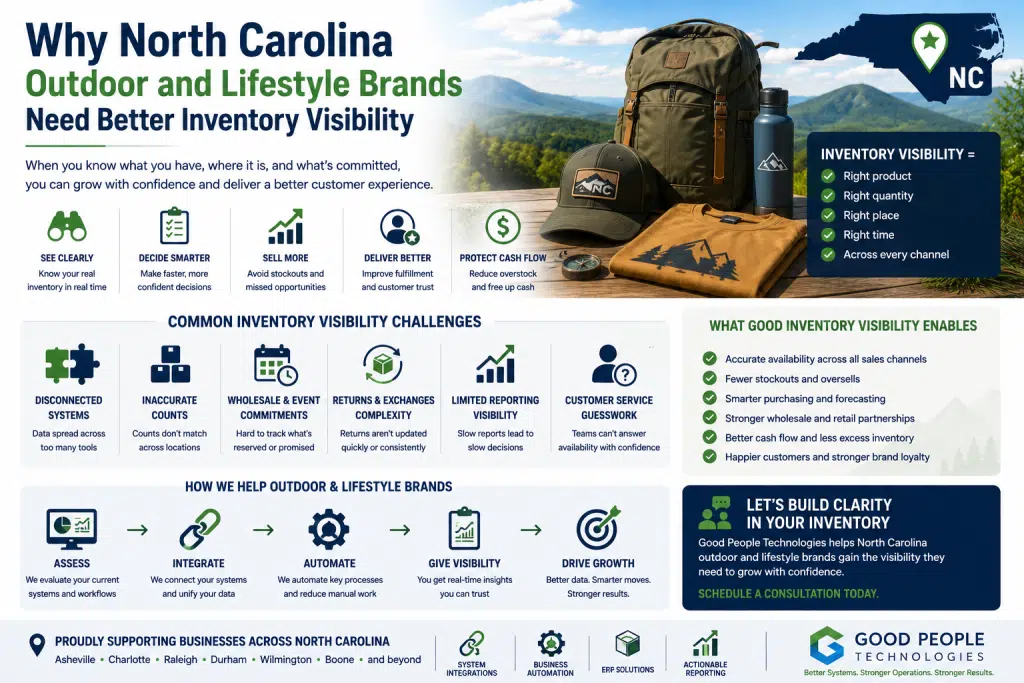
North Carolina outdoor brands inventory visibility is becoming more important as outdoor, lifestyle, apparel, wellness, recreation, and seasonal product companies grow across more sales channels, customer groups, fulfillment workflows, and inventory locations. A brand may start with a small product catalog and a simple Shopify setup, but growth quickly creates new pressure around stock levels, wholesale commitments, warehouse updates, returns, and customer expectations.
Outdoor and lifestyle brands often deal with demand that changes quickly. A product may sell slowly during one part of the year and move fast during warmer months, travel seasons, event weekends, retail promotions, or regional outdoor activity peaks. A business selling hiking gear, apparel, lifestyle accessories, wellness products, home goods, sports-related items, or locally inspired merchandise may need to manage sudden inventory movement without losing control of operations.
For companies across Asheville, Charlotte, Raleigh, Durham, Greensboro, Wilmington, Boone, and other parts of North Carolina, inventory visibility is not just a warehouse concern. It affects sales, fulfillment, purchasing, cash flow, customer service, reporting, and brand reputation.
When teams know what is available, what is committed, what is on order, and what is moving quickly, they can make better decisions. When inventory data is scattered across Shopify, spreadsheets, warehouse systems, accounting software, wholesale records, and manual reports, small gaps can turn into lost sales or customer frustration.
This article explains why North Carolina outdoor and lifestyle brands need better inventory visibility, where inventory problems usually start, and how system integrations, automation, ERP, and cleaner workflows can help product-based brands grow with more control.
Outdoor and Lifestyle Brands Have Different Inventory Pressures
Outdoor and lifestyle businesses often operate with demand patterns that are less predictable than standard retail.
Customer behavior may change based on season, weather, events, travel, tourism, social media attention, local markets, retail partnerships, and product trends. A brand may see strong sales during spring and summer, then shift into holiday demand later in the year. Some products may be evergreen, while others may be highly seasonal.
That creates inventory planning challenges.
A company may need enough stock to capture demand during a busy period, but not so much that cash gets trapped in slow-moving inventory after the season ends. This balance becomes harder when the brand sells through multiple channels.
A North Carolina lifestyle brand might sell through:
- its own e-commerce store
- local retailers
- wholesale accounts
- outdoor events
- pop-up markets
- Amazon or marketplace channels
- social commerce
- regional distributors
Each channel can affect inventory differently.
Online sales may move fast after a promotion. Wholesale accounts may reserve larger quantities in advance. Local events may create sudden product movement that is not reflected immediately in the main system. Retail partners may need restocks before the business has clear visibility into what is actually available.
Without better inventory visibility, the company is forced to make decisions with incomplete information.
That is when growth becomes harder to manage.
Why Inventory Visibility Matters More Than Inventory Count Alone
Inventory count tells a business how many units it has.
Inventory visibility tells the business what those units mean.
A strong inventory process should help teams understand:
- what is currently available
- what has already been committed
- what is in transit
- what is on order
- what is reserved for wholesale
- what is moving quickly
- what is slow-moving
- what is returned but not yet restocked
- what inventory is tied up in cash
- which products are at risk of stockout
This level of visibility helps teams make smarter decisions.
A warehouse count may show 500 units of a product. However, if 300 are committed to wholesale orders, 100 are reserved for an upcoming event, and 50 are damaged or pending inspection, the available inventory picture is very different.
Many product-based businesses struggle because they track inventory quantity but not inventory context.
North Carolina outdoor brands inventory visibility becomes especially important when sales channels overlap. A product may be available to online shoppers, wholesale customers, and event buyers at the same time. If inventory commitments are not tracked clearly, the business may accidentally promise the same stock to multiple channels.
That creates avoidable problems.
Overselling damages trust. Understating availability creates missed revenue. Weak visibility makes purchasing reactive. Poor reporting prevents leadership from understanding which products are truly driving performance.
Disconnected Systems Create Inventory Blind Spots
Inventory visibility problems often start with disconnected systems.
A growing brand may use Shopify for e-commerce, QuickBooks for accounting, spreadsheets for planning, a warehouse tool for fulfillment, and manual notes for wholesale commitments.
At first, this setup may work.
The team is small. Product volume is manageable. One or two people understand the process well enough to keep things moving.
As the business grows, gaps become more visible.
Shopify may show one number. The warehouse system may show another. Accounting may update later. Wholesale commitments may sit in a spreadsheet. Event inventory may be tracked manually. Returns may not flow back into available stock quickly.
When this happens, nobody has a fully reliable view of inventory.
Teams begin checking manually before making decisions. Customer service asks the warehouse whether an item is actually available. Purchasing reviews spreadsheets before reordering. Finance waits for inventory reconciliation. Leadership receives reports that may not reflect current operational reality.
These blind spots slow the business down.
North Carolina outdoor brands inventory visibility improves when the business defines which system owns inventory data and connects the tools around that source of truth.
The goal is not always to replace every tool. In many cases, the first step is making sure the tools already in place share information more reliably.
Seasonal Demand Makes Weak Visibility More Expensive
Seasonal demand is one of the biggest reasons outdoor and lifestyle brands need stronger systems.
A business may manage inventory well enough during slower periods. During seasonal peaks, the same process may become too fragile.
Warm-weather demand can affect outdoor apparel, recreation products, travel accessories, lifestyle goods, wellness items, local merchandise, home and garden products, and event-based inventory. A product that sits steadily for months may sell quickly after a promotion, influencer post, outdoor event, or seasonal campaign.
When demand increases, inventory decisions need to happen faster.
Purchasing teams need to know what to reorder.
Warehouse teams need to understand what is available.
Customer service needs accurate product availability.
Leadership needs visibility into what is selling and what is at risk.
Delayed information creates missed opportunities.
A product may sell out before the team notices. Another item may be reordered too heavily because old reports suggest stronger demand than the current season supports. A wholesale order may reduce available stock, but the e-commerce store may continue selling as if nothing changed.
This is where North Carolina outdoor brands inventory visibility becomes directly connected to revenue.
Better visibility helps brands capture demand without creating unnecessary chaos behind the scenes.
Inventory Visibility Affects Cash Flow
Inventory is one of the biggest cash flow issues for product-based businesses.
Every product sitting in a warehouse represents money that has already been spent. Some inventory will turn quickly and generate revenue. Other inventory may sit too long, require discounts, or become less relevant after a season ends.
Outdoor and lifestyle brands often face a difficult cash flow balance.
They need enough inventory to meet demand during peak periods. At the same time, overbuying can create financial pressure later.
Poor visibility makes this harder.
A business may reorder too early because it cannot trust its inventory data. Another company might order too late and miss sales. Some brands carry excess safety stock because they do not feel confident in the numbers.
That strategy may reduce stockout risk, but it also ties up cash.
Better inventory visibility helps leadership understand:
- which products are worth reordering
- which items are moving slowly
- how much cash is tied up in inventory
- which products need promotion
- which channels are driving demand
- where excess stock may become a problem
- how seasonal purchasing affects margins
A growing brand should not rely only on instinct when making inventory decisions.
Experience matters, but experience works best when supported by accurate data.
Customer Experience Depends on Accurate Inventory
Customers rarely understand what happens inside inventory systems.
They only see whether the brand delivers.
If a product is listed as available, customers expect to receive it. If shipping is promised quickly, they expect updates. When an order is canceled because stock was wrong, the customer may not give the brand another chance.
Inventory visibility affects customer experience in several ways:
- fewer canceled orders
- faster customer updates
- more accurate availability
- better fulfillment timelines
- fewer backorder surprises
- smoother exchanges
- clearer communication
- stronger trust
Outdoor and lifestyle customers may also buy around specific timing.
Someone may need a product before a trip, event, season, or gift occasion. If the product is delayed or canceled, the impact feels bigger.
Customer service teams are often the first to feel inventory issues. They handle complaints, answer availability questions, check order status, and explain delays caused by internal data problems.
Better inventory visibility gives customer-facing teams better answers.
When support can see accurate stock, fulfillment status, and return activity, customers receive clearer communication. That protects the brand experience.
North Carolina outdoor brands inventory visibility should therefore be treated as part of customer experience, not just operations.
Wholesale and Retail Partnerships Add Complexity
Many outdoor and lifestyle brands grow through wholesale and retail partnerships.
This can be a strong growth channel, but it creates inventory complexity.
Wholesale orders often involve larger quantities, different timelines, special pricing, reserved stock, and separate communication workflows. Retail partners may need restocks before direct-to-consumer demand slows down. A brand may also need to balance inventory between online sales and wholesale commitments.
If wholesale inventory is tracked separately from e-commerce inventory, problems can appear quickly.
A team may sell inventory online that was supposed to be reserved for a retail partner. Another business may hold too much inventory for wholesale and miss direct-to-consumer sales. Purchasing may not fully understand upcoming commitments because they are tracked outside the main system.
Wholesale visibility should answer important questions:
- Which inventory is already committed?
- Which orders are pending?
- What needs to be reserved?
- What can still be sold online?
- Which retail partners need restocks?
- How does wholesale demand affect purchasing?
- Which channel is more profitable?
Without this visibility, teams may make decisions based only on partial information.
Brands that plan to grow wholesale relationships need inventory systems that can support those commitments clearly.
Returns and Exchanges Create Hidden Inventory Problems
Returns and exchanges are another common source of inventory confusion.
A returned item may physically arrive at a warehouse, but that does not mean it should immediately become available for resale. It may need inspection, repackaging, quality review, or removal from available stock.
If the return workflow is unclear, inventory accuracy breaks down.
Common return-related problems include:
- returned items not added back correctly
- damaged goods counted as available
- refunds processed before inventory review
- replacement orders tracked manually
- customer service lacking return status
- accounting updates delayed
- warehouse teams handling returns inconsistently
Outdoor and lifestyle products may have additional considerations.
Some items may be seasonal, size-based, color-based, or condition-sensitive. A returned apparel item may need inspection. Outdoor gear may require quality checks. Limited-run products may create customer service pressure if exchanges are not handled quickly.
Returns should be connected to inventory, customer service, accounting, and reporting.
Manual return tracking may work at low volume, but it becomes risky as the brand grows.
Better visibility helps teams understand what is sellable, what is pending, what needs review, and what should not return to available inventory.
North Carolina Outdoor Brands Inventory Visibility
North Carolina outdoor brands inventory visibility becomes a growth requirement when a product-based business sells across multiple channels, handles seasonal demand, manages wholesale relationships, and depends on accurate fulfillment. Inventory can no longer be treated as a static number in a spreadsheet. It needs to be part of a connected operational system.
The most common visibility problems include:
- inventory counts do not match
- wholesale commitments are tracked separately
- e-commerce availability is not updated fast enough
- warehouse adjustments are delayed
- returns are handled manually
- purchasing decisions depend on outdated reports
- leadership cannot see product movement clearly
- customer service lacks accurate stock information
Solving these problems starts with mapping the inventory journey.
A brand should understand how inventory enters the business, where it is stored, how it is sold, how it is committed, how it is fulfilled, how it is returned, and how it is reported.
Once that process is clear, the company can decide where integrations, automation, ERP, or workflow improvements are needed.
Inventory visibility does not improve just because a company adds another tool. It improves when the right data moves to the right place at the right time.
How Integrations Improve Inventory Visibility
System integrations help outdoor and lifestyle brands connect the platforms that manage orders, inventory, accounting, fulfillment, and reporting.
A business may need to connect:
- Shopify
- WooCommerce
- Amazon
- QuickBooks
- ERP
- warehouse systems
- fulfillment providers
- shipping tools
- CRM
- wholesale platforms
- reporting dashboards
The purpose of integration is not only technical connection.
The business outcome is better visibility.
For example, e-commerce sales should update inventory. Warehouse fulfillment should update order status. Returns should affect inventory appropriately. Accounting should receive cleaner transaction data. Reporting should reflect more current information.
Strong integrations reduce the need for employees to manually move data between systems.
They also reduce the chance that teams are working from outdated or conflicting numbers.
For many brands, integrations are the best first step before considering a larger ERP project.
If your team is spending too much time checking inventory across systems, Good People Technologies can help review where data is getting stuck and identify integration opportunities.
How Automation Helps During Busy Seasons
Automation helps teams handle repetitive inventory-related tasks with less manual effort.
Useful automations may include:
- low-stock alerts
- reorder reminders
- customer notifications
- shipping updates
- return status updates
- fulfillment exception alerts
- inventory adjustment alerts
- wholesale order reminders
- recurring inventory reports
- purchasing task creation
Automation is especially helpful during seasonal demand peaks.
Instead of waiting for someone to check a spreadsheet, the system can notify the right person when inventory reaches a threshold. Rather than manually sending every shipping update, customer communication can trigger automatically. Reports can be generated on a schedule instead of built from exports every time.
The best automation does not remove judgment.
It supports judgment by giving teams better information sooner.
Outdoor and lifestyle brands still need people to make purchasing, merchandising, product, and customer decisions. Automation simply reduces the repetitive work that slows those decisions down.
When ERP Becomes the Better Foundation
Some brands can improve inventory visibility with integrations and automation.
Others eventually need ERP.
ERP becomes more valuable when inventory connects to broader business complexity.
A company may need ERP when:
- inventory is difficult to trust
- purchasing is reactive
- accounting and inventory are disconnected
- wholesale commitments are hard to manage
- reporting takes too long
- multiple locations create confusion
- customer service lacks order visibility
- leadership cannot see margins clearly
- spreadsheets run core inventory workflows
ERP can help centralize inventory, purchasing, accounting, order management, fulfillment, customer data, and reporting.
However, ERP should not be rushed.
Before implementing ERP, a business should map workflows, clean product data, define inventory ownership, identify integration needs, and clarify which outcomes matter most.
North Carolina outdoor brands inventory visibility improves most when ERP is part of a practical operational strategy, not just a software replacement.
Composite Example: An Asheville Outdoor Brand With Seasonal Demand
Consider a growing outdoor lifestyle brand near Asheville.
The company sells apparel, accessories, and recreation-related products through Shopify, local retailers, seasonal events, and wholesale accounts.
During most of the year, operations are manageable.
The team tracks inventory through Shopify, QuickBooks, a warehouse spreadsheet, and manual wholesale notes. A few employees understand the process well enough to keep things moving.
Then warm-weather demand increases.
A popular product line sells faster than expected. Retail partners request restocks. Online orders rise after a seasonal campaign. Event inventory is pulled from available stock, but the update is not reflected immediately in the main system.
Customer service starts asking operations for availability before responding to customers. Purchasing tries to reorder, but supplier timelines are longer than expected. Finance needs better inventory data, but reports require manual cleanup.
The business is not failing. It is growing faster than its inventory process.
After reviewing the workflow, the company identifies several gaps:
- wholesale commitments are tracked separately
- event inventory is updated manually
- Shopify and warehouse counts do not always match
- low-stock alerts are not reliable
- returns are processed inconsistently
- reporting is too slow during peak weeks
The brand improves operations by connecting sales and inventory data more clearly, creating better rules for reserved stock, automating low-stock alerts, and improving reporting visibility.
ERP may become necessary later, but the first improvements reduce seasonal pressure and help the team manage demand with more confidence.
Composite Example: A Wilmington Lifestyle Brand With Multi-Channel Sales
A lifestyle brand near Wilmington sells coastal-inspired products through an online store, local boutiques, pop-up events, and wholesale buyers.
Tourism season creates a strong sales lift.
The company has demand, but inventory visibility becomes a problem.
Boutique orders are tracked by email. Pop-up event inventory is counted manually. Online orders update Shopify, but wholesale commitments sit outside the main workflow. Returns are handled in different ways depending on the channel.
The team begins seeing avoidable issues.
Some products sell out online even though inventory exists in another location. Other items are promised to wholesale partners but still appear available for direct sales. Customer service struggles to answer availability questions without checking multiple places.
After mapping the inventory process, the company realizes it does not need more spreadsheets. It needs clearer inventory ownership and better system connections.
The improvement plan includes:
- defining one source of truth for inventory
- tracking wholesale commitments more clearly
- syncing online and warehouse data
- improving event inventory processes
- automating low-stock notifications
- building better reporting for seasonal product movement
The result is stronger visibility across channels and fewer last-minute inventory surprises.
For lifestyle brands, visibility matters because customers and retail partners both depend on accurate availability.
How Brands Can Start Improving Inventory Visibility
A brand does not need to fix every system at once.
The first step is understanding where inventory data lives.
Important questions include:
- Which systems currently track inventory?
- Which system should be the source of truth?
- Where do inventory counts fail to match?
- How are wholesale commitments tracked?
- How is event inventory updated?
- What happens when products are returned?
- Which reports take too long?
- What does customer service need to answer faster?
- Where does purchasing lack visibility?
- Which manual steps happen every week?
After reviewing these questions, the brand can prioritize improvements.
Start with the workflows that create the most risk.
For many outdoor and lifestyle brands, that means inventory syncing, wholesale commitments, low-stock alerts, return handling, and reporting.
The best improvements usually connect operations with customer experience and cash flow.
Better visibility should help the business sell more confidently, fulfill more accurately, purchase more strategically, and report performance faster.
How Good People Technologies Helps Outdoor and Lifestyle Brands
Good People Technologies helps growing businesses improve operations through system integrations, workflow automation, ERP support, and technology strategy.
For outdoor and lifestyle brands, this can include:
- reviewing current inventory workflows
- identifying disconnected systems
- improving e-commerce and warehouse integrations
- automating low-stock alerts
- connecting inventory with accounting
- improving wholesale inventory visibility
- reducing spreadsheet dependency
- improving reporting dashboards
- evaluating ERP readiness
- building scalable seasonal operations
The process starts with understanding how the business actually sells, stores, fulfills, and reports inventory.
Some brands need better integrations between existing tools. Others need automation around repetitive inventory tasks. More complex companies may need ERP or ERP optimization.
If inventory uncertainty is limiting fulfillment, wholesale growth, or customer communication, a systems review can help identify the most practical improvements before those problems become more expensive.
Final Thoughts
North Carolina outdoor brands inventory visibility is becoming more important as outdoor and lifestyle companies grow across channels, seasons, regions, and customer types.
Inventory is no longer just a warehouse count.
It affects cash flow, customer experience, wholesale relationships, seasonal planning, purchasing, fulfillment, reporting, and leadership decisions.
Brands that rely on disconnected systems, spreadsheets, delayed updates, and manual checks may be able to operate for a while, but seasonal growth exposes those weaknesses quickly.
The good news is that inventory visibility can be improved.
With better integrations, automation, ERP planning, reporting workflows, and inventory ownership, North Carolina outdoor and lifestyle brands can scale with more confidence and fewer surprises.
The businesses that build stronger systems now will be better prepared for seasonal demand, channel expansion, and long-term growth.
Frequently Asked Questions
Why do outdoor and lifestyle brands need better inventory visibility?
Outdoor and lifestyle brands need better inventory visibility because seasonal demand, multiple sales channels, wholesale commitments, events, returns, and fulfillment workflows make inventory harder to manage as the business grows.
What causes inventory visibility problems?
Inventory visibility problems are often caused by disconnected systems, manual spreadsheets, delayed warehouse updates, separate wholesale records, inconsistent returns, and unclear inventory ownership.
How does inventory visibility affect customer experience?
Inventory visibility affects customer experience by helping brands avoid canceled orders, delayed shipments, inaccurate availability, slow support responses, and backorder confusion.
Why is seasonal demand difficult for outdoor brands?
Seasonal demand is difficult because products may sell faster during specific months, events, travel periods, or outdoor activity seasons. If inventory data is delayed, brands may stock out or overbuy.
Can system integrations improve inventory visibility?
Yes. System integrations can connect e-commerce, warehouse, accounting, fulfillment, wholesale, and reporting systems so inventory data moves more accurately across the business.
When should an outdoor brand consider ERP?
An outdoor brand should consider ERP when inventory, purchasing, accounting, wholesale commitments, fulfillment, and reporting become too complex for spreadsheets and disconnected tools.
How can automation help with inventory?
Automation can help with low-stock alerts, reorder reminders, customer updates, shipping notifications, return workflows, inventory adjustment alerts, and recurring inventory reports.
Are spreadsheets enough for growing lifestyle brands?
Spreadsheets can help with planning, but they become risky when they manage core inventory workflows. Growing brands usually need connected systems for reliable visibility.
What is the first step to improving inventory visibility?
The first step is identifying every place inventory data lives and deciding which system should be the source of truth. After that, the business can review integrations, automation, and reporting gaps.
How can Good People Technologies help outdoor and lifestyle brands?
Good People Technologies helps brands review inventory workflows, connect systems, automate repetitive tasks, improve reporting, evaluate ERP readiness, and build more scalable operations.

Roman is a B2B marketing specialist focused on technology, ERP systems, business automation, and digital growth strategies. At Good People Technologies, he helps translate complex technology solutions—such as ERP integrations, system integrations, and business process automation—into clear insights for founders, operators, and growing companies.
His work focuses on content strategy, SEO, and thought leadership that helps businesses understand how the right technology infrastructure can support scalable operations and sustainable growth.
At Good People Technologies, Roman contributes to content that explores ERP implementation, automation strategies, and system integration best practices for companies navigating rapid growth and operational complexity.