
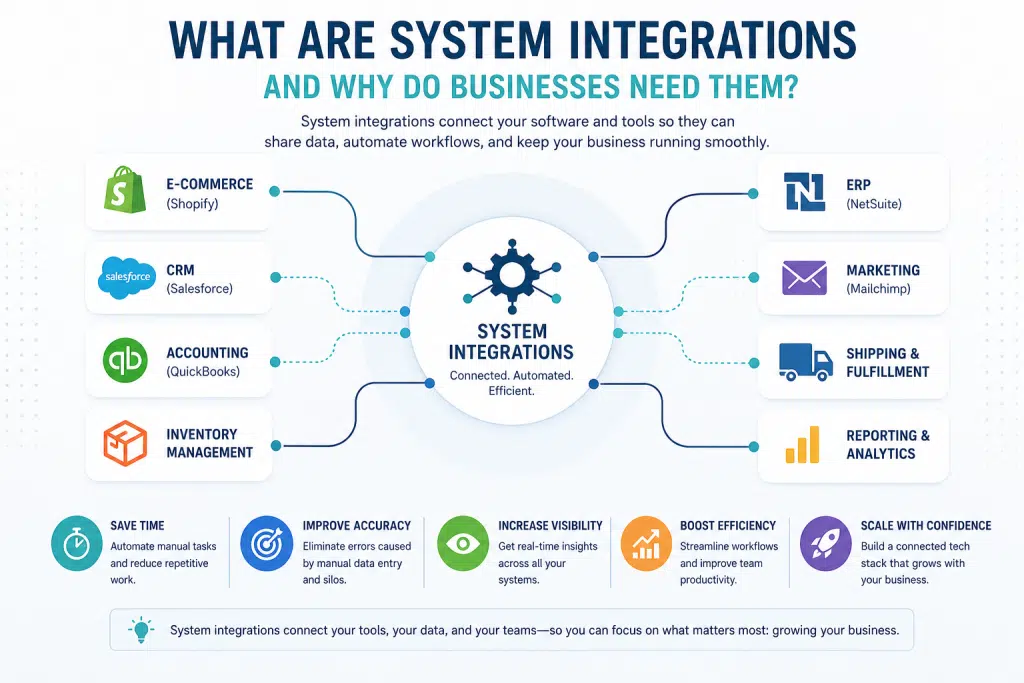
Modern businesses rely on a growing number of software platforms to manage daily operations.
Customer relationship management platforms, accounting software, e-commerce systems, inventory management tools, reporting applications, and fulfillment solutions all play important roles in running a business. Initially, many organizations use these systems independently. However, as operations become more complex, disconnected platforms often create inefficiencies that slow down productivity and growth.
As a result, employees frequently spend valuable time manually transferring data, correcting errors, and managing duplicate workflows.
This is where system integrations become essential.
By connecting software platforms and automating data flow, system integrations help businesses improve efficiency, increase visibility, and reduce manual work.
At Good People Technologies, we help businesses design and implement integration strategies that support scalable operations and long-term growth.
In this guide, we’ll explain what system integrations are, how they work, and why they have become a critical component of modern business operations.
What Are System Integrations?
System integrations are connections between two or more software platforms that allow information to move automatically between systems.
Rather than requiring employees to manually enter the same data multiple times, integrations ensure that information is shared seamlessly across applications.
For example, a business may connect:
- Shopify and QuickBooks
- Salesforce and NetSuite
- CRM platforms and marketing systems
- ERP systems and fulfillment software
- Inventory management tools and e-commerce stores
Consequently, information entered into one system automatically updates across connected platforms.
This not only reduces manual work but also improves data accuracy and operational efficiency.
How Do System Integrations Work?
Although integration methods vary, the goal remains the same: ensuring that systems communicate automatically.
Most integrations use APIs, middleware platforms, pre-built connectors, or custom development to exchange information between applications.
For example, when a customer places an order through an online store, the integration may automatically:
- update inventory levels
- generate accounting records
- trigger fulfillment workflows
- update reporting dashboards
Without these connections, employees would often need to complete these tasks manually. As a result, businesses spend more time managing systems instead of focusing on customers and growth.
Why Do Businesses Need System Integrations?
As organizations grow, operational complexity increases significantly.
Most businesses add software platforms over time. While each tool may serve a specific purpose effectively, disconnected systems often create operational challenges that become increasingly difficult to manage.
For example, a company may initially use:
- accounting software
- CRM software
- spreadsheets
However, additional systems are typically introduced as operations expand. These may include:
- ERP platforms
- inventory management systems
- e-commerce solutions
- marketing automation software
- fulfillment platforms
- business intelligence tools
Although each platform provides value individually, businesses often struggle when those systems operate independently.
Fortunately, system integrations help bridge these gaps and create more efficient workflows.
Common Problems Caused by Disconnected Systems
Many businesses underestimate the true cost of disconnected software platforms.
However, operational inefficiencies can quickly affect productivity, customer experience, and profitability.
Manual Data Entry
One of the most common challenges is duplicate data entry.
Employees often spend hours moving information from one system to another. Consequently, productivity decreases while the risk of human error increases.
Fortunately, integrations eliminate much of this repetitive work by automating data transfer between systems.
Inaccurate Business Data
When software platforms operate independently, information frequently becomes inconsistent.
For example:
- inventory numbers may not match
- customer records may be outdated
- reporting data may be inaccurate
As a result, decision-making becomes more difficult and less reliable.
By keeping information synchronized, integrations help maintain data consistency throughout the organization.
Operational Bottlenecks
Disconnected systems often slow down critical business processes.
In many cases, employees must wait for information to be updated manually before completing the next step in a workflow.
Consequently, operations become slower, less efficient, and more difficult to scale.
Automated integrations help remove these bottlenecks by allowing information to move instantly between systems.
Poor Visibility Across the Business
Leadership teams need accurate data to make informed decisions.
Unfortunately, when information exists across multiple disconnected platforms, gaining a complete view of business performance becomes challenging.
By connecting data sources, integrations improve reporting accuracy and provide better operational visibility.
Benefits of System Integrations
Beyond solving operational challenges, integrations provide numerous long-term business benefits.
Increased Efficiency
One of the biggest advantages of integrations is improved efficiency.
Automated data flow reduces repetitive administrative tasks and allows employees to focus on higher-value work.
As a result, businesses can often scale operations without proportionally increasing headcount.
Improved Data Accuracy
Manual processes inevitably introduce mistakes.
By automating information exchange, integrations significantly reduce the risk of human error.
Furthermore, synchronized systems ensure that teams are working with accurate and up-to-date information.
Better Customer Experience
Operational efficiency has a direct impact on customer satisfaction.
For example, integrations can help businesses:
- process orders faster
- improve communication
- reduce fulfillment delays
- improve service accuracy
As a result, customers receive a more reliable and consistent experience.
Faster Decision-Making
Business leaders rely on accurate information to make strategic decisions.
Because integrations improve access to real-time data, organizations can respond more quickly to both opportunities and challenges.
Better Scalability
As companies grow, operational complexity naturally increases.
Without automation, manual processes often become difficult to manage at scale.
System integrations create scalable operational infrastructure that supports business growth while minimizing additional administrative work.
Ultimately, this allows organizations to grow more efficiently.
System Integrations vs ERP Systems
Many businesses mistakenly assume that integrations and ERP systems are the same thing.
However, they solve different operational challenges.
System integrations connect software platforms and allow information to move between them.
ERP systems, on the other hand, centralize core business operations within a single platform.
In many cases, organizations begin by implementing integrations and later adopt ERP systems as operational complexity increases.
If you’re evaluating both options, you can also read our guide on ERP vs Integrations to better understand the differences.
Final Thoughts
Today, businesses depend heavily on software to operate efficiently.
However, software only delivers maximum value when systems work together effectively.
By connecting platforms, automating workflows, and improving visibility, system integrations help organizations reduce manual work, increase efficiency, and support long-term growth.
Ultimately, for many growing businesses, system integrations become one of the most valuable investments they can make in their operational infrastructure.
A system integration is a connection between two or more software platforms that allows data to flow automatically between them.
System integrations improve efficiency, reduce manual work, increase data accuracy, and help businesses scale more effectively.
Businesses commonly integrate ERP systems, CRM platforms, accounting software, e-commerce stores, marketing tools, fulfillment providers, and analytics platforms.
No. Small and mid-sized businesses often benefit significantly from integrations because they help eliminate manual processes and improve operational efficiency.
ERP systems centralize business operations, while system integrations connect separate software platforms so they can share information automatically.

Roman is a B2B marketing specialist focused on technology, ERP systems, business automation, and digital growth strategies. At Good People Technologies, he helps translate complex technology solutions—such as ERP integrations, system integrations, and business process automation—into clear insights for founders, operators, and growing companies.
His work focuses on content strategy, SEO, and thought leadership that helps businesses understand how the right technology infrastructure can support scalable operations and sustainable growth.
At Good People Technologies, Roman contributes to content that explores ERP implementation, automation strategies, and system integration best practices for companies navigating rapid growth and operational complexity.