
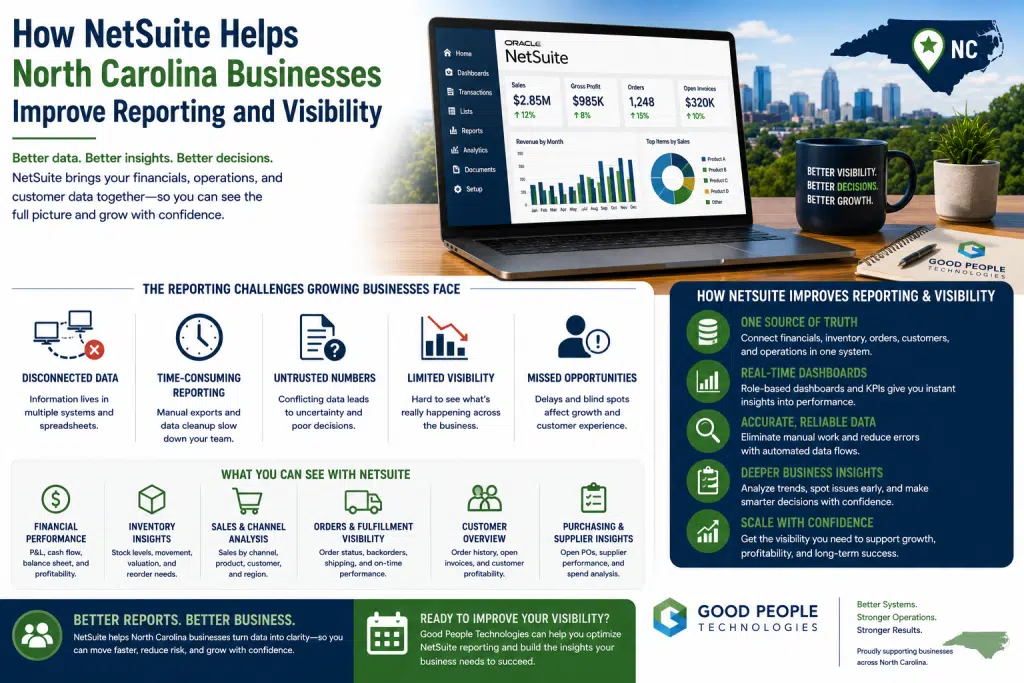
NetSuite reporting North Carolina becomes especially important when growing businesses can no longer rely on spreadsheets, delayed reports, disconnected systems, and manual data cleanup to understand what is happening across operations. A company may have strong sales and an active team, but still struggle to make confident decisions because financial, inventory, customer, fulfillment, and operational data are spread across too many tools.
For businesses across Charlotte, Raleigh, Durham, Greensboro, Winston-Salem, Asheville, Wilmington, and other parts of North Carolina, reporting problems often show up as leadership frustration first. Owners and managers want simple answers. Which products are profitable? Which customers are growing? What inventory is available? Where are orders delayed? How much cash is tied up in stock? Which sales channels are performing best?
Those questions should not take days to answer.
However, many growing companies still build reports by exporting data from QuickBooks, Shopify, warehouse systems, CRM platforms, spreadsheets, payment processors, and fulfillment tools. By the time the report is ready, the information may already be outdated.
NetSuite can help solve this problem by bringing financial and operational data into a more connected ERP environment. When configured well, NetSuite reporting can give teams better visibility into sales, inventory, purchasing, accounting, orders, fulfillment, customers, and business performance.
This article explains how NetSuite helps North Carolina businesses improve reporting and visibility, why reporting becomes harder as companies grow, and when better ERP reporting can create a stronger foundation for decision-making.
Why Reporting Becomes Harder as Businesses Grow
Reporting is simple when a business is small.
A founder may know the numbers personally. Finance may prepare basic reports in QuickBooks. Inventory may be easy to check manually. Sales activity may be visible because the team is small enough to communicate directly.
Growth changes that.
More customers create more records. Additional products increase inventory complexity. New sales channels add more transaction data. More employees create more handoffs. Fulfillment, purchasing, finance, and customer service all begin producing information that leadership needs to understand.
At this stage, reporting becomes harder because the business is no longer simple.
A company may need to track:
- sales by channel
- profit by product
- inventory availability
- order status
- purchasing needs
- fulfillment performance
- customer activity
- cash flow
- delayed orders
- slow-moving inventory
- operational bottlenecks
- finance reconciliation issues
If each of these areas lives in a different system, reporting becomes manual.
Someone exports data. Another person cleans a spreadsheet. Finance checks numbers against accounting records. Operations adds context. Leadership waits for the final version.
This process creates two problems.
First, reports take too long. Second, the data may not be trusted.
A growing company needs reporting that is faster, cleaner, and more connected to the way the business actually operates.
The Problem With Spreadsheet-Based Reporting
Spreadsheets are useful for analysis.
They become risky when they are the main reporting system for a growing business.
Many companies use spreadsheets because they are flexible and familiar. A manager can build a custom report quickly. Finance can combine numbers from multiple sources. Operations can add manual notes. Leadership can request changes without waiting for a system update.
That flexibility is helpful at first.
Over time, spreadsheet-based reporting becomes fragile.
A formula may break. A data export may be incomplete. A file may not be updated on time. Multiple versions may circulate across the team. One employee may become the only person who understands how the report works.
Reporting also becomes slower because spreadsheets usually depend on manual preparation.
A company may need to export sales from Shopify, pull financial data from QuickBooks, review fulfillment status in a warehouse system, and then combine everything manually. Every step creates room for delays and errors.
When reports depend on spreadsheets, leadership often receives information after the fact.
That means the business may discover problems too late.
Inventory may already be low. Fulfillment delays may already be affecting customers. A product may already be losing margin. A sales channel may look strong in revenue but weak in profitability.
NetSuite reporting North Carolina is valuable because many growing businesses need to move beyond spreadsheet reporting into a more connected visibility model.
Why Disconnected Systems Create Poor Visibility
Disconnected systems are one of the biggest causes of reporting problems.
A business may use strong tools individually, but if those tools do not share data properly, reporting becomes difficult.
For example:
- QuickBooks may hold financial data
- Shopify may hold order data
- CRM may hold customer activity
- warehouse software may hold fulfillment updates
- spreadsheets may track inventory adjustments
- payment processors may hold transaction details
- shipping platforms may hold delivery data
Each system may be useful.
The issue is that leadership needs one picture of the business, not seven disconnected pictures.
Disconnected reporting creates familiar problems:
- reports show conflicting numbers
- teams debate which system is correct
- finance spends time reconciling data
- operations manually explains discrepancies
- customer service lacks real-time status visibility
- leadership delays decisions while waiting for better information
The business may still have data, but it does not have visibility.
Visibility means the right people can understand the right information at the right time.
NetSuite can improve this by creating a central ERP environment where financial and operational data are more closely connected. Integrations may still be needed, especially for e-commerce, CRM, warehouse, shipping, or external reporting tools. However, NetSuite can become the core system that gives the company a stronger reporting foundation.
Why North Carolina Businesses Need Better Operational Visibility
North Carolina businesses operate in many different industries.
A manufacturer near Greensboro may need visibility into inventory, purchasing, production costs, and order status. An e-commerce company in Charlotte may need to understand product profitability, fulfillment performance, and channel-level sales. A distributor near Raleigh may care about warehouse activity, stock levels, customer orders, and purchasing needs. A lifestyle brand in Asheville may need seasonal inventory visibility across online sales, wholesale commitments, and local retail partners.
Different industries have different reporting needs.
Still, the core problem is often the same.
The business needs better visibility across finance and operations.
Financial reporting alone is not enough for growing companies. A business may know revenue increased, but not whether margins improved. Sales may look strong, but fulfillment costs may be rising. Inventory may appear valuable on paper, while much of it is slow-moving. Customer demand may increase, but purchasing may not see the risk soon enough.
Better visibility helps leadership ask stronger questions:
- Are we growing profitably?
- Which channels are producing the best margins?
- What inventory needs attention?
- Which customers or products are driving the most value?
- Where are manual processes slowing the team down?
- Which operational problems are affecting customer experience?
- What should we fix before the next stage of growth?
NetSuite Reporting North Carolina
NetSuite reporting North Carolina can help growing businesses move from delayed, spreadsheet-heavy reporting to more connected visibility across finance, operations, inventory, orders, customers, and workflows. Instead of waiting for manual reports, teams can use NetSuite dashboards, saved searches, reports, KPIs, and analytics tools to monitor the parts of the business that matter most.
The biggest advantage is context.
A financial number becomes more useful when it connects to operational data.
For example, revenue by product is helpful. Revenue by product combined with inventory availability, fulfillment cost, purchasing trends, and margin is much more useful.
A cash flow report matters. A cash flow report connected to open purchase orders, inventory commitments, customer payments, and upcoming fulfillment activity creates a stronger leadership view.
Inventory reports are important. Inventory visibility connected to sales orders, returns, purchasing, and customer demand helps the business make better decisions.
NetSuite reporting works best when the company has clear processes and clean data. A poorly designed ERP environment can still produce confusing reports. However, when workflows are mapped properly and data ownership is clear, NetSuite can become a powerful visibility layer for growing businesses.
Reporting Area 1: Financial Visibility
Financial visibility is one of the most important reasons companies consider NetSuite.
QuickBooks may work well for basic accounting, but growing companies often need financial reporting that connects more directly with operations.
A leadership team may need to see:
- revenue
- gross margin
- cash flow
- expenses
- accounts receivable
- accounts payable
- product profitability
- channel performance
- customer profitability
- inventory value
- department-level performance
If financial reports are disconnected from operational activity, finance spends too much time reconciling information manually.
NetSuite can help by connecting financial data with transactions, customers, items, departments, locations, and operational workflows. This gives finance teams a better foundation for reporting and gives leadership faster access to business performance.
The goal is not just cleaner accounting.
The goal is better decision-making.
When financial visibility improves, leaders can understand whether growth is actually profitable, where costs are increasing, and which parts of the business deserve more attention.
Reporting Area 2: Inventory Visibility
Inventory visibility is critical for product-based businesses.
Manufacturers, e-commerce companies, wholesalers, distributors, retailers, and lifestyle brands all depend on accurate inventory data.
Poor inventory visibility can create:
- stockouts
- overselling
- excess inventory
- delayed fulfillment
- poor purchasing decisions
- customer service issues
- inaccurate financial reports
- cash flow pressure
Inventory reporting becomes difficult when data is split between e-commerce platforms, accounting software, warehouse systems, spreadsheets, and manual updates.
NetSuite can help businesses create a more connected inventory view.
Teams can monitor available inventory, committed inventory, reorder needs, item movement, warehouse activity, purchasing, and fulfillment status. This kind of visibility helps companies make better decisions before inventory problems become customer-facing.
For North Carolina businesses with seasonal demand, multi-channel sales, or wholesale commitments, inventory visibility can be especially valuable.
A company should not have to guess whether it can meet demand.
Better reporting gives teams more control.
Reporting Area 3: Sales and Channel Performance
Growing businesses often sell through more than one channel.
An e-commerce company may sell through Shopify, Amazon, wholesale buyers, local retail partners, and direct sales. A distributor may manage different customer groups and pricing structures. A manufacturer may serve both standard product orders and custom work.
Each channel may produce different margins, fulfillment costs, return rates, and customer behavior.
Revenue alone does not tell the full story.
One channel may generate strong sales but weak profit. Another may have lower volume but better margins. A product may sell well online but create high return costs. A wholesale relationship may look valuable until fulfillment and discount structures are fully considered.
NetSuite reporting can help leadership compare performance more clearly.
The company can review sales by channel, customer, item, location, department, or other business dimensions, depending on configuration and data quality.
This helps leaders decide where to focus.
Better channel visibility supports smarter marketing, purchasing, pricing, and growth decisions.
Reporting Area 4: Order and Fulfillment Visibility
Order and fulfillment visibility matters because customers expect speed and accuracy.
If order information is scattered across systems, teams waste time checking status manually.
Customer service may need to ask the warehouse for updates. Sales may not know whether an order is delayed. Finance may not see fulfillment timing clearly. Leadership may not know where order bottlenecks are forming.
NetSuite can help businesses track orders and related operational activity in a more structured environment.
This can improve visibility into:
- open orders
- delayed orders
- fulfilled orders
- backorders
- customer commitments
- shipping status
- fulfillment exceptions
- returns
- order volume trends
For e-commerce and product-based companies, this visibility can reduce customer service pressure.
When teams can see what is happening, they can respond faster.
Order visibility also helps leadership identify recurring problems. If certain products, suppliers, warehouses, or workflows create delays, reporting can make those patterns easier to see.
Reporting Area 5: Purchasing and Supplier Visibility
Purchasing decisions affect inventory, cash flow, fulfillment, and customer experience.
Without strong reporting, purchasing becomes reactive.
A team may reorder because someone noticed stock was low. A supplier delay may not become visible until orders are affected. Leadership may not know which vendors create recurring problems.
NetSuite can improve purchasing visibility by connecting purchase orders, vendors, inventory, receiving, and financial records.
Businesses can better understand:
- open purchase orders
- supplier lead times
- purchasing history
- reorder needs
- vendor performance
- inventory commitments
- cost trends
- delayed receipts
This helps purchasing teams move from reactive work to proactive planning.
For North Carolina companies dealing with seasonal demand, supplier timing, or inventory complexity, purchasing visibility can reduce risk.
When purchasing data connects with inventory and order data, teams can make better decisions about what to buy, when to buy it, and how much cash should be committed.
Reporting Area 6: Customer Visibility
Customer visibility becomes more important as a business grows.
A company may need to understand customer activity, order history, payment status, support issues, sales trends, repeat buying patterns, and account value.
When customer information is scattered across CRM, accounting, e-commerce, spreadsheets, and support tools, teams struggle to see the full relationship.
This affects sales, service, finance, and leadership.
NetSuite can help centralize customer-related data or connect it with other platforms through integrations. Depending on how the system is configured, teams can gain a clearer view of customer orders, invoices, payments, purchasing behavior, and account status.
Better customer visibility helps businesses answer questions such as:
- Which customers are most profitable?
- Which accounts are growing?
- Which customers have delayed payments?
- Which orders are open?
- Which accounts need follow-up?
- Which customers are affected by fulfillment delays?
Stronger customer visibility improves both service quality and business planning.
Why Dashboards Matter
Reports are important, but dashboards help teams monitor performance faster.
A dashboard can give each role a more focused view of the information they need.
Leadership may need KPIs, cash flow, sales trends, and operational alerts.
Finance may need receivables, payables, close status, and financial performance.
Operations may need inventory, order, fulfillment, and purchasing visibility.
Customer service may need open orders, customer records, shipping status, and exception alerts.
Dashboards help reduce the need to search through multiple systems or request updates from other departments.
The value comes from role-based visibility.
People should not have to dig through irrelevant reports to find the information they need. A well-designed dashboard helps each team see what matters most for their decisions.
NetSuite reporting North Carolina becomes stronger when dashboards are built around actual workflows, not generic metrics.
A dashboard should answer real business questions.
Why Saved Searches and KPIs Matter
Saved searches and KPIs can help businesses turn raw data into practical visibility.
A saved search can help teams find records that match specific conditions. For example, a company may want to see open orders above a certain value, inventory items below reorder point, overdue invoices, delayed purchase orders, or customers with recent activity.
KPIs help summarize performance.
Leadership may want to see sales, profit, inventory, cash, order volume, fulfillment status, or other business indicators in a simple format.
The power of these tools depends on thoughtful setup.
If KPIs are chosen randomly, dashboards become cluttered. When saved searches are too broad, teams still waste time sorting through data. Better reporting starts with clear business questions.
For example:
- What do we need to know every day?
- Which issues should trigger action?
- What should leadership review weekly?
- Which operational problems need early warning?
- What information helps teams make faster decisions?
NetSuite can support strong reporting, but the company still needs to decide what visibility matters most.
Composite Example: A Charlotte E-Commerce Business With Reporting Delays
Consider a growing e-commerce business in Charlotte.
The company sells through Shopify, wholesale accounts, and seasonal promotions. It uses QuickBooks for accounting, spreadsheets for inventory planning, a fulfillment provider, and manual reports for leadership visibility.
Sales are increasing, but reporting is becoming more difficult.
Finance spends time reconciling Shopify, payment processor, QuickBooks, and fulfillment data. Customer service checks multiple systems for order status. Leadership wants to see product margins by sales channel, but the report takes days to prepare.
Inventory creates another issue.
The team does not always know what is available, what is committed, and what needs to be reordered. Some products appear profitable until shipping, returns, discounts, and fulfillment costs are reviewed more closely.
After reviewing the reporting process, the company identifies several problems:
- too many systems hold important data
- reports require manual exports
- inventory visibility is delayed
- channel profitability is unclear
- leadership lacks real-time insight
- finance spends too much time reconciling data
The company begins evaluating NetSuite as a stronger reporting and operational foundation.
The goal is not simply replacing one tool.
The goal is creating better visibility across sales, inventory, fulfillment, finance, and customers.
This type of scenario is common for growing product-based businesses that need reporting to keep up with operations.
Composite Example: A Greensboro Manufacturer Needing Better Visibility
A manufacturer near Greensboro faces a different reporting challenge.
The business manages raw materials, finished goods, purchasing, production-related workflows, customer orders, and financial reporting. QuickBooks handles accounting, but production planning and purchasing visibility depend heavily on spreadsheets.
Leadership wants better insight into product costs, material availability, delayed purchase orders, and margin by product line.
The current reporting process is slow.
Operations provides updates manually. Finance reconciles costs after the fact. Purchasing tracks supplier issues through email and spreadsheets. Inventory reports do not always match physical reality.
The company does not need more reports. It needs better connected reporting.
NetSuite may help by connecting financial, inventory, purchasing, and operational data in one ERP environment. Before implementation, the business needs to clean item data, map workflows, review purchasing rules, and define which reports leadership needs most.
The lesson is simple.
NetSuite reporting North Carolina can create value when businesses need visibility across operations, not just accounting reports.
What to Prepare Before Improving NetSuite Reporting
Better NetSuite reporting starts before dashboards are built.
A business should first clarify what it needs to see and why.
Important preparation steps include:
- Define reporting goals
Decide which business questions reports need to answer. - Map current data sources
Identify where financial, inventory, customer, order, fulfillment, and purchasing data currently live. - Review data quality
Clean customers, items, vendors, locations, accounts, and transaction records where needed. - Identify manual reporting steps
Document where teams export, clean, combine, or re-enter data. - Define roles and visibility needs
Leadership, finance, operations, sales, customer service, and warehouse teams usually need different views. - Plan integrations
If important data lives outside NetSuite, integrations may be needed. - Build reports around action
Reports should help teams make decisions, not just display data.
Many companies make the mistake of asking for dashboards before defining business questions. That leads to reporting clutter.
The better approach is to build visibility around decisions.
When NetSuite Reporting Is Not Enough by Itself
NetSuite can improve reporting, but software alone does not fix every visibility problem.
If data is inaccurate, reports will be inaccurate.
When workflows are unclear, dashboards may show confusing results.
If teams continue using side spreadsheets, leadership may still receive conflicting information.
Strong reporting requires:
- clean data
- clear process ownership
- consistent workflows
- proper role permissions
- thoughtful dashboard design
- useful KPIs
- reliable integrations
- team adoption
A business should not treat NetSuite reporting as a one-time setup.
Reports need to evolve as the company grows.
New products, locations, sales channels, customer groups, and operational workflows may require updated dashboards and metrics.
Better visibility is an ongoing discipline.
How Good People Technologies Helps With NetSuite Reporting
Good People Technologies helps growing businesses improve reporting, system visibility, workflow automation, integrations, and ERP readiness.
For companies using or considering NetSuite, this can include:
- reviewing current reporting problems
- identifying manual reporting workflows
- mapping data sources
- improving system integrations
- clarifying dashboard needs
- helping define KPIs
- evaluating ERP readiness
- reducing spreadsheet dependency
- improving operational visibility
- building practical technology roadmaps
The process starts with understanding the business questions leadership needs answered.
Some companies need better NetSuite dashboards. Others need integrations before reports can be trusted. A few may need process cleanup before reporting improvements create real value.
If your team is spending too much time building reports manually or debating which numbers are correct, Good People Technologies can help identify where better systems and reporting workflows would create the most value.
Final Thoughts
NetSuite reporting North Carolina matters because growing businesses need faster, clearer, and more reliable visibility across finance and operations.
As companies scale, spreadsheet reports and disconnected systems often become too slow. Leadership needs answers sooner. Finance needs cleaner data. Operations needs better inventory and order visibility. Customer service needs accurate status information. Purchasing needs stronger supplier and stock insights.
NetSuite can help by connecting reporting with the systems that run the business.
However, good reporting does not happen automatically. Businesses need clean data, clear workflows, thoughtful dashboards, useful KPIs, and integrations that connect important platforms.
For North Carolina companies, better reporting is not just an internal improvement.
It is a growth advantage.
When leaders can see the business clearly, they can make better decisions, respond faster, and build operations that scale with more confidence.
Frequently Asked Questions
How does NetSuite improve reporting for North Carolina businesses?
NetSuite can improve reporting by connecting financial, inventory, order, customer, purchasing, and operational data in one ERP environment. This helps teams reduce spreadsheet work and gain clearer business visibility.
What is NetSuite reporting?
NetSuite reporting includes tools such as reports, dashboards, saved searches, KPIs, scorecards, and analytics features that help businesses monitor performance and make better decisions.
Why do growing businesses struggle with reporting?
Growing businesses struggle with reporting because data often lives across disconnected systems such as QuickBooks, Shopify, CRM tools, warehouse software, spreadsheets, and fulfillment platforms.
Can NetSuite reduce spreadsheet reporting?
Yes. NetSuite can reduce spreadsheet reporting by centralizing data, improving dashboards, supporting saved searches, and giving teams more structured access to business information.
What reports should businesses build in NetSuite?
Common NetSuite reports may focus on sales, cash flow, inventory, purchasing, fulfillment, customer activity, accounts receivable, accounts payable, profitability, and operational performance.
Does NetSuite provide real-time visibility?
NetSuite can support more timely visibility through dashboards, KPIs, saved searches, and connected ERP data. The quality of visibility depends on configuration, data quality, and integrations.
Can NetSuite help with inventory reporting?
Yes. NetSuite can help businesses monitor inventory availability, committed inventory, item movement, reorder needs, purchasing activity, and fulfillment-related inventory data.
Do companies still need integrations with NetSuite?
Often, yes. NetSuite may need to connect with e-commerce platforms, CRM systems, warehouse tools, shipping platforms, payment processors, and external reporting systems.
Why do NetSuite dashboards matter?
NetSuite dashboards matter because they give different roles focused visibility into the metrics, records, reports, and alerts they need to make decisions faster.
How can Good People Technologies help with NetSuite reporting?
Good People Technologies helps businesses review reporting problems, improve integrations, define KPIs, reduce spreadsheet dependency, evaluate ERP readiness, and build stronger visibility across systems.

Roman is a B2B marketing specialist focused on technology, ERP systems, business automation, and digital growth strategies. At Good People Technologies, he helps translate complex technology solutions—such as ERP integrations, system integrations, and business process automation—into clear insights for founders, operators, and growing companies.
His work focuses on content strategy, SEO, and thought leadership that helps businesses understand how the right technology infrastructure can support scalable operations and sustainable growth.
At Good People Technologies, Roman contributes to content that explores ERP implementation, automation strategies, and system integration best practices for companies navigating rapid growth and operational complexity.