
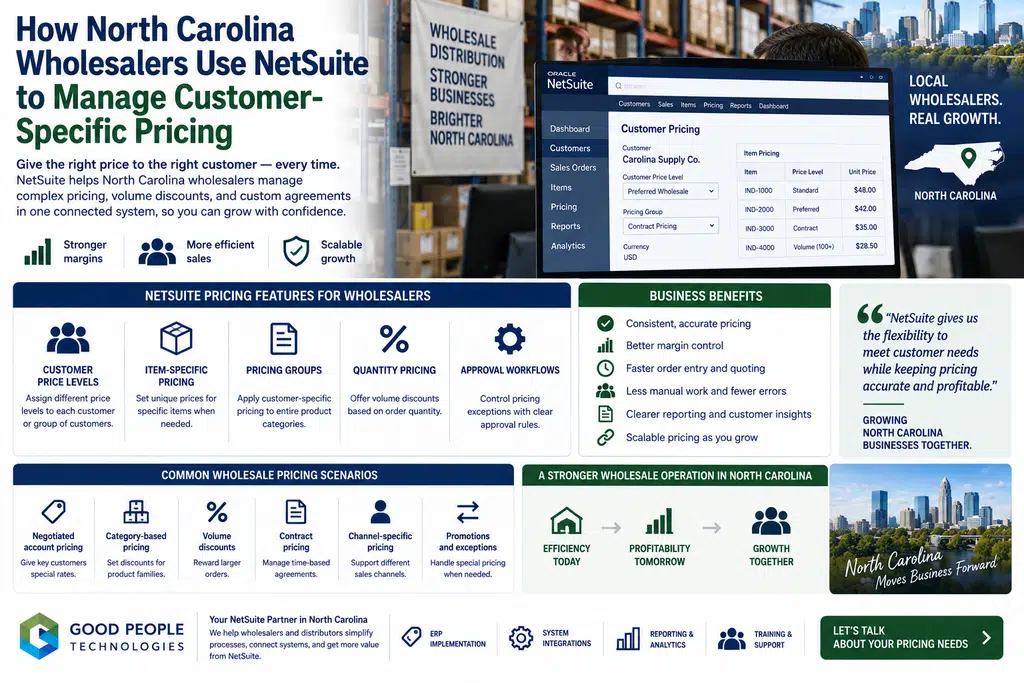
NetSuite customer-specific pricing can help North Carolina wholesalers manage one of the most important and complicated parts of wholesale operations: giving different customers the right price without turning every sales order into a manual pricing decision. Wholesale businesses rarely sell every product to every customer at one standard rate. Pricing may depend on the account, product group, order size, contract, buying history, margin target, or sales agreement.
For wholesalers across Charlotte, Raleigh, Greensboro, Durham, Winston-Salem, Wilmington, Asheville, and other North Carolina markets, that flexibility can become harder to manage as the business grows.
A sales representative may know that one long-term customer receives a special discount. Another account may have different pricing on a specific product family. High-volume buyers may qualify for quantity breaks. A strategic account may have negotiated pricing on individual SKUs. Meanwhile, newer customers may follow a standard wholesale price level.
At a smaller stage, experienced employees can remember many of these rules.
Later, that becomes difficult.
The product catalog expands. More salespeople join the company. Customer agreements change. Order volume increases. Sales arrive through more channels. Finance wants clearer margin control. Customer service needs to explain prices quickly.
As a result, pricing knowledge can become spread across spreadsheets, email threads, sales notes, old quotes, and individual employees.
That creates risk.
A salesperson may use an outdated price. Another employee may apply the wrong discount. Finance may discover margin issues after the order has already shipped. Customers may receive inconsistent quotes for the same product.
NetSuite can help wholesalers create a more structured pricing environment by connecting customer records, items, price levels, pricing groups, quantity rules, sales orders, and reporting.
However, good pricing management requires more than turning on a feature.
The business first needs to understand its pricing model, define ownership, clean up customer and item data, and decide which pricing rules belong in the system.
This article explains how North Carolina wholesalers can use NetSuite to manage customer-specific pricing, reduce manual pricing work, protect margins, and give sales teams clearer information when they quote and process orders.
Why Wholesale Pricing Becomes Complicated So Quickly
Wholesale pricing often looks simple from the outside.
A distributor buys a product at one price and sells it at a higher price.
In practice, the selling price may vary significantly between customers.
One customer may receive standard wholesale pricing. Another may have negotiated a discount because it buys regularly. A large account may receive better pricing on a specific category. Some buyers may qualify for price breaks once an order reaches a certain quantity.
Seasonal agreements can add another layer.
So can special promotions, customer contracts, freight arrangements, manufacturer programs, and sales rep approvals.
The issue is not that wholesalers have too many pricing options.
Flexible pricing is often part of what makes wholesale relationships work.
The challenge is controlling those options as the business grows.
When pricing lives mainly in people’s memory, the process becomes harder to scale. If pricing rules sit in spreadsheets, employees need to check the right file before entering an order. When account notes live in email, another salesperson may not know that a special agreement exists.
Therefore, the real goal is not to simplify every customer into the same price.
The goal is to make pricing complexity easier to manage.
Why Customer-Specific Pricing Matters for North Carolina Wholesalers
Wholesale relationships often develop over time.
A customer may start small and later become a major account. Another buyer may purchase one category in large volume but buy other products only occasionally. A contractor, retailer, manufacturer, reseller, or regional business may have very different pricing needs.
That means pricing can support the relationship.
However, pricing also affects margin.
A discount that made sense several years ago may no longer work after supplier costs change. A customer-specific price may continue even though buying volume has fallen. Another account may receive inconsistent pricing because different salespeople use different rules.
For North Carolina wholesalers, this becomes especially important when the company serves many business accounts across different regions or industries.
Customer-specific pricing should help answer several questions:
- What price should this customer receive?
- Does the price apply to every item or only certain products?
- Does order quantity change the price?
- Is the agreement still profitable?
- Who can override the standard price?
- Does sales see the same price as finance?
- Can customer service explain the pricing?
- How often should special pricing be reviewed?
A strong system helps answer these questions without forcing employees to search through several files.
How NetSuite Customer-Specific Pricing Works
NetSuite customer-specific pricing can support several levels of pricing depending on the features and setup a business uses.
At a basic level, wholesalers can create price levels and associate a customer with the appropriate price level. For example, a company might maintain standard, wholesale, preferred, or other business-defined pricing levels.
This creates consistency.
Instead of asking salespeople to calculate the discount on every order, the customer record can help determine which price the account should receive.
Wholesalers can also create more specific pricing.
For example, a customer may need one price level for most products but receive special pricing for a particular item. NetSuite supports item-specific customer pricing, which can take priority over broader customer or pricing-group settings.
This matters because wholesale agreements are rarely identical across the entire catalog.
A customer may receive normal pricing on most products while receiving negotiated pricing on the items it buys most often.
Pricing groups add another option.
A wholesaler can group related items and assign a customer-specific price level to that group. For example, a company might group a category of pumps, electrical components, packaging materials, or other product family and apply a customer-specific level to the group.
Quantity pricing can add volume-based pricing when the business needs it.
Together, these options give wholesalers several ways to organize pricing without relying on one flat rule for every account.
Customer Price Levels Create a Starting Point
Customer price levels can provide the basic structure for a wholesale pricing model.
Suppose a North Carolina wholesaler has several types of buyers.
Some customers buy occasionally. Others place recurring orders. Strategic accounts purchase large volumes. A few customers have negotiated pricing because of long-term relationships.
The company might create pricing levels that reflect those groups.
The exact names depend on the business. A company could use terms such as:
- Standard Wholesale
- Preferred Wholesale
- Strategic Account
- Dealer Pricing
- Contract Pricing
- Partner Pricing
The important point is not the label.
The important point is consistency.
When the price level sits on the customer record, sales does not need to remember the standard discount for every account.
However, businesses should avoid creating too many levels without clear rules.
If there are dozens of nearly identical price levels and nobody understands why each one exists, pricing becomes complicated again.
A better approach is to start with a manageable structure, then use more specific pricing only where the business truly needs it.
Item-Specific Pricing Helps With Negotiated Agreements
Some customer agreements are more precise.
A customer may have a negotiated price for one SKU, several items, or a small part of the catalog.
That is where item-specific pricing becomes useful.
For example, a Greensboro wholesaler may sell hundreds of industrial components. One customer regularly buys a specific set of valves and negotiates special pricing on those items. The rest of the catalog follows the customer’s normal wholesale price level.
Without item-specific pricing, sales may keep the special agreement in a spreadsheet or customer note.
That creates manual work.
With a more structured setup, the customer record can hold pricing for those specific items.
As a result, the correct price can appear during order entry without forcing employees to check another document.
This is an important benefit of NetSuite customer-specific pricing.
The system can support broad account pricing while also handling exceptions that matter to the relationship.
Still, the company needs clear ownership.
Someone should know who can create special pricing, who reviews it, how long it should remain active, and what happens when costs change.
Pricing Groups Can Reduce Pricing Maintenance
Managing special pricing item by item can become difficult when customers buy large product families.
Pricing groups can help.
A pricing group allows a business to organize related items together and assign customer-specific price levels for that group.
Consider a wholesaler that sells several product categories.
A customer may receive:
- standard pricing on most products
- preferred pricing on electrical supplies
- another pricing level on safety equipment
Instead of maintaining a special rule for every individual item, the company can use product groups where appropriate.
That can make pricing easier to maintain.
However, pricing groups work best when item classification is clean.
If products sit in the wrong group, the wrong price may apply.
Therefore, the wholesaler needs strong item data and clear group definitions.
This connects pricing directly to data governance.
A pricing structure can only work reliably when the underlying customer and item records stay accurate.
NetSuite Customer-Specific Pricing and Quantity Discounts
NetSuite customer-specific pricing can also work alongside quantity-based pricing when wholesalers want to reward larger orders.
Volume matters in wholesale.
A customer that buys a single case may not receive the same economics as an account ordering a full pallet or a much larger quantity.
Quantity pricing helps businesses set different prices based on the amount purchased.
For example, a wholesaler might define price breaks for:
- standard order quantity
- medium-volume order
- high-volume order
The actual structure should reflect the business model, cost, handling requirements, and margin targets.
NetSuite supports quantity pricing schedules and different ways to calculate the relevant quantity.
That can help companies automate pricing that employees might otherwise calculate manually.
Still, wholesalers should keep quantity rules understandable.
A pricing structure that is too complicated can create confusion for sales, finance, customers, and administrators.
The best setup usually reflects the pricing logic the business already wants to enforce consistently.
Why Manual Pricing Creates Margin Risk
Manual pricing feels flexible.
A salesperson can change a rate quickly. A manager can approve an exception. A spreadsheet can hold a negotiated price.
The problem appears when exceptions become the normal process.
One salesperson may give a discount based on an old agreement. Another may enter a custom rate without seeing the current item cost. A new employee may not know which customer has special pricing.
In addition, finance may discover the issue after the transaction.
By then, the business may have already committed to the price.
Small pricing differences can matter when order volume increases.
For example, a discount that reduces margin slightly on one order may not seem significant. The same discount repeated across a large account for months can have a much larger impact.
Manual pricing also makes analysis harder.
Leadership may know total revenue but not understand how many orders used custom prices, which customers receive the deepest discounts, or whether special agreements still make commercial sense.
Structured pricing helps make these patterns easier to review.
Customer-Specific Pricing Should Not Mean Unlimited Discounts
Customer-specific pricing is about controlled flexibility.
It should not mean that every account receives a different price without a clear reason.
Too much pricing variation can create several problems:
- margin becomes harder to understand
- customers may receive inconsistent treatment
- sales representatives rely on memory
- pricing maintenance becomes difficult
- finance spends more time checking orders
- old agreements remain active too long
- reporting becomes harder to interpret
A strong pricing model usually has layers.
The company starts with standard pricing rules. Then it creates customer-specific or item-specific exceptions where commercial needs justify them.
For example, a wholesaler may use standard price levels for most customers, pricing groups for major product categories, quantity pricing for volume, and item-specific prices for negotiated agreements.
That structure gives sales flexibility without turning every transaction into a custom pricing event.
How NetSuite Customer-Specific Pricing Helps Sales Teams
NetSuite customer-specific pricing can help sales teams quote and enter orders with more confidence.
Salespeople need fast answers.
When a customer calls and asks for pricing, the representative should not need to search email, ask finance, open several spreadsheets, and check an old quote before responding.
The system should provide a reliable starting point.
That creates several benefits.
First, sales can respond faster.
Second, pricing becomes more consistent between employees.
In addition, new salespeople do not need to memorize years of account history before they can process an order.
Most importantly, structured pricing reduces uncertainty.
Sales can still request exceptions when a situation requires judgment. However, the normal order process starts from an approved pricing structure.
That is a healthier model than relying on employee memory.
Customer Service Benefits From Better Pricing Visibility
Pricing questions do not only go to sales.
Customer service may also need to answer questions about invoices, orders, credits, pricing differences, and account agreements.
If the correct price exists only in a salesperson’s notes, customer service has limited visibility.
That can create delays.
An employee may need to ask sales for clarification. Finance may need to review the invoice. The customer waits while internal teams determine which rate should apply.
A connected customer record can give service teams better context.
They can see the account, order history, and pricing information that the business chooses to make available through roles and permissions.
As a result, customer questions become easier to resolve.
This does not mean every employee should have permission to change pricing.
Visibility and editing rights should follow different rules.
The company can give teams the information they need while keeping pricing control with the right owners.
Finance Needs Pricing Visibility Too
Finance needs more than final invoice totals.
It needs to understand the rules behind revenue and margin.
Customer-specific pricing affects profitability, forecasts, customer value, discount levels, and financial reporting.
If pricing sits outside the main system, finance may need to investigate why two customers paid different amounts for the same item.
When pricing logic sits inside a structured workflow, finance gets more context.
The team can better review:
- revenue by customer
- margin by account
- margin by product
- discount patterns
- custom pricing activity
- customer profitability
- unusual pricing exceptions
- changes in average selling price
This helps finance support commercial decisions.
For example, leadership may discover that a major account creates high revenue but receives discounts that leave limited margin. Another customer may buy lower volume but produce stronger profitability.
Revenue alone may not show that difference.
Pricing and margin visibility help leadership see it.
Better Pricing Can Support Faster Order Entry
Order entry speed matters in wholesale.
A sales or customer service employee may process many orders during a busy period. If every order requires manual pricing checks, the process slows down.
Structured pricing reduces those checks.
When NetSuite can determine the expected price from customer, item, group, or quantity rules, employees can focus on the order instead of rebuilding the pricing decision.
Exceptions still happen.
A customer may request a one-time deal. A manager may approve a special price. A supplier change may require review.
However, exceptions should remain exceptions.
The routine transaction should move through the business with as little unnecessary manual work as possible.
For wholesalers with high order volume, those small time savings can add up.
They can also reduce errors.
Pricing Ownership Is Essential
A good pricing system needs a clear owner.
Someone should be responsible for the pricing model.
That does not mean one person decides every sales price.
Instead, the company needs clear responsibility for rules, updates, reviews, and exceptions.
Pricing ownership may involve sales leadership, finance, operations, or another commercial role depending on the business.
The owner should help answer questions such as:
- Who can create a new price level?
- Who approves special customer pricing?
- Who can change item-specific pricing?
- When should a discount expire?
- Who reviews margin before approval?
- How often do we review customer agreements?
- Who updates prices after major supplier cost changes?
- Which pricing changes need finance review?
Without ownership, pricing structures can grow without control.
Old levels remain active. Similar pricing groups appear. Employees create custom prices because they do not know the standard process.
Clear ownership keeps the system useful.
NetSuite Customer-Specific Pricing Needs Clean Customer Data
NetSuite customer-specific pricing depends heavily on customer records.
If customer records contain duplicates, outdated account status, unclear ownership, or inconsistent information, pricing becomes harder to manage.
For example, a customer may exist twice under slightly different names.
One record has preferred pricing.
The other uses the standard level.
Now the price depends on which customer record the employee selects.
That creates a problem even if NetSuite itself works correctly.
Therefore, wholesalers should review customer data before building a more advanced pricing structure.
Key areas may include:
- duplicate accounts
- customer status
- account hierarchy
- sales ownership
- payment terms
- price level
- customer group
- item-specific pricing
- account notes
- inactive accounts
Clean customer records make pricing easier to maintain and report.
They also improve finance, sales, order management, and customer service.
Item Data Matters Just as Much
Pricing also depends on item records.
A wholesaler may manage hundreds, thousands, or tens of thousands of SKUs. If item records lack clear structure, pricing rules become difficult to maintain.
Product categories should make sense.
Pricing groups should reflect real commercial logic.
Units of measure need consistency. Base prices and relevant cost information need regular review. Duplicate or inactive items can create unnecessary complexity.
This becomes even more important when the company uses quantity pricing or item-specific customer pricing.
A weak item structure can turn a flexible pricing system into an administrative burden.
Therefore, item data cleanup should be part of pricing improvement.
The company does not need perfect data before it begins.
However, it should know which records affect customer pricing and who owns those records.
Why Cost Changes Need a Pricing Review Process
Wholesale costs change.
Suppliers raise prices. Freight costs move. Product availability changes. Manufacturers introduce new terms. Currency or sourcing conditions may affect landed costs.
A customer-specific price that worked last year may not produce the same margin today.
That is why pricing needs ongoing review.
A good process may flag accounts or products when cost changes create margin pressure.
The business can then decide whether to:
- adjust the customer price
- keep the agreement temporarily
- renegotiate terms
- change the discount level
- review quantity breaks
- change the supplier
- accept a lower margin for strategic reasons
The system does not need to make the commercial decision automatically.
It should help leadership see the issue.
That is an important distinction.
NetSuite can store pricing and support reporting, but people still need to decide which customer relationships justify which economics.
How Reporting Helps Manage Pricing
Pricing becomes much more useful when the company can report on it.
Wholesalers should not only ask, “Did the right price appear on the order?”
They should also ask whether the overall pricing model supports the business.
Useful reporting may include:
- revenue by customer
- gross margin by customer
- gross margin by item
- average selling price
- discount level by account
- sales by pricing level
- customers with special item pricing
- high-volume customers
- low-margin transactions
- pricing overrides
- changes in product cost
- customer profitability
The exact report set will depend on the business.
However, every report should support a decision.
For example, a low-margin report should help leadership decide whether an account, item, or pricing rule needs review.
A customer profitability report may support contract renewal or negotiation.
NetSuite saved searches, reports, dashboards, and analytics can help provide this visibility when teams design them around real pricing decisions.
Why Pricing Overrides Need Controls
Sometimes sales needs to override a price.
There may be a legitimate commercial reason.
A customer has a one-time project. A competitor created unusual pressure. A damaged package requires a discount. Leadership wants to win a strategic order.
The issue is not the override itself.
The issue is whether the business can see and control it.
A good pricing workflow may define:
- who can override pricing
- how large an override can be
- when approval is required
- which reason the employee should record
- who reviews exceptions
- how overrides appear in reporting
This gives the company flexibility while protecting margin.
Without controls, custom pricing can become difficult to distinguish from approved customer pricing.
That reduces accountability and makes pricing analysis harder.
Pricing Rules Should Match the Sales Process
A pricing model should make sales easier, not harder.
If the structure has too many levels, groups, exceptions, and approvals, salespeople may start looking for workarounds.
That is a warning sign.
Before building pricing in NetSuite, wholesalers should map how sales actually works.
How do customers request quotes?
Which accounts have contracts?
How frequently do salespeople need custom pricing?
Who approves discounts today?
Do customers place orders through sales reps, EDI, a portal, e-commerce, phone, or email?
Does pricing need to work consistently across those channels?
These questions help the company choose a pricing structure that fits the real business.
Technology should support the sales process.
The sales process should not become unnecessarily complicated just to fit the technology.
NetSuite Customer-Specific Pricing and Multi-Channel Sales
NetSuite customer-specific pricing becomes especially important when wholesalers sell through several channels.
A customer may order through a sales representative today and use a web portal tomorrow. Another account may submit orders through EDI. Customer service may also enter orders on the customer’s behalf.
The business wants the correct pricing to follow the customer.
Otherwise, channel differences can create confusion.
A sales rep may quote one price while an online experience shows another. Customer service may enter a different rate. Finance then has to determine which one was correct.
The exact solution depends on the connected systems and setup.
However, the principle is clear.
Pricing should have a defined source of truth.
If NetSuite serves that role, integrations should carry the right customer, item, and pricing context to connected sales channels where appropriate.
That reduces duplicate pricing maintenance and helps avoid inconsistent customer experiences.
Integrations Need to Respect Pricing Logic
Many wholesalers connect NetSuite with other business systems.
These may include:
- e-commerce platforms
- customer portals
- CRM tools
- EDI systems
- quoting tools
- warehouse software
- reporting platforms
An integration can move orders successfully while still mishandling pricing if the logic is unclear.
For example, should the connected sales platform calculate the price, or should NetSuite determine it?
Which system owns the customer’s price level?
How should item-specific prices sync?
What happens when a salesperson enters an approved override?
How does quantity pricing work across the channel?
These questions need answers before integration design.
Otherwise, pricing can become duplicated across systems.
Then the company has to maintain the same rules in more than one place.
A strong integration strategy defines system ownership first.
How NetSuite Customer-Specific Pricing Can Reduce Workarounds
NetSuite customer-specific pricing can reduce the spreadsheets, notes, and manual checks that often grow around wholesale pricing.
A wholesaler may currently use:
- pricing spreadsheets by customer
- PDF price sheets
- email approvals
- CRM notes
- shared drive files
- sales rep cheat sheets
- previous quotes
- custom order notes
Each workaround may solve a real problem.
Together, they create risk.
Employees may use old versions. A new salesperson may not know where to look. Finance may not know whether a discount was approved. Leadership may struggle to review special pricing across hundreds of accounts.
Moving appropriate pricing rules into NetSuite gives the business a clearer source of truth.
The company may still use price sheets or quoting documents when customers need them.
However, the internal pricing logic can become more structured.
When Advanced Pricing May Make Sense
Some wholesalers have pricing needs that go beyond a few customer levels.
The business may manage larger catalogs, many customer groups, more complex pricing methods, or broader pricing rules.
Depending on the NetSuite account and enabled features, Advanced Pricing may provide additional options for structuring price levels, customer groups, and pricing rules.
Still, more capability does not always mean the business should use every capability.
Complex pricing should solve a real commercial need.
Before adding another layer, leadership should ask:
- What problem does this pricing rule solve?
- How often will the company use it?
- Who will maintain it?
- Can sales explain it?
- Can finance report on it?
- Does it improve margin or customer experience?
- Would a simpler structure work?
The best NetSuite setup is not the one with the most rules.
It is the one the business can understand and manage reliably.
What Wholesalers Should Map Before Improving Pricing
Before configuring or redesigning pricing, North Carolina wholesalers should map the current process.
Start with customer segments.
Which customers receive standard pricing? Which accounts receive negotiated terms? Why do those differences exist?
Next, review products.
Does special pricing apply to individual SKUs, product families, or the entire catalog?
Then look at volume.
Which products use quantity discounts? What order quantities matter?
Approval rules also need attention.
Who can offer a discount? When does sales need manager approval? Does finance need to review margin?
Finally, map the systems.
Where does pricing live today? NetSuite? CRM? Spreadsheets? Customer portals? E-commerce platforms? Old quotes?
Useful questions include:
- Who owns pricing?
- What is the source of truth?
- How often do prices change?
- Which customers have exceptions?
- Which items have special pricing?
- What manual checks happen during order entry?
- Where do pricing errors occur?
- Which reports help leadership review pricing?
- What should happen when supplier cost changes?
- How should expired agreements be handled?
This process helps the company build a pricing model around business reality.
Composite Example: A Greensboro Industrial Wholesaler
Consider a growing wholesaler near Greensboro.
The company sells a broad range of industrial products to regional business customers.
Over time, pricing has become highly relationship-based.
Long-term accounts receive preferred discounts. Several customers have special pricing on high-volume items. Larger buyers receive quantity breaks. Sales reps also keep notes about negotiated deals.
The business is growing, but pricing takes more effort.
A salesperson checks a spreadsheet before preparing a quote. Customer service sometimes asks sales which price should apply. Finance reviews low-margin orders after the fact. New employees need time to learn which customers have special agreements.
The company maps its pricing structure.
It finds that most customers fit into a small number of standard price levels. Several product categories need pricing groups. A smaller set of strategic accounts require item-specific prices. Quantity pricing covers another group of recurring volume deals.
The wholesaler starts moving those rules into a more structured NetSuite setup.
Sales has a clearer starting price during order entry. Customer-specific item agreements stay with the account record. Finance creates reports to review margin and special pricing.
The company still allows exceptions.
However, exceptions no longer define the entire pricing process.
Composite Example: A Charlotte Wholesale Brand
A Charlotte-based wholesale company sells products to independent retailers and regional business customers.
Its pricing needs are different.
Most customers use standard wholesale pricing, but higher-volume retail accounts receive stronger rates. Certain customers also negotiate special pricing on specific product lines.
Initially, the company manages these differences through customer price sheets.
As the catalog grows, maintenance becomes difficult.
A supplier increases the cost of several products. The company updates the main price sheet, but some customer-specific files still contain older prices. Sales uses one version while finance reviews another.
No one made a major mistake.
The process simply became too difficult to maintain manually.
The company reviews NetSuite customer-specific pricing and reorganizes its model.
Standard customer levels cover most accounts. Pricing groups support key product categories. Item-specific prices remain only where contracts or major account agreements require them.
The team also establishes a review process for supplier cost changes.
As a result, sales keeps the flexibility customers expect while leadership gains better control over margin.
How Good People Technologies Helps With Wholesale Pricing
Good People Technologies helps wholesalers and distributors improve NetSuite workflows, system integrations, reporting, automation, and ERP processes.
For businesses working with customer-specific pricing, this can include:
- reviewing the current pricing process
- mapping customer price levels
- reviewing item-specific pricing needs
- identifying spreadsheet-based pricing
- reviewing pricing groups
- improving customer and item data
- mapping discount approval workflows
- improving pricing and margin reporting
- connecting NetSuite with sales channels
- identifying pricing-related integration gaps
- building phased NetSuite optimization roadmaps
The work starts with the business model.
Some wholesalers need a cleaner basic pricing structure. Others need better reporting, data cleanup, approval workflows, or channel integrations. More complex companies may need a broader review of Advanced Pricing and related NetSuite options.
The goal is not to make pricing more complex.
It is to make the complexity the business already needs easier to manage.
Final Thoughts
NetSuite customer-specific pricing can help North Carolina wholesalers protect both customer relationships and business margins.
Wholesale pricing is naturally flexible.
Different accounts buy at different volumes. Strategic customers may negotiate special terms. Product categories may require different discounts. Supplier costs change. Salespeople need room to respond to real commercial situations.
The problem begins when that flexibility lives mainly in spreadsheets, emails, old quotes, and employee memory.
As the business grows, manual pricing becomes harder to maintain.
NetSuite can provide a more structured foundation through customer price levels, item-specific pricing, pricing groups, quantity pricing, reporting, and related pricing features.
However, the system should reflect a clear business strategy.
Wholesalers need to decide which customers receive which pricing, who owns the rules, when exceptions require approval, how often agreements get reviewed, and how pricing connects to margin.
NetSuite customer-specific pricing works best when the company combines system structure with strong customer data, clean item records, clear ownership, and decision-based reporting.
The result is not one price for every customer.
It is better control over the different prices the business already needs.
For growing North Carolina wholesalers, that can mean faster order entry, fewer pricing mistakes, clearer margin visibility, more consistent customer experiences, and pricing processes that can scale with the business.
Frequently Asked Questions
What is NetSuite customer-specific pricing?
NetSuite customer-specific pricing allows businesses to assign different pricing to customers through customer price levels, pricing groups, item-specific prices, quantity pricing, and other pricing options depending on the features enabled.
Can NetSuite give different customers different prices?
Yes. NetSuite can assign different price levels to customer records. Businesses can also set more specific pricing for items or groups of items.
Can one customer have special pricing on only certain products?
Yes. Item-specific customer pricing can support special prices or price levels for selected items while other products follow broader customer pricing rules.
What are pricing groups in NetSuite?
Pricing groups let businesses group related items and assign customer-specific price levels to that group.
Does NetSuite support quantity discounts?
Yes. NetSuite Quantity Pricing can apply different prices based on the quantity sold, depending on the company’s setup and enabled features.
Why is customer-specific pricing useful for wholesalers?
Wholesale businesses often have negotiated accounts, volume discounts, product-specific agreements, and different customer tiers. Structured pricing helps manage those differences more consistently.
Can NetSuite customer-specific pricing help protect margins?
Yes. A structured pricing process can give finance and leadership better visibility into discounts, customer profitability, item margins, and pricing exceptions.
Should salespeople still be able to override prices?
Some businesses need price overrides for legitimate exceptions. However, the company should define who can make overrides, when approval is required, and how the business reviews those exceptions.
Why does customer and item data matter for pricing?
Pricing rules depend on accurate customer and item records. Duplicate customers, incorrect product groups, or outdated data can cause pricing problems even when the system is configured correctly.
How can Good People Technologies help?
Good People Technologies helps wholesalers review NetSuite pricing workflows, improve customer and item data, connect sales channels, build reporting, reduce spreadsheet dependency, and create practical NetSuite optimization roadmaps.

Roman is a B2B marketing specialist focused on technology, ERP systems, business automation, and digital growth strategies. At Good People Technologies, he helps translate complex technology solutions—such as ERP integrations, system integrations, and business process automation—into clear insights for founders, operators, and growing companies.
His work focuses on content strategy, SEO, and thought leadership that helps businesses understand how the right technology infrastructure can support scalable operations and sustainable growth.
At Good People Technologies, Roman contributes to content that explores ERP implementation, automation strategies, and system integration best practices for companies navigating rapid growth and operational complexity.