
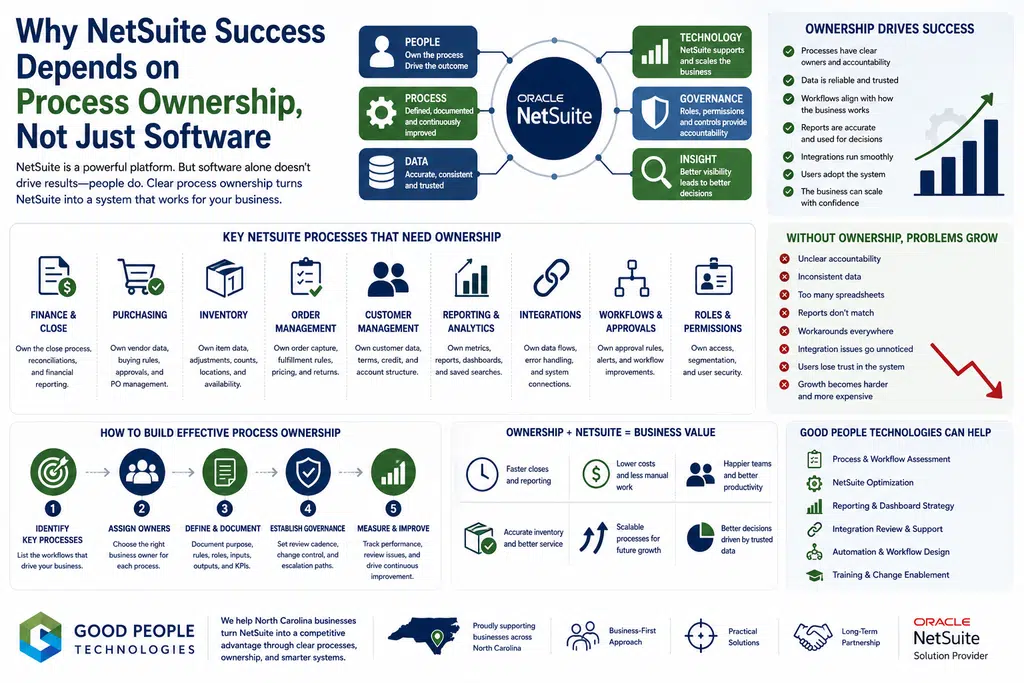
NetSuite process ownership is one of the most important parts of a successful ERP environment, yet many companies focus first on software features, dashboards, integrations, and implementation timelines. Those things matter. However, NetSuite works best when the business also knows who owns each process, who maintains key data, who approves changes, who reviews reports, and who makes sure workflows still match how the company operates.
NetSuite can give a growing business a stronger foundation for finance, inventory, purchasing, order management, reporting, customer records, and operations.
Still, software alone does not create clarity.
A system can hold data, but people define what that data means. A workflow can route approvals, but the business decides who owns the decision. A dashboard can show metrics, but leaders need to know who explains the number and who acts when it changes.
That is where process ownership becomes essential.
For growing companies in North Carolina and beyond, NetSuite often enters the conversation when current systems no longer support the complexity of the business. Reports take too long. Inventory is hard to trust. Finance spends too much time reconciling. Purchasing reacts to demand too late. Customer service checks multiple tools before answering questions. Leadership wants clearer visibility.
NetSuite can help solve many of these problems.
However, the strongest results come when companies treat NetSuite not only as a software platform, but as an operating system for how the business works.
This article explains why NetSuite success depends on process ownership, what process owners actually do, where ownership matters most, and how businesses can create clearer accountability across finance, operations, reporting, inventory, purchasing, integrations, and workflow improvement.
What Process Ownership Means in a NetSuite Environment
Process ownership means one person or team has clear responsibility for how a business process works.
That does not mean one person does all the work.
Instead, the owner makes sure the process has structure, rules, definitions, documentation, reporting, and a clear path for improvement.
In a NetSuite environment, process ownership may apply to areas such as:
- sales order management
- purchasing
- inventory adjustments
- item records
- vendor records
- customer records
- finance reconciliation
- month-end close
- reporting
- saved searches
- dashboards
- integrations
- approvals
- warehouse workflows
- customer service visibility
Without ownership, these areas can become messy over time.
A report may have no clear maintainer. Item records may follow different naming rules. Finance may define a metric one way, while operations uses another version. An integration may fail, but no one knows who should review the issue. A workflow may continue even after the business outgrows it.
Process ownership prevents that drift.
It gives each important workflow a responsible person, a business purpose, and a way to improve.
Why Software Alone Is Not Enough
Companies often buy or implement ERP because they want better systems.
That makes sense.
NetSuite can support more connected workflows, better reporting, stronger financial visibility, improved inventory control, and cleaner operational processes. However, software does not automatically decide how a business should operate.
A company still needs to define:
- who owns each workflow
- what each data field means
- which reports should be trusted
- how approvals should work
- when exceptions need review
- who can change key records
- what happens when data conflicts
- which system is the source of truth
- how teams request system changes
- who decides when a process needs improvement
Without those decisions, the business may move old confusion into a new system.
For example, if no one owns item data before NetSuite, the company may still struggle with item data after NetSuite. If no one owns reporting definitions, dashboards may still create debate. When approval rules are unclear, automated workflows may simply move confusion faster.
Therefore, NetSuite success depends on process ownership because software can support decisions, but it cannot replace them.
Why Ownership Gets Harder as Companies Grow
Small companies often manage processes through direct communication.
People know who to ask. Teams work around gaps quickly. A manager may understand several workflows at once. If something breaks, the business can often solve it informally.
Growth changes that pattern.
More employees join, more departments touch the same data. More customers create more transactions. Product lines expand. Sales channels multiply. Finance needs cleaner reporting. Operations needs more structure. Leadership needs faster visibility.
At that point, informal ownership starts to break down.
A process may involve finance, operations, sales, customer service, warehouse teams, purchasing, and IT. Each group sees part of the workflow, but no one clearly owns the full process.
That creates friction.
Teams may update data differently. Reports may conflict. Exceptions may sit unresolved. System changes may happen without enough business context. Employees may create workarounds because they do not know where to take the issue.
This does not mean the team is doing anything wrong.
Usually, the business has simply reached a stage where process ownership needs to become more formal.
NetSuite can help provide structure, but the company still needs to assign ownership around the workflows that matter most.
NetSuite Process Ownership
It process ownership helps companies turn ERP from a technical system into a practical business foundation, and also creates accountability for the workflows, data, reports, roles, and decisions that NetSuite supports.
This matters because NetSuite touches many parts of a business.
Finance needs accurate transactions and clean close processes. Sales needs clear customer and order data. Purchasing needs reliable vendor and demand signals. Inventory teams need trustworthy item and quantity information. Customer service needs order and account visibility. Leadership needs reports that support decisions.
When no one owns these processes, the system can become harder to manage.
When ownership is clear, NetSuite becomes easier to trust.
A good process owner helps answer questions such as:
- What is this process supposed to accomplish?
- Who uses this workflow?
- Which data fields matter?
- What reports depend on this process?
- Which exceptions need review?
- Who approves changes?
- What should happen when the process breaks?
- How should the workflow improve over time?
These questions turn ownership into daily value.
The Difference Between System Ownership and Process Ownership
System ownership and process ownership are related, but they are not the same.
A system owner may manage NetSuite access, configuration, permissions, vendor support, updates, integrations, and technical administration.
A process owner owns how a business workflow should operate.
Both roles matter.
For example, an administrator may know how to update a saved search. However, the reporting process owner should know what decision the report supports, who reads it, what metric definition it uses, and whether the report still matches business needs.
A technical owner may configure an approval workflow. The process owner should define who approves, why approval matters, what threshold applies, and what exception path should exist.
A systems partner may build an integration. The process owner should help define which data should move, when it should move, what system owns the record, and how the team should handle errors.
When companies confuse system ownership with process ownership, technical teams may receive business decisions they should not have to make alone.
A healthier model pairs technical skill with business accountability.
Why Process Owners Protect Data Quality
Data quality is one of the biggest drivers of NetSuite success.
Clean data helps teams trust reports, automate workflows, connect systems, manage approvals, and make decisions faster. Poor data creates confusion, manual work, reporting delays, and user frustration.
Process owners protect data quality because they understand how the business uses the data.
For example, an item data owner can help define SKU structure, item categories, units of measure, vendor details, costing rules, and naming standards. A customer data owner can help define account records, terms, contacts, pricing, addresses, and segmentation. A finance process owner can help maintain chart of accounts discipline, close rules, reconciliation steps, and reporting definitions.
Without ownership, data problems grow slowly.
Employees may create records differently. Old values may remain in use. Duplicate records may appear. Required fields may not stay consistent. Reports may become harder to trust.
NetSuite process ownership helps prevent these problems by giving data rules a home.
The business knows who reviews data quality, who approves changes, and who handles exceptions.
Why Reporting Needs Ownership
Reporting is one of the clearest places where ownership matters.
NetSuite environments often include dashboards, saved searches, reports, workbooks, KPIs, and exported spreadsheets. Over time, these reporting assets can multiply.
Some reports remain useful.
Others become outdated, duplicated, or disconnected from current decisions.
If no one owns reporting, teams may struggle to know which number to trust. Sales may use one report. Finance may use another. Operations may rely on a spreadsheet. Leadership may ask for manual explanations because dashboards do not fully answer the question.
A reporting process owner helps create structure.
That owner can help define:
- which reports are official
- who uses each report
- what decision each report supports
- how often reports need review
- which metrics need shared definitions
- which saved searches are duplicated
- which reports should be retired
- where manual spreadsheet work still exists
- how reporting requests should be prioritized
This does not require one person to build every report.
Instead, it means someone owns the reporting framework.
As a result, reporting becomes more trusted, more useful, and easier to improve.
Why Workflow Automation Still Needs Human Ownership
Automation can reduce manual work.
It can route approvals, send alerts, update statuses, trigger reports, assign tasks, and reduce repeated follow-up. In NetSuite and connected systems, automation can create major efficiency gains.
However, automation still needs ownership.
A company should not automate a workflow without knowing who owns the process, what should trigger the automation, who receives the alert, what action should follow, and how exceptions should be handled.
Otherwise, automation can create noise.
An alert may go to the wrong person. A workflow may keep running even after the process changes. Approvals may become too strict or too loose. Employees may ignore automated notifications because they do not know what action the system expects.
Process owners help automation stay useful.
They review whether the workflow still matches business needs, clarify thresholds, update rules when operations change and make sure automated steps support real decisions.
Good automation does not remove responsibility.
It makes responsibility easier to act on.
Why Permissions and Roles Need Business Context
NetSuite roles and permissions shape what users can see and do.
That makes them both a technical and business issue.
A technical administrator may know how to configure access. However, the business needs to define what access makes sense for each role, process, and responsibility.
For example, a warehouse employee may need access to fulfillment tasks, but not finance records. A buyer may need vendor and purchase order access, but not unrelated administrative settings. Finance may need broader reporting access, while sales may need customer and order visibility.
If roles lack business context, users may receive too much access, too little access, or confusing access.
Too much access can create risk.
Too little access can slow work and encourage workarounds.
A process owner can help explain what users need to complete their work responsibly. Then administrators can configure roles around real business needs.
This is another reason NetSuite process ownership matters.
The system should reflect how people actually work, not just what permissions exist technically.
Why Integrations Need Owners Too
Integrations often connect NetSuite with e-commerce platforms, CRM systems, warehouse tools, shipping providers, payment processors, reporting platforms, or other business systems.
These integrations can reduce manual work and improve visibility.
Still, every integration needs ownership.
Someone should know what data moves, which system owns each record, how often the sync runs, what errors mean, who reviews failures, and how teams handle exceptions.
Without ownership, integrations can become hidden risk.
A sync may fail quietly. Duplicate records may appear. Orders may not update correctly. Inventory may drift across systems. Finance may spend time reconciling data that should have moved cleanly.
An integration owner does not need to write code.
The owner needs to understand the business process the integration supports.
For example, if Shopify orders flow into NetSuite, the business should know who owns order accuracy, inventory impact, fulfillment status, tax handling, customer data, and exception review.
Integrations work best when technical monitoring and business ownership work together.
Why Process Ownership Improves User Adoption
User adoption is not only a training issue.
People adopt systems when the system helps them do their work clearly and reliably.
If workflows are confusing, reports are not trusted, permissions block basic tasks, or data definitions vary by department, users may avoid the system. They may return to spreadsheets, side trackers, email threads, or manual processes.
That does not happen because people dislike software.
It happens because the system does not yet feel useful enough for the work they need to do.
Process ownership helps improve adoption.
Owners can gather feedback, explain why the workflow exists, clarify rules, update documentation, and identify where the system creates friction. They also help connect user complaints to process improvements instead of treating every issue as a one-off ticket.
When employees know who owns a process, they know where to raise questions.
That makes NetSuite feel more manageable.
Over time, process ownership helps the system become part of how the business works, not just a platform people are expected to use.
Why Ownership Prevents Workarounds From Taking Over
Workarounds often start for good reasons.
A report is missing, so someone builds a spreadsheet. A workflow is unclear, so a team creates an email process. A field does not capture the needed detail, so employees add notes somewhere else. An integration does not cover an exception, so staff members handle it manually.
At first, these fixes help.
Later, they can become hidden infrastructure.
Process owners help prevent workarounds from becoming permanent without review. They can ask why the workaround exists, what decision it supports, how often it happens, who depends on it, and whether NetSuite or another connected system should support it more directly.
Not every workaround needs immediate replacement.
Some are useful and low-risk.
However, business-critical workarounds should not remain invisible. If a spreadsheet drives purchasing, finance, inventory, or customer commitments, the business should review whether that process belongs inside a more reliable workflow.
NetSuite process ownership creates a path for that review.
What Happens When Ownership Is Unclear
Unclear ownership creates slow friction.
At first, the problems may seem small. A report is slightly outdated. A field has inconsistent values. A workflow exception sits too long. A dashboard no longer matches how leadership reviews the business. An integration error waits for someone to notice it.
Over time, small issues create larger costs.
Teams may lose trust in reports. Employees may build side processes. Finance may spend more time reconciling. Customer service may chase information. Operations may handle exceptions by hand. Leadership may delay decisions because the data needs explanation.
The system may still function.
Yet the business may not get the full value from NetSuite.
Unclear ownership also makes improvement harder. If nobody owns a process, nobody has clear authority to change it. Teams may agree that something needs work, but the issue stays unresolved because no one owns the next step.
Clear ownership does not remove every problem.
It does make problems easier to route, discuss, prioritize, and fix.
How to Assign Process Ownership
Companies can start process ownership with a simple review.
First, list the most important workflows NetSuite supports.
These may include order-to-cash, procure-to-pay, inventory management, month-end close, reporting, customer records, vendor management, warehouse fulfillment, billing, approvals, and integrations.
Next, assign a business owner to each process.
That owner should understand the workflow, the teams involved, the decisions it supports, and the data it depends on.
Then define what ownership means.
A process owner may be responsible for reviewing issues, approving changes, maintaining definitions, supporting documentation, prioritizing improvements, and working with technical teams.
After that, create a simple governance rhythm.
The company may review key processes monthly, quarterly, or around major business changes. The goal is not to create bureaucracy. Instead, the goal is to keep workflows aligned with the business as it grows.
Finally, document ownership clearly.
Employees should know who owns the process, how to request changes, and where to report issues.
Where NetSuite Process Ownership Matters Most
Some areas need ownership earlier than others.
The highest-priority areas are usually workflows that affect customers, cash, inventory, compliance, reporting, or daily operations.
For many companies, that includes:
- finance and month-end close
- sales orders
- purchase orders
- inventory adjustments
- item records
- customer records
- vendor records
- pricing rules
- fulfillment workflows
- approvals
- integrations
- dashboards and reporting
- saved searches
- roles and permissions
- data cleanup
- exception handling
These areas create risk when ownership is unclear.
They also create value when ownership improves.
For example, item data ownership can improve inventory and reporting. Reporting ownership can reduce duplicate dashboards. Purchasing ownership can help connect buying decisions to real demand. Integration ownership can reduce hidden sync issues.
Companies do not need to perfect everything at once.
They should start with the processes that create the most manual work, confusion, risk, or delay.
Common Mistakes Companies Make
One common mistake is assuming the implementation partner owns the process forever.
A partner can help design, configure, and improve NetSuite. However, the business still needs internal ownership because employees understand the day-to-day reality behind each workflow.
Another mistake is assigning ownership only to IT.
IT may support the system, but business teams need to own business rules, data meaning, reporting definitions, and workflow decisions.
Companies also sometimes name owners without giving them authority.
A process owner needs enough decision-making power to review issues, approve changes, and coordinate with teams. Otherwise, ownership becomes only a title.
Another common issue is treating documentation as a one-time task.
Processes change. Reports evolve. Employees join and leave. Integrations expand. Therefore, documentation needs review over time.
Finally, some businesses wait until problems become painful before assigning ownership.
A better approach is to define ownership early, especially around high-impact workflows.
How Process Ownership Supports NetSuite Optimization
NetSuite optimization works best when the business knows what it wants to improve.
Without ownership, optimization can become a list of disconnected requests.
One team wants a dashboard. Another asks for a new field. Finance needs a report change. Operations wants fewer clicks. Customer service wants better visibility. Purchasing wants new alerts.
Each request may be valid.
However, process ownership helps organize these requests around workflows and decisions.
For example, instead of building several one-off reports, the reporting owner can review the full reporting estate. Instead of adding fields without structure, the data owner can review what the field should support. Rather than changing an approval rule in isolation, the process owner can look at the full workflow.
This helps the company avoid overbuilding.
It also helps teams prioritize improvements that return the most value.
NetSuite process ownership makes optimization more strategic because it connects system changes to business outcomes.
How Process Ownership Helps With Reporting Cleanup
Reporting cleanup is a strong place to start.
Many NetSuite environments accumulate saved searches, reports, workbooks, dashboards, and spreadsheets over time. Some reports support active decisions. Others overlap, conflict, or no longer serve a clear purpose.
A reporting owner can help build a reporting inventory.
That inventory should show:
- report name
- artifact type
- owner
- audience
- cadence
- data source
- known problems
- decision supported
- duplicate reports
- recommended next step
- priority
This turns reporting cleanup into a structured process.
The business can see which reports to keep, consolidate, rebuild, retire, or create.
More importantly, the team can connect reports to decisions.
A dashboard is more useful when everyone understands what decision it supports and who should act when the number changes.
How Process Ownership Helps With Inventory Accuracy
Inventory accuracy depends on process ownership.
A system may track inventory, but people define how inventory moves, when adjustments happen, who approves changes, how returns enter stock, and which quantities matter for sales or purchasing.
Without ownership, inventory rules can drift.
Sales may use one view of availability. Warehouse teams may rely on another. Finance may focus on inventory value. Purchasing may track reorder needs in a spreadsheet.
These differences can create confusion.
An inventory process owner can help define terms such as on hand, available, committed, allocated, on order, returned, damaged, and in transit. The owner can also help review adjustment rules, item setup, location logic, reporting needs, and exception handling.
This makes NetSuite inventory data more reliable.
As a result, sales can make better promises, purchasing can plan more clearly, warehouse teams can reduce exceptions, and finance can trust inventory value more easily.
How Process Ownership Helps Finance
Finance processes need clear ownership because they affect reporting, controls, cash flow, compliance, and leadership decisions.
A finance process owner may help define how transactions flow, how reconciliations work, how period-end close runs, what reports matter, and which controls protect the business.
As companies grow, finance often absorbs system gaps from other departments.
Sales data may arrive late. Inventory adjustments may need review. Purchase orders may not match bills cleanly. Customer credits may require extra checking. Reports may need manual cleanup.
Process ownership helps finance reduce this burden.
It clarifies which upstream workflows affect finance and who owns them. It also helps the business address root causes instead of only reconciling problems later.
When finance ownership connects with operations, purchasing, inventory, and reporting ownership, the company gains a much clearer view of performance.
How Process Ownership Helps Integrations and Automation
Integrations and automation need business owners because they touch real workflows.
A workflow automation may route approvals, send alerts, update records, or create tasks. An integration may move orders, inventory, payments, customer records, shipping updates, or report data.
Technical setup matters.
However, business logic matters just as much.
Who should receive the alert? What should trigger the workflow? Which system owns the record? When should an exception stop the process? Who reviews failed syncs? What does success look like?
A process owner helps answer these questions.
Without that owner, automation and integrations may work technically while still creating confusion for users.
With ownership, technical tools support business outcomes more clearly.
Composite Example: A North Carolina Distributor
Consider a growing distributor in North Carolina.
The company uses NetSuite for finance, inventory, orders, purchasing, and reporting. The system has improved many areas, but teams still struggle with a few recurring issues.
Sales wants better inventory availability. Purchasing wants clearer demand signals. Warehouse teams manage exceptions manually. Finance spends extra time reconciling inventory adjustments. Leadership sees reports, but some numbers still need explanation.
At first, the company treats these as separate system issues.
After a review, leadership sees a common pattern: ownership is unclear.
No one fully owns item data. Reporting ownership is spread across several departments. Purchasing rules are not reviewed regularly. Integration errors go to technical support, but business teams do not always know how to interpret them.
The company assigns process owners for inventory, purchasing, reporting, and integrations.
Those owners begin reviewing definitions, reports, workflows, and exception paths. They work with technical support to improve saved searches, automate alerts, and clean up item records.
The system does not change overnight.
However, the business starts improving faster because each issue now has a clear owner and a path forward.
Composite Example: A Product-Based Business Improving Reporting
A product-based business has several NetSuite dashboards and saved searches.
Leadership can access many reports, but meetings still include questions about which number to trust. Sales, operations, and finance each use slightly different views of revenue, inventory, and open orders.
The company does not need more dashboards first.
It needs reporting ownership.
A reporting owner builds an inventory of saved searches, reports, dashboards, workbooks, and spreadsheets. The team identifies duplicate reports, clarifies metric definitions, assigns owners, and links key reports to business decisions.
Some reports stay. Others are consolidated. A few old searches are retired after review. New dashboards are designed around decisions, not just available data.
After that, reporting feels more useful.
Leadership spends less time debating numbers and more time deciding what to do next.
How Good People Technologies Helps With NetSuite Process Ownership
Good People Technologies helps growing businesses improve NetSuite performance through ERP consulting, system integrations, workflow automation, reporting cleanup, process review, and practical technology strategy.
For companies working on NetSuite process ownership, this can include:
- reviewing current NetSuite workflows
- mapping process ownership across departments
- identifying unclear data ownership
- reviewing saved searches, reports, and dashboards
- reducing spreadsheet dependency
- improving system integrations
- automating repeatable workflows
- clarifying roles and permissions with business context
- building reporting inventories
- supporting NetSuite optimization roadmaps
The work starts with understanding how the business actually operates.
Some companies need better reporting ownership. Others need clearer inventory rules, cleaner item data, stronger integration monitoring, improved permissions, or workflow automation. More complex businesses may need a broader NetSuite optimization roadmap.
If your team uses NetSuite but still struggles with unclear ownership, manual work, reporting confusion, or disconnected workflows, Good People Technologies can help identify where stronger process ownership would create the most practical value.
Final Thoughts
NetSuite success depends on process ownership because software can only support the business when people define how the business should work.
NetSuite can help connect finance, inventory, purchasing, orders, customers, reporting, and operations.
However, the company still needs clear owners for workflows, data, reports, integrations, automation, permissions, and improvement decisions.
Without ownership, even a strong system can drift into confusion. Reports multiply. Data definitions change. Workarounds grow. Automation creates noise. Integrations lack monitoring. Users lose trust.
With ownership, NetSuite becomes easier to manage and easier to improve.
The business knows who owns each process, what the process supports, which reports matter, how changes get approved, and where issues should go.
That clarity helps teams reduce manual work, improve reporting, protect data quality, support better decisions, and get more value from NetSuite over time.
Good software matters.
Clear ownership makes it work.
Frequently Asked Questions
What is NetSuite process ownership?
NetSuite process ownership means assigning clear responsibility for the workflows, data, reports, roles, permissions, integrations, and business decisions that NetSuite supports.
Why does NetSuite success depend on process ownership?
NetSuite success depends on process ownership because software needs clear business rules, data definitions, workflow owners, reporting accountability, and change management to create lasting value.
Is process ownership the same as system administration?
No. System administration focuses on technical setup, access, configuration, and support. Process ownership focuses on how business workflows should operate and improve.
Who should own NetSuite processes?
Process owners should usually come from the business areas that use the workflow most, such as finance, operations, inventory, purchasing, sales, customer service, or reporting.
Why does reporting need an owner?
Reporting needs an owner because saved searches, dashboards, reports, workbooks, and spreadsheets can multiply over time. Ownership helps clarify which reports are trusted and which decisions they support.
How does process ownership improve data quality?
Process ownership improves data quality by creating clear rules for data entry, updates, approvals, definitions, and exception handling.
Do integrations need process owners?
Yes. Integrations need process owners because someone must understand what data moves, which system owns each record, who reviews errors, and how exceptions should be handled.
Can process ownership improve NetSuite adoption?
Yes. Users are more likely to adopt NetSuite when workflows are clear, reports are trusted, permissions make sense, and they know where to raise issues.
When should a company define process ownership?
A company should define process ownership before implementation, during implementation, and during ongoing NetSuite optimization. It is especially important when workflows become more complex.
How can Good People Technologies help?
Good People Technologies helps businesses review NetSuite workflows, clarify process ownership, improve reporting, connect systems, automate workflows, and build practical optimization roadmaps.

Roman is a B2B marketing specialist focused on technology, ERP systems, business automation, and digital growth strategies. At Good People Technologies, he helps translate complex technology solutions—such as ERP integrations, system integrations, and business process automation—into clear insights for founders, operators, and growing companies.
His work focuses on content strategy, SEO, and thought leadership that helps businesses understand how the right technology infrastructure can support scalable operations and sustainable growth.
At Good People Technologies, Roman contributes to content that explores ERP implementation, automation strategies, and system integration best practices for companies navigating rapid growth and operational complexity.