
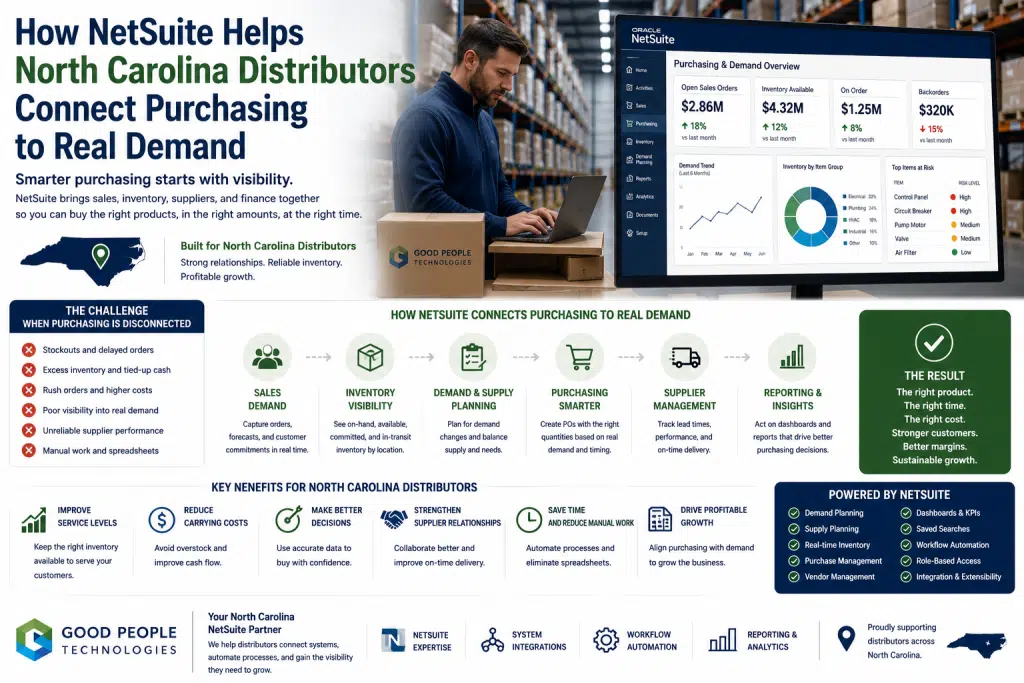
NetSuite purchasing demand North Carolina distributors care about is not only a software topic. It is a day-to-day visibility issue. As a distributor grows, demand changes across customers, channels, seasons, locations, suppliers, and product groups. As a result, buyers need clearer data before they can decide what to order, when to order it, and how much inventory the business should carry.
For distributors across Charlotte, Raleigh, Greensboro, Durham, Winston-Salem, Wilmington, Asheville, and other North Carolina markets, purchasing sits at the center of several pressures. Customers expect products to be available. Sales teams want confidence before making promises. Warehouse teams need enough stock to fulfill orders on time. Finance wants to manage working capital carefully. Meanwhile, leadership needs to know whether inventory supports growth or quietly ties up cash.
The purchasing team has to balance all of that.
When buyers work without real demand data, the business may face stockouts, excess inventory, rushed orders, supplier pressure, lower margins, delayed fulfillment, and customer service issues. However, these problems usually do not come from poor decision-making. More often, buyers are doing their best with data that arrives late, lives in different systems, or does not show the full picture.
That is where NetSuite can become useful.
NetSuite can help distributors connect purchasing decisions to sales orders, available inventory, committed stock, supplier lead times, fulfillment activity, demand planning, finance data, and reporting. Because of that, buyers can see more than a simple stock count. They can make purchase decisions based on what the business actually needs.
This article explains why purchasing often becomes disconnected from demand, how that affects North Carolina distributors, and how NetSuite, integrations, automation, and better reporting can help companies make more confident purchasing decisions.
Why Purchasing Becomes Harder as Distributors Grow
Purchasing is simple only when the business is simple.
A small distributor may know its customers, products, suppliers, and inventory patterns well enough to make buying decisions manually. The team may review past sales, check stock levels, look at a spreadsheet, and place orders based on experience.
That approach can work for a while.
Growth changes the situation.
New customers create new demand signals. A broader product catalog adds more item-level choices. Extra sales channels make inventory movement harder to track. Supplier lead times may change. In addition, seasonal demand can create short windows where availability matters more than usual.
At a certain point, purchasing cannot rely only on habit, memory, or static reports.
The business needs connected visibility.
A buyer should be able to see what sold, what is committed, what is available, what is on order, what is delayed, and what demand may require next. Without that view, purchasing becomes reactive.
Reactive purchasing costs money.
It can lead to emergency orders, overstock, missed sales, supplier strain, and lower confidence across the business.
The Difference Between Purchasing and Demand-Based Purchasing
Purchasing and demand-based purchasing are not the same.
Purchasing means buying the products, materials, or supplies the business needs.
Demand-based purchasing means buying with a clear view of customer demand, order commitments, inventory availability, supplier timing, and cash impact.
That difference matters for distributors.
For example, a buyer may know that a product sold well last month. However, real demand may require a deeper view. How much of that demand came from one-time orders? Which items are already committed to customers? Are open sales orders increasing? Did a promotion change buying patterns for a short time? Are certain customers likely to reorder soon? Is inventory available in the right location? Are supplier lead times changing?
A basic purchasing process may not answer those questions quickly.
A demand-based purchasing process helps the team answer them sooner.
NetSuite purchasing demand North Carolina distributors need should connect buying decisions to the real activity happening across the business. That includes sales orders, inventory, purchase history, open commitments, fulfillment data, vendor performance, customer patterns, and reporting.
The goal is not perfect prediction.
Instead, the goal is better alignment between what the business buys and what customers actually need.
Why Disconnected Systems Make Buyers More Reactive
Many distributors use several systems to manage daily work.
Accounting may live in one tool. Inventory may sit in another. Customer orders may come from sales reps, e-commerce, EDI, email, phone calls, or wholesale portals. Warehouse updates may live in a separate platform. As a result, purchasing may depend on spreadsheets to monitor reorder needs.
Each tool may serve a clear purpose.
Problems begin when buyers have to assemble demand by hand.
A buyer may export sales reports, check stock levels, review open orders, search emails, ask sales about upcoming customer needs, and confirm supplier timelines separately. That takes time and makes purchasing depend too much on individual knowledge.
Information can also become inconsistent.
Sales may see demand increasing. Inventory may show stock on hand but not committed quantities. Warehouse teams may know certain items are not ready to ship, but the system may not show that yet. Finance may see inventory value rising without knowing which items drive the increase.
In that situation, the buyer has to make decisions from partial views.
Disconnected systems do not stop purchasing from happening.
They make purchasing harder to trust.
Inventory Visibility Is the Foundation
Purchasing depends on inventory visibility.
A distributor cannot buy well if teams do not clearly define inventory.
On-hand inventory is not always available inventory. Some products may already support customer orders. Other items may be damaged, in transit, reserved, waiting for inspection, allocated to another location, or still waiting for receiving.
Therefore, buyers need to understand these differences before they place purchase orders.
For example, buying based only on on-hand quantity can create problems. The system may show stock, but sales may have already committed it. A report may show inventory value, but not reveal that key items are running low. Another view may show available units, but not show whether demand is speeding up.
NetSuite can help connect inventory with purchasing, sales orders, fulfillment, finance, and reporting so buyers have a stronger base for decisions.
For North Carolina distributors, this can matter during seasonal demand, supplier delays, regional growth, or expansion into new customer segments.
In practice, better inventory visibility helps buyers answer questions such as:
- What is truly available to sell?
- What is already committed?
- What is on order?
- Which items are delayed?
- What products are moving faster than expected?
- Which items are tying up cash?
- What stock is needed to support upcoming demand?
Purchasing improves when those answers become easier to trust.
NetSuite Purchasing Demand North Carolina
NetSuite purchasing demand North Carolina distributors need is about connecting buying decisions to the business data behind real customer demand. Instead of buying from isolated spreadsheets or delayed reports, companies can use a more connected ERP environment to understand how sales, inventory, supplier timing, warehouse activity, and finance affect each other.
This matters because purchasing is not only a back-office task.
It directly affects customer service, revenue, cash flow, margin, and growth.
When purchasing aligns with demand, the business can reduce stockouts, avoid unnecessary overbuying, improve supplier planning, and support more reliable fulfillment. Buyers gain more context before they place orders. Sales teams can make promises with more confidence. Finance can better understand how inventory decisions affect working capital.
The value of NetSuite does not come from software alone.
It comes from setting up workflows, reports, item data, vendor records, purchasing rules, demand planning, and integrations around how the distributor actually operates.
A company that wants stronger purchasing visibility should not only ask what NetSuite can do. It should also ask what purchasing decisions need better information.
Demand Signals Buyers Should Not Ignore
Demand is not one number. Instead, it is a mix of signals from across the business.
Recent sales are useful, but they are only one part of the picture. Open sales orders, backorders, forecasted demand, customer commitments, seasonal patterns, sales rep input, promotion plans, supplier lead times, and inventory availability can all change what the business should buy.
A strong purchasing process may look at:
- recent sales speed
- open sales orders
- committed inventory
- customer-specific demand
- backorders
- expected reorder cycles
- seasonal product movement
- supplier lead times
- incoming purchase orders
- warehouse capacity
- slow-moving inventory
- margin by product
- sales channel demand
- fulfillment delays
However, when these signals live in different systems, buyers may not see the full picture soon enough.
NetSuite can help bring more of this information into connected workflows and reports. Based on the setup, distributors may use demand planning, supply planning, saved searches, dashboards, purchasing workflows, and inventory reports to improve buying decisions.
Therefore, the most important step is deciding which signals matter most for the business.
Not every distributor needs the same planning model.
Why Supplier Lead Times Change the Purchasing Decision
Supplier timing can change the whole purchasing decision.
A product that can be restocked quickly does not create the same risk as an item with a long or uneven lead time. A slow-moving product may not need urgent action. At the same time, a fast-moving product with supplier delays may need attention much earlier.
Buyers need demand and lead time together.
For example, looking at demand without supplier timing can create false confidence. A product may look safe today, but if replenishment takes longer than expected, the business may run out before the next purchase order arrives.
Supplier lead times also affect cash flow.
A distributor may overbuy to protect availability when supplier timing feels uncertain. That can reduce stockout risk, but it can also tie up money in inventory. On the other hand, ordering too late may protect cash for a short time while creating missed sales later.
As a result, better purchasing visibility helps teams balance these tradeoffs.
NetSuite can support vendor records, purchase history, purchase orders, expected receipts, inventory availability, and planning workflows that help teams see supplier timing more clearly.
In the end, the practical benefit is better timing.
Purchasing should happen early enough to support demand, but not so early that inventory becomes unnecessarily heavy.
Why Buyers Need Finance Context
Purchasing decisions affect cash.
Every purchase order represents an inventory investment. If buyers place orders without enough finance visibility, the company may carry too much stock, miss margin issues, or tie up working capital in products that do not move quickly.
At the same time, underbuying can also cost the business.
A company may protect cash by ordering carefully, but then lose sales because inventory is not available. It may avoid overstock, but disappoint customers. For that reason, finance and purchasing need a shared view of risk.
NetSuite can help connect purchasing with finance reporting, inventory value, vendor bills, sales demand, and margin visibility.
This helps leadership ask better questions:
- Which products deserve more inventory investment?
- Where is cash tied up in slow-moving stock?
- Which supplier terms affect purchasing timing?
- What items create margin pressure?
- How do backorders affect revenue?
- Are emergency purchases increasing costs?
- Which product groups need tighter planning?
Finance does not need to control every purchasing decision.
Still, buyers need enough financial context to understand the business impact of what they purchase.
How Real Demand Reduces Overstock
Overstock often happens when purchasing decisions rely on incomplete or old information.
A buyer may reorder because past sales looked strong. Then demand slows. Another team may purchase extra stock because availability reports are hard to trust. A seasonal product may be overbought because the business did not separate temporary demand from ongoing demand.
Overstock is expensive.
It ties up cash, takes warehouse space, adds carrying costs, and may lead to discounts or write-offs. For distributors with broad catalogs, slow-moving inventory can quietly reduce flexibility.
Demand-based purchasing helps reduce that risk.
When buyers can see current demand, committed stock, open orders, supplier timing, and sales patterns together, they can make more measured choices.
NetSuite purchasing demand North Carolina distributors rely on should help identify where inventory supports growth and where inventory sits without enough movement.
The goal is not to remove all extra inventory.
Some buffer stock may be necessary.
Instead, the goal is to make inventory investment intentional.
How Better Purchasing Reduces Stockouts
Stockouts hurt distributors because they affect customer trust.
Customers come to distributors for availability, speed, and reliability. If a product is not available when needed, the customer may wait, accept a substitute, split the order, or buy elsewhere.
A stockout can also create internal work.
Sales may contact the customer. Customer service may handle updates. Purchasing may rush an order. Warehouse teams may split shipments. Finance may adjust invoices. Leadership may need to review why the issue happened.
Stockouts do not always come from low inventory alone.
They can happen because demand signals arrive late, available inventory is unclear, supplier timing changes, sales channels are disconnected, or purchasing reports arrive too late.
Better purchasing visibility helps buyers see risk earlier.
NetSuite can support low-stock visibility, purchase order tracking, demand and supply planning, reporting, and alerts that help teams respond before stockouts affect customers.
A distributor may still face supplier issues or sudden demand.
However, stronger systems make those risks easier to see and manage.
Backorders Need Better Visibility
Backorders are common in distribution.
They are not always a problem when teams manage them well. Customers may accept backorders when communication is clear and fulfillment timing feels reliable.
Poor backorder visibility creates problems.
Sales may not know which items are delayed. Customer service may not have accurate dates. Purchasing may miss the full demand impact. Warehouse teams may not understand priority. Finance may not know how much revenue is waiting on supply.
A backorder is not only an inventory issue.
It is also a promise management issue.
NetSuite can help connect backorders with sales orders, purchase orders, expected receipts, customer records, and reporting. As a result, teams can see which demand is waiting on supply and what needs attention.
For North Carolina distributors, backorder visibility can be especially important when business customers depend on timely replenishment.
Good backorder reporting should help answer:
- Which customers are affected?
- Which items are delayed?
- What purchase orders are expected?
- Are expected receipt dates reliable?
- Which orders should get priority?
- How much revenue is waiting on fulfillment?
- What updates should customers receive?
Better visibility helps teams manage expectations before frustration grows.
Why Sales and Purchasing Need Shared Data
Sales and purchasing often see different sides of demand.
Sales hears from customers, manages relationships, sees upcoming opportunities, and understands account-specific needs. Purchasing sees inventory levels, supplier timing, reorder needs, and product availability.
Both views matter.
Problems appear when those views do not connect.
Sales may know that a customer plans to increase orders, but purchasing may not see that signal early enough. Buyers may know that supplier lead times are changing, but sales may continue promising the usual availability. Leadership may not see the gap until orders become delayed.
Shared data helps both teams work better.
Sales should see availability, committed stock, backorder status, and realistic fulfillment timing. Purchasing should have access to customer demand patterns, open opportunities, recurring order behavior, and sales forecasts when those forecasts are useful.
NetSuite can help connect customer, order, inventory, purchasing, and reporting information so teams work from a more consistent view.
In practical terms, customers receive better promises because internal teams have better context.
How NetSuite Helps With Reorder Planning
Reorder planning becomes harder as the product catalog grows.
A small distributor may review key items by hand. A larger company often needs more structured rules, reports, and planning workflows.
Reorder decisions depend on several factors:
- current inventory
- available inventory
- committed stock
- sales speed
- reorder points
- vendor lead times
- minimum order quantities
- seasonality
- open purchase orders
- backorders
- warehouse location
- customer commitments
NetSuite can support reorder planning through item records, purchasing workflows, inventory data, planning tools, saved searches, and reporting. The exact approach depends on how the business sets up the system.
The important point is that reorder planning should not depend only on memory or spreadsheets.
Buyers still need judgment.
However, that judgment becomes stronger when the system gives them better context.
NetSuite purchasing demand North Carolina distributors use well should help buyers see what requires attention instead of forcing them to search across several systems.
How Reporting Turns Purchasing Into a Strategic Function
Purchasing becomes more strategic when reporting improves.
A buyer should not only know what to order today. The business should also understand which purchasing patterns support profit, service levels, cash flow, and customer growth.
Useful purchasing reports may include:
- items below reorder point
- fast-moving products
- slow-moving products
- open purchase orders
- vendor performance
- expected receipts
- backorder exposure
- inventory value
- fill rate
- demand by customer or channel
- purchase order aging
- margin by product
- stockout risk
- overstock risk
These reports help leadership see purchasing as a business driver.
Without reporting, purchasing may look like an admin task.
With better visibility, it becomes part of growth strategy.
NetSuite dashboards, saved searches, workbooks, and KPIs can support this when teams design reporting around decisions. The business should not build reports only because data exists. It should build reports around what buyers, finance, sales, warehouse teams, and leadership need to decide.
How Automation Supports Purchasing Decisions
Automation can help purchasing teams respond faster.
A buyer may not need to search for every exception by hand if the system can surface the right alerts.
Useful purchasing automations may include:
- low-stock alerts
- reorder reminders
- backorder notifications
- purchase approval routing
- expected receipt updates
- vendor follow-up reminders
- demand spike alerts
- delayed purchase order alerts
- slow-moving inventory reviews
- item setup notifications
- inventory exception reports
- approval workflows
Automation should not replace buyer judgment.
Instead, it should reduce the manual effort needed to find problems.
For example, a buyer should not discover a stockout only after sales complains. A low-stock or demand spike alert can bring attention earlier. In addition, finance should not wait until month-end to understand purchasing pressure. Better reporting can show changes sooner.
Teams should design automation carefully.
Before they automate a workflow, they should define the trigger, owner, expected response, and escalation path.
When Integrations Still Matter With NetSuite
NetSuite can serve as a central operating system, but distributors often still rely on connected tools.
Orders may come from e-commerce platforms, EDI systems, customer portals, sales tools, marketplace channels, or external systems. Warehouse workflows may involve shipping tools, scanning systems, or third-party logistics providers. Finance may connect to payment processors, tax tools, or reporting platforms.
Integrations help these systems share information.
Without integration, buyers may still work from incomplete demand signals.
For example, an e-commerce order should affect inventory availability. A wholesale order should reserve stock properly. A warehouse update should change fulfillment status. A supplier change may need to appear in purchasing reports. Customer commitments may need to be visible before buyers make replenishment choices.
NetSuite works best when integration design supports the purchasing decisions the business needs to make.
The goal is not to connect every possible system at once.
Start with the systems that affect demand visibility most directly.
Common Mistakes Distributors Make With Purchasing Systems
One common mistake is treating purchasing as a standalone function.
Purchasing depends on sales, inventory, suppliers, finance, warehouse activity, and reporting. Improving purchase orders alone may not solve the deeper visibility problem.
Another mistake is relying too heavily on past sales.
Past sales matter, but they do not always show current demand. Customer behavior, seasonality, promotions, supplier conditions, and channel changes can all affect what the business should buy.
Poor item data can also weaken purchasing.
If SKUs, units of measure, vendor details, lead times, reorder points, or item groups are inconsistent, planning becomes harder. Clean item records are essential.
Some companies also overlook reporting design.
A system may capture data, but buyers still need reports that show what requires action. Leadership needs purchasing visibility that connects to cash flow, margin, and customer service.
Finally, businesses sometimes try to automate before they understand the workflow.
Process clarity should come before automation.
What to Review Before Improving Purchasing
Before improving purchasing with NetSuite or integrations, distributors should review how purchasing works today.
Start with demand signals.
Where does demand appear first? It may show up in sales orders, forecasts, customer conversations, e-commerce orders, recurring accounts, seasonal trends, or backorders.
Next, review inventory definitions.
What does available inventory mean? How does the business handle committed stock? When do returns go back into inventory? Which locations matter? What inventory is already on order?
The team should review supplier data carefully.
Are lead times current? Do vendor records reflect reality? Are minimum order quantities documented? Which suppliers create the most exceptions?
Purchasing workflows also need review.
Who creates purchase orders? What approvals are required? Which reports trigger buying decisions? How does the team handle urgent purchases?
Teams should map reporting to decisions.
Which reports do buyers trust? What does finance need to see? How does leadership review purchasing performance? Where do spreadsheets still carry the process?
This review helps determine whether the business needs reporting cleanup, better integrations, workflow automation, NetSuite improvement, or a broader ERP roadmap.
Composite Example: A Greensboro Distributor
Consider a distributor near Greensboro.
The company serves regional business customers and carries a growing product catalog. Orders arrive through sales reps, email, and an online portal. Inventory lives in the accounting system, while purchasing uses spreadsheets to monitor reorder needs.
For a while, the process works.
As demand grows, purchasing becomes harder. Sales wants better availability before making commitments. Buyers do not always see customer demand early enough. Warehouse updates lag behind order activity. Finance wants a clearer view of inventory investment and supplier commitments.
The company starts by mapping demand signals.
It finds that purchasing decisions depend mostly on past sales and manual inventory checks, while real demand is spread across open orders, customer conversations, backorders, and channel activity.
At first, the company focuses on reporting and integration.
Orders, inventory, and purchasing data become easier to review together. In addition, low-stock alerts help buyers respond sooner. The team reviews supplier lead times and cleans up item records. Leadership gains better visibility into what inventory supports demand and what inventory sits too long.
Eventually, NetSuite becomes part of the roadmap because the business needs purchasing, inventory, orders, finance, and reporting in a more connected foundation.
The key lesson is simple.
Purchasing improved when it became connected to demand.
Composite Example: A Charlotte Wholesale Business
A wholesale business in Charlotte manages customer-specific orders, supplier relationships, seasonal demand, and a mix of standard and special-order products.
The purchasing team has strong experience, but demand signals sit in too many places.
Some information lives in sales conversations. Customer commitments appear in spreadsheets. Inventory reports show on-hand stock but do not always clarify what is truly available. Finance sees inventory value rising and wants better context around future demand.
The company does not need to assume the team is doing anything wrong.
Instead, the issue is that the current system environment makes real demand harder to see.
A review identifies several opportunities:
- define available versus committed inventory more clearly
- connect order data to purchasing reports
- improve supplier lead time tracking
- create alerts for fast-moving products
- review slow-moving inventory more often
- reduce manual spreadsheet planning
- design purchasing dashboards around decisions
After these improvements, buyers have a clearer view before placing orders.
Then the company can decide whether targeted integrations are enough or whether NetSuite should support a more complete operating model.
How Good People Technologies Helps Distributors Connect Purchasing to Demand
Good People Technologies helps distributors and wholesalers improve operations through NetSuite consulting, ERP planning, system integrations, workflow automation, reporting cleanup, and practical technology strategy.
For purchasing and demand visibility, this can include:
- reviewing current purchasing workflows
- mapping demand signals across systems
- improving inventory visibility
- connecting sales, inventory, purchasing, warehouse, and finance data
- reducing spreadsheet dependency
- improving NetSuite saved searches and dashboards
- automating low-stock and exception alerts
- reviewing item and vendor data quality
- supporting integration planning
- building phased NetSuite roadmaps
The work starts with understanding how purchasing decisions happen today.
Some distributors need better reports. Others need integrations between order, inventory, and warehouse systems. More complex businesses may need NetSuite improvement, demand planning, supply planning, or a broader ERP roadmap.
If your purchasing team works hard but still reacts to demand too late, Good People Technologies can help identify which system improvements would create the most practical value.
Final Thoughts
NetSuite purchasing demand North Carolina distributors need is really about visibility, timing, and confidence.
Purchasing decisions affect inventory, customer promises, warehouse flow, cash flow, margin, supplier relationships, and growth. When buyers work from disconnected reports, manual spreadsheets, delayed inventory updates, or incomplete demand signals, the business becomes more reactive.
That does not mean the purchasing team is doing anything wrong.
More often, the systems are not giving buyers the full context they need.
NetSuite can help distributors connect purchasing to real demand by bringing sales orders, inventory availability, committed stock, supplier timing, purchase orders, fulfillment activity, finance, and reporting closer together.
The goal is not to remove judgment from purchasing.
The goal is to give buyers better information before they make decisions.
For North Carolina distributors and wholesalers, stronger purchasing visibility can reduce stockouts, limit overbuying, improve customer service, protect margins, and support more scalable growth.
Frequently Asked Questions
What does it mean to connect purchasing to real demand?
Connecting purchasing to real demand means making buying decisions based on current sales, open orders, committed inventory, supplier lead times, backorders, fulfillment activity, and customer needs instead of relying only on past sales or spreadsheets.
How can NetSuite help distributors with purchasing?
NetSuite can help distributors connect purchasing with inventory, sales orders, vendor records, fulfillment, finance, reporting, demand planning, and supply planning based on the company’s setup and business needs.
Why do purchasing teams become reactive?
Purchasing teams become reactive when demand signals arrive late, inventory is hard to trust, supplier timing is unclear, reporting is manual, or order data does not connect to purchasing workflows.
What demand signals should distributors track?
Distributors should track recent sales, open sales orders, committed inventory, backorders, customer commitments, supplier lead times, incoming purchase orders, seasonality, and channel-specific demand.
Can better purchasing reduce stockouts?
Yes. Better purchasing visibility can help teams identify demand and inventory risks earlier, so buyers can reorder or adjust plans before stockouts affect customers.
Can better purchasing reduce overstock?
Yes. Demand-based purchasing helps buyers avoid overbuying by connecting purchase decisions to current demand, inventory movement, supplier timing, and finance visibility.
Does NetSuite replace buyer judgment?
No. NetSuite does not replace buyer judgment. It supports buyers by giving them clearer data, better reports, planning tools, and earlier signals.
Do distributors still need integrations with NetSuite?
Often, yes. Many distributors connect NetSuite with e-commerce platforms, EDI systems, warehouse tools, shipping providers, CRM systems, payment processors, or reporting platforms.
What should distributors review before improving purchasing?
Distributors should review demand signals, inventory definitions, supplier data, item records, purchasing workflows, approval rules, reporting needs, and manual spreadsheets.
How can Good People Technologies help?
Good People Technologies helps distributors review purchasing workflows, connect systems, improve NetSuite reporting, automate alerts, reduce spreadsheet dependency, and build practical ERP roadmaps.

Roman is a B2B marketing specialist focused on technology, ERP systems, business automation, and digital growth strategies. At Good People Technologies, he helps translate complex technology solutions—such as ERP integrations, system integrations, and business process automation—into clear insights for founders, operators, and growing companies.
His work focuses on content strategy, SEO, and thought leadership that helps businesses understand how the right technology infrastructure can support scalable operations and sustainable growth.
At Good People Technologies, Roman contributes to content that explores ERP implementation, automation strategies, and system integration best practices for companies navigating rapid growth and operational complexity.