
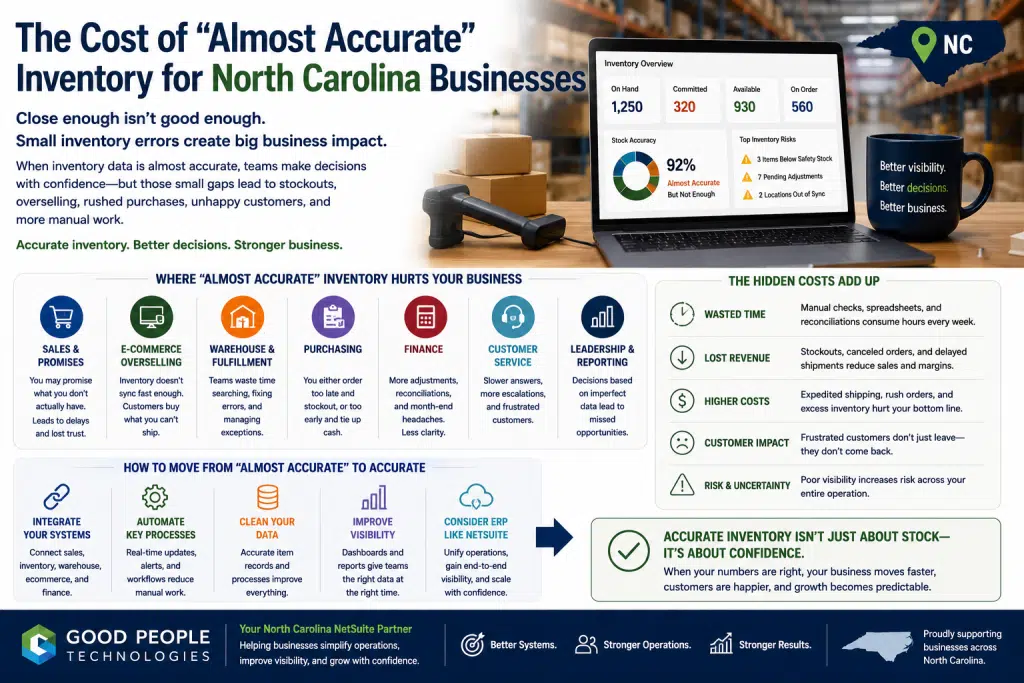
Almost accurate inventory for North Carolina businesses can be more expensive than inventory that is obviously wrong. When a company knows its inventory data is unreliable, teams usually slow down, double-check, and treat the numbers carefully. The bigger risk comes when inventory looks close enough to trust, but still contains small gaps that affect sales, fulfillment, purchasing, finance, and customer service.
A product-based business may think it has enough stock to support a promotion. A distributor may promise availability based on a report that is slightly outdated. An e-commerce company may oversell a popular product because inventory did not sync quickly enough. A manufacturer may delay purchasing because the system shows materials that are not truly available.
None of these problems require inventory to be completely wrong.
It only needs to be close enough to create false confidence.
For businesses across Charlotte, Raleigh, Durham, Greensboro, Winston-Salem, Asheville, Wilmington, and other parts of North Carolina, inventory accuracy can affect daily operations in practical ways. It influences what sales teams promise, what customers expect, what purchasing teams reorder, how warehouses prioritize work, what finance reports, and how leadership plans growth.
The cost of “almost accurate” inventory is not only a warehouse issue.
It is a business visibility issue.
This article explains why small inventory inaccuracies become expensive, how they affect growing North Carolina companies, and how better systems, integrations, automation, ERP, and NetSuite planning can help businesses move from “close enough” to inventory data they can actually trust.
Why “Almost Accurate” Inventory Feels Acceptable at First
Many growing businesses live with small inventory mismatches for a long time.
A few numbers are off. Some products need manual checks. One sales channel updates slower than another. Warehouse adjustments happen later than expected. A spreadsheet contains the latest correction, while the system still shows yesterday’s number.
At first, this may feel manageable.
Employees know where the gaps are. Sales can ask operations before confirming a large order. The warehouse can check shelves manually. Finance can reconcile inventory at the end of the month. Purchasing can keep a separate tracker for products that move quickly.
This kind of practical adjustment is common.
It is also understandable.
Teams often create manual processes because they are trying to protect the customer and keep the business moving. A workaround may be the fastest way to solve an immediate problem.
The challenge appears when those workarounds become permanent.
A business may still say inventory is “mostly accurate,” but that phrase hides a lot of operational effort. People are checking, correcting, adjusting, reconciling, and explaining the numbers behind the scenes.
Inventory that is almost accurate may not stop the business from operating.
It simply makes every inventory-related decision slower, riskier, and more expensive.
Why Small Inventory Errors Create Big Operational Costs
Inventory affects many parts of a business at once.
A small error can travel through sales, fulfillment, purchasing, finance, customer service, and reporting. Because inventory is connected to so many decisions, even a small mismatch can create a larger chain reaction.
For example, a system may show 40 units available when only 34 are actually ready to sell.
That gap may seem small.
However, the sales team may confirm an order. E-commerce may continue taking purchases. The warehouse may discover the issue during fulfillment. Customer service may need to explain the delay. Purchasing may need to reorder quickly. Finance may need to adjust records later.
One small inventory difference can create several downstream tasks.
The cost is not only the missing units.
It includes the labor required to find the issue, correct the order, communicate with the customer, adjust the report, update purchasing, and reconcile the financial impact.
Almost accurate inventory for North Carolina businesses becomes expensive because it creates small problems repeatedly across departments.
The business may not experience one dramatic failure.
Instead, teams feel constant friction.
The False Confidence Problem
Inventory that is clearly wrong creates caution.
Almost accurate inventory creates confidence.
That confidence can be dangerous.
When teams believe inventory numbers are close enough, they may make decisions without the extra review that inaccurate data requires. Sales may promise availability. Marketing may promote a product. Purchasing may delay a reorder. Finance may trust inventory value. Leadership may use inventory reports to plan cash flow.
If the numbers are only slightly wrong, the mistake may not appear immediately.
A stockout may happen later. A customer order may be delayed. A warehouse team may discover the issue during picking. Finance may catch the adjustment at month-end. Leadership may realize after the fact that demand was stronger than the reports suggested.
False confidence makes inventory issues harder to detect early.
Teams are not ignoring the business.
They are acting on information that appears reliable.
This is why inventory accuracy should not be treated as a technical detail. It should be treated as a decision-making foundation.
A company can only move quickly when people trust the data they are using.
Sales Teams Promise Based on Inventory Visibility
Sales teams need accurate inventory to make good commitments.
When inventory is almost accurate, sales may spend more time checking availability before confirming orders. In other cases, they may trust the system and later learn that the product is not available.
Both situations create problems.
If sales has to check manually, the process slows down. Customers wait longer for answers. Internal teams spend more time confirming stock. Large orders may require extra coordination before approval.
When sales trusts an inaccurate number, the risk shifts to the customer experience.
A promised product may not ship on time. A customer may need to accept a substitute. An account manager may have to explain why availability changed. For wholesale or distribution relationships, repeated availability issues can damage trust.
Product-based businesses, distributors, wholesalers, and e-commerce companies all depend on accurate availability.
The key question is not only “How much inventory do we have?”
A better question is: “How much inventory can we confidently promise?”
That includes on-hand quantity, committed stock, pending orders, damaged goods, warehouse location, returns, transfers, and incoming supply.
Almost accurate inventory for North Carolina businesses often fails because it does not clearly separate these categories.
E-Commerce Overselling Happens Quietly
E-commerce businesses can experience inventory errors quickly.
A product may sell through a website, marketplace, retail partner, wholesale channel, or manual order process. Each channel may affect available inventory. If systems do not sync correctly, overselling becomes more likely.
Overselling does not always come from large inventory mistakes.
It often comes from timing gaps.
A marketplace may not update quickly enough. A wholesale order may reserve stock outside the e-commerce platform. A return may not be processed correctly. A warehouse adjustment may happen after the online store has already shown the item as available.
From the customer’s perspective, the issue is simple.
They bought something the business appeared to have.
From the company’s perspective, the issue may involve systems, timing, workflows, integrations, and manual updates.
Overselling creates costs beyond the lost product.
There may be refund work, customer support time, apology emails, replacement offers, fulfillment adjustments, and lost future trust.
A single issue may be recoverable.
Repeated overselling can make customers less confident in the brand.
For North Carolina e-commerce companies, stronger inventory integrations can help connect online stores, marketplaces, warehouse systems, accounting, fulfillment tools, and reporting so availability is updated more reliably.
Fulfillment Teams Absorb the Consequences
Warehouse and fulfillment teams often discover inventory inaccuracies after other departments have already made commitments.
The order has been placed. The customer expects shipment. Sales believes the item is available. The system says the product should be there.
Then the warehouse cannot find it.
This creates immediate pressure.
Fulfillment teams may search multiple locations, check receiving areas, review returns, ask supervisors, adjust the order, or flag the issue for customer service. A pick ticket that should be simple becomes an exception.
Exceptions are expensive because they interrupt flow.
Warehouse teams are most efficient when work is clear, accurate, and repeatable. Almost accurate inventory creates uncertainty. Employees spend more time investigating and less time fulfilling.
The impact becomes larger during busy periods.
If order volume increases, small inventory issues multiply. A few exceptions per day can become a serious operational bottleneck.
Better inventory accuracy helps fulfillment teams work faster and with less frustration.
It also helps customers receive more reliable service.
Purchasing Decisions Become Reactive
Purchasing depends on trustworthy inventory data.
A buyer needs to know what is on hand, what is committed, what is selling, what is on order, what is delayed, and what needs replenishment.
When inventory is almost accurate, purchasing becomes reactive.
A team may reorder too late because the system shows enough stock. Another company may overbuy because nobody trusts the numbers. Some businesses keep extra safety stock to protect against uncertainty, which ties up cash.
None of these outcomes is ideal.
Late purchasing can create stockouts and missed sales. Overbuying can increase carrying costs. Extra safety stock can hide inventory problems instead of solving them.
Almost accurate inventory for North Carolina businesses can be especially costly when supplier lead times are long or seasonal demand is short.
A product may need to be available during a specific window. If the reorder decision is delayed, the business may not recover the lost opportunity later.
Better inventory visibility helps purchasing move from reaction to planning.
That means clearer demand signals, more accurate reorder points, better supplier coordination, and stronger reporting.
Finance Feels the Inventory Problem Later
Inventory inaccuracies eventually reach finance.
The issue may begin in the warehouse, sales channel, or purchasing process, but finance has to reconcile the impact.
Inventory value may not match reality. Cost of goods sold may need adjustment. Refunds and returns may affect reports. Purchase orders, receipts, fulfillments, and invoices may not align cleanly. Month-end close can take longer because inventory needs extra review.
Finance teams often create disciplined workarounds to manage this.
They may use reconciliation spreadsheets, manual checks, adjustment logs, or special reports. These processes help protect accuracy, but they also take time.
The deeper cost is delayed visibility.
Leadership may not understand margin, product profitability, inventory value, or cash flow as quickly as it needs to.
A business can have strong sales but still lose control of profitability if inventory data is not accurate enough.
Better system design helps finance connect inventory activity with purchasing, sales, fulfillment, returns, and accounting.
When inventory becomes easier to trust, finance can spend less time cleaning up the past and more time helping the business plan forward.
Customer Service Deals With the Fallout
Customer service teams often feel inventory problems directly.
A customer asks why an item has not shipped. Another wants to know when a product will be back in stock. Someone placed an order and now needs a replacement. A wholesale account wants an update on a delayed shipment.
If inventory data is almost accurate, customer service may not have a confident answer.
The representative may need to check the warehouse, review the order system, ask operations, search emails, or wait for someone else to confirm availability.
This creates slower responses.
Customers may not care that the issue came from a small system mismatch. They only experience uncertainty.
Customer service teams work best when they can answer quickly and accurately. That requires access to reliable order, inventory, fulfillment, and customer account information.
Inventory accuracy therefore affects service quality.
It also affects employee workload.
When the system cannot provide the answer, people have to chase it.
Almost Accurate Inventory for North Carolina Businesses
Almost accurate inventory for North Carolina businesses is often a sign that the company has outgrown earlier systems, manual workflows, or disconnected tools. The business may still be operating successfully, but inventory data may no longer be accurate enough to support faster decisions, larger order volume, more sales channels, or more complex fulfillment.
This issue commonly appears when companies manage inventory across:
- accounting software
- e-commerce platforms
- warehouse systems
- spreadsheets
- marketplace channels
- wholesale orders
- purchase order records
- manual adjustments
- returns processes
- supplier updates
- ERP reports
- fulfillment tools
Each system may hold part of the truth.
The problem is that teams need one reliable operating view.
A company does not need perfect inventory in every possible sense. It needs inventory data accurate enough to support the decisions being made every day.
Can sales promise this product? Should purchasing reorder now? Can the warehouse fulfill this order? Is this item profitable? Are we tying up too much cash? Which products are at risk of stockout? Which inventory is slow-moving?
When the answers require manual checking, the inventory system is not fully supporting the business.
The Difference Between On Hand, Available, and Committed
One reason inventory becomes “almost accurate” is that teams use inventory terms differently.
On hand inventory is not always the same as available inventory.
A product may physically exist in the warehouse but already be committed to a customer order. Another item may be on hand but damaged, reserved, in quality review, or located somewhere that cannot fulfill the order quickly.
Available inventory should reflect what can actually be promised or used.
Committed inventory is stock already tied to an order, project, production need, or customer obligation.
On order inventory has been purchased but not yet received.
In transit inventory may be moving between locations or from a supplier.
Returned inventory may need inspection before it can be sold again.
When these categories are not clearly defined, teams may talk past each other.
Sales may look at on hand quantity. Operations may think in terms of available stock. Finance may focus on inventory value. Purchasing may care about on order and reorder points.
Nobody is necessarily wrong.
They are simply using different views for different decisions.
Good inventory reporting should make these distinctions clear.
Why Inventory Errors Increase With More Sales Channels
More sales channels usually create more inventory complexity.
A business may sell through its website, Amazon, wholesale customers, retail accounts, trade shows, manual orders, sales reps, and seasonal promotions. Each channel may create demand at a different speed.
If inventory does not update quickly across channels, small mismatches appear.
A wholesale order may consume stock that the e-commerce store still shows as available. A marketplace order may not sync right away. A manual sales order may not reserve inventory correctly. A return may be processed in one system but not another.
The more channels a business adds, the more important inventory synchronization becomes.
Without strong integrations, employees become responsible for keeping channels aligned.
That may work for a while.
Eventually, the manual effort becomes too large and the risk becomes too high.
Almost accurate inventory for North Carolina businesses often becomes visible when a company expands channels faster than its systems can support.
Seasonal Demand Makes Inventory Gaps More Expensive
Seasonal demand can expose inventory weaknesses quickly.
A summer promotion, holiday rush, outdoor product season, tourism-related demand cycle, wholesale buying period, or local event can increase order volume and speed.
During these periods, inventory accuracy matters more.
A slow-moving error during a quiet month may be manageable. The same error during a busy season can create missed revenue, delayed shipments, customer complaints, and rushed purchasing.
North Carolina companies with seasonal patterns should review inventory workflows before demand increases.
That review should include:
- inventory sync timing
- stock availability rules
- sales channel updates
- purchasing triggers
- warehouse adjustments
- return processing
- manual inventory reports
- low-stock alerts
- fulfillment exceptions
- leadership dashboards
The goal is not to eliminate every possible inventory issue.
It is to reduce the gaps most likely to affect revenue, customer service, and cash flow during high-demand periods.
How Manual Inventory Workarounds Create Risk
Manual workarounds often appear because teams are trying to solve real problems.
A spreadsheet may track inventory more clearly than the current system. A warehouse supervisor may maintain a side list of problem items. Purchasing may use a separate reorder file. Sales may ask for manual confirmation before large orders.
These workarounds are not failures.
They show where the business needs better support.
The risk appears when manual workarounds become essential.
If a key spreadsheet breaks, does the business lose visibility? If one person is unavailable, can the team still understand availability? Are manual adjustments documented clearly? Do side trackers update the main system? Does leadership know which reports are official?
Manual work can protect a business temporarily.
It can also hide the fact that the system is not keeping up.
Businesses should identify which manual inventory processes are low-risk and which ones support critical decisions.
Critical workflows should eventually move into more reliable systems, integrations, automations, or ERP processes.
How Integrations Improve Inventory Accuracy
System integrations can reduce inventory problems by helping data move between tools automatically.
For North Carolina businesses, common inventory-related integrations may involve:
- e-commerce and inventory systems
- accounting and warehouse tools
- NetSuite and Shopify
- marketplace channels and ERP
- fulfillment providers and order management
- purchasing systems and inventory planning
- CRM and customer account data
- reporting dashboards and operational systems
Integrations help reduce duplicate entry and delayed updates.
They also help teams work from the same information.
A good integration plan should define which system owns inventory data, how often updates happen, what triggers changes, how errors are handled, and what teams should do when exceptions appear.
Technology alone is not enough.
The business also needs clear process rules.
For example, when is inventory considered committed? How are returns added back? Who approves adjustments? Which system is the source of truth for available inventory?
When process and integration design work together, inventory becomes more trustworthy.
If inventory gaps are creating customer issues or manual work, Good People Technologies can help review where better integrations would improve visibility.
How Automation Reduces Inventory Surprises
Automation helps teams respond to inventory issues earlier.
It can support alerts, workflows, approvals, reports, and exception handling.
Useful inventory automations may include:
- low-stock alerts
- reorder point notifications
- delayed receiving alerts
- fulfillment exception alerts
- backorder notifications
- inventory adjustment approvals
- return inspection workflows
- weekly inventory health reports
- slow-moving inventory reviews
- committed inventory alerts
- purchasing reminders
- warehouse task notifications
Automation does not replace inventory strategy.
It helps the right people notice issues sooner.
A purchasing manager should not have to discover a stockout manually. A warehouse supervisor should not rely on memory to flag recurring exceptions. Leadership should not wait for month-end to see inventory risks.
Automation turns inventory issues into visible signals.
That gives teams more time to act.
When ERP or NetSuite Becomes Relevant
Some inventory problems can be solved with better integrations, cleaner workflows, or targeted automation.
Other problems suggest the business may need ERP.
NetSuite becomes more relevant when inventory accuracy depends on several connected areas at once: sales orders, purchasing, warehouse operations, finance, customer records, fulfillment, reporting, and multiple channels.
A company may want to evaluate ERP when:
- inventory numbers differ across systems
- sales depends on manual availability checks
- purchasing is reactive
- finance spends too much time reconciling inventory
- warehouse teams frequently discover exceptions
- reporting is delayed or inconsistent
- multiple sales channels create overselling risk
- spreadsheets are the real inventory source of truth
- leadership lacks clear visibility into inventory value
- growth is increasing complexity faster than systems can support
ERP should not be rushed.
A thoughtful approach begins with discovery. The company should map current workflows, identify data sources, review inventory definitions, clean up item records, evaluate integrations, and prioritize the most expensive gaps.
Good People Technologies can help businesses evaluate whether integrations, automation, NetSuite, or a phased ERP roadmap makes the most sense.
Why Item Data Matters More Than Many Teams Expect
Inventory accuracy depends on item data.
If item records are incomplete, duplicated, outdated, or inconsistent, inventory reporting becomes harder to trust.
A business may have variations in naming, SKU structure, units of measure, item categories, vendor details, pricing, costing, dimensions, or warehouse handling rules.
These details may seem small.
They can create real problems.
A product may be purchased in one unit and sold in another. Similar SKUs may be confused. Vendor lead times may not be updated. Item categories may not support useful reporting. Cost data may not reflect reality. Warehouse teams may lack handling instructions.
Before improving inventory systems, businesses should review item data quality.
Clean item records make integrations, reporting, purchasing, fulfillment, and ERP implementation easier.
Poor item data can make even a strong system feel unreliable.
How to Audit Inventory Accuracy Before It Becomes Expensive
Businesses do not need to wait for a major inventory failure before improving accuracy.
A practical inventory audit can start with questions:
- Which system is the source of truth for inventory?
- How often does inventory sync between systems?
- What is the difference between on hand, available, committed, and on order?
- Where do manual adjustments happen?
- Who approves inventory changes?
- Which products create the most exceptions?
- Which sales channels cause overselling risk?
- How are returns processed?
- How does purchasing know what to reorder?
- How does finance reconcile inventory value?
- Which reports does leadership trust?
- What inventory spreadsheets are still required?
These questions help reveal where “almost accurate” inventory is creating risk.
After that, the business can prioritize improvements.
Start with areas that affect customers, revenue, cash flow, or repeated manual work.
A small improvement in the right workflow can produce meaningful value.
Composite Example: A Charlotte E-Commerce Brand
Consider a growing e-commerce brand in Charlotte.
The company sells seasonal lifestyle products through its website, wholesale customers, and a few marketplace channels. Inventory is tracked through a mix of e-commerce tools, accounting software, warehouse updates, and spreadsheets.
Most of the time, the numbers are close.
During a summer promotion, the company starts overselling a few popular products. The website shows inventory as available, but some units have already been committed to wholesale orders. Returns are also not being added back consistently because they require inspection first.
The team works hard to fix each issue.
Customer service contacts buyers. The warehouse reviews available stock manually. Finance adjusts reports later. Purchasing rushes an order, but supplier timing is tight.
After the promotion, leadership reviews the process.
The issue was not one large inventory failure. It was several small mismatches: committed stock, channel timing, return status, and manual updates.
The company improves inventory rules, connects systems more clearly, and creates alerts for low-stock and committed inventory. Over time, it also evaluates whether ERP would help support multi-channel growth.
For this business, almost accurate inventory was not accurate enough during demand spikes.
Composite Example: A Greensboro Distributor
A distributor near Greensboro manages a broad catalog of products, several suppliers, customer-specific pricing, and regional delivery expectations.
Inventory looks reliable in the main system, but employees know certain categories require manual checks.
Sales confirms availability with the warehouse before large orders. Purchasing maintains a separate reorder spreadsheet. Finance reviews inventory adjustments at month-end. Customer service sometimes waits for warehouse confirmation before answering account questions.
The company continues operating, but the manual work increases as volume grows.
Eventually, leadership realizes that the issue is not only inventory accuracy. It is coordination.
Sales, purchasing, warehouse, finance, and customer service all need inventory data, but each team is using a slightly different view.
The distributor begins by mapping inventory workflows and identifying which reports support daily decisions. It improves item data, clarifies inventory definitions, reviews integrations, and starts building a roadmap toward better ERP visibility.
The goal is not perfection.
The goal is confidence.
How Good People Technologies Helps Improve Inventory Visibility
Good People Technologies helps growing businesses improve inventory visibility through system integrations, workflow automation, ERP support, NetSuite consulting, reporting improvements, and practical technology strategy.
For businesses dealing with almost accurate inventory for North Carolina businesses, this can include:
- reviewing current inventory workflows
- identifying disconnected systems
- mapping inventory data sources
- improving integrations between sales, warehouse, accounting, and ERP tools
- reducing spreadsheet dependency
- automating low-stock and exception alerts
- improving reporting dashboards
- reviewing NetSuite readiness
- supporting item data cleanup planning
- helping teams build phased inventory improvement roadmaps
The work starts by understanding where inventory inaccuracies create the most business pressure.
Some companies need targeted integrations. Others need automation, better reporting, item record cleanup, process redesign, or ERP planning.
If your team is spending too much time checking inventory manually or explaining inventory surprises, Good People Technologies can help identify which system improvements would create the most practical value.
Final Thoughts
Almost accurate inventory for North Carolina businesses is costly because it creates confidence without enough reliability.
The numbers may look close. Teams may know how to work around the gaps. Customers may still receive most orders. Finance may still close the books. Purchasing may still keep products moving.
However, small inventory inaccuracies create friction across the business.
Sales makes promises with uncertainty. E-commerce channels risk overselling. Warehouses absorb exceptions. Purchasing becomes reactive. Finance spends more time reconciling. Customer service chases answers. Leadership loses visibility into cash, margin, and growth.
The solution is not to blame the team.
Most inventory workarounds exist because people are trying to keep the business moving.
A better approach is to map where inventory data lives, clarify definitions, connect systems, automate alerts, clean up item data, improve reporting, and evaluate whether ERP or NetSuite should become part of the next stage.
Inventory does not need to be perfect to improve.
It needs to be accurate enough for the decisions your business depends on every day.
Frequently Asked Questions
What does “almost accurate” inventory mean?
Almost accurate inventory means inventory data looks close enough to trust, but still contains small mismatches that affect sales, purchasing, fulfillment, finance, customer service, or reporting.
Why is almost accurate inventory expensive?
It is expensive because small inventory errors create downstream work, including manual checks, delayed orders, overselling, purchasing mistakes, customer service issues, and finance reconciliation.
How does inventory inaccuracy affect sales?
Sales teams may promise products that are not truly available or spend extra time manually confirming stock before responding to customers.
Can almost accurate inventory cause overselling?
Yes. Overselling can happen when inventory does not sync quickly or accurately across e-commerce platforms, marketplaces, wholesale orders, warehouse tools, and accounting systems.
How does inventory accuracy affect finance?
Finance depends on inventory accuracy for inventory value, cost of goods sold, margin reporting, reconciliation, and cash flow visibility.
Why do businesses use spreadsheets for inventory?
Businesses often use spreadsheets when current systems do not fully support their inventory workflows, reporting needs, reorder planning, or availability rules.
Can integrations improve inventory accuracy?
Yes. Integrations can help inventory data move automatically between systems, reducing manual updates, delayed syncs, duplicate entry, and reporting gaps.
When should a business consider ERP or NetSuite for inventory?
ERP or NetSuite becomes more relevant when inventory accuracy depends on connected workflows across sales, purchasing, warehouse operations, finance, fulfillment, and reporting.
What should businesses review first?
Businesses should review inventory definitions, data sources, sync timing, manual adjustments, item records, sales channels, returns processes, purchasing workflows, and trusted reports.
How can Good People Technologies help?
Good People Technologies helps businesses review inventory workflows, improve integrations, automate alerts, reduce spreadsheet dependency, evaluate NetSuite readiness, and build practical inventory visibility roadmaps.

Roman is a B2B marketing specialist focused on technology, ERP systems, business automation, and digital growth strategies. At Good People Technologies, he helps translate complex technology solutions—such as ERP integrations, system integrations, and business process automation—into clear insights for founders, operators, and growing companies.
His work focuses on content strategy, SEO, and thought leadership that helps businesses understand how the right technology infrastructure can support scalable operations and sustainable growth.
At Good People Technologies, Roman contributes to content that explores ERP implementation, automation strategies, and system integration best practices for companies navigating rapid growth and operational complexity.