
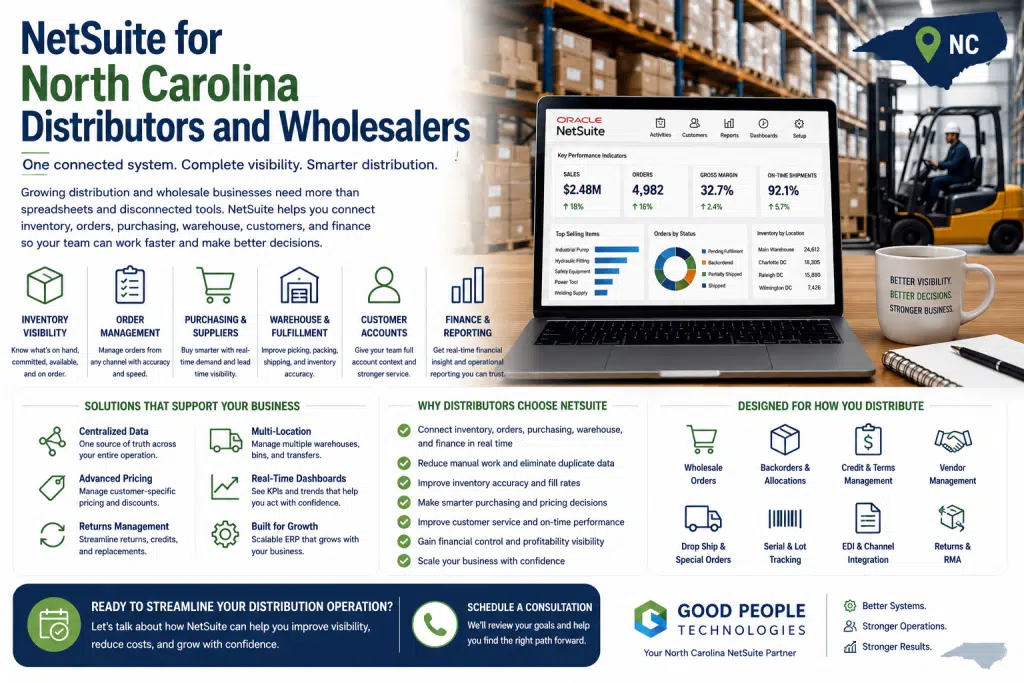
NetSuite for North Carolina distributors and wholesalers can become an important next step when a growing company needs better visibility across inventory, purchasing, order management, warehouse operations, finance, customer accounts, and reporting. Distribution and wholesale businesses often grow through relationships, speed, product availability, and operational consistency. As order volume increases, the systems that worked at an earlier stage may begin to create delays, duplicate work, and decision-making gaps.
For North Carolina companies, this pressure can come from several directions.
A distributor in Charlotte may be managing multiple sales channels, warehouse workflows, and supplier relationships. A wholesale business near Raleigh may need better visibility into customer pricing, order history, and inventory availability. Companies around Greensboro, Winston-Salem, Durham, Wilmington, Asheville, or other growing business hubs may be expanding product lines, serving larger accounts, or coordinating more complex fulfillment expectations.
The challenge is not simply “more growth.”
The challenge is managing growth without losing control of the details that make distribution work: what is available, what is committed, what needs to be purchased, what has shipped, what is delayed, what is profitable, and what customers need next.
When those answers live across disconnected systems, spreadsheets, emails, and manual workflows, teams can still work hard — but the business becomes harder to see clearly.
This article explains when NetSuite becomes useful for distributors and wholesalers in North Carolina, which operational problems it can help address, and how companies can think about ERP, integrations, warehouse visibility, reporting, and process improvement before making a major system decision.
Why Distribution and Wholesale Businesses Are So Operationally Complex
Distribution and wholesale companies depend on coordination.
A customer places an order. Inventory needs to be available. Pricing must be correct. The warehouse has to pick, pack, and ship accurately. Purchasing may need to replenish stock. Finance has to invoice, collect, reconcile, and report. Customer service may need to answer questions about order status, backorders, returns, or account terms.
None of these steps exists in isolation.
A small delay in one area can affect the rest of the business.
For example, inaccurate inventory can lead to overselling. Poor purchasing visibility can create stockouts. Slow warehouse updates can make customer service less responsive. Weak reporting can make it harder for leadership to understand margin, demand, or operational pressure.
Distribution businesses also tend to carry more complexity than many companies realize.
They may deal with:
- multiple warehouses or locations
- different customer pricing levels
- volume discounts
- account-specific terms
- backorders
- purchase orders
- supplier lead times
- special orders
- drop shipping
- returns
- freight costs
- inventory transfers
- seasonal demand
- sales reps or account managers
- e-commerce or EDI orders
- complex reporting needs
At an early stage, a company may manage these moving parts with accounting software, spreadsheets, warehouse tools, and manual communication.
That can work for a while.
Eventually, the number of handoffs grows. Teams spend more time checking systems, updating files, reconciling data, and confirming information manually. The business may still be growing, but the operating model becomes harder to scale.
Why Disconnected Systems Become More Expensive as Volume Grows
Disconnected systems rarely become a problem all at once.
They usually become more expensive gradually.
A distributor may start with accounting software, a spreadsheet for inventory planning, a separate CRM, warehouse notes, email approvals, and manually prepared reports. At low volume, this setup may feel flexible. People know where to look, who to ask, and how to correct issues.
Growth changes that dynamic.
More customers create more account activity. Additional products create more inventory complexity. Larger orders create more fulfillment pressure. New channels create more data. Supplier relationships become harder to manage through email alone.
Manual coordination starts consuming more time.
A warehouse team may need to confirm availability before every large order. Customer service may check multiple places before answering a question. Finance may spend extra time reconciling sales, invoices, payments, inventory value, and purchasing data. Leadership may wait for spreadsheets before understanding what happened that week.
The issue is not that the team is doing something wrong.
Often, the systems simply were not designed for the level of coordination the business now requires.
That is where ERP becomes part of the conversation.
For many growing companies, NetSuite for North Carolina distributors and wholesalers is not only about replacing software. It is about creating a more connected operating foundation.
NetSuite for North Carolina Distributors and Wholesalers
NetSuite for North Carolina distributors and wholesalers is usually most relevant when a business needs one connected view across core operations rather than separate tools for finance, inventory, orders, customers, purchasing, fulfillment, and reporting.
This matters because distribution decisions depend on current information.
A sales team needs to know whether inventory is available. Purchasing needs to know what demand is coming. Warehouse teams need accurate order and item details. Finance needs visibility into cost, margin, billing, and cash flow. Customer service needs quick access to order status and account history.
When each team works from a different system or spreadsheet, the business can move, but not always with confidence.
NetSuite can help companies bring many of these workflows into a more unified ERP environment, depending on configuration, modules, integrations, and business requirements.
That last part matters.
ERP is not magic by itself.
A successful NetSuite implementation depends on good process design, clean data, realistic priorities, proper configuration, and strong adoption. For distributors and wholesalers, the goal should not be to copy old workflows into a new system. The goal should be to design workflows that support how the business needs to operate at its next stage of growth.
Inventory Visibility Is Often the First Major Need
Inventory visibility is one of the biggest reasons distributors and wholesalers consider ERP.
A company may know how much inventory it bought, but not always how much is truly available. Stock may be on hand, committed, reserved, damaged, in transit, pending receipt, allocated to another customer, or sitting in a different location.
Those distinctions matter.
A sales rep should not promise inventory that is already committed. Purchasing should not reorder based on outdated data. Warehouse teams need clear item and location information. Finance needs accurate inventory value. Leadership needs to understand which products are turning, sitting, or tying up cash.
When inventory visibility is weak, businesses often compensate with manual checks.
Someone calls the warehouse. Another person updates a spreadsheet. A manager reviews recent orders before approving a sale. Purchasing holds extra safety stock because reports are not trusted.
These workarounds may protect the business in the short term, but they become expensive over time.
NetSuite can support stronger inventory visibility by connecting inventory data with orders, purchasing, fulfillment, financials, and reporting. For companies with more advanced needs, warehouse management, bin tracking, item setup, and related workflows may become part of the system design.
The business outcome is practical: fewer surprises, better order confidence, cleaner purchasing decisions, and stronger reporting.
Order Management Gets Harder With More Channels
Wholesale and distribution orders can arrive through different paths.
Some customers may order by email. Others may place orders through sales reps, portals, e-commerce channels, EDI, phone calls, or recurring account processes. A company may also handle special orders, backorders, drop shipments, or customer-specific pricing.
At low volume, teams may manage this manually.
As the business grows, order management becomes more demanding.
The company needs to know:
- which orders are open
- which orders are ready to fulfill
- which items are committed
- which orders are delayed
- which customers have special terms
- which orders need approval
- which shipments are partial
- which backorders need attention
- which orders affect purchasing needs
- which accounts require follow-up
Disconnected order workflows create delays because information has to be checked and rechecked.
A sales team may not see fulfillment status. Warehouse teams may not receive complete order details. Finance may not know when orders should be invoiced. Customer service may need to chase updates across systems.
NetSuite for North Carolina distributors and wholesalers can help order workflows become more consistent by connecting sales orders, inventory availability, fulfillment activity, customer records, invoicing, and reporting.
That connection matters because order management is not just a sales process.
It is the bridge between demand, inventory, warehouse execution, customer experience, and cash flow.
Purchasing and Supplier Coordination Need Better Timing
Purchasing is a major pressure point for distributors and wholesalers.
The company has to decide what to buy, when to buy it, how much to buy, and which supplier to use. Those decisions depend on demand, lead times, current stock, committed inventory, seasonality, customer expectations, cash flow, and supplier reliability.
If purchasing visibility is delayed, the business can become reactive.
A fast-moving product may stock out before the team reorders. Slow-moving inventory may absorb too much cash. Supplier delays may not be visible early enough. Purchase orders may not align with real demand.
These problems are not always caused by poor judgment.
Purchasing teams often make difficult decisions with incomplete information.
A more connected ERP environment can help by tying purchasing decisions to inventory, sales orders, demand signals, vendor records, receiving, and financial reporting.
For North Carolina distributors serving regional customers, this can be especially valuable because customer expectations are often tied to speed and reliability. If a business is known for having product available, weak purchasing visibility can directly affect customer trust.
Better supplier coordination also helps leadership understand vendor performance.
Which suppliers are late? Which items have unpredictable lead times? Where is purchasing creating margin pressure? What inventory is being bought too early or too late?
When that information becomes easier to see, purchasing becomes more strategic.
Warehouse and Fulfillment Workflows Need Accurate Data
Warehouses depend on execution.
Orders must be released, picked, packed, shipped, updated, and sometimes returned. Every step depends on accurate item, quantity, location, and customer information.
If warehouse data is disconnected from orders and inventory, fulfillment slows down.
A picker may search for items that are not where the system says they are. A shipment may be delayed because the order needs manual clarification. Customer service may not know whether an order has shipped. Finance may wait for fulfillment status before invoicing.
Warehouse problems can also affect customer relationships.
A customer usually does not see the internal system issue. They only see a delayed order, incorrect shipment, missing update, or frustrating support experience.
NetSuite can support warehouse and fulfillment processes through inventory, order, item, location, and warehouse management capabilities depending on the company’s setup. For some distributors, this may involve basic inventory and fulfillment workflows. Others may need more advanced warehouse management, mobile workflows, bin processes, or shipping coordination.
The key is matching system design to operational reality.
A simple warehouse should not be overcomplicated. A complex warehouse should not be forced into a workflow that lacks the controls it needs.
Good ERP planning starts by understanding how warehouse work actually happens.
Customer Account Visibility Matters in Wholesale
Wholesale relationships often depend on account history.
A customer may have specific pricing, terms, buying patterns, service expectations, reorder habits, credit considerations, or special handling needs. Sales and customer service teams need access to that context.
When customer information is scattered, account management becomes harder.
Sales may track notes in one place. Finance may track payment status elsewhere. Customer service may see order questions but not account history. Leadership may lack visibility into customer profitability or buying trends.
A connected ERP environment can help by bringing customer, order, invoice, payment, and support information closer together.
This matters for distributors and wholesalers because customer relationships often grow over time.
A company may want to know:
- which customers are growing
- which accounts are slowing down
- which customers buy certain product categories
- which accounts frequently create exceptions
- which customers are most profitable
- which customers need proactive follow-up
- which accounts have open balances
- which products are commonly purchased together
Without connected data, these questions require manual reporting.
With better visibility, account management becomes more proactive.
NetSuite for North Carolina distributors and wholesalers can support stronger customer visibility when the system is configured around the way sales, service, finance, and fulfillment teams actually work together.
Finance Needs More Than Basic Accounting
Many distributors start by thinking about accounting.
That makes sense. Finance is one of the first areas affected by growth.
However, distribution finance is not just general ledger, accounts receivable, accounts payable, and bank reconciliation.
Finance needs operational context.
Revenue has to be understood alongside product cost, inventory value, freight, returns, discounts, payment timing, vendor bills, customer terms, and margin. If those details live across separate systems, finance spends more time reconciling and less time analyzing.
A distributor may know sales increased, but not whether profitability improved.
That distinction matters.
Higher order volume can hide margin problems. Freight costs may rise. Discounts may expand. Slow-moving inventory may tie up cash. Returns may increase. Manual work may grow behind the scenes.
ERP can help finance see more of the operating picture because accounting is connected to inventory, purchasing, orders, fulfillment, and customer records.
For leadership, this creates better questions.
Which products are profitable? Which channels perform best? Where is cash tied up? Which customers create margin pressure? How do purchasing decisions affect financial results?
Stronger financial visibility helps the company make decisions based on performance, not only revenue.
Reporting Becomes a Strategic Advantage
Reporting is often where system problems become visible.
A distributor may have data, but not timely answers.
Leadership may need to understand inventory turns, fill rates, sales by product, customer profitability, margin by channel, purchasing needs, open orders, backorders, warehouse performance, and cash flow. If reports require manual exports from several systems, decision-making slows down.
Reporting delays are especially challenging during growth.
By the time the report is ready, the business may have already moved on.
NetSuite can support dashboards, saved searches, workbooks, KPIs, and reporting workflows that help teams see key information more quickly. The value depends on how well reporting is designed around business decisions.
A useful report should answer a practical question.
What should purchasing do next? Which orders need attention? What inventory is at risk? Which customers should sales contact? Where are margins changing? Which warehouse issues are increasing?
When reports are tied to decisions, they become operational tools instead of passive summaries.
That is why reporting should be part of the ERP roadmap from the beginning, not something added after implementation.
When NetSuite Starts to Make Sense
NetSuite does not make sense for every distributor or wholesaler at every stage.
A smaller company with simple inventory, limited order complexity, and manageable reporting may not need ERP immediately. Targeted integrations, better workflows, or improved reporting may be enough.
The conversation changes when operational complexity becomes harder to manage with current tools.
NetSuite may be worth evaluating when:
- inventory accuracy is difficult to trust
- order management depends on manual updates
- purchasing is reactive
- finance spends too much time reconciling data
- reporting requires repeated spreadsheet work
- warehouse visibility is limited
- customer account information is scattered
- sales, operations, and finance use different numbers
- multiple channels or locations create confusion
- growth is increasing workload faster than headcount can keep up
These signs do not mean the company has failed.
They usually mean the business has outgrown the earlier operating model.
For many companies, the best next step is not immediately committing to ERP. A more practical approach is to review systems, workflows, data quality, reporting needs, integration gaps, and process maturity.
Good People Technologies can help North Carolina distributors and wholesalers evaluate whether NetSuite, integrations, automation, or a phased roadmap makes the most sense for their current stage.
Common Mistakes to Avoid Before Implementation
ERP projects are most successful when companies prepare carefully.
A distributor or wholesaler should avoid treating NetSuite as a simple software swap. Moving from disconnected systems into ERP requires business decisions about process, ownership, data, and reporting.
One common mistake is copying old workflows without asking whether they still make sense.
If a process was built around system limitations, it may not belong in the future state. The company should identify which workflows are truly necessary and which ones only exist because older tools required them.
Another mistake is underestimating data cleanup.
Item records, customer records, vendor records, pricing, inventory data, and transaction history need careful review. Poor data can limit the value of even a well-configured system.
Reporting is also easy to overlook.
Teams often focus on go-live workflows but wait too long to define the reports leadership and departments will need. That can create frustration after launch.
Change management matters as well.
Warehouse, finance, sales, purchasing, customer service, and leadership teams all experience ERP differently. Each group needs clear expectations, training, and involvement.
A thoughtful implementation roadmap helps reduce surprises.
What to Review Before Choosing NetSuite
Before deciding whether NetSuite is the right fit, distributors and wholesalers should review the current operating environment.
Start with inventory.
Where does inventory data live? How accurate is it? Which adjustments happen manually? Are there multiple locations, bins, committed quantities, backorders, or special handling needs?
Next, review order management.
How do orders arrive? Who enters them? What approvals are required? Where do delays occur? Which channels create the most exceptions?
Purchasing should be evaluated carefully.
How are reorder decisions made? Are supplier lead times visible? Do purchase orders connect clearly to demand? What information does the purchasing team need sooner?
Warehouse workflows need practical review.
How are items received, stored, picked, packed, shipped, and returned? Which steps are manual? Where does the team lose time?
Finance should map reconciliation work.
Which reports take too long? What data has to be cleaned? Where do accounting and operations disagree?
Finally, leadership should define decision needs.
What information should be visible daily, weekly, and monthly? Which metrics matter most? Which reports must be trusted from the start?
This review creates a stronger foundation for ERP planning.
How Integrations Still Matter With NetSuite
NetSuite can become the operational center of the business, but most companies still rely on connected tools.
A distributor may use e-commerce platforms, EDI providers, shipping systems, CRM tools, warehouse technology, payment processors, tax tools, or business intelligence platforms.
Integrations help these systems work together.
The goal is to avoid rebuilding data silos around the ERP.
A strong integration plan should define which system owns which data, how information moves, what exceptions need review, and how errors are monitored.
For example, customer data may need to sync with a CRM. Orders may flow from an e-commerce platform into NetSuite. Shipping updates may need to return to customer service tools. Payment information may need to support reconciliation. Reporting dashboards may pull data from multiple sources.
Without a clear integration plan, teams may continue exporting spreadsheets and updating records manually.
NetSuite for North Carolina distributors and wholesalers works best when ERP, integrations, automation, and reporting are designed as one operating system, not separate projects.
Composite Example: A Greensboro Distributor Outgrowing Manual Workflows
Consider a growing distributor near Greensboro.
The company serves regional business customers, carries a wide product catalog, and works with several suppliers. Orders come in through sales reps, email, and an online portal. Inventory is tracked in the accounting system, but warehouse updates are not always timely. Purchasing uses spreadsheets to monitor reorder needs.
The business is growing, but daily coordination feels harder.
Sales wants better visibility before confirming customer orders. Warehouse teams need clearer pick and ship information. Finance spends too much time reconciling purchasing, inventory, and invoice data. Leadership wants reporting that shows margin, fill rates, open orders, and stock risk.
After reviewing workflows, the company finds that the main issue is not effort. Teams are doing their best with tools that were not designed for the current level of complexity.
The company begins evaluating ERP and integration options.
NetSuite becomes part of the conversation because the business needs a stronger connection between inventory, sales orders, purchasing, warehouse activity, customer accounts, finance, and reporting.
The goal is not simply to modernize software.
It is to give the company a better foundation for the next stage of growth.
Composite Example: A Raleigh Wholesaler Needing Better Customer Visibility
A wholesaler near Raleigh has built strong customer relationships over many years.
The business offers account-specific pricing, recurring orders, and special handling for certain customers. Sales knows the accounts well, but important details live across email, spreadsheets, accounting records, and individual notes.
As the company grows, customer visibility becomes harder to manage.
New employees need more context. Customer service has to look in several places before answering questions. Finance tracks balances separately from order conversations. Leadership wants to understand customer profitability, but the data is difficult to assemble.
The company realizes that customer visibility is not only a CRM issue.
It connects to orders, pricing, invoices, inventory, fulfillment, support, and reporting.
A more connected ERP environment can help the business organize customer information around the full account relationship. Sales, service, finance, and operations can work from better context.
For this wholesaler, NetSuite for North Carolina distributors and wholesalers would be evaluated not only for inventory or accounting, but for the way it could support account management and customer experience.
How Good People Technologies Helps Distributors and Wholesalers
Good People Technologies helps growing businesses improve operations through ERP support, NetSuite consulting, system integrations, workflow automation, reporting improvements, and technology strategy.
For distributors and wholesalers, this can include:
- reviewing current systems and workflows
- evaluating NetSuite readiness
- mapping inventory and order processes
- improving reporting visibility
- reducing spreadsheet dependency
- connecting e-commerce, CRM, warehouse, finance, and fulfillment tools
- supporting NetSuite dashboards, saved searches, and reporting
- identifying manual work that can be automated
- helping teams plan phased ERP improvements
- building integration roadmaps around business needs
The work usually begins with discovery.
Before recommending a system change, it is important to understand where the business is losing time, where data is disconnected, which reports are trusted, and which workflows create the most pressure.
Some companies need NetSuite. Others may need better integrations first. A few may need reporting cleanup, automation, or process redesign before ERP becomes the right next move.
If your company is trying to scale distribution or wholesale operations in North Carolina, Good People Technologies can help review your current systems and identify a practical path forward.
Final Thoughts
NetSuite for North Carolina distributors and wholesalers can be valuable when growth creates more complexity than current systems can comfortably support.
Distribution and wholesale businesses depend on accurate inventory, reliable order management, strong purchasing visibility, warehouse execution, customer account context, financial control, and timely reporting. As the business grows, disconnected tools and spreadsheets can make those areas harder to coordinate.
ERP can help by creating a more connected operating foundation.
That does not mean every company should rush into implementation.
The best approach is to review current workflows, identify the highest-friction areas, clean up data, define reporting needs, evaluate integration requirements, and decide whether NetSuite fits the company’s next stage of growth.
For North Carolina distributors and wholesalers, the goal is not just better software.
The goal is better visibility, smoother operations, stronger customer service, and more confident decisions as the business grows.
Frequently Asked Questions
What is NetSuite for distributors and wholesalers?
NetSuite for distributors and wholesalers is an ERP approach that can help companies manage inventory, orders, purchasing, finance, warehouse workflows, customer accounts, and reporting in a more connected system.
Why do North Carolina distributors consider NetSuite?
North Carolina distributors often consider NetSuite when growth creates inventory issues, manual reporting, order delays, purchasing challenges, warehouse visibility gaps, or disconnected finance and operations data.
Can NetSuite help with inventory visibility?
Yes. NetSuite can help improve inventory visibility by connecting inventory data with orders, purchasing, fulfillment, finance, and reporting workflows, depending on configuration and modules.
Does every distributor need NetSuite?
No. Some distributors may only need better integrations, automation, or reporting improvements. NetSuite becomes more relevant when operational complexity requires a more unified ERP foundation.
How can NetSuite help wholesalers manage customer accounts?
NetSuite can help connect customer records with orders, invoices, payments, pricing, fulfillment, support, and reporting so teams have better account visibility.
What problems happen when wholesale systems are disconnected?
Disconnected systems can create inventory errors, duplicate data entry, slow order updates, manual purchasing work, reporting delays, customer service issues, and finance reconciliation challenges.
Is NetSuite useful for warehouse operations?
NetSuite can support warehouse and fulfillment workflows, and more advanced warehouse management may be available depending on the company’s setup, modules, and requirements.
How should a distributor prepare before implementing NetSuite?
A distributor should review inventory data, order workflows, purchasing processes, warehouse operations, customer records, financial reporting, integrations, and decision-making needs before implementation.
Can NetSuite integrate with other business tools?
Yes. Many companies connect NetSuite with e-commerce platforms, CRM systems, EDI tools, shipping software, payment processors, warehouse systems, and reporting platforms.
How can Good People Technologies help?
Good People Technologies helps distributors and wholesalers evaluate NetSuite readiness, improve integrations, automate workflows, clean up reporting, and build practical ERP roadmaps.

Roman is a B2B marketing specialist focused on technology, ERP systems, business automation, and digital growth strategies. At Good People Technologies, he helps translate complex technology solutions—such as ERP integrations, system integrations, and business process automation—into clear insights for founders, operators, and growing companies.
His work focuses on content strategy, SEO, and thought leadership that helps businesses understand how the right technology infrastructure can support scalable operations and sustainable growth.
At Good People Technologies, Roman contributes to content that explores ERP implementation, automation strategies, and system integration best practices for companies navigating rapid growth and operational complexity.