
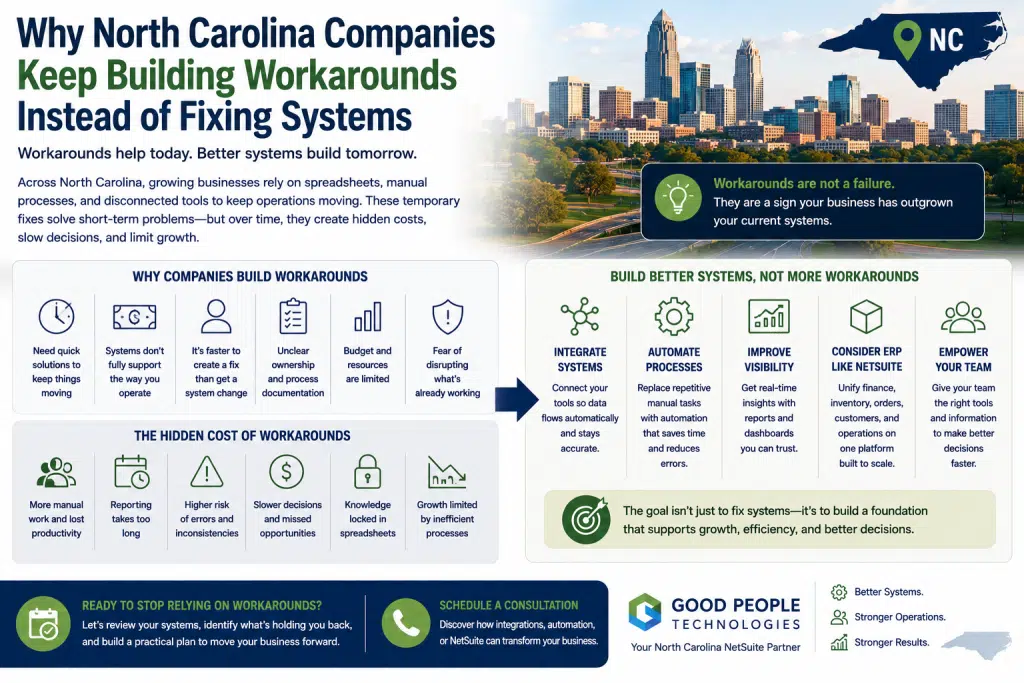
North Carolina business system workarounds often begin as practical solutions. A team needs a report faster than the system can provide it, so someone creates a spreadsheet. Inventory does not update cleanly between tools, so operations adds a manual check. Finance cannot get the exact data it needs, so a reconciliation file becomes part of the monthly process. Customer service needs better order visibility, so employees create their own tracking method.
None of this usually starts as a problem.
Most workarounds are created by capable people trying to keep the business moving. They are often signs of initiative, not signs of poor performance. When a system does not fully support the way a company operates, employees naturally find a way to bridge the gap.
The challenge is that temporary fixes rarely stay temporary.
As North Carolina companies grow, those small workarounds can become part of the operating model. A spreadsheet becomes the real source of truth. A manual report becomes the only version leadership trusts. A process that was supposed to last a few weeks stays in place for years. Different teams begin solving the same issue in different ways.
At that point, the workaround is no longer helping the business move faster.
It is quietly making the business harder to manage.
For companies in Charlotte, Raleigh, Durham, Greensboro, Winston-Salem, Asheville, Wilmington, and other North Carolina markets, this issue can appear in many industries: e-commerce, manufacturing, wholesale distribution, professional services, retail, product-based businesses, field services, and growing local brands.
This article explains why companies keep building workarounds instead of fixing systems, when those workarounds become expensive, and how better integrations, automation, reporting, ERP planning, and NetSuite readiness can help businesses move from temporary fixes to scalable operations.
Workarounds Usually Start for Good Reasons
It is easy to look at a messy system environment and assume something went wrong.
In reality, many workarounds are reasonable when they first appear.
A growing business may not have time to redesign a workflow during a busy season. The team may need a quick way to track inventory, reconcile orders, monitor customer requests, or prepare leadership reports. A department may not have access to the system change it needs, so it creates a practical solution outside the main software.
That is not necessarily bad.
The problem begins when nobody revisits the workaround later.
A spreadsheet created for a short-term reporting need may become part of the weekly leadership process. A manual inventory check may become the only way sales trusts availability. An email approval process may stay in place even after order volume increases. A finance file may keep growing because no one has time to rebuild the workflow properly.
Businesses often do not ignore these issues because they are careless.
They delay system fixes because there are customers to serve, orders to fulfill, employees to support, and daily work to complete. Fixing the system can feel slower than maintaining the workaround, especially when the workaround still appears to function.
That is why North Carolina business system workarounds should be understood as a growth signal.
They often show where the company has outgrown an older process, tool, or integration.
Why Companies Keep Choosing Workarounds
Companies usually keep using workarounds for several practical reasons.
The first reason is speed.
A workaround can often be created in a day. A proper system fix may require discovery, process mapping, vendor review, integration planning, testing, training, and budget approval.
The second reason is familiarity.
People know the spreadsheet. They understand the manual process. The workflow may be inefficient, but it feels predictable. A new system fix introduces change, and change requires time.
The third reason is unclear ownership.
A workaround may touch multiple departments. Finance uses it, operations updates it, customer service depends on it, and leadership reviews it. Because everyone uses it, nobody clearly owns the system problem behind it.
Budget also matters.
A company may know that a better integration or ERP improvement is needed, but the cost can be difficult to justify when the workaround is still “working.” The hidden cost is often spread across many employees and many small tasks, so it does not appear as one obvious expense.
Another reason is risk avoidance.
If a manual process is keeping the business moving, changing it can feel risky. A company may worry that fixing the system will disrupt daily operations, expose data issues, or require more internal effort than the team can spare.
These concerns are understandable.
The goal is not to shame the workaround.
The goal is to recognize when the workaround has become more expensive than the fix.
The Hidden Cost of “Still Working”
One of the most common reasons system problems remain unresolved is that the workaround still works.
That phrase can be misleading.
A workaround may still work because employees are spending extra time every week to keep it alive. Reports may still arrive because someone manually exports data, cleans columns, updates formulas, checks numbers, and sends the final file. Inventory may still appear manageable because the warehouse confirms availability by hand. Customer service may still answer questions because employees check several systems before responding.
The business sees the output.
It does not always see the effort behind the output.
That hidden effort is where the cost lives.
Manual work reduces capacity. Employees spend time moving data instead of improving operations. Managers review exceptions that better workflows could prevent. Finance reconciles numbers that could flow more cleanly between systems. Leadership waits for reports instead of acting on live information.
Small tasks become expensive when they repeat often.
A five-minute manual step may not matter once. The same step repeated across hundreds of orders, every week, across several employees, becomes part of the company’s operating cost.
North Carolina business system workarounds become especially expensive when they hide operational pressure from leadership.
The business may look stable from the outside while employees are quietly absorbing the complexity.
Workarounds Make Reporting Harder to Trust
Reporting is one of the first places where workarounds create long-term problems.
A company may have reports in accounting software, dashboards in a CRM, exports from e-commerce platforms, spreadsheets from operations, inventory trackers, and manually prepared leadership summaries.
Each report may be useful on its own.
Trouble starts when different teams produce different versions of the same number.
Sales may report revenue based on orders placed. Finance may use recognized revenue or reconciled invoices. Operations may focus on fulfilled orders. Inventory may adjust for committed stock. Customer service may track open issues. Leadership may receive a spreadsheet that combines several of these views.
No single team is necessarily wrong.
The business simply lacks a shared reporting structure.
Workarounds often fill this gap. Someone creates a spreadsheet that “makes the numbers make sense.” Over time, that file becomes trusted more than the system report.
This can create a difficult situation.
The workaround may be useful, but it may also be fragile. If one person maintains it, the business depends on that person’s knowledge. If formulas are complex, errors can be hard to find. When source data changes, the report may not update correctly.
Better reporting starts by mapping what exists.
Which reports are being used? Who owns them? Which decisions do they support? Where do numbers conflict? What gets exported and fixed manually?
Those questions help companies move from reporting workarounds to reporting clarity.
North Carolina Business System Workarounds
North Carolina business system workarounds often appear when companies grow faster than their internal systems. The business adds customers, employees, products, locations, vendors, sales channels, or service lines, but the workflows behind the scenes do not evolve at the same pace.
This creates pressure in several areas:
- inventory tracking
- order management
- finance reconciliation
- reporting
- customer service
- purchasing
- project management
- warehouse workflows
- approvals
- data entry
- scheduling
- billing
- leadership dashboards
A workaround may solve one of these problems temporarily.
For example, a distributor may use a spreadsheet to track backorders because the main system does not show the needed view. A manufacturer may use manual production notes because reporting is not aligned with shop-floor reality. An e-commerce business may copy order data between systems because the integration is incomplete. A service company may rely on email approvals because the workflow has not been automated.
The repeated pattern is simple: the business needs a process that current systems do not support well enough.
Instead of fixing the system immediately, the team builds a bridge.
That bridge may be useful at first. Later, it can become a bottleneck.
Why Workarounds Spread Across Departments
Workarounds rarely stay isolated.
A finance spreadsheet may begin as a month-end tool, then operations starts using it for planning. A customer service tracker may become a source for leadership reporting. A manual purchasing file may become part of inventory management. A sales report may become the basis for warehouse decisions.
The more useful a workaround becomes, the more departments begin depending on it.
This creates several risks.
First, the workaround may not have a clear owner. Everyone uses it, but nobody is responsible for maintaining it as a system asset.
Second, changes become harder. If a spreadsheet supports finance, operations, and leadership, updating it may require coordination that never happens.
Third, the workaround may not be documented. New employees learn it informally. Existing employees understand parts of it. Leadership may not know how much business activity depends on it.
Over time, a workaround can become invisible infrastructure.
People stop seeing it as a temporary fix and start treating it as the normal process.
That is why system reviews are valuable.
They help companies identify which workflows are official, which are informal, and which informal workflows now carry real operational weight.
Inventory Workarounds Can Become Expensive Quickly
Inventory is a common area for system workarounds.
A company may track inventory in accounting software, warehouse tools, e-commerce platforms, spreadsheets, and manual notes. Different systems may show different views: on hand, available, committed, allocated, damaged, in transit, or on order.
When teams do not trust the main system, they create manual checks.
Sales may ask the warehouse before confirming large orders. Purchasing may keep a separate reorder spreadsheet. Operations may adjust inventory manually after fulfillment. Finance may reconcile inventory value separately from operational counts.
These steps can protect the business in the short term.
They can also slow it down.
Inventory workarounds become expensive because inventory decisions affect sales, purchasing, fulfillment, cash flow, and customer satisfaction. If availability is unclear, sales may hesitate, and if purchasing lacks visibility, stockouts or excess inventory become more likely. If finance cannot trust inventory value, reporting becomes slower.
For product-based businesses, distributors, wholesalers, manufacturers, and e-commerce companies, inventory workarounds are often a sign that better integration or ERP planning is needed.
NetSuite may become part of the conversation when inventory needs to connect more clearly with orders, purchasing, warehouse workflows, finance, and reporting.
Finance Workarounds Hide Operational Complexity
Finance often becomes the place where disconnected systems show up.
A company may appear to have separate operational problems, but finance has to reconcile the final result.
Sales orders come from one system. Payments come from another. Inventory adjustments live somewhere else. Fulfillment costs need to be matched. Refunds, vendor bills, customer credits, tax details, and manual corrections all need to be reviewed.
When systems do not connect cleanly, finance creates workarounds.
These may include reconciliation spreadsheets, manual exports, custom reports, side files, approval trackers, and period-end checklists.
Finance workarounds are often highly disciplined. They may be accurate and carefully maintained.
Still, they can limit growth.
The more finance relies on manual reconciliation, the less time the team has for analysis, forecasting, margin review, cash flow planning, and strategic support.
A business may know what happened after finance completes the work.
The bigger opportunity is knowing what is happening early enough to act.
Better system design can reduce the amount of manual reconciliation needed and help finance move from cleanup to insight.
Customer Service Workarounds Affect Experience
Customer service teams often build workarounds because they need answers quickly.
A customer asks where an order is. The representative checks the e-commerce platform, warehouse system, shipping tool, email thread, and internal notes. Another customer asks about availability, so the team confirms with operations manually. A billing question may require finance to check a separate report.
These workarounds help employees serve customers despite system gaps.
However, they can also slow response times.
Customers do not see the internal effort. They only experience the delay, uncertainty, or inconsistent answer.
Customer service workarounds may include:
- shared spreadsheets
- manual status trackers
- copied order notes
- internal chat threads
- email-based approvals
- customer issue logs outside the CRM
- separate return trackers
- manual follow-up reminders
Each tool may solve a real problem.
Together, they may create a fragmented service experience.
When customer service depends on system workarounds, the business should review whether teams have the visibility they need across orders, inventory, fulfillment, billing, and account history.
Improving those connections can reduce internal chasing and create a better customer experience.
Why “We’ll Fix It Later” Becomes the Default
Many companies know which systems need improvement.
The issue is timing.
System fixes are rarely convenient. A business may be in a busy season, preparing for growth, managing staffing changes, launching products, serving customers, or dealing with operational pressure.
Because the workaround is already in place, fixing the system can be postponed.
This is understandable, but it creates a long-term pattern.
Every new workaround makes the future system fix more complicated.
There are more files to review, more processes to map, more employees to interview, more reports to reconcile, and more dependencies to understand.
The company may eventually reach a point where nobody wants to touch the workaround because too many people depend on it.
That is why small system problems should be reviewed before they become core infrastructure.
Not every workaround needs an immediate fix.
Some should remain temporary. A few may be acceptable long term. Others need to be replaced with integrations, automation, reporting improvements, or ERP workflows.
The key is making that decision intentionally.
How to Decide Whether a Workaround Should Stay
Not every workaround is bad.
Some are useful, low-risk, and efficient.
The question is whether the workaround is helping the business or hiding a system problem that should be addressed.
A company can evaluate a workaround by asking:
- How often does this process happen?
- How many people depend on it?
- Who owns it?
- What happens if the owner is unavailable?
- Does it support a critical decision?
- Does it involve customer, financial, inventory, or operational data?
- How much manual effort does it require?
- How often does it create errors or delays?
- Is the workaround documented?
- Could an integration or automation reduce the burden?
- Is this process still aligned with how the business operates today?
A low-frequency workaround for a minor internal task may not deserve immediate attention.
A recurring workaround that affects finance, inventory, customer experience, or leadership reporting should be reviewed more seriously.
The goal is not to eliminate every manual process.
The goal is to stop relying on fragile manual processes for business-critical work.
How Integrations Reduce Workarounds
System integrations are often the first step toward reducing workarounds.
An integration connects tools so data can move automatically between them. This can reduce duplicate entry, manual exports, spreadsheet cleanup, and internal chasing.
For North Carolina companies, common integration opportunities include:
- e-commerce and accounting
- CRM and project management
- inventory and warehouse systems
- fulfillment and customer service
- payment processors and finance
- ERP and reporting dashboards
- scheduling and billing
- purchasing and inventory planning
The best integrations are not built just because two systems can connect.
They are built because a specific business workflow needs to improve.
For example, an e-commerce company may integrate orders, inventory, shipping, and accounting to reduce manual reconciliation. A service company may connect CRM, scheduling, billing, and reporting. A distributor may connect purchasing, warehouse, inventory, and customer account data.
Integrations help when the current tools are still useful but the handoffs between them are slowing the business down.
If your team is maintaining too many workarounds between systems, Good People Technologies can help identify which integrations would reduce the most manual effort.
How Automation Helps Teams Move Faster
Automation helps when a workaround exists because someone is repeating the same task over and over.
Examples include sending order confirmations, creating invoices, updating task status, routing approvals, generating recurring reports, sending low-stock alerts, or notifying a team when an exception occurs.
Automation is especially useful for work that is:
- repetitive
- rules-based
- time-sensitive
- easy to define
- frequently delayed
- dependent on manual reminders
A business should not automate a broken process without understanding it first.
Process review comes before automation.
Once the workflow is clear, automation can reduce the manual effort that keeps a workaround alive.
This gives employees more time for judgment-based work: customer conversations, exception handling, planning, analysis, and decision-making.
Good automation does not remove people from the business.
It removes unnecessary friction from their day.
When ERP or NetSuite Becomes Part of the Conversation
Integrations and automation can solve many workaround problems.
At some point, however, the issue may be bigger than a few disconnected workflows.
ERP or NetSuite becomes more relevant when workarounds exist across finance, operations, inventory, purchasing, orders, customer records, warehouse activity, and reporting at the same time.
That pattern suggests the business may need a more connected operating foundation.
NetSuite may be worth evaluating when:
- finance relies heavily on reconciliation spreadsheets
- inventory data is difficult to trust
- reporting takes too long
- order management depends on manual updates
- customer service checks several tools for basic answers
- purchasing lacks reliable demand visibility
- warehouse workflows are disconnected
- leadership receives numbers too late
- spreadsheets have become core operating tools
This does not mean NetSuite is automatically the right answer.
The better starting point is discovery.
A company should review current workflows, manual processes, reporting gaps, data quality, integration needs, and future growth plans before deciding whether ERP, integrations, automation, or process redesign should come first.
Why Discovery Comes Before Fixing Systems
Many system problems look simple until the business starts mapping them.
A spreadsheet may appear to support one report, but it may actually affect purchasing, finance, sales, and leadership review. A manual order update may seem minor, but it may be the only reason customer service has accurate information. An approval email may look inefficient, yet several teams may depend on the history it creates.
Fixing systems without discovery can create new problems.
A better approach starts with mapping the current state.
What systems are used? Where does data move manually? Which spreadsheets are critical? Who owns each workaround? What decisions do they support? Which workflows create the most friction? Where are customers affected? Which processes create the greatest risk?
Once this is clear, the business can prioritize.
Some workarounds can be retired. Others should be replaced by integrations. A few may need automation. Larger patterns may require ERP planning.
Discovery prevents companies from overbuilding solutions or fixing the wrong problem.
Composite Example: A Charlotte E-Commerce Business
Consider a growing e-commerce company in Charlotte.
The company sells through Shopify, wholesale accounts, and occasional marketplace channels. It uses accounting software, a fulfillment tool, spreadsheets, and manual reports.
At first, the system environment works well enough.
As volume grows, several workarounds become part of daily operations. Inventory is checked manually before large orders. Finance exports sales and payment data for reconciliation. Customer service keeps a separate order issue tracker. Leadership reviews a spreadsheet that combines data from several systems.
The team is not doing anything wrong.
Employees are keeping the business moving.
Still, the company starts to feel the cost. Reporting takes longer. Inventory confidence drops. Customer service spends more time checking status. Finance has less time for analysis. Leadership cannot see performance as quickly as it would like.
After mapping the workflows, the company identifies which workarounds are low-risk and which ones are slowing growth.
The first improvements are targeted integrations between sales, inventory, fulfillment, and accounting. Recurring reports are automated. Later, the company reviews whether ERP should become part of its next stage.
The important lesson is that the business does not need to fix everything at once.
It needs a clear path away from the workarounds that cost the most.
Composite Example: A Greensboro Distributor
A distributor near Greensboro faces a different version of the same issue.
The company manages a large product catalog, supplier lead times, customer-specific pricing, backorders, warehouse workflows, and finance reconciliation.
Several teams have built their own practical tools.
Purchasing uses a spreadsheet to monitor reorder needs. Sales keeps notes about special customer requirements. Warehouse teams track certain exceptions manually. Finance maintains reconciliation files. Leadership relies on manually prepared performance reports.
Each workaround solves a real problem.
Together, they show that the business needs better system visibility.
After reviewing the current state, the company realizes that the main issue is not one spreadsheet or one report. The deeper challenge is that core workflows are connected through people instead of systems.
For this distributor, NetSuite may be worth evaluating because inventory, purchasing, orders, warehouse execution, customer accounts, finance, and reporting all depend on shared data.
A phased roadmap helps the company avoid rushing.
The first phase documents workflows and data. The next phase improves reporting and integrations. ERP readiness is evaluated based on business value, not pressure or guesswork.
How Good People Technologies Helps Reduce System Workarounds
Good People Technologies helps growing businesses reduce unnecessary workarounds through system integrations, workflow automation, ERP support, NetSuite consulting, reporting improvements, and practical technology strategy.
For companies dealing with North Carolina business system workarounds, this can include:
- reviewing current systems and workflows
- mapping manual processes
- identifying spreadsheet dependency
- finding duplicate data entry
- improving reporting visibility
- connecting disconnected tools
- automating repetitive tasks
- evaluating ERP or NetSuite readiness
- improving dashboards and saved searches
- building phased technology roadmaps
The work starts by understanding the business reality behind the workaround.
A spreadsheet may point to a reporting issue. Manual reconciliation may reveal an integration gap. Customer service trackers may show order visibility problems. Inventory checks may suggest ERP readiness.
Some companies need targeted integrations. Others need automation or reporting cleanup. More complex businesses may need NetSuite planning or broader process redesign.
If your company has outgrown temporary fixes, Good People Technologies can help identify which system improvements would create the most practical value.
Final Thoughts
North Carolina companies keep building workarounds because workarounds are useful at first.
They help teams move quickly, serve customers, produce reports, reconcile data, and keep operations running when systems do not fully match business needs.
The problem is not the workaround itself.
The problem is what happens when temporary fixes become permanent infrastructure.
As a company grows, workarounds can create reporting delays, inventory uncertainty, finance reconciliation burden, customer service friction, duplicate data entry, unclear ownership, and leadership visibility gaps.
The solution is not to blame the team or remove every manual process overnight.
A better approach is to map the workarounds, understand why they exist, identify which ones are business-critical, and decide which should be replaced with integrations, automation, ERP improvements, or NetSuite planning.
Growth creates complexity.
Strong systems help companies manage that complexity without asking employees to carry more and more manual work.
When a workaround keeps appearing, it is often pointing to something important.
The business should listen.
Frequently Asked Questions
Why do companies build system workarounds?
Companies build system workarounds because teams need practical ways to keep operations moving when software does not fully support the workflow, report, data connection, or decision they need.
Are workarounds always bad?
No. Workarounds can be useful temporary solutions. They become risky when they support critical operations, require repeated manual effort, depend on one person, or hide system problems.
What are common examples of business system workarounds?
Common examples include manual spreadsheets, duplicate data entry, exported reports, email approvals, side trackers, reconciliation files, inventory checks, customer service logs, and manually updated dashboards.
When should a company fix a workaround?
A company should review a workaround when it happens often, affects customers, supports finance or inventory, delays reporting, creates errors, or becomes necessary for daily operations.
Can integrations reduce system workarounds?
Yes. Integrations can reduce workarounds by allowing systems to share data automatically, which reduces manual exports, duplicate entry, spreadsheet cleanup, and internal chasing.
How does automation help with workarounds?
Automation helps when a workaround involves repetitive tasks such as alerts, approvals, report generation, invoice creation, order updates, or status notifications.
When does NetSuite become relevant?
NetSuite becomes more relevant when workarounds affect several core areas at once, such as finance, inventory, orders, purchasing, customer records, warehouse activity, and reporting.
Should businesses remove all spreadsheets?
No. Spreadsheets are useful for analysis and planning. The risk appears when spreadsheets become the only source of truth for critical operations.
Why should discovery come before fixing systems?
Discovery helps businesses understand why workarounds exist, who depends on them, which decisions they support, and which system improvements should happen first.
How can Good People Technologies help?
Good People Technologies helps businesses map workarounds, improve integrations, automate workflows, evaluate NetSuite readiness, strengthen reporting, and build practical system roadmaps.

Roman is a B2B marketing specialist focused on technology, ERP systems, business automation, and digital growth strategies. At Good People Technologies, he helps translate complex technology solutions—such as ERP integrations, system integrations, and business process automation—into clear insights for founders, operators, and growing companies.
His work focuses on content strategy, SEO, and thought leadership that helps businesses understand how the right technology infrastructure can support scalable operations and sustainable growth.
At Good People Technologies, Roman contributes to content that explores ERP implementation, automation strategies, and system integration best practices for companies navigating rapid growth and operational complexity.