
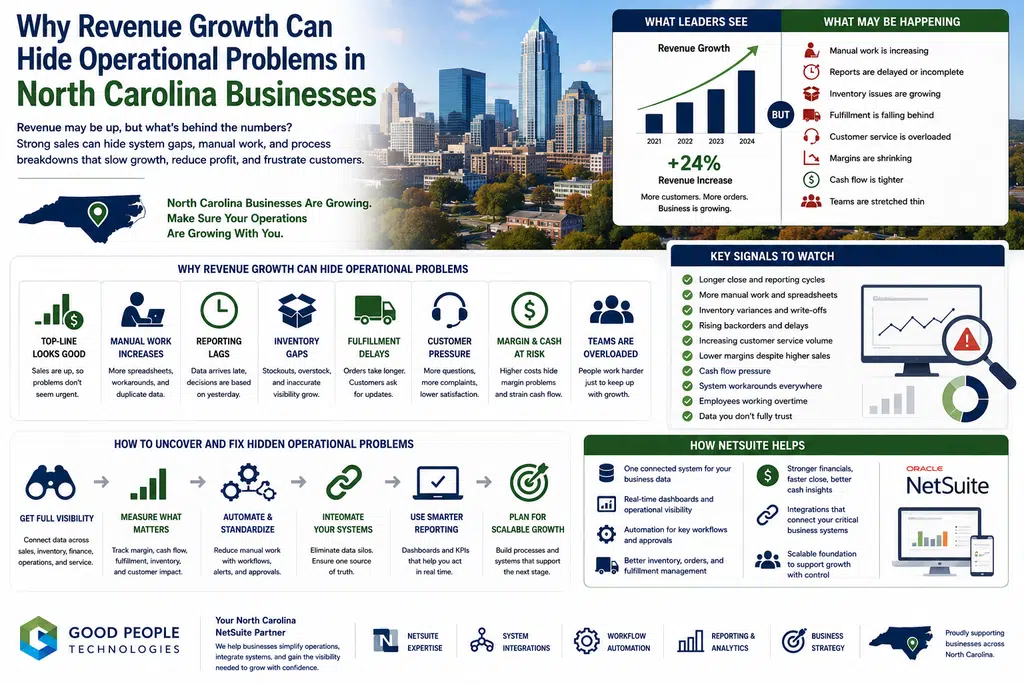
Revenue growth operational problems in North Carolina businesses often become visible only after a company has already entered a faster stage of growth. Sales may be increasing, customer demand may look strong, and leadership may see positive top-line numbers. However, behind that growth, teams may also be dealing with delayed reports, inventory mismatches, manual work, finance cleanup, customer service pressure, fulfillment issues, and disconnected systems.
Revenue growth is a good thing.
It means customers are buying, the market is responding, and the business has real momentum. For companies across Charlotte, Raleigh, Durham, Greensboro, Winston-Salem, Wilmington, Asheville, and other North Carolina markets, growth can create exciting new opportunities: more orders, larger accounts, new sales channels, bigger product lines, and stronger regional presence.
At the same time, revenue alone does not show the full health of the business.
A company can grow revenue while also increasing manual work. More sales can hide lower margins. Higher order volume can cover up fulfillment delays. Strong customer demand can distract from inventory problems. A busy team may look productive while spending too much time fixing system gaps by hand.
This does not mean growth is bad.
Instead, it means growth should be reviewed with context.
The real question is not only, “Are we selling more?” A stronger question is, “Can our systems, workflows, data, and teams support this growth without creating hidden costs?”
This article explains why revenue growth can hide operational problems, which warning signs North Carolina businesses should watch for, and how better reporting, automation, integrations, ERP planning, and NetSuite support can help companies grow with more control.
Why Revenue Can Look Strong While Operations Feel Strained
Revenue is one of the easiest numbers to notice.
When sales go up, the business appears to be moving in the right direction. More orders, more customers, and more demand can create confidence across the company.
However, operations may tell a more complex story.
A business may be selling more while teams are also working longer hours to keep up. Finance may need more time to reconcile transactions. Customer service may answer more questions about delayed orders. Warehouse teams may manage more exceptions. Managers may spend more time in spreadsheets because reports do not update quickly enough.
In other words, revenue may improve while operational strain also increases.
That pattern is common in growing companies.
At first, teams can absorb the extra work. They create spreadsheets, manual checks, status trackers, and side processes. These workarounds help the business keep moving. As growth continues, though, the hidden cost becomes harder to ignore.
The company may still be successful, but the operating model becomes more fragile.
That is why leadership should look beyond sales growth and review how much effort the business needs to produce that growth.
Revenue Growth Does Not Always Mean Profit Growth
A growing business may assume that higher revenue leads to better profit.
Sometimes it does.
However, revenue and profit do not always move together.
A company may bring in more sales while also increasing costs in ways that are not immediately obvious. Fulfillment expenses may rise. Rush shipping may become more common. Discounts may increase. Returns may grow. Inventory carrying costs may climb. Customer service volume may expand. Manual labor may take more time.
As a result, the business may feel busier without becoming more profitable.
This is especially important for product-based companies, distributors, wholesalers, manufacturers, and e-commerce businesses. Revenue can grow quickly when demand is strong, but margin can shrink if the company does not manage inventory, purchasing, fulfillment, pricing, and operations carefully.
For example, a North Carolina distributor may increase sales volume but also rush more purchase orders because inventory planning is reactive. An e-commerce company may sell more units but lose margin through higher return rates and fulfillment costs. A manufacturer may accept more orders but face higher material costs, production delays, or overtime.
Revenue growth looks positive on the surface.
Still, the business needs visibility into margin, cost, cash flow, inventory, and operational effort to understand whether growth is healthy.
The Hidden Cost of Manual Work
Manual work often grows quietly.
A team may copy data from one system into another. Finance may export reports and clean spreadsheets. Operations may track order exceptions by hand. Customer service may check several tools before answering a customer. Purchasing may review inventory manually before placing orders.
During slower periods, this work may feel manageable.
As revenue grows, manual work increases with it.
More orders mean more records to update. More customers mean more questions to answer. More transactions mean more reconciliation. More inventory movement means more adjustments. More reports mean more cleanup.
Therefore, manual work can become one of the hidden costs of growth.
The business may think it needs more people when it first needs better systems. In some cases, hiring is the right answer. Yet if new employees spend most of their time maintaining manual workarounds, the company may only be adding labor to support inefficient processes.
Revenue growth operational problems in North Carolina businesses often appear when people become the link between systems.
Instead of data moving automatically, employees move it manually.
That creates cost, delay, and risk.
Why Disconnected Systems Hide Operational Problems
Disconnected systems can make growth look cleaner than it really is.
A company may use one platform for sales, another for accounting, another for inventory, another for customer service, and several spreadsheets for reporting. Each system may work well for its own purpose. However, the business may still lack one clear view across the whole operation.
This matters because operational problems often happen between systems.
An order may enter through e-commerce but not update inventory quickly enough. A warehouse shipment may not update customer service tools. Finance may not see fulfillment costs until later. Purchasing may not receive demand signals in time. Leadership may wait for manual reports before seeing what changed.
When data sits in separate places, problems become harder to spot early.
The business may know revenue increased, but not know which channels created the most pressure. Sales may look strong, but fulfillment may be falling behind. Inventory may appear sufficient, while available stock is already committed. Customer service may be overloaded, but leadership may not see the trend until reports are prepared.
In this situation, more software does not always create more visibility.
Better visibility comes from connected systems, clear reporting, shared definitions, and workflows that support decisions.
Reporting Delays Can Make Growth Harder to Manage
Growth requires faster reporting, not slower reporting.
When business activity increases, leaders need timely answers. They need to know what is selling, which customers are growing, where bottlenecks are forming, what inventory is at risk, how margins are changing, and whether teams have the capacity to keep up.
If reports arrive late, the company becomes reactive.
A leadership team may review last month’s numbers after the problems have already changed. Finance may need extra time to reconcile data. Operations may wait for spreadsheet updates. Sales may rely on one view while finance relies on another. Customer service may see issues before they appear in management reports.
Delayed reporting creates a gap between activity and action.
That gap becomes more costly as revenue grows.
For example, a product line may show strong sales, but if reporting does not connect revenue to margin and fulfillment cost, leadership may not know whether the growth is profitable. A busy sales channel may look successful, yet it may create more returns, support tickets, or shipping expense than expected.
Better reporting should help the company act while the information still matters.
Revenue Growth Operational Problems in North Carolina Businesses
Revenue growth operational problems in North Carolina businesses often appear when sales increase faster than internal systems, workflows, and reports can support. A company may see higher revenue, but the growth may also create more complexity across finance, inventory, purchasing, fulfillment, customer service, and leadership reporting.
Common hidden problems include:
- more manual data entry
- slower reporting
- inventory mismatches
- delayed fulfillment
- reactive purchasing
- rising customer service volume
- unclear margins
- cash flow pressure
- disconnected systems
- duplicate reports
- spreadsheet dependency
- employee overload
- weak visibility across departments
None of these signs means the business is failing.
In fact, many of them appear because the business is succeeding and moving into a more complex stage.
However, growth becomes harder to manage when leadership only sees revenue and not the effort behind it.
A stronger approach is to look at revenue together with operational signals. That gives the company a clearer view of whether growth is healthy, sustainable, and supported by the right systems.
Inventory Problems Can Stay Hidden Behind Strong Sales
Inventory issues may not look urgent when revenue is growing.
If customers keep buying, the business may assume inventory is under control. However, higher sales volume can hide small inventory problems until they become larger ones.
A company may oversell because inventory does not sync across channels. Another business may stock out of high-demand items because purchasing did not receive demand signals early enough. A distributor may carry too much slow-moving inventory while still running out of key products. An e-commerce company may rely on manual checks to keep availability accurate.
These issues can stay hidden because sales continue.
The company sees demand, but not always inventory health.
Inventory visibility should answer more than “How much do we have?”
It should help teams understand what is available, what is committed, what is on order, what is delayed, what is slow-moving, and what inventory is tying up cash.
As revenue grows, those questions become more important.
Better inventory reporting, system integrations, automation, and ERP tools like NetSuite can help businesses connect inventory with orders, purchasing, fulfillment, finance, and reporting.
Fulfillment Delays Can Grow Quietly
Fulfillment problems often start small.
A few orders take longer to ship. A warehouse team handles more exceptions. Customer service receives more status questions. Partial shipments become more common. Employees create side notes to track what needs attention.
When revenue is growing, these issues may seem like normal growing pains.
However, fulfillment delays can become expensive if the company does not address them early.
Customers may lose confidence. Support workload may increase. Warehouse teams may spend more time fixing exceptions. Finance may need to adjust invoices or revenue timing. Leadership may not see the issue clearly until complaints rise.
Fulfillment is where sales promises become customer experience.
If growth creates more orders than the process can handle, revenue may continue rising for a while, but customer trust can weaken behind the scenes.
Therefore, leadership should review fulfillment metrics alongside revenue.
Useful signals include open orders, delayed orders, order cycle time, backorders, returns, shipping exceptions, customer complaints, warehouse capacity, and fulfillment cost.
These reports help the business understand whether growth is creating operational strain.
Customer Service Pressure Is an Early Warning Sign
Customer service teams often see operational problems early.
Customers ask where orders are. They request updates. They report missing items. They ask about invoices, returns, delays, stock availability, or account status. When systems are disconnected, service teams spend more time finding answers.
Revenue growth can increase customer service pressure quickly.
More customers create more questions. More orders create more exceptions. More sales channels create more places where information can differ. If customer service does not have a connected view of orders, inventory, billing, fulfillment, and account history, response times may slow down.
This pressure can signal deeper system issues.
For example, repeated shipping questions may point to fulfillment visibility gaps. Billing questions may show finance or integration issues. Return questions may reveal product, inventory, or customer communication problems. Availability questions may suggest inventory sync issues.
Instead of treating customer service volume only as a staffing issue, businesses should review what the questions reveal.
Sometimes the team needs more support.
Other times, the business needs better data flow, automation, reporting, or system integration.
Finance May Spend More Time Cleaning Up the Past
Finance teams often absorb the hidden cost of growth.
As revenue increases, finance may manage more transactions, invoices, vendor bills, payment records, refunds, returns, discounts, taxes, inventory value, fulfillment costs, and account activity.
If systems are disconnected, finance must reconcile more data manually.
That can slow month-end close, delay reports, and reduce time for analysis. The team may still produce accurate work, but the effort required to do so keeps increasing.
This matters because finance should help the business understand performance, not only clean up records after the fact.
Leadership needs to know whether growth is profitable, which channels are healthy, where cash is tied up, which products create margin pressure, and how operating costs are changing.
When finance spends too much time reconciling, those insights arrive later.
NetSuite and other ERP systems can help when finance needs a more connected view of orders, inventory, purchasing, fulfillment, customers, and reporting. Still, the value depends on proper setup, clean data, and workflows that match the business.
Cash Flow Can Tighten Even When Revenue Grows
Revenue growth can create cash flow pressure.
This may seem surprising, but it is common.
A company may need to buy more inventory before revenue turns into cash. Larger customer orders may come with longer payment terms. More sales may increase payroll, fulfillment cost, packaging, freight, software, support, or supplier commitments. Returns and refunds may also affect cash timing.
As a result, the business may grow revenue and still feel cash pressure.
For distributors, wholesalers, manufacturers, and product-based businesses, inventory investment can be a major factor. Buying more stock to support growth can reduce available cash. Overstock can tie up money, while underbuying can create stockouts and missed sales.
Service businesses can also feel the pressure.
More projects may require more labor before invoices are collected. Billing delays may grow if systems do not connect scheduling, project status, and finance.
Revenue alone does not show cash timing.
Therefore, leadership should track cash flow, receivables, payables, inventory value, order backlog, fulfillment cost, and billing delays alongside sales growth.
Growth Can Make Workarounds Look Normal
Workarounds often appear during growth.
A spreadsheet helps track an issue. An email thread becomes an approval process. A manual report supports a leadership meeting. A side file helps finance reconcile numbers. Customer service creates a tracker because system visibility is limited.
At first, these workarounds help.
Over time, they can become normal.
The danger is that the business stops seeing them as signs of system strain.
A workaround may be useful, but it may also show that current tools no longer match the way the company operates. If the workaround supports a critical decision, depends on one person, or requires frequent manual effort, it should not stay invisible.
Revenue growth operational problems in North Carolina businesses often hide inside these practical fixes.
The team keeps moving, so the issue does not feel urgent.
Still, every repeated workaround creates a cost. It can slow decisions, increase risk, and make the business harder to scale.
More Headcount Does Not Always Solve the Problem
Growing companies often consider hiring when teams feel overloaded.
That may be the right decision.
However, more headcount does not always solve system problems.
If employees are overloaded because processes are manual, disconnected, or poorly reported, adding people may only spread the same inefficient work across a larger team.
For example, hiring another finance person may help with reconciliation, but it may not fix why finance needs so much manual cleanup. Adding customer service staff may reduce response times, but it may not solve why customers need so many order updates. Hiring more operations support may help manage exceptions, but it may not address the systems creating those exceptions.
The better question is not simply, “Do we need more people?”
A stronger question is, “Which work should people still do, and which work should systems handle better?”
Automation, integrations, reporting cleanup, and ERP planning can help reduce repetitive manual tasks. Then new hires can focus on higher-value work instead of maintaining workarounds.
Why Leadership Needs Better Operational Signals
Leadership teams need more than revenue reports.
They need operational signals that show whether growth is healthy.
Useful signals may include:
- gross margin by product or channel
- order cycle time
- fulfillment delays
- inventory availability
- committed inventory
- backorders
- customer service volume
- returns
- finance reconciliation time
- manual reporting burden
- cash flow timing
- supplier delays
- slow-moving inventory
- employee workload
- system exceptions
These signals help leadership see what revenue alone cannot show.
For example, sales may increase while margin shrinks. Customer count may rise while service quality drops. Inventory may grow while availability remains weak. Orders may increase while fulfillment speed declines.
Decision-based reporting connects these signals to action.
Instead of reviewing numbers only to understand the past, leadership can use reporting to decide what to fix next.
That may mean improving an integration, changing purchasing rules, adjusting staffing, automating a report, cleaning item data, reviewing pricing, or evaluating NetSuite.
How Better Reporting Reveals the Full Picture
Better reporting helps companies understand the quality of growth.
A revenue report shows top-line performance. A stronger report connects revenue to margin, operations, cash, inventory, customers, and workflow capacity.
For example, leadership may need to see:
- revenue by channel
- margin by product
- fulfillment cost by order type
- returns by product group
- inventory value and availability
- backorders by customer
- order delays by reason
- customer service volume by issue
- cash flow impact
- manual work required to support growth
This level of reporting does not always require a large new system immediately.
Sometimes companies need to clean up existing reports, connect a few systems, define metrics, or automate recurring dashboards. In other cases, ERP or NetSuite becomes necessary because the business needs a more connected foundation.
The main point is simple.
Revenue growth becomes easier to manage when reporting shows what growth is doing to the business.
How Integrations Reduce Hidden Growth Costs
Integrations help systems share data automatically.
That can reduce the manual work that often hides behind revenue growth.
For example, an integration may connect e-commerce orders with accounting, inventory, fulfillment, and customer service. Another integration may connect CRM activity with billing and reporting. A distributor may connect purchasing, warehouse, inventory, and finance workflows.
When systems connect, teams spend less time moving data and more time using it.
Integrations can help reduce:
- duplicate data entry
- manual exports
- delayed updates
- inconsistent reports
- inventory mismatches
- customer service chasing
- finance reconciliation
- order status confusion
- reporting delays
This does not mean every system needs to connect at once.
Instead, businesses should start with the workflows where hidden growth costs are highest.
For many North Carolina companies, that may be sales-to-finance, order-to-fulfillment, inventory-to-purchasing, CRM-to-billing, or ERP-to-reporting.
How Automation Helps Growth Scale Better
Automation helps companies handle repeated tasks more consistently.
As revenue grows, repeated tasks multiply.
Order confirmations, low-stock alerts, invoice creation, status updates, approval routing, report delivery, customer notifications, and exception alerts can all consume time if handled manually.
Automation helps move information faster.
It can also reduce delays caused by human handoffs.
For example, a low-stock alert can help purchasing act sooner. An order status update can reduce customer service questions. An automated report can give leadership faster visibility. An approval workflow can prevent tasks from waiting in email.
Automation should not replace judgment.
Instead, it should support people by removing repetitive steps.
Before automating, the company should understand the workflow, define the trigger, assign ownership, and decide what should happen when an exception appears.
When done well, automation helps revenue growth become less stressful for the team.
When ERP or NetSuite Becomes Relevant
Some growth problems can be solved with better integrations, reporting cleanup, or targeted automation.
Other problems suggest the company needs a stronger system foundation.
ERP or NetSuite becomes more relevant when revenue growth creates complexity across several core areas at once: finance, inventory, purchasing, orders, fulfillment, customer records, reporting, and operations.
A business may want to evaluate NetSuite when:
- reporting takes too long
- inventory is hard to trust
- finance spends too much time reconciling
- orders require manual updates
- customer service checks several systems
- purchasing reacts to demand too late
- spreadsheets support critical workflows
- leadership lacks clear margin visibility
- growth requires too much extra manual work
NetSuite can help bring many core workflows into a more connected environment, depending on setup, modules, integrations, and business needs.
However, ERP should not be rushed.
A good decision starts with discovery. The company should map workflows, review reporting, identify manual work, assess data quality, define system ownership, and decide whether ERP, integrations, automation, or process cleanup should come first.
How to Review Whether Growth Is Healthy
North Carolina businesses can review revenue growth more clearly by looking at both top-line and operating signals.
Start with revenue, but do not stop there.
Review margin, cash flow, order volume, fulfillment cost, inventory health, customer service pressure, finance workload, and reporting delays. Then compare these signals against the systems and workflows behind them.
Useful questions include:
- Are we growing revenue and profit?
- Which products or services create the best margin?
- Which channels create the most operational pressure?
- Are customers receiving orders or service on time?
- Does finance close and report without too much manual cleanup?
- Do teams trust inventory and reporting?
- How much work happens in spreadsheets?
- Which repeated tasks should be automated?
- Which systems need to connect better?
- What would break if volume increased again?
These questions help leadership understand whether growth is scalable.
They also help the company decide which system improvements should come first.
Composite Example: A Charlotte E-Commerce Business
Consider a growing e-commerce company in Charlotte.
Revenue increases after several successful campaigns. At first, the growth looks like a clear win. Orders are up, new customers are buying, and several products are performing well.
Behind the scenes, the team feels pressure.
Inventory data does not sync cleanly across channels. Customer service receives more questions about shipping and availability. Finance spends more time reconciling payment data, refunds, shipping costs, and order records. Leadership sees revenue growth but lacks a clear view of margin by channel.
The issue is not that the company is doing poorly.
The issue is that revenue is growing faster than the systems behind it.
After reviewing workflows, the company identifies the biggest hidden costs: manual reporting, delayed inventory updates, fulfillment exceptions, and finance cleanup.
The first improvements focus on connecting order, inventory, fulfillment, and finance data. Low-stock alerts help purchasing respond sooner. Reporting starts showing revenue together with margin, returns, and fulfillment cost.
As a result, leadership can see not only that the company is growing, but how healthy that growth really is.
Composite Example: A Greensboro Distributor
A distributor near Greensboro sees strong revenue growth from larger customer accounts and expanded product demand.
Sales looks healthy.
However, operations feels more complicated.
Backorders increase. Purchasing reacts to demand later than expected. Warehouse teams handle more partial shipments. Finance wants better visibility into inventory value and cash flow. Customer service spends more time giving status updates to customers.
The company reviews the situation and finds that revenue growth is hiding several system gaps.
Orders, inventory, purchasing, warehouse activity, and finance data do not connect clearly enough. The business has strong demand, but weak visibility into how that demand affects operations.
A phased roadmap helps the company respond.
First, it improves reporting around backorders, purchasing, and inventory. Next, it connects key systems to reduce manual work. Later, the company evaluates whether NetSuite improvements or broader ERP planning should support the next growth stage.
For this distributor, revenue growth remains a positive sign.
However, better visibility helps the company protect customer trust, cash flow, and margin as it grows.
How Good People Technologies Helps Reveal Hidden Growth Costs
Good People Technologies helps growing businesses understand and improve the systems behind revenue growth through system integrations, workflow automation, ERP planning, NetSuite consulting, reporting cleanup, and practical technology strategy.
For companies dealing with revenue growth operational problems in North Carolina businesses, this can include:
- reviewing current systems and workflows
- identifying manual work behind growth
- mapping reporting gaps
- connecting sales, finance, inventory, fulfillment, and customer data
- reducing spreadsheet dependency
- improving NetSuite dashboards and saved searches
- automating recurring updates and reports
- reviewing inventory and purchasing visibility
- evaluating ERP readiness
- building phased system roadmaps
The work starts with understanding what growth is costing the business today.
Some companies need better reporting. Others need integrations, automation, process cleanup, or NetSuite improvements. More complex businesses may need a broader ERP roadmap.
If your company is growing but operations feel harder to manage, Good People Technologies can help identify which system improvements would create the most practical value.
Final Thoughts
Revenue growth operational problems in North Carolina businesses can stay hidden because sales growth feels like proof that everything is working.
Often, many things are working.
Customers are buying. Teams are serving the business. Demand is increasing. The company has momentum.
Still, revenue does not show the full picture by itself.
A business can grow revenue while also creating more manual work, slower reporting, inventory risk, fulfillment delays, customer service pressure, finance cleanup, cash flow stress, and disconnected data.
The goal is not to slow growth.
The goal is to understand it better.
With stronger reporting, integrations, automation, ERP planning, and NetSuite support, North Carolina businesses can see whether growth is profitable, scalable, and supported by the right systems.
Top-line growth is important.
Healthy growth is better.
Frequently Asked Questions
How can revenue growth hide operational problems?
Revenue growth can hide operational problems because higher sales may cover up manual work, reporting delays, inventory issues, fulfillment strain, customer service pressure, and finance reconciliation problems.
Does higher revenue always mean a business is healthier?
No. Higher revenue is positive, but a business also needs to review margin, cash flow, fulfillment costs, inventory health, customer experience, and operational workload.
What are signs that growth is creating operational problems?
Common signs include slower reporting, more spreadsheets, inventory mismatches, delayed orders, customer service pressure, finance cleanup, cash flow stress, and teams relying on manual workarounds.
Why does finance feel hidden growth problems?
Finance often has to reconcile sales, payments, inventory, refunds, vendor bills, fulfillment costs, and reports. As revenue grows, disconnected systems can make that work harder.
How do inventory problems hide behind revenue growth?
Sales may increase while inventory accuracy worsens, stockouts grow, purchasing becomes reactive, or slow-moving products tie up cash.
Can automation help manage revenue growth?
Yes. Automation can reduce repeated manual tasks such as reports, alerts, approvals, order updates, customer notifications, and finance reminders.
How do integrations help reveal growth costs?
Integrations connect systems so data moves more reliably between sales, finance, inventory, fulfillment, customer service, and reporting tools.
When should a business consider ERP or NetSuite?
A business should consider ERP or NetSuite when growth creates complexity across finance, inventory, orders, purchasing, fulfillment, reporting, and customer data.
What should leadership review besides revenue?
Leadership should review margin, cash flow, inventory health, fulfillment delays, customer service volume, reporting speed, finance workload, and manual process burden.
How can Good People Technologies help?
Good People Technologies helps businesses review workflows, connect systems, automate processes, improve NetSuite reporting, evaluate ERP readiness, and build practical system roadmaps.

Roman is a B2B marketing specialist focused on technology, ERP systems, business automation, and digital growth strategies. At Good People Technologies, he helps translate complex technology solutions—such as ERP integrations, system integrations, and business process automation—into clear insights for founders, operators, and growing companies.
His work focuses on content strategy, SEO, and thought leadership that helps businesses understand how the right technology infrastructure can support scalable operations and sustainable growth.
At Good People Technologies, Roman contributes to content that explores ERP implementation, automation strategies, and system integration best practices for companies navigating rapid growth and operational complexity.