
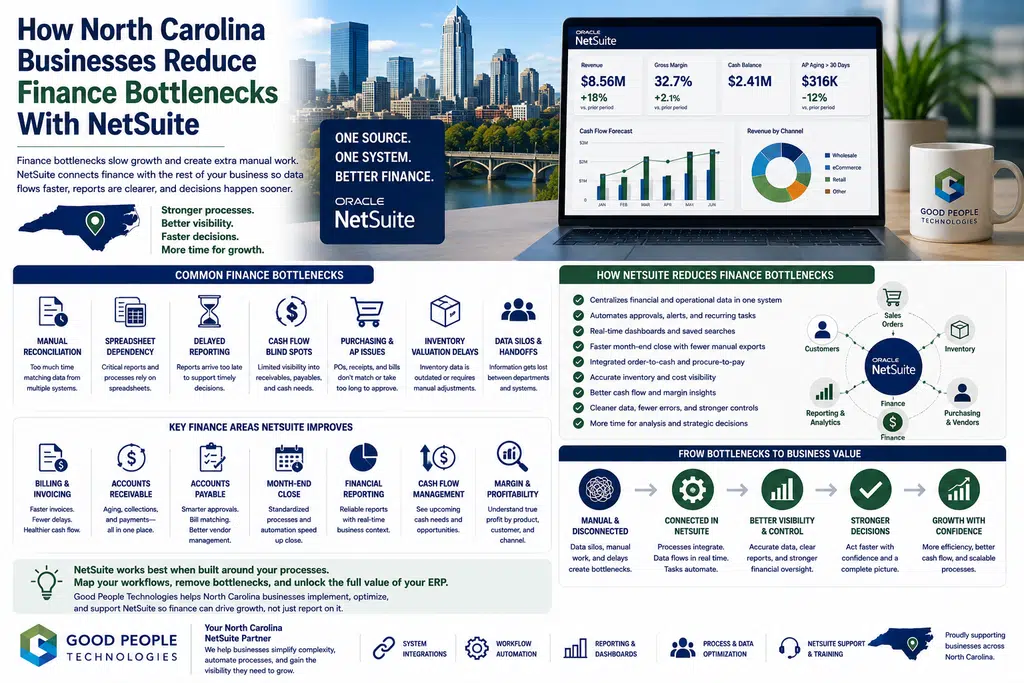
NetSuite finance bottlenecks North Carolina businesses experience often start small. A finance team waits for sales data, checks inventory adjustments, reconciles payments, reviews vendor bills, updates spreadsheets, and prepares reports after several departments have already moved on. At first, this may feel like normal finance work. However, as the business grows, these delays can slow decisions, create extra manual effort, and make it harder for leadership to see what is really happening.
Finance bottlenecks rarely happen because one team is not working hard enough.
More often, finance becomes the place where disconnected systems, unclear workflows, late data, and manual processes finally meet. Sales may use one system. Operations may track work in another. Inventory may live in spreadsheets or warehouse tools. Purchasing may manage vendor activity separately. Customer service may update issues somewhere else. Then finance has to turn all of that activity into accurate numbers.
For North Carolina companies in Charlotte, Raleigh, Greensboro, Durham, Winston-Salem, Wilmington, Asheville, and other growing markets, this issue can appear in many types of businesses. Product-based companies may struggle with inventory value and cost of goods sold. Distributors may need better purchasing and order visibility. Service businesses may need cleaner billing and project reporting. E-commerce companies may need to connect sales, payments, refunds, shipping costs, and finance data.
Revenue may be growing, but finance may still feel stuck in cleanup mode.
That is where NetSuite can help.
NetSuite can reduce finance bottlenecks by connecting finance with orders, inventory, purchasing, billing, reporting, customers, vendors, and operations in one more unified system. Still, the value does not come from software alone. The business also needs clear workflows, clean data, useful reports, process ownership, and the right integrations.
This article explains why finance bottlenecks happen, how they affect growing North Carolina businesses, and how NetSuite can help finance teams move from manual cleanup to clearer visibility and faster decisions.
Why Finance Bottlenecks Happen as Businesses Grow
Finance bottlenecks often appear when business activity grows faster than internal systems.
At a smaller stage, finance may manage the work with accounting software, spreadsheets, manual exports, and direct communication. The team knows where to find information. Employees know who to ask. Reports may take time, but the process still feels manageable.
Growth changes that.
More customers create more invoices, more sales channels create more payment records, more orders create more fulfillment and inventory movement. Extra vendors create more bills and approvals. Returns, refunds, credits, discounts, taxes, shipping costs, and adjustments add more detail.
As a result, finance has to process more information from more places.
If systems do not connect, the team spends too much time collecting and checking data. Someone exports reports. Another person matches records. A manager reviews spreadsheet formulas. Finance asks operations for missing details. Leadership waits for final numbers.
This creates a bottleneck.
The issue is not only speed. It is also trust.
When finance has to clean up data manually, leadership may wait longer for reports. Teams may debate numbers. Decisions may happen with incomplete visibility. Meanwhile, finance spends more time fixing the past instead of helping the business plan ahead.
Finance Often Becomes the Integration Layer
Many companies do not plan for finance to become the integration layer.
It happens gradually.
A business adds tools to solve specific problems. Sales uses a CRM. E-commerce runs through Shopify or another platform. Inventory sits in warehouse software. Purchasing uses vendor records and spreadsheets. Customer service works in a support tool. Project teams track work somewhere else.
Each system may help its own team.
However, finance still needs the final answer.
What revenue should be recorded? Which invoices are open? What payments came in? Which refunds need review? How much inventory value changed? Which vendor bills relate to which purchase orders? What costs affect margin? Which reports should leadership trust?
When systems do not share data clearly, finance has to connect the dots by hand.
That creates extra work.
It also creates risk because manual handoffs can lead to delays, missed updates, duplicate records, and mismatched reports.
NetSuite finance bottlenecks North Carolina companies face often reflect this pattern. Finance is not the root problem. Instead, finance is where system gaps become visible.
A better system foundation helps data move earlier, cleaner, and with less manual effort.
The Cost of Manual Reconciliation
Manual reconciliation is one of the clearest finance bottlenecks.
Reconciliation matters because businesses need accurate records. Finance teams should check that payments, invoices, bills, orders, inventory, and reports match. The problem starts when too much of that work depends on manual exports and spreadsheet cleanup.
For example, an e-commerce company may reconcile online orders, payment processor fees, refunds, shipping costs, taxes, and accounting records. A distributor may compare purchase orders, vendor bills, inventory receipts, customer invoices, and warehouse updates. A service company may match project work, billing milestones, payments, and labor costs.
Each step may seem reasonable.
Together, they can take too much time.
Manual reconciliation can create several costs:
- slower financial close
- delayed leadership reports
- more spreadsheet dependency
- higher risk of errors
- less time for analysis
- more stress during busy periods
- weaker visibility into margin and cash flow
Because of that, finance bottlenecks affect more than finance.
They affect the whole business.
When finance spends most of its time reconciling data, it has less time to help leadership understand performance, risk, and growth opportunities.
Why Reports Arrive Too Late
Finance reports often arrive late because the data behind them arrives late.
Revenue may depend on order data. Margin may depend on item costs, shipping costs, fulfillment costs, discounts, and returns. Cash flow may depend on invoices, payments, vendor bills, purchase orders, and customer terms. Inventory value may depend on receiving, adjustments, transfers, and sales activity.
If those inputs live in different systems, reporting slows down.
Finance may wait for operations. Operations may wait for warehouse updates. Sales may update customer records separately. Purchasing may track vendor issues in spreadsheets. As a result, reports take longer to prepare.
A late report can still be accurate.
However, it may not help the business act in time.
Leadership needs timely visibility into cash flow, margin, receivables, payables, inventory value, revenue trends, and operating costs. If reports arrive after the decision window has passed, the business becomes reactive.
NetSuite can help by bringing finance and operating data closer together. Dashboards, saved searches, reports, and workflows can give teams a clearer view when the system is set up around real decisions.
Still, reporting improvement starts with a key question.
What decision should this report support?
NetSuite Finance Bottlenecks North Carolina
NetSuite finance bottlenecks North Carolina businesses want to reduce usually come from delays between finance and the rest of the company. The numbers may depend on sales, inventory, purchasing, fulfillment, billing, customer records, vendor data, and reporting workflows. When those areas do not connect well, finance has to spend more time cleaning up and explaining the data.
This issue can show up in many ways:
- invoices take too long to create
- payments require manual matching
- vendor bills need extra review
- purchase orders do not match receipts
- inventory value needs cleanup
- revenue reports arrive late
- cash flow visibility is unclear
- month-end close takes too long
- finance depends on spreadsheets
- leadership waits for final numbers
- reports conflict across departments
- manual approvals slow work down
These bottlenecks do not mean the company is failing.
In many cases, they show that the business has grown into a more complex stage.
NetSuite can help when the company needs finance, operations, inventory, purchasing, billing, and reporting to work from a more connected foundation. However, the business should also review process ownership, data quality, roles, permissions, integrations, and reporting needs before expecting software to solve everything on its own.
How NetSuite Connects Finance and Operations
Finance does not operate in isolation.
Every invoice, payment, vendor bill, inventory adjustment, refund, and report connects to real business activity. When finance and operations work in separate systems, the business loses speed and context.
NetSuite can help connect finance with the workflows that create financial results.
For example, sales orders can connect more clearly to invoicing. Purchase orders can connect to vendor bills and receiving. Inventory movement can support financial reporting. Customer records can connect to billing and payment activity. Reports can show both financial and operating data.
This matters because finance needs context.
Revenue is useful, but margin is better. Sales volume is helpful, but fulfillment cost matters too. Inventory value is important, but available and slow-moving inventory add more meaning. Open invoices matter, but customer terms and payment behavior provide stronger insight.
When NetSuite connects finance and operations, finance can spend less time asking for missing information.
Leadership can also see the business more clearly.
Instead of reviewing finance after operations have already created problems, teams can use finance data to guide decisions earlier.
How NetSuite Helps With Billing Bottlenecks
Billing delays can create cash flow problems.
A company may complete work, ship products, or fulfill orders, but invoices may still take too long to create or approve. If billing depends on manual checks, email approvals, spreadsheets, or disconnected order data, finance may lose time at the point where cash should begin moving.
NetSuite can help streamline billing workflows when the system connects orders, customers, pricing, fulfillment, approvals, and finance.
For example, a distributor may need invoices tied to fulfilled orders. A service company may need billing tied to project milestones. An e-commerce business may need cleaner handling of payments, refunds, and fees. A product-based company may need better links between shipments, returns, and billing records.
Better billing workflows help finance act sooner.
They also reduce the need for manual follow-up.
However, companies should not only automate billing because they can. First, they should define billing rules, approval paths, customer terms, exception handling, and reporting needs.
When billing workflows match the business, NetSuite can help reduce delays and improve cash flow visibility.
How NetSuite Helps With Accounts Receivable
Accounts receivable bottlenecks can limit cash visibility.
A business may know it has strong revenue, but still struggle to see when cash will arrive. Open invoices, customer terms, payment delays, credits, disputes, and collection follow-up all affect cash flow.
When A/R work lives across spreadsheets, accounting tools, email threads, and customer records, finance has to chase information.
NetSuite can help by bringing customer records, invoices, payments, credits, and reports into a more connected process. Teams can review open balances, aging, payment status, and customer activity with more context.
As a result, finance can manage cash more actively.
A/R visibility also helps leadership make better decisions.
If certain customers pay slowly, the business can review terms. If invoices stall because of order issues, operations can address the root cause. When disputes rise, customer service and finance can work together earlier.
Better A/R is not only about collecting money faster.
It is about understanding customer payment behavior and cash timing before they become larger problems.
How NetSuite Helps With Accounts Payable
Accounts payable can also become a finance bottleneck.
As a company grows, vendor bills increase. Purchase orders multiply. Receiving activity becomes more complex. Approval rules may vary by department, amount, vendor, or location. Finance needs to make sure bills are accurate before payment.
If A/P depends on manual routing, email approvals, spreadsheet trackers, and disconnected purchase data, delays appear quickly.
NetSuite can help connect purchase orders, vendor records, receipts, approvals, bills, and reporting. This gives finance a clearer view of what the company owes, what needs approval, and which bills connect to real business activity.
Better A/P workflows can help the business manage cash more carefully.
They also help reduce confusion.
For example, finance can review whether a bill matches a purchase order and receipt. Purchasing can see vendor status. Leadership can understand upcoming cash needs. Approvers can act with clearer context.
A/P improvement works best when the company defines ownership.
Who approves which bills? What exceptions need review? Which vendors require special handling? How should the team manage urgent payments?
NetSuite can support the workflow, but the business needs clear rules behind it.
How NetSuite Helps With Month-End Close
Month-end close often reveals finance bottlenecks.
A company may operate smoothly during the month, but close exposes every missing record, late update, unclear adjustment, and manual report. Finance may need to confirm revenue, review expenses, reconcile accounts, check inventory value, match bills, adjust accruals, and prepare reports.
When data comes from many systems, close takes longer.
The team may still complete accurate work, but the process can feel too heavy.
NetSuite can help reduce close bottlenecks by connecting financial activity with the operations behind it. When transactions, approvals, inventory, purchasing, billing, and reporting live closer together, finance can reduce some of the manual cleanup that slows close.
In addition, saved searches, dashboards, workflows, and recurring reports can help teams review issues before the end of the month.
That timing matters.
If finance finds every problem during close, the team has to fix too much at once. If the system surfaces issues earlier, teams can correct them during the month.
A faster close does not happen only because the software changes.
It happens because the business improves workflows, data quality, ownership, and review habits.
How NetSuite Helps With Cash Flow Visibility
Cash flow is one of the most important reasons to reduce finance bottlenecks.
A company can show revenue growth and still feel cash pressure.
This may happen because customers pay later, inventory purchases increase, vendor bills grow, projects require labor before billing, or fulfillment costs rise before payments arrive.
Finance needs timely cash visibility.
NetSuite can help connect cash flow signals across receivables, payables, sales, purchasing, inventory, billing, and reporting. When those areas work from a more connected system, leadership can see upcoming cash needs more clearly.
For example, a distributor may see that inventory purchases will affect cash before customer payments arrive. A service company may notice that billing delays create cash gaps. An e-commerce business may track refunds, payment fees, and fulfillment costs more clearly.
Cash flow reporting should help leadership act.
The company may adjust purchasing, review customer terms, speed up billing, manage vendor timing, or reduce manual delays.
When finance bottlenecks slow cash visibility, growth becomes harder to manage.
How NetSuite Helps With Margin Visibility
Revenue does not tell the full story.
A business also needs to understand margin.
Margin can change because of product cost, labor cost, discounts, returns, shipping costs, vendor pricing, fulfillment issues, project overruns, or service delivery time.
If finance data is disconnected from operations, margin reporting may arrive late or lack context.
NetSuite can help by connecting financial results with item, order, purchasing, fulfillment, customer, and project data. This makes it easier to understand what drives profit and where pressure appears.
For example, a product may sell well but carry high return or shipping costs. A customer may generate revenue but require extra service. A sales channel may grow quickly while lowering margin. A vendor price change may affect profitability before leadership notices.
Better margin visibility helps leaders make stronger decisions.
They can review pricing, purchasing, customer terms, channel strategy, inventory planning, or service delivery.
NetSuite finance bottlenecks North Carolina companies face often hide inside margin reporting. The business may know what it sold, but not clearly enough what it earned.
How NetSuite Helps Reduce Spreadsheet Dependency
Spreadsheets are useful.
Finance teams use them for analysis, planning, modeling, and one-time reviews. The problem starts when spreadsheets become the main finance workflow.
A company may rely on spreadsheets for reconciliation, billing checks, A/R tracking, A/P approvals, inventory value review, margin analysis, cash flow planning, or leadership reporting.
At first, this may help the team move faster.
Later, it can create risk.
Spreadsheets may depend on one person. Formulas can break. Versions may conflict. Data can become outdated. Updates may not flow back into the main system. Leadership may trust a spreadsheet more than the software because it reflects the real process.
NetSuite can reduce spreadsheet dependency by moving key workflows into a more connected system.
However, the business should not remove spreadsheets without understanding why they exist.
A finance spreadsheet usually points to a real need.
It may show a reporting gap, an integration issue, a workflow problem, or a missing approval process. Therefore, the best approach is to map the spreadsheet, understand its purpose, and decide whether NetSuite should replace, support, or connect that workflow.
Why Reporting Design Matters
NetSuite can provide reports, dashboards, saved searches, and analytics tools.
Still, reporting does not become useful automatically.
A business needs reporting design.
Finance reporting should support real decisions, not only show available data. Leadership needs to know what to review, when to review it, who owns each metric, and what action should happen when numbers change.
Useful finance reports may include:
- cash flow visibility
- A/R aging
- A/P aging
- margin by product or service
- revenue by channel
- inventory value
- purchase order exposure
- billing delays
- open invoices
- project profitability
- customer profitability
- finance close status
- exception reports
- manual work reduction opportunities
Each report should answer a business question.
For example, A/R aging should help the team decide which accounts need follow-up. Margin reporting should help leadership review pricing, cost, or channel strategy. Billing delay reports should show where cash flow may slow down.
NetSuite finance bottlenecks North Carolina companies reduce most successfully when reporting supports action.
How Workflow Automation Helps Finance
Automation can reduce repeated finance tasks.
For example, teams may automate approvals, alerts, invoice workflows, payment reminders, recurring reports, exception notices, and review tasks.
This can help finance move faster.
However, automation needs clear process design.
Before automating, the business should define the trigger, owner, rule, exception path, and desired outcome. Otherwise, automation may create noise instead of clarity.
Good finance automation can help with:
- invoice approval routing
- vendor bill review
- payment reminders
- recurring finance reports
- A/R follow-up alerts
- purchase order exceptions
- billing status updates
- close checklist tasks
- margin exception reports
- cash flow alerts
Automation does not replace finance judgment.
Instead, it helps finance notice issues sooner and spend less time on repeated follow-up.
When teams design automation around finance bottlenecks, NetSuite can help move work through the business with less manual effort.
Why Integrations Still Matter With NetSuite
NetSuite may become the core system, but many businesses still use other tools.
An e-commerce company may use Shopify, Amazon, payment processors, shipping tools, and customer service software. A distributor may use EDI, warehouse technology, supplier portals, and shipping platforms. A service business may use CRM, scheduling, project management, and field tools.
Integrations help these systems work with NetSuite.
Without integration, finance may still need manual exports and reconciliation.
For example, online orders should connect to financial records. Payments should support reconciliation. Shipping and fulfillment data should help explain costs. Customer records should match billing records. Vendor and purchase data should support A/P.
A strong integration plan should define which system owns each record, how often data syncs, what happens when errors occur, and who reviews exceptions.
NetSuite can reduce finance bottlenecks when integrations support the full business process.
The goal is not to connect every tool at once.
Instead, the company should start with the systems that create the most finance cleanup.
Common Finance Bottlenecks NetSuite Can Help Address
North Carolina businesses may use NetSuite to reduce several types of finance bottlenecks.
Common areas include:
- manual invoice creation
- delayed billing approvals
- slow payment matching
- spreadsheet-based reconciliation
- vendor bill approval delays
- purchase order matching issues
- unclear inventory value
- late margin reporting
- cash flow blind spots
- manual A/R follow-up
- disconnected sales and finance data
- delayed reporting packages
- inconsistent department numbers
- unclear report ownership
NetSuite can help address these areas when the system design matches the workflow.
For example, invoice delays may require better order-to-cash mapping. Vendor bill issues may require procure-to-pay cleanup. Margin reporting may require cleaner item data and cost rules. Cash flow visibility may require better A/R, A/P, billing, and purchasing reports.
Software helps most when the company knows which bottleneck it wants to solve first.
What to Review Before Improving Finance in NetSuite
Before improving finance workflows, businesses should review how finance works today.
Start with data flow.
Where does finance data come from? Which systems create transactions? What gets entered twice? Which records arrive late? Where do spreadsheets fill gaps?
Next, review close and reporting.
How long does month-end close take? Which steps create delays? Which reports does leadership trust? What numbers require explanation? Where do reports conflict?
Billing and cash flow also need review.
How quickly do invoices go out? Which approvals slow billing? What A/R follow-up happens manually? How does the business track cash timing?
Then review purchasing and A/P.
Do purchase orders match vendor bills? Are approval rules clear? Which bills create exceptions? Can leadership see upcoming cash needs?
Finally, look at ownership.
Who owns finance workflows, reports, data definitions, approvals, integrations, and exceptions?
This review helps the business decide whether it needs NetSuite optimization, reporting cleanup, integration support, automation, process ownership, or broader ERP planning.
Composite Example: A Charlotte Product-Based Business
Consider a product-based business in Charlotte.
The company sells through e-commerce, wholesale accounts, and a few retail partners. Revenue is growing, but finance feels more pressure every month.
Orders come from several channels. Payment data needs cleanup. Refunds and shipping costs require manual review. Inventory reports do not always match accounting records. Leadership wants margin by channel, but finance has to build that report from exports.
The finance team works carefully.
Still, the process takes too long.
After reviewing the workflows, the company finds that finance bottlenecks come from disconnected order, inventory, payment, and fulfillment data.
The first improvements focus on integration and reporting.
Orders flow more cleanly into finance. Payment reconciliation becomes easier. Inventory value reports improve. Leadership receives reports that connect revenue with margin, returns, and fulfillment cost.
Later, the company uses NetSuite workflows and dashboards to reduce manual review and improve decision timing.
As a result, finance spends less time cleaning up data and more time helping leadership understand performance.
Composite Example: A Greensboro Distributor
A distributor near Greensboro faces a different finance bottleneck.
The company manages a broad product catalog, vendor relationships, purchase orders, backorders, customer-specific pricing, and warehouse activity.
Finance needs accurate data from purchasing, inventory, sales, and fulfillment. However, several key steps still happen through spreadsheets and manual updates.
Vendor bills do not always match purchase records cleanly. Inventory adjustments require extra review. Backorders affect revenue timing. Customer service tracks some order updates outside the system. Leadership wants better cash flow visibility.
The business reviews procure-to-pay, order-to-cash, inventory, and reporting workflows.
That review shows that finance bottlenecks do not start only in finance. They begin earlier in purchasing, receiving, fulfillment, and order management.
The company improves NetSuite reports, clarifies approval rules, reviews item and vendor data, and connects backorder visibility with finance reporting.
Over time, finance gains a clearer view of what the company owes, what customers owe, what inventory is worth, and how delays affect cash.
For this distributor, NetSuite finance bottlenecks North Carolina growth created became easier to manage once finance connected more closely with operations.
How Good People Technologies Helps Reduce Finance Bottlenecks
Good People Technologies helps growing businesses reduce finance bottlenecks through NetSuite consulting, ERP planning, system integrations, workflow automation, reporting cleanup, and practical technology strategy.
For companies working through finance delays, this can include:
- reviewing finance workflows
- mapping order-to-cash and procure-to-pay processes
- identifying manual reconciliation work
- improving NetSuite dashboards and saved searches
- reducing spreadsheet dependency
- connecting sales, inventory, purchasing, and finance data
- automating recurring reports and alerts
- clarifying process ownership
- reviewing integration gaps
- building phased NetSuite optimization roadmaps
The work starts with understanding where finance loses time today.
Some companies need better reports. Others need integration cleanup, workflow automation, A/R improvements, A/P process design, billing updates, or inventory value visibility. More complex businesses may need broader NetSuite optimization or ERP planning.
If your finance team is spending too much time chasing data, reconciling spreadsheets, or waiting for clean reports, Good People Technologies can help identify which system improvements would create the most practical value.
Final Thoughts
NetSuite finance bottlenecks North Carolina businesses face often reveal deeper system issues.
Finance may feel the delay, but the root cause may sit in sales, inventory, purchasing, fulfillment, billing, customer records, reporting, integrations, or workflow ownership.
That is why finance improvement should not focus only on accounting tasks.
A stronger approach looks at the full business process.
NetSuite can help reduce finance bottlenecks by connecting finance with the operational data behind invoices, payments, vendor bills, inventory, purchasing, margins, cash flow, and reporting.
However, the business also needs clear process owners, clean data, useful reports, thoughtful automation, and integrations that support daily work.
When those pieces work together, finance can move from cleanup to insight.
The company gets faster reporting, clearer cash flow visibility, better margin understanding, fewer manual steps, and stronger decisions.
For growing North Carolina businesses, that can turn finance from a bottleneck into a better source of control and confidence.
Frequently Asked Questions
What are finance bottlenecks?
Finance bottlenecks are delays or manual steps that slow billing, reconciliation, reporting, A/R, A/P, close, cash flow visibility, or financial decision-making.
Why do finance bottlenecks happen?
Finance bottlenecks often happen because sales, inventory, purchasing, fulfillment, billing, customer, and vendor data live in disconnected systems or manual spreadsheets.
How can NetSuite reduce finance bottlenecks?
NetSuite can reduce finance bottlenecks by connecting finance with orders, inventory, purchasing, billing, customers, vendors, workflows, dashboards, saved searches, and reports.
Can NetSuite help with month-end close?
Yes. NetSuite can help support month-end close when transactions, approvals, reports, reconciliations, and operating data are connected more clearly.
How does NetSuite help with cash flow visibility?
NetSuite can help connect A/R, A/P, billing, purchasing, inventory, and reporting so leadership can see cash timing and upcoming needs more clearly.
Does NetSuite eliminate spreadsheets?
No. Spreadsheets may still help with analysis and planning. However, NetSuite can reduce the need for spreadsheets that support core finance workflows or repeated manual reconciliation.
Why do finance teams need integrations?
Finance teams need integrations because sales, payments, fulfillment, inventory, CRM, e-commerce, warehouse, and vendor data often affect financial reporting.
What should businesses review before improving NetSuite finance workflows?
Businesses should review data flow, billing, A/R, A/P, month-end close, reporting, integrations, manual spreadsheets, approvals, and process ownership.
Is NetSuite only for accounting?
No. NetSuite can support finance, inventory, purchasing, orders, billing, reporting, customers, vendors, and operations depending on the company’s setup and needs.
How can Good People Technologies help?
Good People Technologies helps businesses review finance workflows, improve NetSuite reporting, connect systems, automate tasks, reduce spreadsheet dependency, and build practical ERP roadmaps.

Roman is a B2B marketing specialist focused on technology, ERP systems, business automation, and digital growth strategies. At Good People Technologies, he helps translate complex technology solutions—such as ERP integrations, system integrations, and business process automation—into clear insights for founders, operators, and growing companies.
His work focuses on content strategy, SEO, and thought leadership that helps businesses understand how the right technology infrastructure can support scalable operations and sustainable growth.
At Good People Technologies, Roman contributes to content that explores ERP implementation, automation strategies, and system integration best practices for companies navigating rapid growth and operational complexity.