
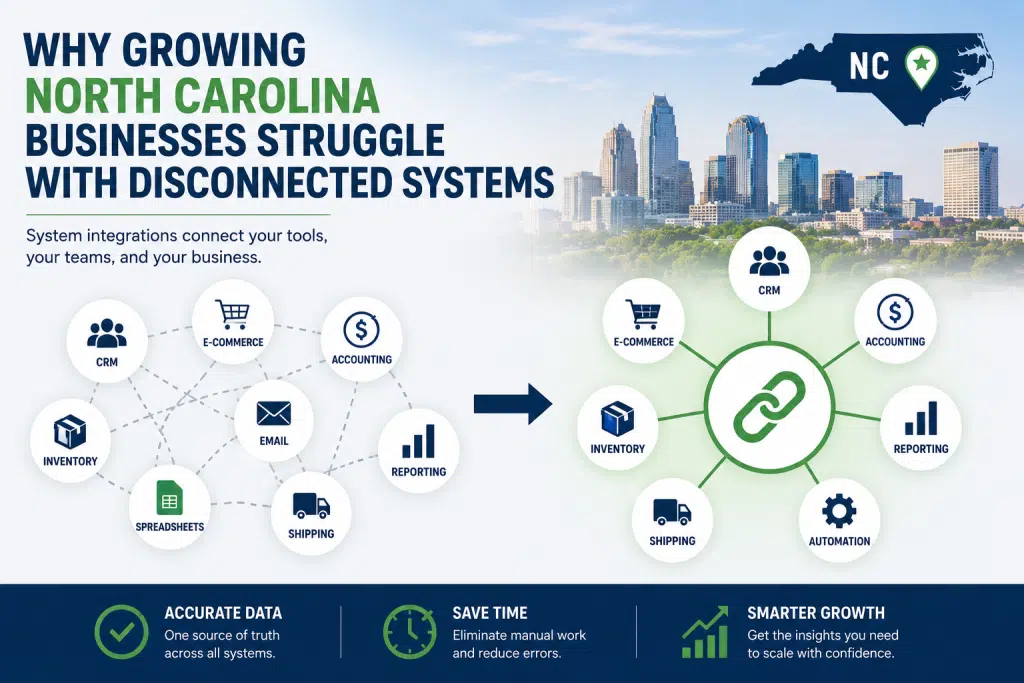
North Carolina system integrations are becoming increasingly important for growing businesses that rely on multiple tools to manage sales, operations, accounting, inventory, customer communication, fulfillment, and reporting. As companies expand, the systems that once helped them move faster can start creating friction when they do not communicate with each other.
A business may use QuickBooks for accounting, Shopify for e-commerce, Salesforce or HubSpot for customer relationships, spreadsheets for reporting, a warehouse system for fulfillment, and email for internal approvals. At first, this kind of setup can feel practical. Each tool solves a specific problem, and the team finds ways to make everything work.
Eventually, growth changes the situation.
More customers create more communication needs. Higher order volume increases operational pressure. Additional products, services, vendors, and locations make data harder to manage. Reports take longer to prepare because information lives in different platforms. Employees spend more time moving data between systems instead of using that data to make better decisions.
That is where disconnected systems become a real business problem.
For growing businesses across Charlotte, Raleigh, Durham, Greensboro, Winston-Salem, Asheville, and other parts of North Carolina, disconnected software often becomes one of the biggest hidden barriers to scaling efficiently. The company may look successful from the outside, but internally, teams may be slowed down by manual work, inconsistent data, reporting delays, and unclear ownership of information.
This article explains why growing North Carolina businesses struggle with disconnected systems, how those problems affect operations, and when integrations, automation, or ERP may be needed to create a more scalable foundation.
What Disconnected Systems Actually Mean
Disconnected systems are software tools that do not share information automatically or reliably.
A business may have strong individual platforms, but if those platforms do not communicate, employees become responsible for connecting the dots manually.
For example:
- sales data may live in a CRM
- invoices may live in accounting software
- inventory may live in a warehouse system
- orders may come from Shopify or another e-commerce platform
- customer updates may happen through email
- reports may be built in spreadsheets
- fulfillment data may live with a third-party logistics provider
None of these tools is necessarily wrong.
The problem appears when the business cannot get one clear, reliable view of operations.
A disconnected system environment often creates questions like:
- Which customer record is accurate?
- Has this order shipped?
- Is the inventory count correct?
- Did accounting receive the latest transaction?
- Which report should leadership trust?
- Why does one system show different numbers from another?
- Who is responsible for updating this information?
When these questions become part of daily work, the business is no longer just using software. It is managing around software gaps.
That is why North Carolina system integrations matter for companies that want growth without unnecessary operational drag.
Why Growing Businesses Add Systems Before They Add Strategy
Most disconnected systems do not happen because of poor planning.
They happen because businesses grow in stages.
A company starts with simple tools because simple tools are enough. Then new problems appear, and the company adds software to solve them.
A CRM is added when sales activity becomes harder to track.
Accounting software becomes necessary as transactions increase.
An e-commerce platform supports online sales.
A warehouse tool helps with fulfillment.
Project management software organizes team activity.
Reporting dashboards are added when leadership wants more visibility.
Each decision can make sense at the time. However, if there is no broader system architecture, the company slowly builds a stack of tools that were never designed to operate together.
This is especially common in small and mid-sized businesses.
Large enterprises often have dedicated IT departments, system architects, and long-term technology roadmaps. Growing companies usually do not. Decisions are made quickly because the team needs to solve immediate business problems.
That speed can help a company grow in the beginning.
Later, it creates complexity.
The business may have good tools, but no clear data flow. Departments may have software that supports their own work, but leadership cannot see how the whole operation is performing. Employees may build spreadsheet workarounds because the systems do not provide the answers they need.
At that stage, the issue is no longer whether the company has enough software.
The real issue is whether the software works together.
Why North Carolina Businesses Feel This Problem Locally
North Carolina has a diverse and growing business environment.
Companies across the state operate in manufacturing, e-commerce, professional services, logistics, retail, food production, healthcare services, outdoor recreation, technology, and product-based industries. Many of these businesses are not huge corporations, but they are no longer small startups either.
That middle stage is where disconnected systems become especially painful.
A company may have outgrown its early tools but may not yet have the internal technology team needed to manage a more complex environment. Leadership knows operations need improvement, but the path forward is not always obvious.
In Charlotte, a growing product-based business may need to connect sales, inventory, fulfillment, and accounting.
Near Raleigh or Durham, a service company may struggle with CRM, project management, invoicing, and reporting.
A manufacturer in Greensboro or Winston-Salem may need better coordination between production, purchasing, inventory, and finance.
In Asheville, a regional business may be managing customers, online sales, internal workflows, and reporting across multiple tools without a unified system.
The local industries may be different, but the pattern is similar: growth creates more data, more workflows, and more dependencies between departments.
Without North Carolina system integrations, those dependencies often become manual.
The Hidden Cost of Disconnected Systems
Disconnected systems rarely create one obvious failure.
Instead, they create many small inefficiencies that spread across the business.
A team member spends ten minutes copying data from one platform into another. Someone else checks a spreadsheet before confirming inventory. Finance waits for operations to send updated numbers. Customer service asks the warehouse for an order update. Leadership delays a decision because the report is not ready.
Each individual task may seem minor.
Together, they create a hidden operational cost.
Disconnected systems can lead to:
- duplicated data entry
- delayed reporting
- inconsistent customer records
- inventory errors
- fulfillment delays
- missed handoffs
- poor visibility into margins
- manual reconciliation
- employee frustration
- slower decision-making
The most expensive part is often not the time spent on one task. It is the way disconnected systems reduce the company’s ability to move quickly.
When people cannot trust the data, they slow down.
When reports take too long, leadership becomes reactive.
When customer-facing teams need to chase internal updates, service quality declines.
If operations depend on too many manual workarounds, growth becomes harder than it should be.
Manual Data Entry Becomes the Integration Layer
One of the clearest signs of disconnected systems is manual data entry.
When software tools do not communicate, employees become the connection between them.
They copy customer information from one system to another.
Order data gets entered twice.
Inventory changes are updated manually.
Reports are built from exports.
Invoices are checked against spreadsheets.
Shipping updates are copied into customer records.
This creates a risky situation. People are not just doing their jobs; they are compensating for missing integrations.
Manual data entry creates problems in three areas.
The first is time. Employees spend hours on repetitive work that could often be automated.
Accuracy is another issue. A small typo, wrong quantity, incorrect SKU, or outdated customer record can create downstream problems.
Speed also suffers. Information does not move through the business until someone manually transfers it.
As transaction volume increases, this problem grows. More orders, customers, vendors, products, and reports all create more manual work unless systems are connected.
That is why manual data entry is often one of the first places to evaluate when reviewing North Carolina system integrations.
Reporting Delays Create Leadership Blind Spots
Leadership teams need timely information.
They need to know what is happening with revenue, margins, inventory, operations, customer demand, fulfillment, cash flow, and team performance.
Disconnected systems make this difficult.
If information lives across multiple platforms, reports often require manual preparation. Someone exports data from accounting, pulls information from the CRM, checks operational spreadsheets, cleans the numbers, and prepares a summary for leadership.
By the time the report is ready, the situation may already have changed.
This creates leadership blind spots.
A business owner may not see inventory issues until they affect customers. Margin pressure may go unnoticed because product costs are not connected to sales performance. Operational delays may appear as isolated problems instead of patterns.
Reporting problems are especially dangerous because they do not always feel urgent.
The company may still have reports. They just take too long, require too much manual effort, or fail to show the full picture.
For growing businesses, delayed reporting is a warning sign. It means leadership is making decisions with limited visibility.
Better integrations can connect key systems so reporting becomes faster, cleaner, and more reliable.
Customer Experience Suffers When Systems Do Not Communicate
Customers do not care which internal system caused a problem.
They care about the experience.
If an order is delayed, the customer sees a missed expectation. When billing information is wrong, the customer sees confusion. If support teams cannot answer a simple status question, the customer loses confidence.
Disconnected systems often affect customer experience in ways that are not obvious at first.
A sales team may not know whether inventory is available.
Customer service may not see order updates.
Billing may not reflect the latest changes.
Operations may not receive important customer notes.
Fulfillment may work from incomplete data.
These issues create friction between the business and its customers.
The customer may experience:
- delayed updates
- inconsistent communication
- order mistakes
- billing confusion
- slow response times
- inaccurate timelines
- repeated requests for the same information
Internally, employees may be trying hard to help. However, without connected systems, they do not have the visibility they need.
North Carolina system integrations can help improve customer experience by making important data available where teams need it.
Inventory and Fulfillment Problems Become More Frequent
Product-based businesses are especially vulnerable to disconnected systems.
If inventory, sales, purchasing, accounting, and fulfillment tools do not communicate properly, the business may struggle to know what is actually available.
This can create problems such as:
- overselling
- stockouts
- excess inventory
- delayed fulfillment
- inaccurate purchasing
- poor warehouse visibility
- customer service issues
- financial reporting errors
Inventory problems often start small.
One platform shows an item in stock, while another shows it unavailable. A spreadsheet is updated manually, but the e-commerce platform is not. A warehouse adjustment happens, but accounting does not reflect it quickly.
Over time, the team stops trusting the system.
Employees create manual checks because they do not believe the numbers. Spreadsheets become backup systems. Purchasing decisions become reactive. Customer communication slows down because availability is uncertain.
For growing businesses in North Carolina, this can become a serious operational constraint.
A company may have demand, but weak inventory visibility limits its ability to serve that demand efficiently.
Integrations between e-commerce, inventory, warehouse, accounting, and ERP systems can reduce these issues by keeping data more consistent.
Departments Build Their Own Workarounds
When systems do not communicate, departments often create their own solutions.
Sales may build a spreadsheet to track customer commitments.
Operations may maintain a separate production or fulfillment file.
Finance may create a manual reconciliation process.
Customer service may keep notes outside the CRM.
Leadership may request custom reports that require manual data cleanup.
These workarounds are understandable. Teams need to get work done, and they often create practical fixes under pressure.
However, workarounds can become a long-term problem.
They create separate versions of the truth. They also make the business dependent on specific people who understand those files or processes.
Over time, the company may have several unofficial systems operating alongside official software.
That makes operations harder to manage.
If one employee leaves, the business may lose important process knowledge. If a spreadsheet breaks, reporting may be delayed. If departments define data differently, leadership may struggle to compare performance.
A workaround can solve today’s problem while creating tomorrow’s bottleneck.
The goal is not to eliminate every spreadsheet or manual step. Instead, companies should identify which workarounds have become critical to operations and decide whether those workflows need integration, automation, or a more central system.
North Carolina System Integrations for Growing Businesses
North Carolina system integrations help growing businesses connect the tools they already use so data can move more reliably across the company.
This does not always mean replacing every system.
In many cases, businesses already have useful tools. The issue is that the tools do not share information properly.
A strong integration strategy can connect systems such as:
- CRM
- ERP
- accounting software
- e-commerce platforms
- inventory tools
- warehouse systems
- fulfillment providers
- project management software
- reporting dashboards
- customer support platforms
The purpose is not only technical connection.
The real goal is operational improvement.
A good integration should reduce manual work, improve data accuracy, speed up reporting, support better customer communication, and help leadership make more confident decisions.
For example, an integration between e-commerce and accounting can reduce duplicate order entry. Connecting CRM and project management can improve handoffs from sales to delivery. Linking inventory and fulfillment systems can reduce customer-facing errors. Integrating ERP with reporting dashboards can improve leadership visibility.
North Carolina system integrations become especially valuable when a business is growing but not yet ready to replace its entire software stack.
When Integrations Are Enough
A business does not always need ERP immediately.
Sometimes integrations can solve the most painful issues.
Integrations may be enough when:
- current tools are still useful
- departments like the systems they use
- the main issue is data movement
- manual entry is the biggest problem
- reporting needs better source data
- customer records need to sync
- order and inventory data need better alignment
For example, a company may use Shopify, QuickBooks, a warehouse system, and a CRM. If those tools support the business well but do not communicate properly, integrations may create major improvements without a full platform change.
This approach can be faster and more cost-effective than replacing everything.
It can also help the company prepare for future ERP implementation by improving data structure and reducing manual work.
Integrations are often the best first step when disconnected tools are causing friction, but the overall system environment is still workable.
When ERP Becomes Necessary
ERP becomes more important when the business needs a central operational system.
This often happens when the company has outgrown a patchwork of tools.
ERP may be worth evaluating when:
- accounting and operations are disconnected
- inventory is difficult to trust
- reporting takes days instead of minutes
- purchasing is reactive
- order management is too manual
- departments maintain separate records
- leadership lacks real-time visibility
- spreadsheets run core workflows
- growth creates more admin work instead of more efficiency
ERP can help centralize business functions such as finance, inventory, purchasing, operations, order management, reporting, and workflow automation.
However, ERP should not be treated as a magic fix.
A successful ERP project still requires process mapping, clean data, clear requirements, change management, and integration planning.
For many companies, the best path is phased. Improve integrations first, automate high-friction workflows, then evaluate ERP when the business is ready for a central system.
Composite Example: A Growing Charlotte Product Business
Consider a growing product-based business in Charlotte.
The company sells through its website, wholesale accounts, and regional retail partners. It uses Shopify for online sales, QuickBooks for accounting, spreadsheets for inventory planning, a CRM for customer relationships, and a fulfillment provider for shipping.
For several years, the setup worked well enough.
Then growth accelerated.
Order volume increased. Inventory became harder to trust. Wholesale customers needed faster updates. Finance spent more time reconciling transactions. Customer service had to check multiple systems before answering order questions.
The team was not lazy or disorganized. The systems simply were not connected well enough for the company’s new size.
The business started seeing recurring issues:
- duplicate order entry
- inconsistent inventory numbers
- delayed customer updates
- manual reporting
- slow finance reconciliation
- spreadsheet dependency
- limited visibility into channel profitability
After reviewing the workflow, leadership realized that many problems came from data movement.
The first step was not replacing every tool. Instead, the company focused on system integrations.
Shopify order data was connected more cleanly with accounting. Inventory updates were improved between fulfillment and internal systems. Reporting was redesigned so leadership could see sales, inventory, and profitability more clearly.
Later, the company began evaluating whether ERP should become the central operational system.
This phased approach reduced immediate friction while creating a better foundation for future growth.
Composite Example: A Raleigh Service Business With Disconnected Workflows
A growing service business near Raleigh faced a different type of disconnected systems problem.
The company used a CRM for sales, project management software for delivery, accounting software for invoices, and spreadsheets for resource planning.
Sales activity was strong, but handoffs were inconsistent.
Project teams sometimes lacked full customer context. Finance did not always receive billing details quickly. Leadership had difficulty seeing project profitability. Resource planning depended on a spreadsheet that required constant manual updates.
The business did not have an inventory problem. It had a workflow visibility problem.
After mapping the process, several gaps became clear.
Customer information did not flow smoothly from sales to delivery. Project status did not connect cleanly with billing. Reporting required too much manual work. Leadership could not easily compare revenue, workload, and profitability.
The solution involved connecting CRM, project management, accounting, and reporting workflows.
This helped reduce manual handoffs and gave leadership a clearer view of performance.
The lesson is important: disconnected systems are not only a manufacturing or e-commerce issue. Service businesses can struggle just as much when customer, delivery, finance, and reporting systems do not communicate.
How to Identify Disconnected System Problems
Growing businesses can begin by reviewing where information slows down.
Useful questions include:
- Where does the same data get entered more than once?
- Which reports take too long to create?
- Which systems show conflicting numbers?
- Where do employees use spreadsheets as workarounds?
- Which customer questions require internal chasing?
- Which departments define the same data differently?
- Where do errors happen repeatedly?
- What information does leadership wish it had sooner?
- Which workflows depend heavily on one person?
These questions help reveal integration opportunities.
A one-time mistake may not justify a major system project. Repeated friction usually deserves attention.
Businesses should also review the path of important data.
For example, what happens from the moment a customer places an order until the order is fulfilled, invoiced, reported, and analyzed?
Every manual step in that journey is a possible bottleneck.
How Good People Technologies Helps With Disconnected Systems
Good People Technologies helps growing businesses improve operations through system integrations, ERP support, workflow automation, and technology strategy.
For companies struggling with disconnected systems, this can include:
- reviewing the current software stack
- mapping workflows across departments
- identifying manual data entry points
- finding reporting bottlenecks
- clarifying data ownership
- connecting key systems
- automating repetitive workflows
- evaluating ERP readiness
- improving operational visibility
The process starts with understanding how the business actually works.
Some companies need integrations between existing tools. Others need ERP implementation or ERP optimization. A few may first need process cleanup before technology changes make sense.
The best solution depends on the business problem.
If your team is spending too much time copying data, reconciling reports, chasing updates, or questioning system accuracy, Good People Technologies can help identify where better integrations or automation would create the most value.
Final Thoughts
North Carolina system integrations are becoming more important because growing businesses need connected operations, not just more software.
Disconnected systems can slow every part of the company. They create manual work, reporting delays, customer communication problems, inventory confusion, department silos, and leadership blind spots.
At first, these issues may feel manageable. As the business grows, they become harder to ignore.
The good news is that disconnected systems can be improved.
Some companies need targeted integrations. Others need automation around repetitive workflows. More complex businesses may eventually need ERP as the central operational foundation.
The right path depends on where the friction is happening and what the company needs to support its next stage of growth.
For businesses across North Carolina, solving disconnected systems is not just an IT project. It is a growth strategy.
Frequently Asked Questions
Why do growing businesses struggle with disconnected systems?
Growing businesses struggle with disconnected systems because they add software over time to solve specific problems. As the company expands, those tools often do not communicate well, creating manual work, inconsistent data, reporting delays, and operational confusion.
What are disconnected systems in business?
Disconnected systems are software tools that do not automatically or reliably share information. Examples include separate CRM, accounting, inventory, e-commerce, warehouse, project management, and reporting systems that require employees to move data manually.
How do disconnected systems affect business growth?
Disconnected systems slow growth by increasing manual work, delaying reports, creating data errors, weakening customer communication, and making leadership decisions harder. As volume increases, these issues become more expensive.
When should a business consider system integrations?
A business should consider system integrations when employees enter the same data into multiple tools, reports take too long, systems show conflicting information, customer updates require internal chasing, or manual work increases with growth.
Are integrations better than ERP?
Integrations may be better when a company already has useful systems that simply need to communicate. ERP may be better when the business needs one central platform for finance, operations, inventory, purchasing, reporting, and workflow management.
Can system integrations reduce manual data entry?
Yes. System integrations can reduce manual data entry by allowing information to move automatically between platforms such as CRM, accounting software, e-commerce systems, inventory tools, and reporting dashboards.
What types of businesses need system integrations?
Manufacturers, e-commerce businesses, distributors, service companies, product-based businesses, and growing local companies often need integrations when operations rely on multiple disconnected platforms.
How do disconnected systems affect customer experience?
Disconnected systems affect customer experience by causing delayed updates, inaccurate information, billing confusion, order mistakes, and slow response times. Customers experience the outcome even if they never see the internal system problem.
What is the first step to fixing disconnected systems?
The first step is to map how data moves through the business. Once the company understands where manual work, delays, and duplicate data entry happen, it can decide whether integrations, automation, ERP, or process changes are needed.
How can Good People Technologies help with disconnected systems?
Good People Technologies helps businesses review current systems, identify workflow gaps, connect software platforms, automate repetitive tasks, improve reporting, and evaluate whether ERP or integrations are the right next step.

Roman is a B2B marketing specialist focused on technology, ERP systems, business automation, and digital growth strategies. At Good People Technologies, he helps translate complex technology solutions—such as ERP integrations, system integrations, and business process automation—into clear insights for founders, operators, and growing companies.
His work focuses on content strategy, SEO, and thought leadership that helps businesses understand how the right technology infrastructure can support scalable operations and sustainable growth.
At Good People Technologies, Roman contributes to content that explores ERP implementation, automation strategies, and system integration best practices for companies navigating rapid growth and operational complexity.