
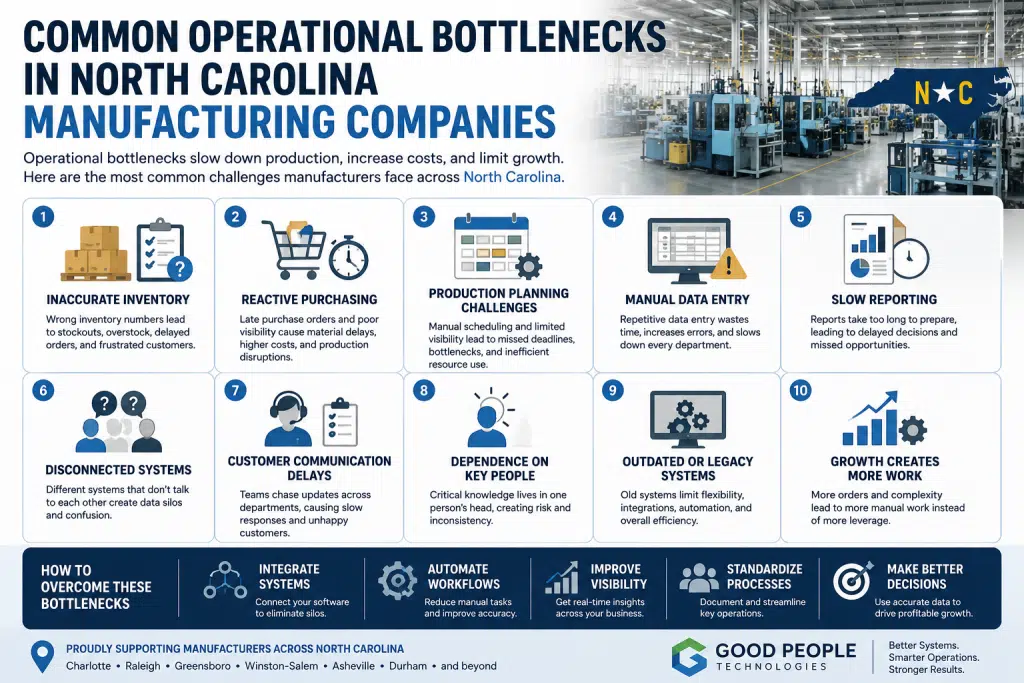
Common operational bottlenecks in North Carolina manufacturing companies often appear slowly. At first, a delayed purchase order, an inaccurate inventory number, or a late production report may seem like a small internal issue. However, as manufacturing businesses grow, these small problems can turn into larger operational constraints that affect delivery timelines, margins, customer satisfaction, and the company’s ability to scale.
For manufacturers across Charlotte, Raleigh, Durham, Greensboro, Winston-Salem, Asheville, and other parts of North Carolina, growth often creates more complexity than their current systems were built to handle. A company may have strong products, experienced employees, and steady demand, but still struggle because its internal workflows rely on disconnected software, manual processes, and outdated reporting habits.
That is why operational bottlenecks are not just “process problems.” They are often systems problems.
When departments cannot easily share accurate data, teams spend more time correcting information than using it. Then, when inventory visibility is weak, purchasing and production decisions become reactive. When leadership waits days for reliable reports, decision-making slows down. Over time, the business becomes less efficient, even if the team is working harder than ever.
This article explains the most common operational bottlenecks in North Carolina manufacturing companies, why they happen, how they affect growth, and what manufacturers can do to build more efficient, scalable operations.
Why Operational Bottlenecks Matter More as Manufacturers Grow
These common operational bottlenecks in North Carolina manufacturing companies often become more visible when a business moves from a small, experience-driven operation to a more complex organization that needs repeatable systems.
A small manufacturing company can often survive with informal processes.
The production manager may know what is happening on the floor. The purchasing team may understand supplier patterns from experience. Finance may rely on spreadsheets to close reports. Customer service may ask around for updates when a customer needs an answer.
At an early stage, this can work because the business is small enough for people to manage complexity through communication and experience.
Growth changes that.
As a manufacturer adds more customers, SKUs, suppliers, employees, production runs, and delivery commitments, informal systems begin to break down. The business now needs repeatable workflows, accurate data, connected systems, and clear accountability.
Without that foundation, operational bottlenecks become more frequent.
A bottleneck is any point in the business where work slows down, gets delayed, requires unnecessary manual effort, or depends too heavily on one person or one disconnected process.
In manufacturing, bottlenecks can appear in:
- inventory management
- purchasing
- production planning
- order processing
- quality control
- reporting
- accounting
- shipping
- customer communication
- system integrations
Some bottlenecks are easy to see, such as a machine that cannot keep up with production demand. Others are harder to notice because they happen inside workflows, spreadsheets, and software systems.
Those hidden bottlenecks are often the most expensive.
North Carolina Manufacturing Has Local Growth Pressures
Manufacturing in North Carolina is diverse and competitive.
The state includes manufacturers in industries such as furniture, textiles, food production, packaging, aerospace components, industrial equipment, medical devices, electronics, automotive suppliers, consumer goods, and specialty manufacturing.
A manufacturer in Greensboro may face different market dynamics than one in Asheville or Charlotte, but many operational pressures are similar.
Companies are dealing with:
- labor constraints
- supplier uncertainty
- rising material costs
- customer demand for faster delivery
- more complex product requirements
- pressure to improve margins
- higher expectations for visibility and communication
- competition from larger, more automated operations
Because of these pressures, North Carolina manufacturers cannot afford inefficient internal systems.
For that reason, common operational bottlenecks in North Carolina manufacturing companies should be reviewed before they turn into customer-facing problems or margin pressure.
If a company loses time to manual data entry, delayed reporting, poor inventory visibility, or disconnected workflows, it becomes harder to compete. The business may still operate, but it operates with drag.
This is why common operational bottlenecks in North Carolina manufacturing companies should be treated as strategic issues, not just daily annoyances.
Bottleneck 1: Inventory Numbers Are Not Reliable
Inventory is one of the most common sources of operational friction in manufacturing.
A company may have raw materials, components, packaging, work-in-progress, finished goods, replacement parts, and supplier-managed inventory. If the systems tracking those items are not accurate, the entire operation becomes harder to manage.
Inventory problems often show up in familiar ways:
- the system says materials are available, but the warehouse cannot find them
- purchasing orders more stock than needed because reports are outdated
- production is delayed because critical components are missing
- finished goods appear available but are already committed to another order
- finance struggles to understand true inventory value
- employees rely on spreadsheets instead of the main system
These issues create a chain reaction.
Production planning becomes less reliable. Purchasing becomes more reactive. Customer timelines become harder to promise. Cash gets tied up in excess inventory. Leadership loses confidence in operational reports.
The root cause is usually not one mistake.
More often, inventory bottlenecks happen because multiple systems are tracking different parts of the inventory process without proper integration.
For example, accounting may have one number. The warehouse may have another. A spreadsheet may show something else. Production may be working from an older update.
When no system acts as the trusted source of truth, employees must manually verify inventory before making decisions.
That manual verification becomes the bottleneck.
Bottleneck 2: Purchasing Is Reactive Instead of Strategic
Purchasing is another major bottleneck for manufacturers.
In an ideal operation, purchasing decisions are based on real-time visibility into demand, inventory, supplier lead times, production schedules, and cost trends.
In many growing companies, purchasing is much more reactive.
A buyer may place orders because someone on the production team noticed materials were low. A spreadsheet may be updated manually. Supplier communication may live in email threads. Purchase orders may be created based on outdated demand forecasts.
This creates several problems.
The business may run out of critical materials. It may over-order slow-moving items. Suppliers may be evaluated based on memory instead of data. Emergency purchasing may increase costs. Production schedules may shift because materials arrive late.
Reactive purchasing is especially painful when supply chains are unpredictable.
Manufacturers need to know:
- which materials are required soon
- which suppliers are reliable
- which items have long lead times
- how demand is changing
- whether current inventory can support production
- how purchasing decisions affect cash flow
Disconnected systems make these questions harder to answer.
A stronger operational foundation connects purchasing with inventory, production planning, accounting, and supplier management. When that happens, purchasing becomes a strategic function instead of a constant firefighting exercise.
Bottleneck 3: Production Planning Depends Too Much on Manual Coordination
Production planning is one of the most complex areas in manufacturing.
A production schedule must account for materials, labor, machine availability, customer deadlines, work orders, changeovers, quality checks, and unexpected delays.
If planning happens through spreadsheets, whiteboards, emails, or informal conversations, the process becomes fragile.
One missed update can affect the entire schedule.
A customer order may be promised before production capacity is confirmed. A work order may be delayed because materials are unavailable. A machine may be scheduled without considering maintenance. A production manager may spend hours manually adjusting schedules because systems do not provide enough visibility.
Manual production planning often works until the company reaches a certain level of complexity.
After that point, the process becomes too dependent on individual knowledge.
This creates risk.
If one key employee is unavailable, the team may struggle to understand what is happening. If demand increases, the planning process may not scale. When customer expectations rise, the business may not respond quickly enough.
Manufacturers do not need every production process to be fully automated overnight. However, they do need better visibility and more reliable planning workflows.
That usually requires stronger systems, better integrations, and clearer data flows.
Bottleneck 4: Manual Data Entry Slows Every Department
Manual data entry is one of the most expensive hidden bottlenecks in manufacturing.
It usually appears in small, repeated tasks:
- entering sales orders into accounting
- copying inventory updates into spreadsheets
- manually creating purchase orders
- updating customer records in multiple systems
- transferring production data into reports
- entering shipping information by hand
- reconciling invoice details manually
Each task may only take a few minutes. However, repeated across days, weeks, departments, and employees, the cost becomes significant.
Manual data entry creates three problems.
First, it consumes time that could be spent on higher-value work.
Second, it increases the chance of errors.
Third, it delays information flow across the business.
A wrong SKU, incorrect quantity, outdated customer record, or missed inventory update can create downstream issues. Sometimes the mistake is caught quickly. In other cases, it causes delays, customer complaints, or financial reporting problems.
The larger the business becomes, the more costly manual data entry becomes.
For many manufacturers, manual work is not a sign that employees are inefficient. It is a sign that systems are not connected properly.
If the same data must be entered multiple times, the process should be reviewed.
Common Operational Bottlenecks in North Carolina Manufacturing Companies
Common operational bottlenecks in North Carolina manufacturing companies often share the same root cause: the business has grown faster than its systems, processes, and reporting structure.
A manufacturer may not need a complete technology overhaul immediately. However, bottlenecks usually indicate that the company needs to improve how work moves through the business.
The most common patterns include:
- disconnected accounting, inventory, and production systems
- too much spreadsheet dependency
- slow reporting cycles
- unclear ownership of data
- reactive purchasing
- inconsistent inventory accuracy
- manual order processing
- production planning based on incomplete information
- poor visibility into margins
- limited integration between departments
These bottlenecks create more than operational inconvenience. They create business constraints.
A company may want to grow, but its systems make growth harder. More orders create more admin work, more customers create more coordination problems, more products create more inventory complexity and more revenue creates more reporting pressure.
When the business reaches that stage, leadership needs to ask a different question.
Not “How do we get people to work harder?”
The better question is: “Where is the system forcing people to compensate for weak processes?”
Bottleneck 5: Reporting Takes Too Long
Reporting delays are a major sign of operational inefficiency.
Leadership teams need accurate information to make decisions about inventory, production, purchasing, staffing, pricing, cash flow, and profitability.
Yet many manufacturers still rely on manual reporting processes.
A manager may export data from one system, combine it with spreadsheet data, ask another department for updates, clean the numbers manually, and then prepare a report.
By the time the report is ready, the information may already be outdated.
This creates a serious problem.
If leadership cannot see what is happening in near real time, decisions become slower and less confident.
For example:
- inventory reports may not reflect recent production activity
- margin reports may not include updated material costs
- production reports may not show current bottlenecks
- purchasing reports may not capture supplier delays
- customer reports may not reflect open operational issues
Delayed reporting makes the business reactive.
Instead of spotting problems early, the company discovers them after they have already created cost, waste, or customer frustration.
Improving reporting does not always require a new ERP system immediately. Sometimes the first step is integrating existing systems, cleaning data flows, and defining which metrics matter most.
However, if reporting depends heavily on manual work, the company should treat that as a bottleneck worth fixing.
Bottleneck 6: Departments Work From Different Versions of the Truth
Manufacturing depends on coordination.
Sales, production, finance, purchasing, warehouse, and leadership teams all need accurate information.
When each department uses a different system or spreadsheet, alignment becomes difficult.
Sales may have one view of customer commitments. Production may have another view of capacity. Inventory may show one number in the warehouse and another in accounting. Finance may not see operational changes until reports are manually updated.
This creates tension between teams.
People begin questioning the data.
Meetings become focused on reconciling numbers instead of solving problems.
Employees create their own spreadsheets because they do not trust the official system.
That is when the business starts operating from multiple versions of the truth.
This issue is especially common in companies that added software over time without a clear integration plan.
Each tool may be useful on its own. Together, they create confusion if data does not move properly between them.
The solution is not always to replace everything. Often, the first step is deciding which system should own which data.
For example:
- accounting may own financial data
- ERP may own operational data
- CRM may own sales pipeline data
- warehouse systems may own location-level inventory
- reporting dashboards may visualize combined data
Clear ownership reduces confusion.
Integrations then help systems share the right data at the right time.
Bottleneck 7: Customer Communication Depends on Internal Chasing
Customers judge manufacturers by reliability.
They want to know when orders will ship, whether products are available, how delays are being handled, and whether timelines are accurate.
If customer-facing teams do not have access to reliable operational information, they must chase updates internally.
A customer service representative may need to ask production for status. Sales may need to ask purchasing about material availability. Account managers may need to ask the warehouse whether an order shipped.
This slows communication and creates frustration.
Customers may receive delayed answers. Internal teams may be interrupted constantly. Production managers may lose time responding to update requests instead of managing operations.
Poor internal visibility becomes a customer experience issue.
Better systems help by making operational information easier to access. If order status, inventory availability, production updates, and shipping information are connected, customer-facing teams can respond faster and more accurately.
That improves trust.
In manufacturing, customer experience is not only about service attitude. It is also about operational accuracy.
Bottleneck 8: Too Much Knowledge Lives in One Person’s Head
Many manufacturers rely heavily on experienced employees.
That experience is valuable. However, it becomes risky when critical workflows depend on one person’s knowledge rather than documented systems.
For example, one employee may know:
- how to update the production spreadsheet
- which supplier usually delays shipments
- how inventory adjustments are handled
- where specific reports are stored
- which customer orders require special handling
- how to fix common system problems
This works until that person is unavailable, overloaded, promoted, or leaves the company.
Then the bottleneck becomes obvious.
The business does not just lose labor capacity. It loses operational knowledge.
Manufacturers can reduce this risk by documenting workflows, standardizing processes, improving systems, and reducing dependence on individual workarounds.
Technology cannot replace human expertise, but it can make expertise easier to share, repeat, and scale.
Bottleneck 9: Legacy Systems Limit Growth
Some manufacturers use older systems that were implemented years ago and never fully updated.
These systems may still function, but they may not support modern operational needs.
Common problems include:
- limited reporting capabilities
- poor integration options
- outdated user experience
- slow performance
- difficult customization
- manual exports
- limited automation
- lack of real-time visibility
Legacy systems create a difficult situation.
The business may depend on them, but they also hold the business back.
Replacing a legacy system can feel risky. However, continuing to build manual workarounds around it can be even more expensive over time.
A practical approach is to evaluate the legacy system honestly.
Can it still support growth?
Or can it integrate with modern tools?
Can reporting be improved?
Can workflows be automated?
Would ERP modernization create a better long-term foundation?
The answer may not be immediate replacement. Sometimes optimization, integration, or phased modernization is the better path.
Bottleneck 10: Growth Creates More Work Instead of More Leverage
Healthy growth should create leverage.
As a company grows, systems should help the team handle more volume more efficiently.
In many manufacturing companies, the opposite happens.
More orders create more manual entry.
At the same time more products create more inventory confusion.
More customers create more communication work.
More suppliers create more purchasing complexity.
And finally, more revenue creates more reporting pressure.
This is a sign that the business model is growing, but the operating system is not.
A scalable manufacturer needs processes that do not break every time volume increases.
That usually requires:
- clearer workflows
- better data ownership
- stronger system integrations
- workflow automation
- improved reporting
- ERP or ERP optimization when appropriate
- documented processes
- reduced spreadsheet dependency
The goal is not to remove people from the process.
The goal is to stop using people as the glue between disconnected systems.
Composite Case Study: A Winston-Salem Manufacturer With Hidden Bottlenecks
Consider a mid-sized manufacturer near Winston-Salem.
The company produces specialty components for commercial customers. It has grown steadily over several years and now manages more SKUs, more suppliers, and more custom orders than before.
On the surface, the company is doing well.
Revenue is growing. Customer demand is strong. The team is experienced.
Internally, however, operational bottlenecks are becoming more visible.
Inventory is tracked in the main system, but production managers also use spreadsheets. Purchasing decisions rely on email updates and manual reorder checks. Finance uses QuickBooks and exports data into monthly reports. Customer service often asks production for order status because the system does not show enough detail.
The company’s issues include:
- inconsistent inventory numbers
- delayed purchase orders
- manual reporting
- production schedule changes
- slow customer updates
- too much spreadsheet dependency
- limited visibility into margins
- one employee owning critical reporting workflows
None of these problems seems catastrophic on its own.
Together, they create drag.
Leadership begins noticing that growth is making operations feel heavier. The business is selling more, but teams are becoming more reactive.
After reviewing workflows, the company identifies several improvement opportunities:
- connect inventory and purchasing data
- reduce manual spreadsheet updates
- automate recurring reports
- define one source of truth for production status
- integrate customer order data with internal workflows
- evaluate whether ERP should become the central operational system
- document key processes so knowledge is not trapped with one employee
The improvement plan does not require fixing everything at once.
Instead, the company starts with high-friction workflows that create the most delays.
Within the first phase, leadership gains faster reporting, purchasing becomes less reactive, and production teams spend less time answering status requests.
The larger lesson is simple: bottlenecks are not always caused by lack of effort. Often, they are caused by systems that no longer match the size and complexity of the business.
How to Identify Bottlenecks in a Manufacturing Business
Manufacturers can begin identifying bottlenecks by asking practical questions.
Where does work slow down?
Which reports take too long?
Which tasks require repeated manual entry?
Where do employees rely on spreadsheets?
Which numbers are often questioned?
Where do customers wait for answers?
Which processes depend too much on one person?
What problems happen every month?
These questions help reveal patterns.
A single delay may not matter. A repeated delay is a bottleneck.
A one-time mistake may be normal. A recurring data problem is a systems issue.
A spreadsheet may be useful. A spreadsheet that runs a core workflow is a risk.
Leaders should also look across departments. Bottlenecks often hide between teams, not inside one department.
For example, inventory problems may affect purchasing, production, finance, and customer service at the same time. Reporting delays may originate from disconnected systems rather than the finance team itself.
A cross-functional review is usually more useful than asking each department to solve problems in isolation.
How ERP, Integrations, and Automation Help Remove Bottlenecks
Operational bottlenecks can often be reduced through a combination of ERP, integrations, automation, and process improvement.
ERP can help centralize core operations such as inventory, purchasing, production planning, accounting, reporting, and order management.
Integrations help different systems share data automatically, reducing the need for manual entry.
Automation can improve repetitive workflows such as report generation, purchase order creation, order updates, inventory syncing, and customer notifications.
Process improvement ensures that technology supports the actual way the business needs to operate.
The best solution depends on the company.
Some manufacturers need ERP because their operations have outgrown disconnected systems.
Others may benefit from integrating existing tools before making a larger ERP decision.
In some cases, automation can solve immediate bottlenecks while the company builds a longer-term technology roadmap.
If your manufacturing company is dealing with recurring delays, reporting problems, inventory confusion, or manual workflows, Good People Technologies can help review your current systems and identify the most practical path forward.
When to Get Outside Help
A manufacturer should consider outside help when internal teams know there is a problem but do not have the time or technical capacity to solve it.
Common signs include:
- employees are too busy maintaining current processes to improve them
- leadership does not have clear visibility into system gaps
- departments disagree about where the bottleneck starts
- integrations are missing or unreliable
- ERP is being considered, but requirements are unclear
- manual work keeps increasing with growth
- reporting is too slow to support decision-making
An outside technology partner can help map workflows, identify root causes, prioritize improvements, and determine whether ERP, integrations, automation, or process redesign should come first.
The goal should not be technology for its own sake.
The goal should be measurable operational improvement.
How Good People Technologies Helps North Carolina Manufacturers
Good People Technologies helps growing businesses improve operations through ERP, system integrations, workflow automation, and technology strategy.
For manufacturing companies, this can include:
- reviewing current software and workflows
- identifying operational bottlenecks
- mapping manual data entry points
- improving system integrations
- evaluating ERP readiness
- automating repetitive processes
- improving reporting visibility
- reducing spreadsheet dependency
- supporting operational technology planning
The approach starts with understanding how the business actually works.
Rather than assuming one solution fits every manufacturer, Good People Technologies focuses on practical improvements that match the company’s stage of growth, operational complexity, and business goals.
For some companies, that may mean ERP implementation.
For others, it may mean connecting existing systems, automating high-friction workflows, or improving reporting before making a larger platform decision.
A focused operations and technology review can help determine where bottlenecks are costing the business time, accuracy, and growth potential.
Final Thoughts
Common operational bottlenecks in North Carolina manufacturing companies are often signs that the business has outgrown its current systems.
Inventory problems, reactive purchasing, manual data entry, delayed reporting, production planning issues, and poor visibility are not just daily frustrations. They are signals that operations need a stronger foundation.
As manufacturers grow, the cost of these bottlenecks increases.
Teams spend more time chasing information. Leadership waits longer for answers. Customers experience delays. Margins become harder to manage. Growth creates more pressure instead of more leverage.
The good news is that these problems can be improved.
With the right combination of ERP, integrations, automation, reporting improvements, and process design, manufacturers can reduce operational friction and build systems that support long-term growth.
Solving common operational bottlenecks in North Carolina manufacturing companies usually requires more than asking teams to work faster; it requires better data, better systems, and clearer processes.
For North Carolina manufacturers, solving bottlenecks is not only about becoming more efficient today. It is about building an operation that can compete tomorrow.
Frequently Asked Questions
What are the most common operational bottlenecks in manufacturing?
The most common operational bottlenecks in manufacturing include inventory inaccuracies, reactive purchasing, manual data entry, production planning delays, slow reporting, disconnected systems, poor visibility, and too much dependence on spreadsheets.
Why do North Carolina manufacturers experience operational bottlenecks?
North Carolina manufacturers often experience bottlenecks because growth increases complexity. More customers, suppliers, SKUs, production schedules, and reporting needs can overwhelm disconnected systems and manual workflows.
How can manufacturers identify operational bottlenecks?
Manufacturers can identify bottlenecks by reviewing where work slows down, where manual data entry happens, where reports are delayed, where employees rely on spreadsheets, and where teams repeatedly question data accuracy.
Can ERP help remove manufacturing bottlenecks?
ERP can help reduce manufacturing bottlenecks by centralizing operations, improving inventory visibility, connecting purchasing and production data, reducing manual work, and improving reporting. However, ERP works best when paired with strong processes and integrations.
Are integrations enough to fix operational bottlenecks?
Integrations may be enough if a manufacturer already has useful systems that simply do not communicate well. If the company lacks a central operational foundation, ERP may also be needed.
Why is manual data entry a bottleneck?
Manual data entry slows work, increases error risk, delays reporting, and forces employees to spend time moving data between systems instead of using accurate information to improve operations.
How do spreadsheets create bottlenecks?
Spreadsheets create bottlenecks when they become the main system for inventory, production planning, purchasing, or reporting. They are flexible, but they are often disconnected, hard to control, and dependent on manual updates.
When should a manufacturer get help with operational bottlenecks?
A manufacturer should get help when recurring delays, data problems, reporting issues, or manual workflows begin affecting growth, customer service, profitability, or leadership visibility.
What is the first step to fixing manufacturing bottlenecks?
The first step is to map current workflows and identify where data, approvals, reports, or decisions slow down. After that, the business can prioritize improvements such as integrations, automation, ERP, or process redesign.
How does Good People Technologies help manufacturers reduce bottlenecks?
Good People Technologies helps manufacturers review systems, identify bottlenecks, improve integrations, evaluate ERP readiness, automate workflows, and build more scalable operational processes.

Roman is a B2B marketing specialist focused on technology, ERP systems, business automation, and digital growth strategies. At Good People Technologies, he helps translate complex technology solutions—such as ERP integrations, system integrations, and business process automation—into clear insights for founders, operators, and growing companies.
His work focuses on content strategy, SEO, and thought leadership that helps businesses understand how the right technology infrastructure can support scalable operations and sustainable growth.
At Good People Technologies, Roman contributes to content that explores ERP implementation, automation strategies, and system integration best practices for companies navigating rapid growth and operational complexity.